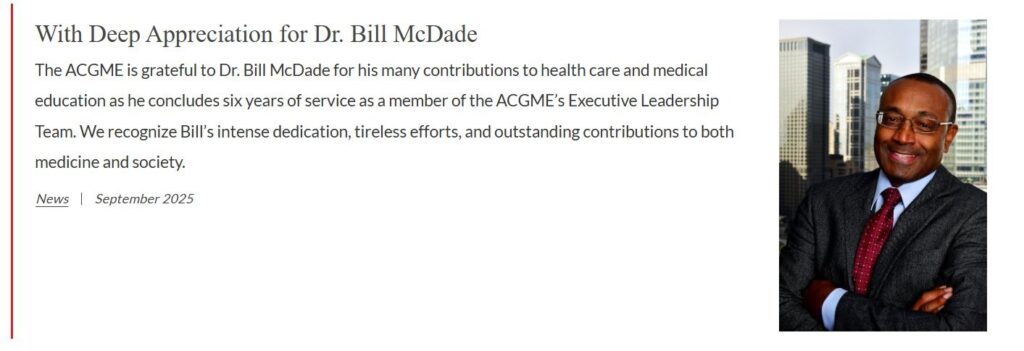
In September of this year, the Accreditation Council for Graduate Medical Education (ACGME), the accrediting body for medical residency programs, eliminatedits DEI department and removed DEI requirements from its accreditation standards.
And around the same time, the ACGME’s then-Chief DEI Officer, Dr. William McDade, left the organization.
These actions, undertaken at least partly in light of the Trump administration’s executive ordercracking down on accreditors’ DEI mandates, were incredibly significant and a huge step toward getting DEI out of medical education. Because the ACGME accredits residency programs, its DEI standards effectively mandated programs to engage in diversity hiring practices (which, in practice, is effectively racial discrimination) as a condition of their accreditation.
But new information shines a light on what may have motivated the ACGME’s commitment to DEI.
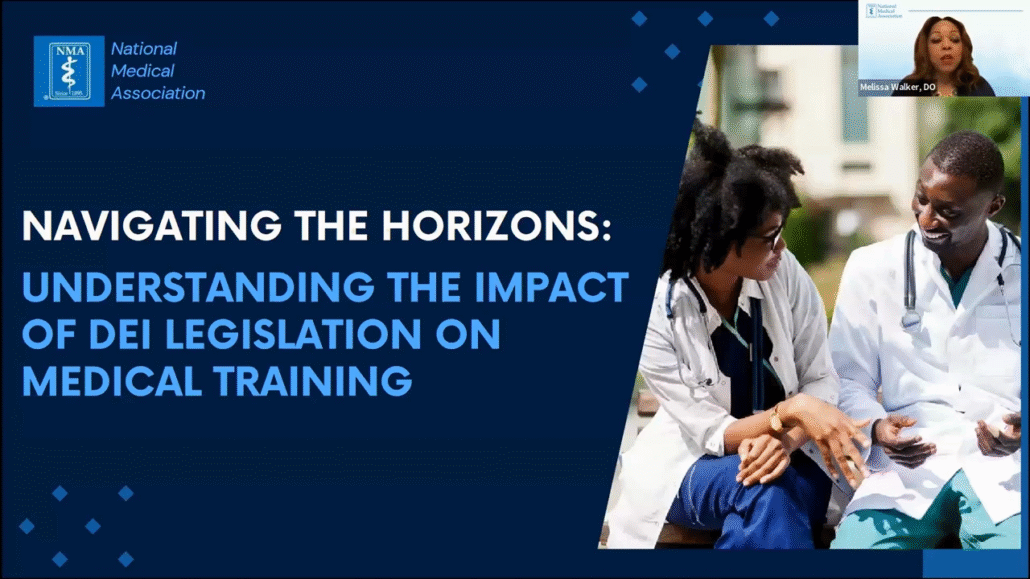
A Do No Harm member recently flagged a webinarhosted by the National Medical Association that took place in March 2024 titled “Navigating the Horizons – Understanding the Impact of DEI Legislation on Medical Training.”
That webinar featured Dr. McDade (then still serving as the ACGME’s DEI czar) and the American Medical Association’s Vice President of Equity, Diversity, and Belonging for Medical Education Dr. David Henderson, and discussed the EDUCATE Act, a critical piece of legislation endorsed by Do No Harm that would defund DEI programs that would, among other things, defund medical schools that have diversity, equity, and inclusion (DEI) offices or any functional equivalent.
During the webinar, panelists bemoaned the potential impact of the legislation and fretted about the future of DEI efforts with Dr. McDade even focusing on Do No Harm specifically.
“What disturbs me about this […] Do No Harm group is the proponents are physicians; they’re people in our own profession,” Dr. McDade said.
“Just a week ago the American Academy of Dermatology had a resolution that said that dermatologists should disband their DEI programs; well how insane is that?” Dr. McDade continued, appearing to refer to a March proposalto disband the organization’s DEI activities that was defeated. “I mean African Americans represent about two or three percent of dermatologists, and yet they feel that they need to get rid of their DEI programs.”
The implication here that a disparity in representation between racial groups justifies discriminatory policies is disturbing.
Removing DEI programs, which in practice often function as vehicles for discriminatory hiring, recruiting, admissions, and promotion, in most cases simply means that institutions return to treating future physicians on the basis of merit, rather than race.
Earlier in the webinar, Dr. McDade justified DEI policies on the grounds that racial concordance, in which patients are treated by physicians of the same race, produces positive health outcomes.
“The idea that racially concordant care is built into the fabric of medical education […] is what we’ve used over the last 112 years now in order to guide our pathway in medical education as a country,” McDade said.
“And that’s one of the problems I think is that we are rooted in a history that this legislation for instance wants to deny,” he continued, referring to the EDUCATE Act.
As Do No Harm and others have repeatedly shown, the notion that racial concordance produces better health outcomes is simply not supported by the existing evidence.
Do No Harm’s December 2023 reporton this issue examined the literature on racial concordance and highlighted the fact that four out of five systematic reviews found no evidence to support the claim that racial concordance produces positive health outcomes.
Another recent reviewpublished in the Substance Use & Addiction Journal found inadequate evidence to support the notion that racial concordance improves health outcomes for black patients in addiction treatment.
Despite this, Dr. McDade believes that racially concordant care should be and is built into the “fabric of medical education”; it’s not hard to see how such a premise could then be used to justify discriminatory hiring practices aimed at promoting racial concordance.
McDade’s reliance on debunked concepts and opposition to common-sense legislation that merely seeks to promote equality and end discrimination obviously reflects on the ACGME itself.
And it’s further evidence that the ACGME is taking the correct steps to ditch the harmful DEI agenda.
https://donoharmmedicine.org/wp-content/uploads/videoframe_22376.png7201280Ailan Evanshttps://donoharmmedicine.org/wp-content/uploads/DNH_Logo_Stethescope-1.pngAilan Evans2025-12-03 19:48:122026-02-11 15:34:16‘How Insane Is That’? A Peek Inside the ACGME’s Past DEI Agenda