In December 2024, Do No Harm submitted an application to the Oregon Health Authority — the agency overseeing most of Oregon’s heath care programs — to provide a “cultural competency” training course. Basically, Do No Harm sought to provide a healthcare education opportunity that breaks down identity politics and replaces it with a focus on patients’ unique situations and clinical presentations.
As you can imagine, Oregon officials were not thrilled.
Perhaps the questions on their application form were a giveaway as to their attitude on DEI in medicine. For example, one question asked:
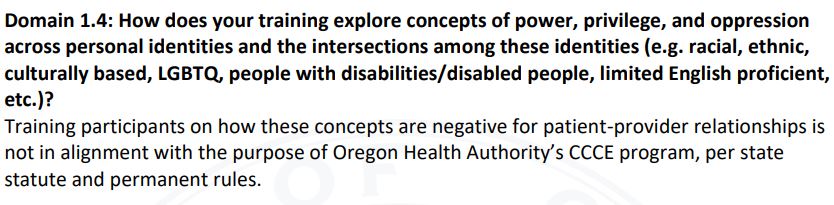
“How does your training explore concepts of power, privilege and oppression across personal identities? Please be inclusive of individuals who hold multiple social/cultural identities which intersect in unique ways for each individual (e.g. racial, ethnic, culturally-based, LGBTQ, people with disabilities, limited English proficient, etc.)?”
Translation: tell us what we want to hear, not what you actually believe. And, as expected, our responses were not what Oregon bureaucrats had in mind.
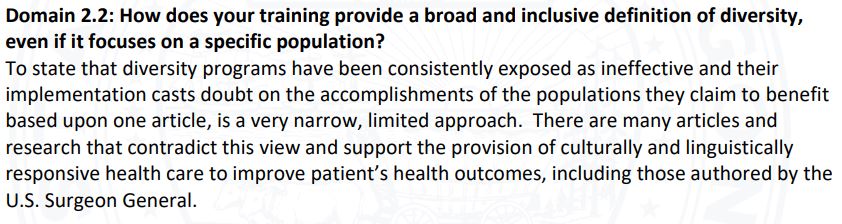
In their six-page rejection letter of Do No Harm’s application, the Oregon Health Authority described in great detail why Do No Harm’s course was not acceptable. In doing so, the Authority revealed its own bias.
Figure 1. An excerpt from the Oregon Health Authority’s rejection letter.
For example, the Authority noted “While evaluators appreciate the importance of focusing on the patient in the room and their specific needs, it seems harmful to not acknowledge implicit bias, systemic racism, and other forms of oppression, which very much impact a patient’s experience of the world and of the healthcare system.” They went on to assert that “The DO NO HARM organization appears to believe their counter perspective to be factual and any other perspective that does not align with their thinking as ‘ideological’ and without merit.”
In other words, DEI, implicit bias training, and racial concordance theories are “sound, scientific criteria.” But daring to question them is indicative of a “pervasive ideology.”
Maybe it’s the Oregon Health Authority who is being ideological, and not the other way around?
Figure 2. An excerpt from the Oregon Health Authority’s rejection letter.
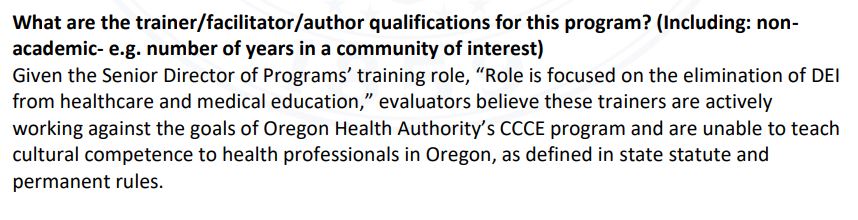
The rejection letter concluded by noting that “Given the Senior Director of Programs’ training role, ‘Role is focused on the elimination of DEI from healthcare and medical education,’ evaluators believe these trainers are actively working against the goals of Oregon Health Authority’s CCCE [cultural competence continuing education] program.”
Figure 3. An excerpt from the Oregon Health Authority’s rejection letter.
If the “goals” of the program are to indoctrinate healthcare professionals with DEI, treat woke concepts as indisputable facts, and dismiss any alternative viewpoint as a “pervasive ideology,” then perhaps the Authority has a point: Do No Harm does indeed dispute those goals.
None of this is entirely surprising given Oregon’s past missteps when it comes to medical regulation and licensure.
For example, in July 2024, Do No Harm reportedthat the Oregon Medical Board was seeking to revoke providers’ medical licenses if they were alleged to have engaged in “microaggressions.” Even doctors who simply failed to report microaggressions would have been stripped of licensure.
Just a few weeks later, the Oregon Medical Authority did a complete 180 and updated its proposed rule, with all references to “microaggressions” removed.
But while that reversal was encouraging at the time, the rejection of Do No Harm’s course application demonstrates that meaningful change among Oregon’s healthcare bureaucracy simply has not occurred. Rather than realizing that the concepts they are promoting are actively harmful — or even just permitting alternative viewpoints to be considered — officials have doubled-down on the same activist-infused standards that unfortunately are all-too-common among state healthcare agencies.
The sooner Oregon makes a real, substantive attempt to reverse course in a truly lasting way, the better. But until then, the underlying problems in Oregon’s healthcare environment will only grow worse.
https://donoharmmedicine.org/wp-content/uploads/2024/07/shutterstock_249441406-scaled.jpg17072560Ailan Evanshttps://donoharmmedicine.org/wp-content/uploads/DNH_Logo_Stethescope-1.pngAilan Evans2025-12-08 14:11:502026-02-11 15:34:17Do No Harm Applied to Provide Training in Oregon. State Officials Weren’t Pleased