This week, Do No Harm reported on how the Association of American Medical Colleges (AAMC) spent much of its annual meetingdiscussing ways to advance DEI priorities.
These sessions demonstrate that, despite the AAMC removing much of its DEI programming from its website, DEI is still integral to the organization’s institutional priorities.
Nevertheless, the AAMC has continued to remove more of its overtly pro-DEI resources from its website.
Roughly one year ago, Do No Harm unveiled an exhaustive reportexamining the AAMC’s various DEI initiatives, many of which the AAMC openly advertised on its website.
Now, many of the DEI resources highlighted by Do No Harm have either been rebranded to include more innocuous language, altered to redirect to less-overt endorsements of DEI, or removed entirely.
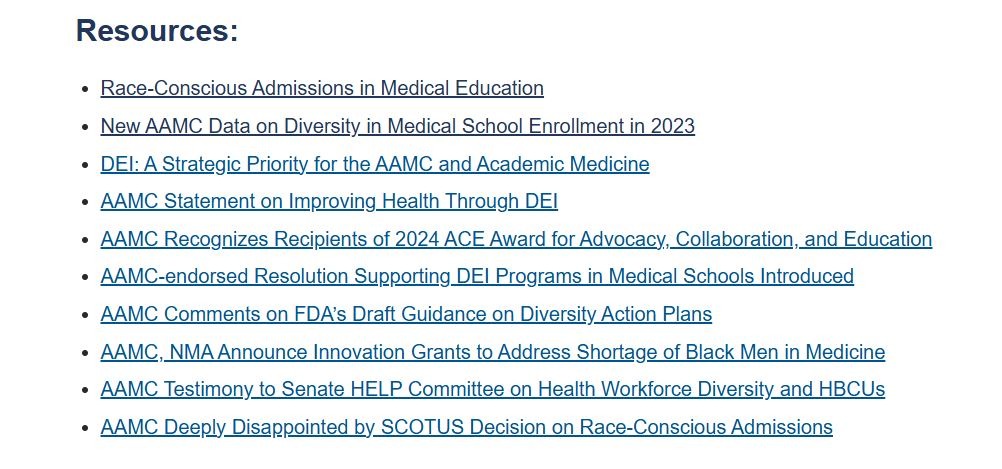
For instance, the AAMC’s webpagetitled “Investing in Healthier Communities” is no longer live; the website previously hosted a slew of DEI resources. These included endorsements of race-conscious admissions in medical schools, DEI initiatives in the federal health bureaucracy, and wide-scale DEI programming.
Figure 1. A screenshot of the AAMC’s archived Investing in Healthier Communities webpage.
Now, the webpage redirectsto the AAMC’s advocacy webpage.
That webpage also featured the AAMC’s political advocacy efforts, but was significantly more ideological and replete with DEI activism.
For instance, the page included:
Support for increased immigration on the grounds that immigrants “add diversity of culture and experience to our nation’s workforce.”
Support for programs that “invest in scholarship, loan repayment, and mentorship programs for future health care professionals from underrepresented minority, rural, and disadvantaged backgrounds.”
As another example, the AAMC’s “Medical Minority Applicant Registry” has been discontinued, according to the organization’s website.
This tool was explicitly designed to get students from “historically underrepresented” groups into medical school; the eligibility criteria stated that students must either be “economically disadvantaged” or members of underrepresented racial groups such as “African-American/Black, Hispanic/Latino, American Indian/Alaska Native or Native Hawaiian/Pacific Islander.”
The webpage of the program remains up, however, with the following disclaimer: “The AAMC is committed to a culture of excellence in academic medicine, where physicians from all backgrounds, perspectives, and experiences are welcomed and respected.”
Additionally, one of the “affinity groups” formerly advertised on the AAMC website, the Group on Diversity and Inclusion or GDI, has been removed entirely from the AAMC’s website.
There is now the Group on Collaboration, Engagement, and Community (GCEC), which per the AAMC “supports the efforts of AAMC-member institutions and academic medicine to foster an environment where people of all backgrounds and perspectives have an equal opportunity to thrive.”
And finally, the link to the AAMC’s “Advancing Health Equity” guide is no longer live. That guide was chock full of DEI resources and concepts.
It’s true that the AAMC’s decision to actually discontinue DEI programs is encouraging.
But, as recent events have demonstrated, the AAMC hasn’t ditched DEI wholesale just yet. It must publicly distance itself from DEI completely and recommit itself to excellence in medical education.
https://donoharmmedicine.org/wp-content/uploads/2025/05/shutterstock_2303902473-scaled.jpg14972560Ailan Evanshttps://donoharmmedicine.org/wp-content/uploads/DNH_Logo_Stethescope-1.pngAilan Evans2025-12-19 13:40:532026-02-11 15:34:18The AAMC Does More Damage Control on DEI