The Georgetown University Hospital/Washington Hospital Center Emergency Medicine Residency Program appears intent on inserting DEI into its core educational activities.
“We understand that an inclusive academic program will enrich our learning environment and improve care of the patients we serve,” the program’s DEI page reads. “Our program is dedicated to recruiting and retaining a diverse group of residents and faculty.”
If that seems like just the usual jargon paying lip service to DEI, think again.
The program boasts a $1,500 diversity scholarshipintended to “[r]ecruit and retain a diverse residency class to best reflect the diverse population that our program serves.”
This appears to be a subtle, indirect gesture at the (debunked) notion that patients experience better health outcomes when treated by physicians of the same racial group.
The scholarship description also states that applicants will “ideally” have an “interest in diversity & inclusion in the equitable delivery of healthcare.”
While the scholarship criteria disclaim any overt racial discrimination in the application process, they do state that 4th-year medical students “from groups underrepresented in medicine” are especially encouraged to apply.
Next, DEI is incorporated into the program’s curriculum. The program’s diversity page states it best:
Diversity and inclusion permeates all aspects of our curriculum. Every clinical shift our residents have the opportunity to care for and learn from a profoundly diverse patient population. We offer elective rotations focused on the care of unique populations. During didactics, we address the importance of diversity and inclusion via lectures, journal clubs, workshops, small group discussions, and simulation. We highlight the importance of understanding and mitigating implicit bias.
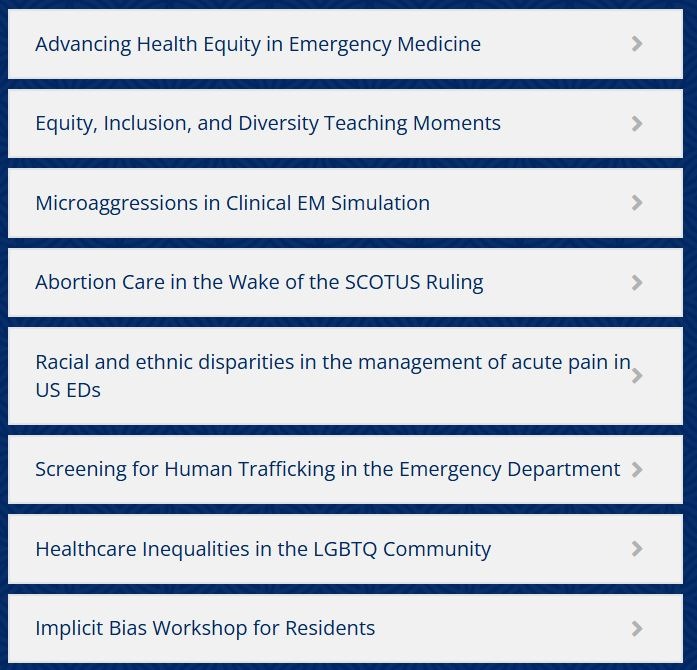
Indeed, the curriculum contains a host of political and DEI-related sessions including “Advancing Health Equity in Emergency Medicine”; “Microaggressions in Clinical EM Simulation”; and “Implicit Bias Workshop for Residents.”
Additionally, much of the scholarly work listed on the program’s diversity webpage matches the political nature of the program’s curriculum, with ample references to DEI and related concepts.
In this case, we don’t need to read between the lines.
As the program’s diversity page states, “diversity and inclusion permeates all aspects” of the Georgetown University Hospital/Washington Hospital Center Emergency Medicine Residency Program’s curriculum.
Unfortunately, Georgetown’s program seems more concerned with indoctrination and ideology, and less concerned with training the next generation of emergency physicians to be as competent as they can.
https://donoharmmedicine.org/wp-content/uploads/2024/06/shutterstock_1189798267-scaled.jpg14402560Ailan Evanshttps://donoharmmedicine.org/wp-content/uploads/DNH_Logo_Stethescope-1.pngAilan Evans2025-12-23 22:55:592026-02-11 15:34:18Georgetown’s Emergency Medicine Residency Program Makes DEI A ‘Top Priority’