During a March discussionhosted by the Urban Institute and Georgetown University Law School, faculty members from law and medical schools discussed plans to continue “increasing physician diversity” through DEI initiatives.
The event, titled “Equal Protection and the Future of the Physician Workforce,” was premised on the notion that a decline in minority enrollment in medical schools, following the Supreme Court’s decision in Students for Fair Admissions v. Harvard (SFFA), would lead to negative health outcomes.
“[R]esearch shows that diversity among health professionals improves patient access, trust, and outcomes,” the event description reads. “Join the Urban Institute and Georgetown Law for a discussion of declining diversity in medicine, the worrisome health implications, and legal strategies for increasing physician diversity.”
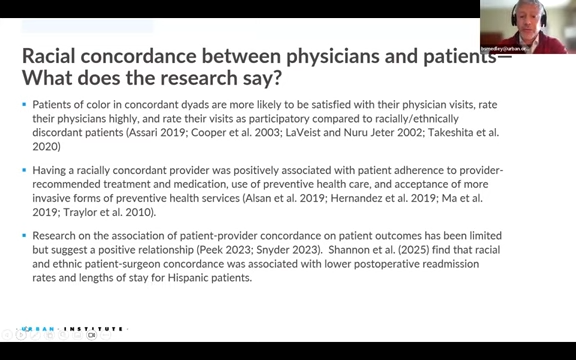
To support this premise, Urban Institute Senior Fellow Brian Smedley overviewed a report, “Racially Minoritized Patients Can Benefit from Racially Concordant Providers but Struggle to Find Them,” which argued that racial concordance improves health outcomes and thus diversity initiatives in medicine are justified.
Figure 1. Screenshot of “Equal Protection and the Future of the Physician Workforce.”
The notion that racial concordance – when patients are treated by physicians of the same race – improves health outcomes is not supported by the preponderance of existing evidence; five out six systematic reviews find that racial concordance has no impact on health outcomes.
Moreover, the Urban Institute report cites along-debunkedstudy to justify its claims that racial concordance improves health outcomes. That study, “Physician–patient racial concordance and disparities in birthing mortality for newborns,” failed to control for the effect of very low birth weight on mortality; researchers at the Manhattan Institute attempted to replicate the study using the same data while applying that control, andfoundthat the racial concordance effect disappeared.
Next, Demicha Rankin, MD, the associate dean for Admissions at The Ohio State University College of Medicine, discussed ways in which medical schools could continue to diversify their student body, despite no longer being able to engage in racial discrimination in admissions.
These included recruitment and admissions strategies.
When discussing recruiting, Dr. Rankin argued that while the SFFA decision prevented racial discrimination in admissions, it did not prevent the targeting of race in recruiting outreach.
“In many instances, recruitment can be targeted for specific demographics, so long as it is open to all,” Dr. Rankin said.
Next, when discussing admissions decisions, Dr. Rankin appeared to argue that a more “diverse” admissions committee would lead to more diversity among accepted students.
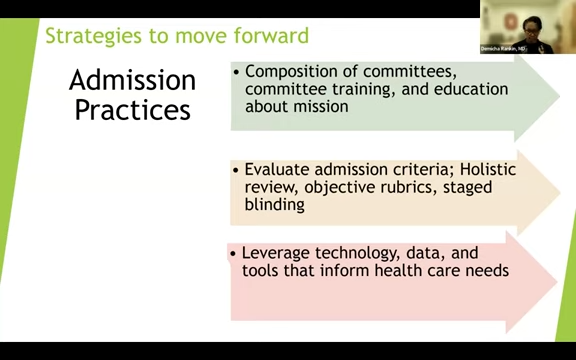
“Really lean into who is on the committee, how can you diversify the committee, because if there’s representation there and if there’s broad-lived experiences, this can influence the decisions that a committee is making in terms of who is accepted,” she said.
Next, Dr. Rankin discussed how “holistic review” (in which admission is determined by weighing factors unrelated to academic achievement) could be a tool for diversifying the student body.
Figure 2. Screenshot of “Equal Protection and the Future of the Physician Workforce.”
“I think the biggest takeaway is leaning into holistic review,” she said. “It takes more than just a perfect MCAT or GPA to matriculate into medical school.”
“They also have to have compassion, empathy, resiliency, grit; and that is not measured by an academic metric,” she continued.
The next speaker, Ruqaiijah Yearby, a law professor at Saint Louis University, argued that medical schools should not “pre-comply” with guidance from the Trump administration to end discriminatory DEI practices, stating that schools that do so are “violating” federal and state antidiscrimination laws.
To be clear, racial discrimination in scholarships, funding decisions, and so on is illegal under the United States Constitution as well as federal civil rights law.
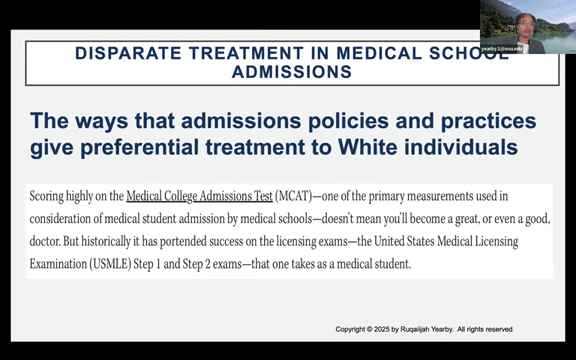
Next, Yearby argued that medical schools already employ “admissions policies and practices that give preferential treatment to white individuals, even though they are not connected to the ability of people to actually be great doctors.”
In explaining this point, Yearby pointed to the MCAT, with the apparent but unspoken implication that because white applicants tend to score higher on the MCAT than applicants of other racial groups, considering the MCAT gives preferential treatment to white applicants.
Figure 3. Screenshot of “Equal Protection and the Future of the Physician Workforce.”
This notion is truly disturbing. It does not logically follow that considering a test in the admissions process is somehow giving the group that performed better on that test a leg up.
Yearby’s argument would essentially treat any consideration of objective measures of merit as giving “preferential treatment” to whichever racial group happened to perform better. Any disparity would be evidence of bias. This is not sound reasoning.
Next, Yearby appeared to devalue the MCAT entirely, arguing that “research has shown that [high MCAT scores] does not necessarily track” to applicants with high MCAT scores “being great doctors.” She then argued to deprioritize the MCAT in admissions decisions.
It’s certainly true that one is not necessarily guaranteed to be a great doctor solely because of his or her MCAT score. Yet that is irrelevant; the question is whether MCAT scores correlate with the future ability to show clinical mastery.
“There is a strong correlation between MCAT scores and clerkship or ‘shelf’ exams, as well as United States Medical Licensing Examination (USMLE) clinical knowledge exams. This means that, in general, the better a student’s MCAT scores, the better they will perform in medical school and the more mastery of clinical knowledge they will exhibit. In short, students with better MCAT scores tend to be better medical students.”
Taken together, the comments of the event’s participants reveal a shocking and disturbing vision of medical education as a tool not for producing the best possible physicians, but for advancing the DEI agenda.
These ideas have no place anywhere near medical education.
https://donoharmmedicine.org/wp-content/uploads/2023/02/image-1.png3791484Ailan Evanshttps://donoharmmedicine.org/wp-content/uploads/DNH_Logo_Stethescope-1.pngAilan Evans2025-12-04 18:33:522026-02-11 15:34:16Med School Official, Academics Plot Ways to Continue DEI Initiatives in Wake of Supreme Court Decision