Someone throw a life preserver. The UC Berkeley School of Public Health is drowning in woke buzzwords and abstractions.
The problem begins on the school’s landing page. There, site visitors encounter not only such leftist preoccupations as “climate change” and “social inequity” but a misappropriated Martin Luther King, Jr., line manipulated to fit the school’s woke mission.
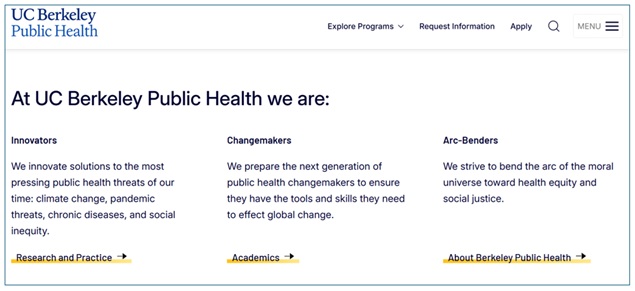
Despite the fact that the line has become a political cliché in recent years, it is pleasant enough to believe that the “arc of the moral universe … bends toward justice,” as King argued in 1958, borrowing from the 19th-century abolitionist minister Theodore Parker. What is less likely is that it bends toward “health equity,” a concern, like climate change, with which schools of public health signal vogue progressivism rather than scientific seriousness.
A tour through the rest of the school’s website is equally troubling.
The school’s “Purpose,” according to its “Research and Practice” page, is to “conduct research that emphasizes the social determinants of health.”
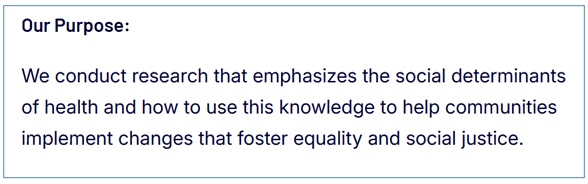
Yet that theory of medicine, as Do No Harm has previously explained, “confuses social and economic conditions that correlate with poor health outcomes with the actual causes of those outcomes.” To give just one example, poverty may correlate with obesity, but it is obesity itself with which physicians and public-health officials ought to concern themselves, helping patients make lifestyle improvements or, in some cases, choose appropriate pharmacological or surgical interventions.
Elsewhere on the same page, the school improperly conflates a political dilemma with appropriate public-health concerns, implying, for example, that “global access to clean energy” lies within the public-health realm’s reasonable sphere of influence.
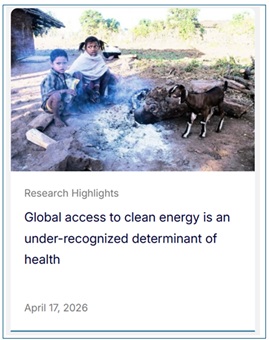
It doesn’t. Nor, for that matter, does “help[ing] Asian American men flourish” by giving them “pride in their cultural heritage,” however noble that goal might be.

Things are little better on the curricular side. Among the school’s offerings is a graduate certificate in racism, health, and social justice, the purpose of which is to “provide theoretical, methodological, and applied training at the intersection of public health inequities, racial justice, and social justice.”
Here as elsewhere on the site, the school argues that “social, economic, and political determinants … drive health inequalities and must be confronted to create a more equitable and just society.”
The problem with this line of thinking is that, to the extent these determinants exist, they are the proper remit of voters and our elected representatives, not public-health officials acting under the ostensibly neutral and objective auspices of science. Confusing the two “lanes” will only heighten the public’s distrust of the public-health establishment in the long run.
It is concerning that the UC Berkeley School of Public Health seems unable or unwilling to come to this conclusion.
Americans deserve better: public-health schools that aren’t floundering in the progressive mire.