Another day, another DEI office name change. Yet this one has been so halfheartedly done that we question the point of the exercise.
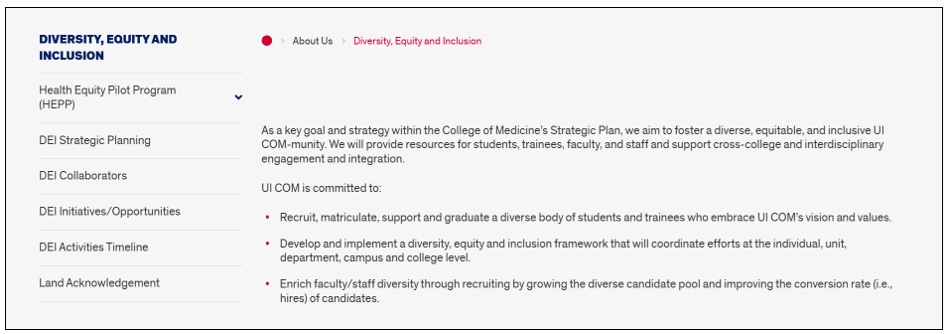
Until at least May 24 of this year, the University of Illinois College of Medicine (UI COM) operated a “Diversity, Equity and Inclusion” office dedicated to “foster[ing] a diverse, equitable, and inclusive UI COM-munity.”
In recent months, however, that unit has been renamed the “Advocacy and Engagement” office.
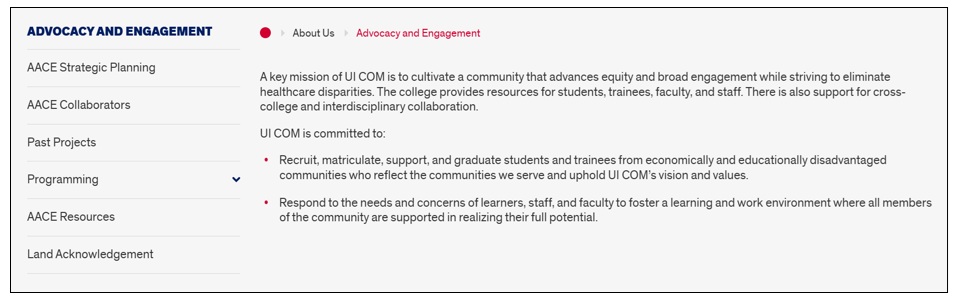
A few things have indeed been altered as a result of the shift. Whereas the DEI office’s homepage previously noted that UI COM meant to “[d]evelop and implement a diversity, equity and inclusion framework that [would] coordinate efforts at the individual, unit, department, campus and college level,” that particular language has now vanished.
So has UI COM’s pledge to “[e]nrich faculty/staff diversity through recruiting by growing the diverse candidate pool and improving the conversion rate (i.e., hires) of candidates.”
A third commitment has been reworded. Previously, UI COM promised to “[r]ecruit, matriculate, support and graduate a diverse body of students and trainees who embrace UI COM’s vision and values.”
Now, however, the institution will recruit “students and trainees from economically and educationally disadvantaged communities who reflect the communities we serve and uphold UI COM’s vision and values.”
We concede that these revisions modestly soften the institution’s DEI-related language. A tour of the renamed office’s website, however, gives us reason to wonder if cosmetic edits have been the extent of the change.
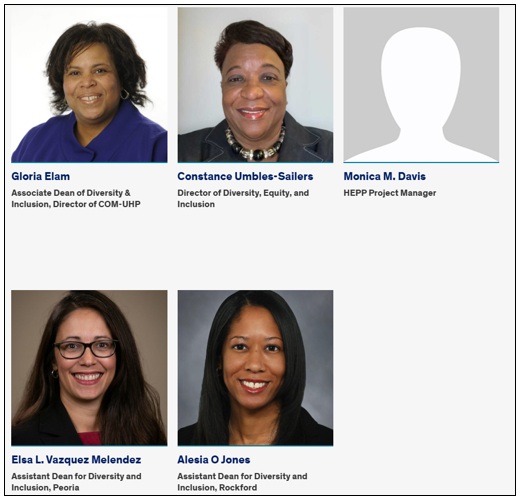
For instance, the office continues to be run by Gloria Elam, previously associate dean of diversity & inclusion and now associate dean for advocacy and engagement. Dean Elam’s four listed colleagues remain the same, though several of their titles have been altered along similar lines.
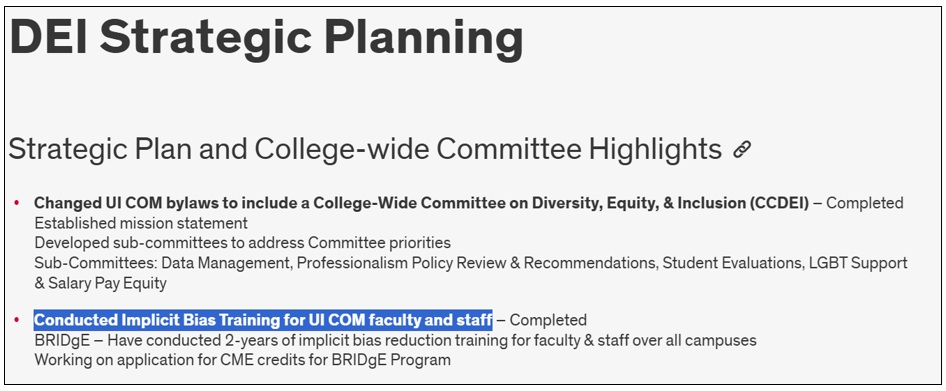
Both the old site and the new link to “Strategic Planning” pages that boast of DEI-related accomplishments. In the case of the old, one representative example is “Conducted Implicit Bias Training for UI COM faculty and staff.” The new, meanwhile, lists as a highlight “Developed and Conducted Unconscious Bias Training for UI COM faculty and staff through the BRIDgE Program.”
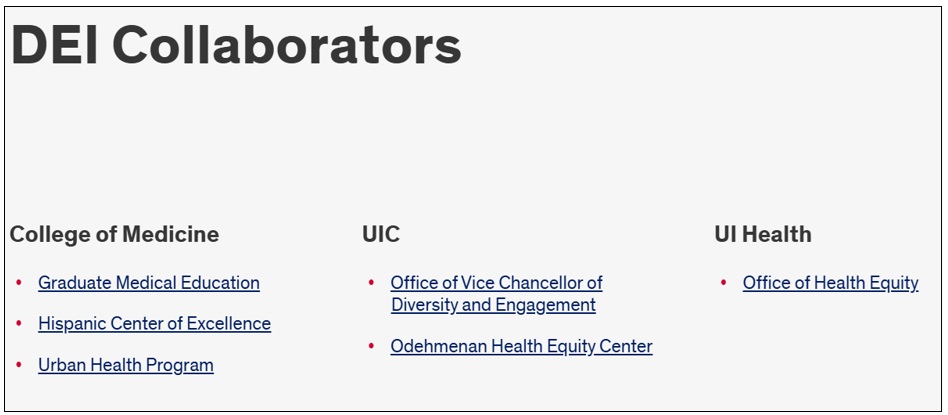
Though the acronym “DEI” has given way to “AACE,” both the old site and the new link to a “Collaborators” page listing many of the same academic and administrative units. One of these, the Odehmenan Health Equity Center, offers such events as “‘There can never really be justice on stolen land’ – An Indigenous Methodology Approach to Police Violence.”
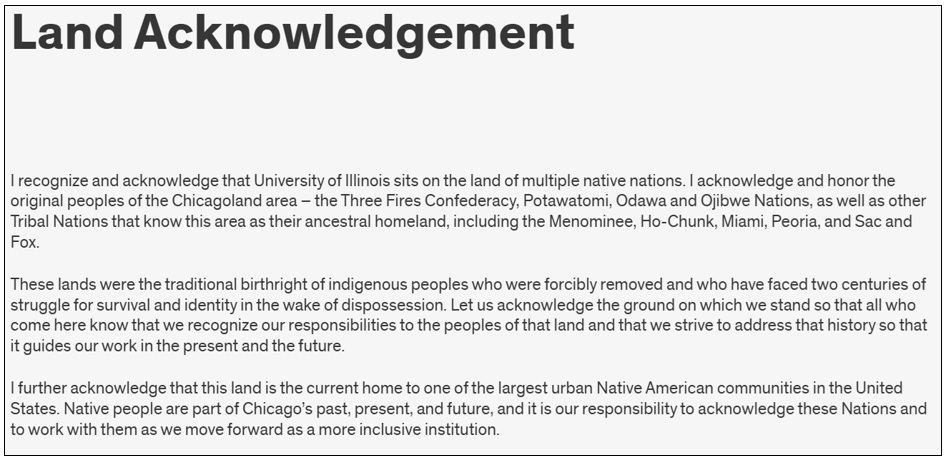
Finally, both sites include a “Land Acknowledgement” recognizing “the traditional birthright of indigenous peoples who were forcibly removed.” The particular language therein has not changed at all.
Given these similarities in both resources and personnel, we have our suspicions about UI COM’s evolution. Had the institution unwound its public DEI commitments or reassigned (or parted ways with) its DEI staff, we would celebrate the depoliticization of the education it offers.
Because it clearly did neither, we must simply roll our eyes. Call it whatever you like: A DEI office by any name remains an affront to unideological medical education.