Do No Harm grades medical schools according to measurable standards of academic excellence and resistance to politicized ideology. The Planetary Health Report Card (PHRC), founded by medical students in 2019, grades them on how tightly they embrace “climate” orthodoxy.
PHRC’s members say of their initiative, “As future health professionals, we must be prepared to address the impacts of human-caused environmental changes on our patients’ health, and to understand and mitigate the environmental impact of clinical care.”
As such, the report card itself, now evaluating “over 100 medical schools in 15 nations,” grades institutions according to the muscularity of their
- “Planetary Health Curriculum,”
- “Interdisciplinary Research,”
- “Community Outreach & Advocacy,”
- “Support for Student-led Initiatives,” and
- “Campus Sustainability.”
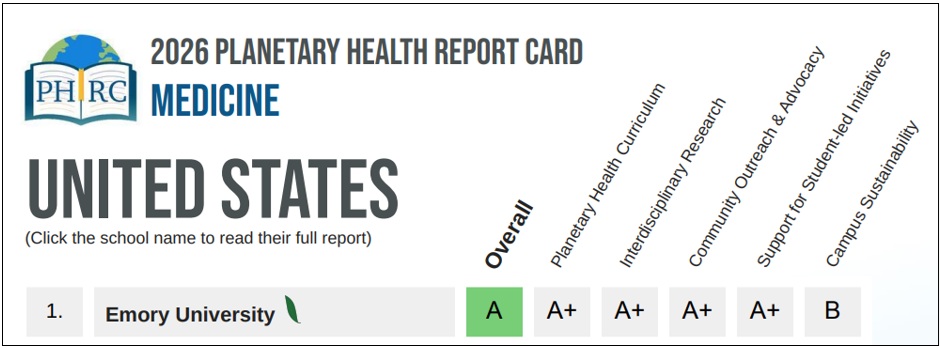
Take, for example, the Emory University School of Medicine, the top-ranked American medical school in PHRC’s 2026 report. As the following screen capture indicates, the Georgia institution scores an overall grade of “A,” with “A+’s” in every category except “Campus Sustainability.” (Time to order some recycling bins, Emory.)
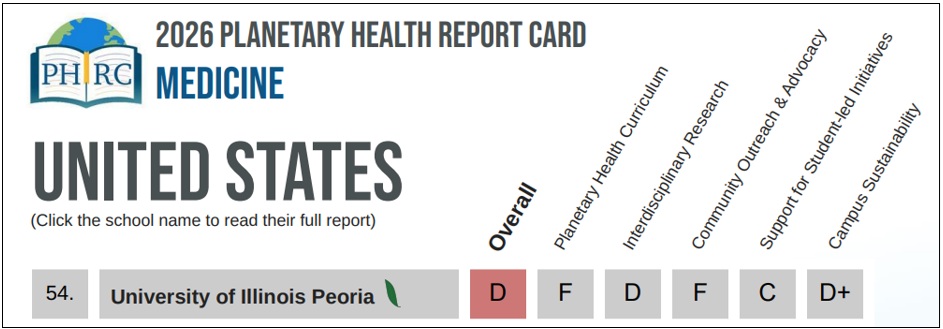
Or take the 54th-ranked (and last-placed) American medical school, the University of Illinois College of Medicine Peoria. That institution earns an overall “D” with outright “F’s” in “Planetary Health Curriculum” and “Community Outreach & Advocacy.”
Perusing one of the narrative reports to which these rankings link helps us to unpack the grades. The Emory University School of Medicine’s report card, for example, explains that the institution “is in its sixth year of implementing a faculty and student co-created climate change & environmental health pre-clinical curriculum.”
Moreover, 2026 will be “the fourth year of a longitudinal Climate Change and Environmental Health (CCEH) ‘Thread’ (or longitudinal portion of the curriculum) spanning all 4 years, with the last 1.5 years seeing significant focus on content and immersive activities integrated into the clerkship or clinical phase of the required curriculum.”
PHRC sums up, “As Emory envisions transforming to a symptom-based pre-clinical curriculum, the curriculum team is re-imagining planetary health content as [an] authentic context for patient pathophysiology and narratives.”
Here we come to the problem with grading medical schools on the basis of their conformity to non-medical values. While there is obviously nothing wrong with “Campus Sustainability” (or, more specifically, with recycling bins), medical educators err seriously when their curricula veer away from the foundational sciences, clinical training, and patient-care instruction that students need if they are to become effective doctors.
In medical school as elsewhere, the days, weeks, months, and years are necessarily limited. Every time one devotes part of the curriculum to climate change, less of the curriculum remains for actual medical science.
Disappointingly, Emory not only earns but celebrates its Planetary Health Report Card marks. So, to give a few more examples, do the Hackensack Meridian School of Medicine (second place among American medical schools), the UConn School of Medicine (fifth place), and the University of Pittsburgh School of Medicine (eighth place).
If we had our way, medical schools such as Loma Linda University, with its “D” in the PHRC’s “Planetary Health Curriculum” category and “A” in our own rankings, would put out a press release plugging that contrast: “That’s right, guys. We just do medicine here.”
Perhaps that would set an example for other institutions to follow.