Good neighbors warn one another when something is awry. Perhaps without meaning to, a Canadian province’s official pediatric transgender apparatus provides a warning to American readers about where “gender” ideologues will take this country if not opposed.
The official site in question, Trans Care BC, is a “provincial clinical program” operated by the publicly funded Provincial Health Services Authority (PHSA) in British Columbia.
Though many of Trans Care BC’s services seem designed for adults, an entire page on the program’s website is explicitly pitched to “Youth.”
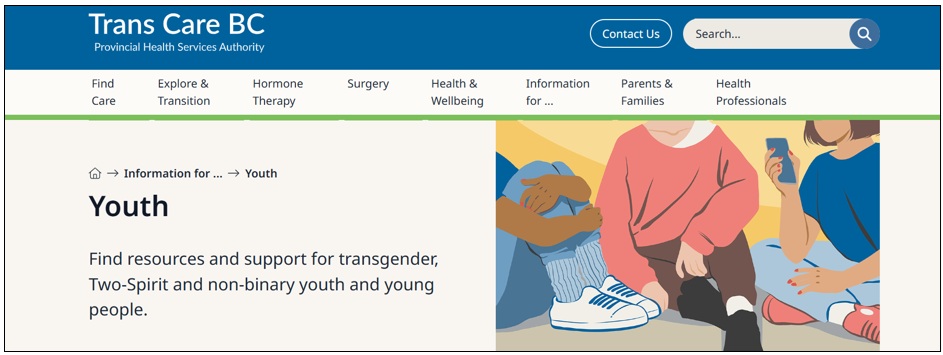
On this page, one learns that “[c]onnecting with other trans, Two-Spirit[,] and non-binary youth can be a wonderful way to make friends, talk about issues that are important to you[,] and learn from others who may be going through similar experiences.”
One reads about Queer Straight Alliances (QSAs), groups that focus in part “on support, raising awareness about the issues faced by … trans people, and challenging discrimination based on gender identity.”
In a “Peer Support Directory” linked to on the page, “children” are invited to “[f]ind peer support groups and services.” Among the groups listed if one clicks the “Children & youth” audience button are
- The Foundry 2SLGBTQIA+ group in Campbell River, which offers “a program by appointment that provides gender-affirming gear, such as chest binders and breast forms”;
- Chilliwack Rainbow Families, which provides “educational and peer support to children and parents of children under 12 experiencing gender diversity” and encourages participants to “bring an open mind”;
- The Fraser Youth Society, offering “2SLGBTQIA+ and Allied Youth (ages 13 – 19) … gender-affirming wear”; and
- Friends of Dorothy, in Langley, in which “youth ages 12 to 24” — that is not a typo — “safely explore identity, connect with[,] and [are] supported by peers.”
If anything, matters are even worse back on the homepage, where scrolling down produces options for “Supporting children under 12” and “Supporting youth 13–18.”
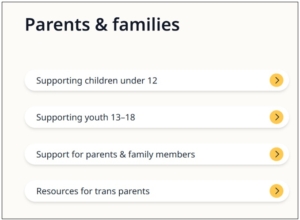
Horrifyingly, clicking on the former brings up options for “Affirmation & social transition” (bad enough) and “Medical options” (the stuff of nightmares).
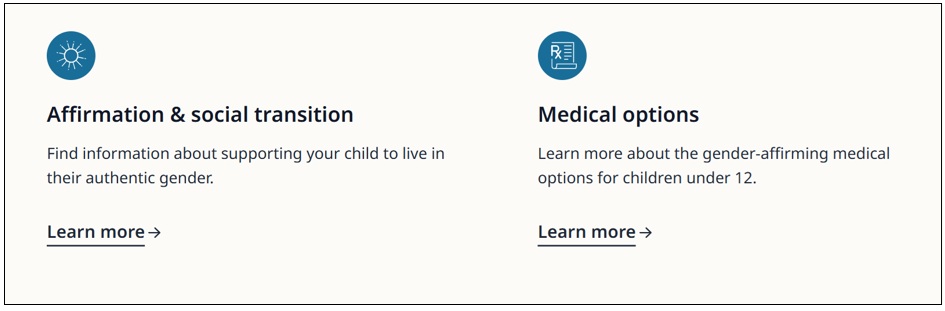
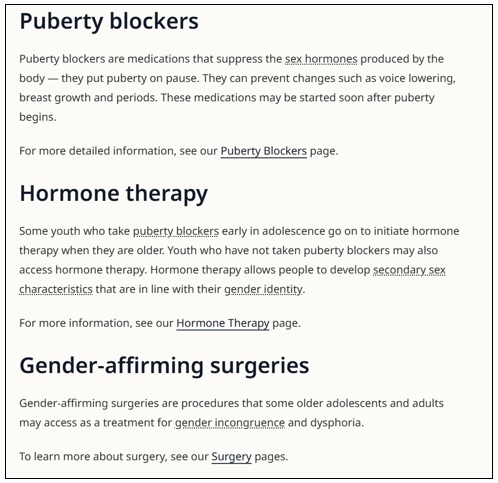
The second of those pages introduces site visitors to puberty blockers (“These medications may be started soon after puberty begins”), hormone therapy (“Some youth who take puberty blockers early in adolescence go on to initiate hormone therapy when they are older”), and so-called gender-affirming surgeries (“Gender-affirming surgeries are procedures that some older adolescents and adults may access”).
Like several other pages on the Trans Care BC website, an eye-catching banner offers those who “need support” the option to “[c]ontact our team of experienced health navigators for information about gender-affirming care in B.C.”

All of this is paid for by regular Canadians. Indeed, the site shocks the conscience in part because it is so user-friendly, well-designed, thorough, and official — in a word, costly. Someone put together Trans Care BC’s website with attention to detail and a big enough budget to facilitate that careful work.
Let us have no doubts: That person has ideological allies on this side of the border. Some American states already point residents to “gender-affirming care” online, just not yet with British Columbia’s slick and seductive polish. Those allies would happily close the gap.
We can’t say we weren’t warned if we let them.