Rates of slavery in a Southern county in 1860 are the root cause of modern health disparities, claims a new study published in the Proceedings of the National Academy of Sciences. According to the article, “Our model estimates ~22 additional deaths per 100,000 among Black Americans relative to White Americans for every 10% increase in the 1860 enslaved population. […] Our analyses held even after controlling for a comprehensive suite of historical and contemporary covariates. These findings are consistent with a model wherein slavery’s legacy continues to shape present-day Black–White racial health disparities via enduring structural inequities.”
If it seems hard to believe that slavery in 1860 is killing black people today, that’s because these findings are simply not credible. A careful examination of the authors’ own results reveals that variation in modern health outcomes is caused by current health practices and behaviors and not by the enduring legacy of slavery.
The authors are aware that “counties with more slavery in 1860 may differ in other ways that shape health today, so an association between slavery and mortality need not be causal.” To overcome this concern and convince the reader that historic slavery is the actual cause of recent health disparities, they conduct an instrumental variable (IV) analysis in which cotton suitability of the land predicts the rate of enslaved people in a county in 1860. They then use the predicted rate of slaveholding to account for disparities in all-cause mortality rates during 2010–2020, controlling for other observed factors.
The key to this type of analysis is that the instrument, in this case cotton suitability, should be predictive of the independent variable of interest (rates of slavery) but not empirically or theoretically associated with the dependent variable (disparities in mortality rates). The authors attempt to justify their use of cotton suitability as an instrument to isolate the causal effects of slavery on modern health disparities by arguing that “there is no obvious reason why soil properties that favor cotton cultivation should be associated with mortality disparities if not through slavery. However, this exclusion restriction assumption cannot be directly tested and may only be inferred through failed attempts to falsify it.”
The authors, and apparently the reviewers and editors at PNAS, must have been so attracted to the conclusion of this study that they failed to devote any time to considering why it is not “obvious” that soil properties couldn’t influence modern health other than through the effects of slavery. In fact, it should be fairly obvious that the favorable soil conditions for the production of cotton would continue to shape economic arrangements and migration patterns in these areas for many years, with direct implications for health disparities.
Because the land was suitable for cotton, and because a railroad infrastructure had been built for bringing the crop to ports, there were reasons to continue growing and exporting it after slavery ended. Without enslaved labor to grow the cotton, cotton production turned to sharecropping. About two-thirds of sharecroppers were white, and about one-third were black, but all were very poor and, relatedly, had weak health outcomes. In more recent decades, however, factories began to locate in these areas to take advantage of the low cost of land, the absence of organized labor, and railroad access to ports. That brought into these areas higher-skilled, predominantly white and Hispanic workers, who tended to have better health outcomes than the “native” sharecroppers. In other words, the suitability of the land for cotton led to the construction of railroads, which attracted factories and exacerbated health disparities in a previously low-income and predominantly agricultural area. In this scenario, the railroad, not slavery, was the mechanism by which cotton suitability caused health disparities.
In addition to the differential effects of cotton suitability on attracting healthier white workers in recent years, areas that were good for growing cotton had differential effects on black migration. Critically, the decision whether to stay or pursue economic opportunities elsewhere was not random. Rather, it was informed in part by the reality that high-quality cotton soils produced stronger economic incentives for both landowners and laborers to establish an arrangement that kept former slaves on the plantation. The result is that those who were enslaved in regions with better soil would have been less likely or slower to migrate out of the rural South. Specifically, according to a 1989 economics study, “Tenants and sharecroppers in the plantation regions of the South tended to move far less frequently than those outside the plantation regions…. Southern tenants on plantations had on average been living on their present farm roughly twice as long as tenants not on plantations in the 1930s.”
Postbellum migration patterns and their link to soil quality mean that, on average, those who were enslaved in areas with better soil and their descendants would have been less mobile due to decisions made after emancipation. This means that rural areas that were less suitable for cotton would have lost more of their population to the Great Migration. At the same time, more recent opportunities in Southern cities would have attracted back from the North, as well as from the Caribbean and Africa, wealthier blacks with better health outcomes on average. These migratory patterns, correlated with cotton suitability but not caused by the legacy of slavery, could account for modern health disparities and clearly violate the “exclusion restriction” required for the instrumental variable to render causal estimates.
Additional evidence of the absurdity of this new study is found in “Supplemental Analysis S9,” where the researchers predict the effect of slavery on black–white disparities in mortality in 1968–1978 rather than during the years 2010–2020, as they report in the main text of their study. Oddly, they find that “higher instrumented slavery predicted lower Black-White mortality disparities in 1968–1978 and higher disparities in 2010–2020. This pattern is consistent with the historical record: the civil rights era brought convergence in racial health outcomes in high-slavery counties, while the post-civil-rights period saw a reversal of those gains as structural inequalities reasserted themselves.”
This is both historical and medical nonsense. Mortality rates during the period 1968–1978 would be the cumulative result of health practices and behaviors over several decades. The passage of the Civil Rights Act of 1964 and the Voting Rights Act of 1965 did not cure black Southerners of the health problems they had acquired over time and that might have caused their deaths over the following decade. Nor does the “historical record” show that structural inequalities reasserted themselves to impact mortality outcomes from 2010–2020, resulting in a reversal in mortality rates. In fact, national data on black and white mortality rates clearly show a gradual and persistent closing of that gap over time. (See figure below generated by AI from CDC data.)
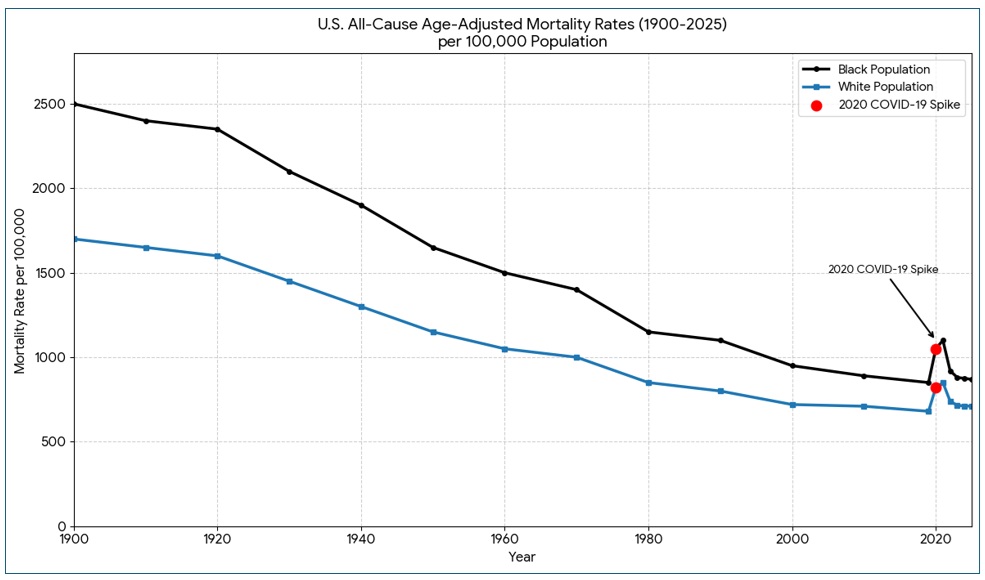
In addition, claiming that slavery caused lower mortality disparities between 1968–1978 but also caused higher mortality disparities between 2010–2020 because of a change in the progressivity of the civil-rights environment concedes that gains or reversals in civil rights, not slavery, cause mortality gaps. Slavery couldn’t flip the direction of its causal effect, since it long ago ceased to exist. The authors might try to contend that slavery has an enduring effect, but slavery did not cause progress or reversals in civil rights and therefore cannot be described as the cause by the authors’ own interpretation of their own results.
Of course, our alternative railroad explanation is perfectly consistent with the results they report in “Supplemental Analysis S9.” Areas that were suitable for growing cotton had low disparities in mortality because black and white sharecroppers shared poor outcomes. Those areas historically had slavery, but it was sharecropping that drove low disparities in mortality rates well into the 20th century. By the end of the 20th century, however, the existence of cheap land and railroads attracted factories that also drew higher-skilled white and Hispanic workers who tended to have better health outcomes, exacerbating mortality disparities.
Just because researchers use an instrument variable and declare that they cannot think of another mechanism by which cotton suitability might contribute to health disparities other than through the legacy of slavery, that doesn’t mean that they have demonstrated a causal relationship. A little bit of thought easily yields other paths by which areas suitable for growing cotton might generate economic systems and migration patterns that cause modern health disparities. And finding that slavery actually had a positive effect on disparities in 1968–1978 undermines the authors’ claim that they are observing the enduring legacy of slavery rather than the varying responses to current economic and political conditions.