• HAVE YOU SEEN OR EXPERIENCED THE IMPACT OF DEI OR RADICAL GENDER IDEOLOGY AT YOUR INSTITUTION? CLICK HERE TO SHARE YOUR STORY.
Do No Harm
  • About Us
    • ABOUT
    • TEAM
    • FAQS
    • WHAT OTHERS SAY
    • VOICES OF DO NO HARM
  • OUR WORK
    • NEWSROOM
    • ISSUE AWARENESS
      • IDENTITY POLITICS (DEI)
      • GENDER IDEOLOGY
    • POLICY WORK
    • LEGAL ACTION
    • RESEARCH
    • RESOURCES
    • CENTERS
  • GET INVOLVED
    • SUBMIT A TIP
    • BECOME A MEMBER
    • CAREERS
  • MEDIA INQUIRIES
  • Search
  • DONATE
  • Menu Menu

Do No Harm Submits Amicus Brief in ‘Secret Transition’ Lawsuit Against School District

Uncategorized New York, United States Gender Ideology School District Commentary Do No Harm Staff

This week, Do No Harm filed an amicus brief in support of Jennifer Vitsaxaki’s lawsuit against her daughter’s school district for “secretly transitioning” her daughter without Vitsaxaki’s consent.

The case, Vitsaxaki v. Skaneateles Central School District, concerns Vitsaxaki’s fundamental parental rights under the Constitution.

Employees at Vitsaxaki’s daughter’s school, acting under Skaneateles Central School District official policy, had been secretly referring to her 12-year-old daughter as a boy, such as through the use of a masculine name. 

This so-called “social transition” was done without Vitsaxaki’s knowledge or consent; employees allegedly concealed this behavior from Vitsaxaki and continued doing it without her consent.

Vitsaxaki sued the school district, arguing that the school district’s policy violated her parental rights under the Fourteenth Amendment.

The district court granted the school district’s motion to dismiss the case, and Vitsaxaki appealed the decision to the U.S. Court of Appeals for the Second Circuit.

Do No Harm’s amicus brief urges the Second Circuit to reverse the district court’s decision, arguing that because Vitsaxaki alleged a violation of her fundamental constitutional rights that are “deeply rooted in our history and tradition,” the “strict scrutiny” standard should apply. This means that the school district’s policy must further a compelling state interest in order to be permissible. 

Moreover, social transition invariably increases the risk of medical harm.

The natural conclusion of affirming a child’s self-professed “gender” is to place children onto the transgender medicalization pathway, in which they undergo invasive medical interventions to alter their body in accordance with their self-identified “gender.”

Protecting children from their parents thoughtlessly and automatically affirming their gender dysphoria is an important first step to prevent further harmful medicalization.

Read the full amicus brief here.

https://donoharmmedicine.org/wp-content/uploads/2024/06/shutterstock_2148891659-scaled.jpg 1707 2560 Ailan Evans https://donoharmmedicine.org/wp-content/uploads/dono-logo.png Ailan Evans2025-06-13 18:43:572026-01-12 05:15:13Do No Harm Submits Amicus Brief in ‘Secret Transition’ Lawsuit Against School District

Children’s Hospital Los Angeles Will Stop Performing Child Sex Change Interventions 

Uncategorized California Gender Ideology Children's Hospital Los Angeles Hospital System Commentary Do No Harm Staff

Welcome news for parents and children in Southern California: Children’s Hospital Los Angeles (CHLA), one of the chief providers of child sex change services, is shuttering its program providing so-called “gender-affirming care” for minors, according to The Los Angeles Times.

The decision is due to a number of actions taken by the Trump administration to crack down on federal funding of dangerous and experimental gender procedures. 

“These threats are no longer theoretical,” hospital executives said in an email to patients. “Taken together, the Attorney General memo, HHS review, and the recent solicitation of tips from the FBI to report hospitals and providers of GAC strongly signal this Administration’s intent to take swift and decisive action, both criminal and civil, against any entity it views as being in violation of the executive order.”

The email refers to the recent Department of Health and Human Services (HHS) report which reviewed the ethics and evidence behind “gender-affirming care” and found that the “affirmation” approach to pediatric gender medicine “lacked sufficient scientific and ethical justification.”

CHLA’s pediatric gender clinic, The Center for Transyouth Health and Development, is helmed by Dr. Johanna Olson-Kennedy.

Last year, The New York Times reported that Olson-Kennedy had initially refused to publish the results of a multi-million dollar, federally-funded study that found that “puberty blockers did not lead to mental health improvements” in children; Olson-Kennedy’s decision was due to fears that the results could undermine the argument for “gender-affirming care.” 

The results of the study were finally released earlier this month, finding that children’s depression symptoms and emotional health “did not change significantly over 24 months” of being on puberty blockers. 

Olson-Kennedy was also sued for medical negligence by a woman who alleged that Olson-Kennedy’s clinic put her on puberty blockers when she was 12 and performed a double mastectomy on her at 14.

CHLA is one of the most prolific and prominent providers of so-called “gender-affirming care” in the country.

According to insurance claims data compiled in Do Harm’s Stop the Harm Database, between 2019 and 2023 CHLA performed surgical procedures on over 160 patients under the age of 18. 

And according to The Los Angeles Times, CHLA’s pediatric gender clinic provides services to nearly 3,000 patient families. 

https://donoharmmedicine.org/wp-content/uploads/2025/06/shutterstock_2076463606-scaled.jpg 1690 2560 Ailan Evans https://donoharmmedicine.org/wp-content/uploads/dono-logo.png Ailan Evans2025-06-13 15:30:122026-01-12 05:15:12Children’s Hospital Los Angeles Will Stop Performing Child Sex Change Interventions 

Michigan’s Licensing Department Grills Drug Providers on Race, DEI Policies

Uncategorized Michigan DEI Commentary Do No Harm Staff

Why does a state regulatory agency care about a physician’s opinions on the role of “implicit bias” in health outcomes?

Well, according to Michigan’s Department of Licensing and Regulatory Affairs (LARA), physicians’ opinions on this topic must be of some importance.

LARA sent out surveys to physicians, giving them gift cards in exchange for rating their level of agreement with a series of statements ostensibly related to LARA’s rule changes governing the prescribing of buprenorphine.

Buprenorphine is a medication that works as a partial-opioid agonist and is used to treat individuals suffering from addiction to opioids such as fentanyl, heroin, or oxycontin.

The statements in the survey appeared to portray racial minorities as having worse drug treatment outcomes due to systemic factors or implicit bias.

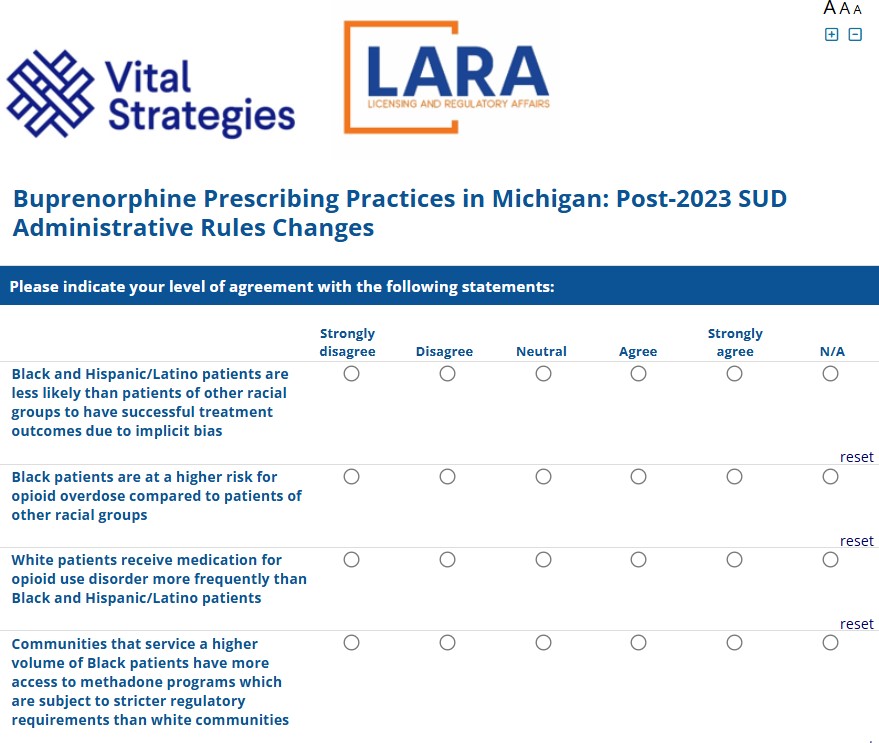
For instance, the survey included statements such as: “Black and Hispanic/Latino patients are less likely than patients of other racial groups to have successful treatment outcomes due to implicit bias”; “Black patients are at a higher risk for opioid overdose compared to patients of other racial groups”; “White patients receive medication for opioid use disorder more frequently than Black and Hispanic/Latino patients”; and “Communities that service a higher volume of Black Patients have more access to methadone programs which are subject to stricter regulatory requirements than white communities.”

Figure 1. A screenshot of the LARA survey sent to physicians.

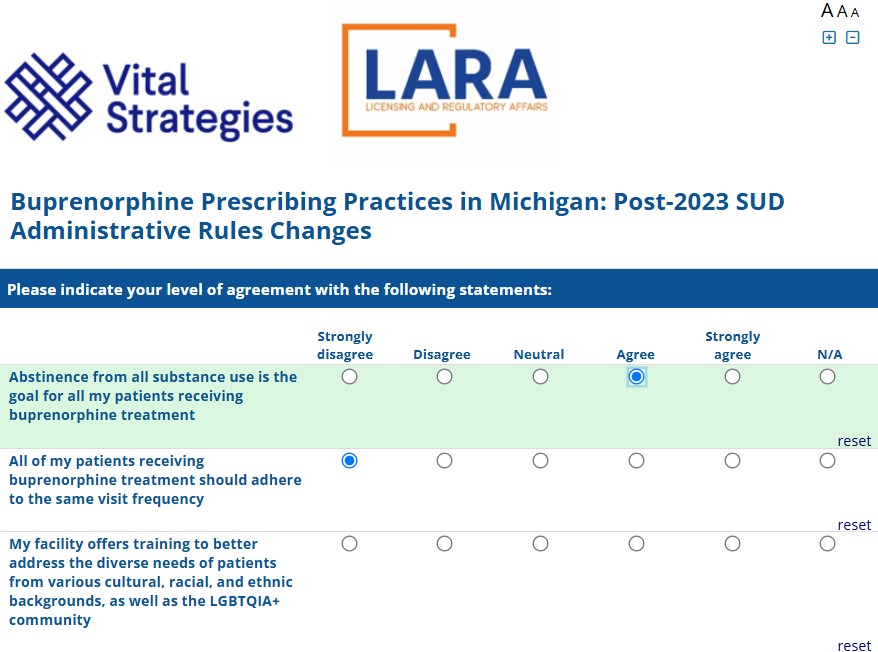
Additionally, LARA asked physicians to provide information on whether their healthcare facility provides “training” to address the “diverse needs” of patients.

“My facility offers training to better address the diverse needs of patients from various cultural, racial, and ethnic backgrounds, as well as the LGBTQIA+ community,” the survey asked.

Figure 2. A screenshot of the LARA survey sent to physicians.

Why this information is at all relevant to LARA is unclear, but it’s disturbing nonetheless that a regulatory agency is intent on grilling physicians regarding their adherence to DEI ideology.

Yet this is par for the course for LARA and the Michigan executive branch. In 2022, pursuant to a 2020 executive order issued by Michigan Governor Gretchen Whitmer, LARA mandated physicians to take a continuing education course on “implicit bias.”

The implicit bias training program must include strategies to reduce disparities in access to and delivery of healthcare services, and discuss, among other topics, current research on implicit bias in the access to and delivery of healthcare services.

As a result, Do No Harm set up our implicit bias course, meeting LARA’s requirements, while dispelling myths of systemic racism by providing factual, evidence-based information on the topic.

There is no solid evidence finding a causal link between unconscious bias/implicit bias (which is itself a dubious concept at best) and racial disparities in health outcomes, with the tests used to evaluate or identify implicit bias found to be “poor predictors” of real-world bias and discrimination. 

Each year, opioids claim the lives of tens of thousands of Americans, with over 80,000 Americans dying from opioids in 2022 alone. LARA should not attempt to play ideological games with people’s lives and taxpayer dollars. Instead, it should ensure that physicians provide the best treatment possible for everyone.

https://donoharmmedicine.org/wp-content/uploads/2023/11/shutterstock_2150211137-scaled.jpg 1350 2560 Ailan Evans https://donoharmmedicine.org/wp-content/uploads/dono-logo.png Ailan Evans2025-06-11 17:07:052025-06-11 17:07:05Michigan’s Licensing Department Grills Drug Providers on Race, DEI Policies

Michigan’s Licensing Department Grills Drug Providers on Race, DEI Policies

Uncategorized Michigan DEI Commentary Do No Harm Staff

Why does a state regulatory agency care about a physician’s opinions on the role of “implicit bias” in health outcomes?

Well, according to Michigan’s Department of Licensing and Regulatory Affairs (LARA), physicians’ opinions on this topic must be of some importance.

LARA sent out surveys to physicians, giving them gift cards in exchange for rating their level of agreement with a series of statements ostensibly related to LARA’s rule changes governing the prescribing of buprenorphine.

Buprenorphine is a medication that works as a partial-opioid agonist and is used to treat individuals suffering from addiction to opioids such as fentanyl, heroin, or oxycontin.

The statements in the survey appeared to portray racial minorities as having worse drug treatment outcomes due to systemic factors or implicit bias.

For instance, the survey included statements such as: “Black and Hispanic/Latino patients are less likely than patients of other racial groups to have successful treatment outcomes due to implicit bias”; “Black patients are at a higher risk for opioid overdose compared to patients of other racial groups”; “White patients receive medication for opioid use disorder more frequently than Black and Hispanic/Latino patients”; and “Communities that service a higher volume of Black Patients have more access to methadone programs which are subject to stricter regulatory requirements than white communities.”

Figure 1. A screenshot of the LARA survey sent to physicians.

Additionally, LARA asked physicians to provide information on whether their healthcare facility provides “training” to address the “diverse needs” of patients.

“My facility offers training to better address the diverse needs of patients from various cultural, racial, and ethnic backgrounds, as well as the LGBTQIA+ community,” the survey asked.

Figure 2. A screenshot of the LARA survey sent to physicians.

Why this information is at all relevant to LARA is unclear, but it’s disturbing nonetheless that a regulatory agency is intent on grilling physicians regarding their adherence to DEI ideology.

Yet this is par for the course for LARA and the Michigan executive branch. In 2022, pursuant to a 2020 executive order issued by Michigan Governor Gretchen Whitmer, LARA mandated physicians to take a continuing education course on “implicit bias.”

The implicit bias training program must include strategies to reduce disparities in access to and delivery of healthcare services, and discuss, among other topics, current research on implicit bias in the access to and delivery of healthcare services.

As a result, Do No Harm set up our implicit bias course, meeting LARA’s requirements, while dispelling myths of systemic racism by providing factual, evidence-based information on the topic.

There is no solid evidence finding a causal link between unconscious bias/implicit bias (which is itself a dubious concept at best) and racial disparities in health outcomes, with the tests used to evaluate or identify implicit bias found to be “poor predictors” of real-world bias and discrimination. 

Each year, opioids claim the lives of tens of thousands of Americans, with over 80,000 Americans dying from opioids in 2022 alone. LARA should not attempt to play ideological games with people’s lives and taxpayer dollars. Instead, it should ensure that physicians provide the best treatment possible for everyone.

https://donoharmmedicine.org/wp-content/uploads/2023/11/shutterstock_2150211137-scaled.jpg 1350 2560 Ailan Evans https://donoharmmedicine.org/wp-content/uploads/dono-logo.png Ailan Evans2025-06-11 17:07:052025-06-11 17:07:05Michigan’s Licensing Department Grills Drug Providers on Race, DEI Policies

Unproven and Unsafe: The Evidence Gap in So-Called ‘Gender-Affirming Care’

Uncategorized United States Gender Ideology Medical Journal Resource Kurt Miceli, MD

This resource details the lack of evidence supporting the use of so-called “gender-affirming care” to treat minors suffering from gender dysphoria.

Claims abound regarding the benefits of so-called “gender-affirming care” (GAC) for minors, which includes medical interventions such as puberty blockers, cross-sex hormones, and surgical procedures to foster alignment with an individual’s perceived gender identity when it differs from one’s biological sex. Yet, the reality is quite different. The evidence simply does not support GAC. More so, the danger is great given the resulting permanent, irreversible harm caused by such interventions.

Continue reading Do No Harm’s full resource below.

GAC Evidence Gap ResourceDownload
https://donoharmmedicine.org/wp-content/uploads/2025/06/iStock-1411002384-1.jpg 1414 2121 Ailan Evans https://donoharmmedicine.org/wp-content/uploads/dono-logo.png Ailan Evans2025-06-11 15:49:372026-01-20 14:41:14Unproven and Unsafe: The Evidence Gap in So-Called ‘Gender-Affirming Care’

‘None of Our Values Have Changed’: DEI Doesn’t Die Easy at UVA

Uncategorized Virginia DEI University of Virginia Medical School Commentary Do No Harm Staff

On March 7, the University of Virginia Board of Visitors passed a resolution to dissolve the school’s Office of Diversity, Equity, Inclusion, and Community Partnerships and take steps to ensure that all programs do not discriminate in violation of federal law. 

And following that resolution, the Department of Justice (DOJ) sent a letter April 28 to UVA asking the school to produce evidence that it has dismantled its DEI apparatus. 

But according to internal discussions between UVA and UVA Health officials, DEI, especially in the medical and health departments, may not be going anywhere anytime soon.

Instead, officials equivocated on actual tangible steps that would be taken to address DEI initiatives.

During a UVA Faculty Senate meeting on March 22, several weeks before the DOJ letter, officials discussed how UVA would treat its DEI initiatives going forward. These discussions revealed a deep institutional commitment to DEI, as succinctly expressed by Mitchell Rosner, MD, Interim Executive Vice President for Health Affairs at the University of Virginia.

“None of our values have changed,” Rosner said in reference to DEI, while acknowledging that UVA Health must be in compliance. “None of what we’re going to do changes.”

Next, Rosner discussed how DEI has pervaded UVA Health and how it will be difficult to extricate it from UVA Health’s mission.

“We also have to focus on health outcomes,” Rosner said.

“Everybody in the health system is passionate to ensure that health outcomes in our community are equalized and everybody has access to healthcare,” Rosner continued.

The notion that health outcomes should be “equalized” flies in the face of foundational principles of medical ethics. Medical professionals should strive to provide the best care possible to individuals regardless of race, not ensure that different racial groups have equal health outcomes.

Rosner made clear that programs aimed at equalizing health outcomes will likely remain in place.

“We don’t intend really to back away from any of those programs,” Rosner said, while noting that “we have to do it with the eye on being compliant.”

However, in the context of this DEI discussion, Rosner did mention a “value statement” that was used for promotion decisions.

“We have an issue around a particular value statement that’s part of the health system mission that was included, for example, in promotion and tenure reviews,” Rosner said.

It’s not clear exactly which document Rosner was referring to, though it’s worth noting that UVA has in the past required applicants for several of its positions to submit diversity statements. 

Additionally, Rosner, in response to a question about the status of so-called “gender-affirming care” provided by UVA Health, said that “we will be compliant with the law” while failing to commit to any policy changes. UVA Health has continued to provide child sex change procedures despite President Trump’s executive order targeting providers of such interventions.

Since the March meeting took place, UVA has been in the center of a legal and political firestorm surrounding its DEI proclivities.

First, UVA’s Board of Visitors passed a second resolution in April which formally rescinded portions of the September 2020 resolution entitled “Board of Visitors Support for Racial Equity Initiatives”; the 2020 resolution had effectively endorsed a racial quota system. 

Then, the DOJ opened a civil rights investigation into UVA last month, alleging that UVA engages in discriminatory behaviors in violation of Title VI of the Civil Rights Act of 1964.

Rosner’s comments, and the larger goings-on at UVA, indicate the broader trend in medical education: DEI isn’t going away overnight. Do No Harm documented this phenomenon in a recent report, explaining how DEI has persisted in higher education despite state laws ostensibly prohibiting it.

Further oversight and action will be needed to truly restore merit and fairness to medical education.

https://donoharmmedicine.org/wp-content/uploads/2025/06/shutterstock_2310579491-scaled.jpg 1846 2560 Ailan Evans https://donoharmmedicine.org/wp-content/uploads/dono-logo.png Ailan Evans2025-06-10 19:54:152025-06-10 19:54:15‘None of Our Values Have Changed’: DEI Doesn’t Die Easy at UVA

Reassessing Pediatric Gender Care: Evidence, Transparency, and the Path Forward

Uncategorized United States Gender Ideology Federal government, Health system, Medical association Commentary Kurt Miceli, MD

The prevailing consensus from organized medicine currently favors pediatric medical transition (PMT). This comes in contrast to mainstream America where 71% of respondents to a New York Times/Ipsos poll earlier this year agreed that “no one under age 18 should have access” to puberty-blocking medications or hormone therapy. Similarly, lawmakers in 27 states have enacted laws – of varying degrees – banning PMT. The difference between the medical establishment and the American public on the care of minors with gender dysphoria is real.

This divide was only further highlighted by the response to the recently published report from the Department of Health and Human Services (HHS), “Treatment for Pediatric Gender Dysphoria – Review of Evidence and Best Practice.” The American Academy of Pediatrics (AAP), on the same day as the report’s release, chided the authors for not consulting the organization and “[misrepresenting] the current medical consensus.” Also on that same day, five additional physician groups, along with the AAP, issued a joint statement echoing their collective support for the “full spectrum of evidence-based health care.”

Interestingly, the HHS report does just that – assess the evidence. It offers an umbrella review, thereby evaluating systematic reviews themselves. To conduct the overview, the report’s authors followed the Cochrane Handbook for Systematic Reviews of Interventions. The risk of bias for each systematic review was assessed using a standard tool. Then, for each outcome, the authors used a standard methodology to determine the certainty or quality of the evidence. After assessing 286 studies for eligibility, seventeen systematic reviews met the inclusion criteria, of which ten were determined to have a low risk of bias.

Yet, the AAP argues the HHS report “must consider the totality of available data.” A series of questions naturally follows: What data might the HHS review have omitted that the AAP would have included? At the risk of lowering the quality of evidence, should the HHS have incorporated select, individual studies beyond systematic reviews? And, of the systematic reviews deemed eligible, should those focused primarily on adults have been included?

One such excluded review was from Dr. Kellan Baker and colleagues, which has been cited 305 times according to Google Scholar and was conducted to inform the World Professional Association for Transgender Health’s (WPATH’s) Standards of Care for the Health of Transgender and Gender Diverse People, Version 8 (SOC-8). Yet, any definitive conclusions related to the care of minors should be taken with caution. For example, Baker included just one trial of 50 adolescents which showed “no difference in [quality of life] scores after a year of endocrine interventions.” Furthermore, while less than a handful of studies on depression showed some improvement, the risk of bias was determined to be either “moderate” or “serious.” The abstract itself noted a “high risk of bias in study designs, small sample sizes, and confounding with other interventions.” The study’s authors “could not draw any conclusions about death by suicide.”

The dearth of high-quality evidence unfortunately extends throughout this area of medicine. HHS’s review confirmed what our colleagues overseas had previously reported. Simply, HHS’s report noted, “the overall quality of evidence concerning the effects of any intervention on psychological outcomes, quality of life, regret, or long-term health, is very low.” Studies related to PMT are often of low quality given small sample sizes, significant attrition of enrollees, and relatively short follow up periods. Selection bias, uncontrolled confounding, and lack of a comparison group also weigh heavily on many of these trials. All of this leads to low quality evidence in the face of life altering interventions.

Moreover, data has not always been published in a timely manner. This past fall The New York Times reported that Dr. Johanna Olson-Kennedy’s “long-awaited study of puberty-blocking drugs” remained unpublished. This study began nearly a decade ago as part of a National Institutes of Health grant. As per the Times’ article, Olson-Kennedy’s study of 95 children did not find improvements in mental health from puberty blockers. After many years of waiting a preprint was posted last month confirming this to be the case. Similarly, findings from England’s youth gender clinic in 2011 showed that puberty blockers had “not changed volunteers’ well-being, including rates of self harm.” It was not until 2020 that those results were made public.

Within this climate, unwavering transparency, critical engagement, and intellectual rigor are needed now more than ever from both individual physicians and organized medicine. Physicians – particularly those caring for youth with gender dysphoria – must come to read and understand the HHS report. The duty to be informed is paramount, especially when the well-being of America’s children is at stake and irreversible interventions are in question.

Similarly, medical societies like the AAP and the Endocrine Society must review their clinical practice guidelines for PMT independent of external influence. Uncritically accepting WPATH’s recommendations, for example, will not serve this purpose, particularly when WPATH itself suppressed its own evidence reviews and allowed political pressures to influence its standards of care. Fortunately, the AAP opened the door to a new direction when its Board of Directors nearly two years ago called for a “systematic review of the evidence.” Now is the time to deliver on this directive.

As part of any reevaluation, American medicine must place a renewed focus on psychosocial support and psychotherapy as a legitimate and essential modality of care – one that carries no physical harms and prioritizes long-term well-being. Medicine in general, and pediatrics in particular, needs to move past the consumerist model, where minors – who are not of age to give informed consent – direct their own medical treatment absent valued clinical input. We cannot neglect our duty as physicians. In each clinical encounter patients and parents look to us as highly educated and well-trained professionals who must offer more than technical prowess. Physicians bear great moral responsibility, making it imperative that we act as thoughtful practitioners who weigh the totality of evidence along with our ethical duty to more than just blind allegiance to patient autonomy and little else. Ultimately, we must first do no harm.

To that end, the American Medical Association (AMA) must act, recognizing its unique role as America’s largest medical association with representation from numerous specialty societies at its House of Delegates. The AMA should ensure coordination of efforts among America’s medical societies to increase transparency, promote open debate, and ensure rigorous scientific scrutiny in the reevaluation of clinical practice guidelines related to pediatric gender medicine. The broader medical community, rather than a select group of individuals, must be involved. This entails reading and understanding the HHS’s review, as well as engaging with its contributors once the post-publication peer review process is complete.

The time has come for the medical community to have an honest conversation about PMT. It is of the utmost importance for the health and wellbeing of our nation’s youth that we, as physicians, have this dialogue and take the necessary appropriate steps. It is also critical to the integrity of our profession if we are to maintain the trust of the American people. The public is watching, and our actions must speak louder than the words we have thus far offered.

https://donoharmmedicine.org/wp-content/uploads/2023/11/shutterstock_1845309475-scaled.jpg 1440 2560 Ailan Evans https://donoharmmedicine.org/wp-content/uploads/dono-logo.png Ailan Evans2025-06-10 17:01:232026-01-20 14:41:14Reassessing Pediatric Gender Care: Evidence, Transparency, and the Path Forward

Get Racial Preferences Out of Orthopedic Surgery

Uncategorized United States DEI Medical association Commentary Do No Harm Staff

In the medical field, opportunities should be awarded to individuals on the basis of merit, talent, and achievement. 

This encourages the best and brightest physicians and, by extension, promotes excellence in medicine.

But the Mid Atlantic Shoulder and Elbow Society (MASES) appears to think otherwise.

To support attendance to its annual meeting in September, MASES is offering “Education Scholarships” to students interested in orthopedic surgery. These scholarships cover the cost of the meeting registration.

Yet there’s a catch.

“Preference will be given to underrepresented minorities and women considering the field of orthopedic surgery,” the scholarship description states, while qualifying this preference with the line that “all applicants will be considered.”

This qualification doesn’t change the fact that MASES is still engaging in discrimination on the basis of immutable characteristics. 

A prospective physician is no more or less deserving of an opportunity due to their race or sex. It’s hard to see why these qualities should matter at all for the field of orthopedic surgery.

MASES should drop its racial preferences at once, and make clear that race or sex will not be factors in its consideration.

https://donoharmmedicine.org/wp-content/uploads/2023/05/shutterstock_526407691-scaled.jpg 1590 2560 Ailan Evans https://donoharmmedicine.org/wp-content/uploads/dono-logo.png Ailan Evans2025-06-10 16:24:522025-06-10 16:24:52Get Racial Preferences Out of Orthopedic Surgery

What Does Indiana University Have to Hide?

Uncategorized Indiana DEI Indiana University School of Medicine Commentary Do No Harm Staff

Sunlight is the best disinfectant.

Yet the Indiana University (IU) Simon Cancer Center is doing its best to prevent oversight of its discriminatory program.

In 2024, Do No Harm submitted public records requests about the IU Simon Cancer Center’s Educational Pathways for Cancer Research (EPCR) summer program that appeared to be restricted to “underrepresented” students. The center advertised the program as recently as January 14, 2025, but removed the program’s webpage at some point after. 

The since-removed program description stated that it was “designed to serve students from populations underrepresented in biomedical and clinical research,” linking to the National Institutes of Health’s (NIH) diversity webpage.

The NIH previously defined “underrepresented” groups as “Blacks or African Americans, Hispanics or Latinos, American Indians or Alaska Natives, Native Hawaiians and other Pacific Islanders.” The NIH has since deleted that definition from its public guidance.

Additionally, the EPRC program provided opportunities to high school teachers, enabling them to “participate in four weeks of laboratory research experience and curriculum development activities that integrate cancer-related topics into the state curriculum.”

According to an archived version of the teacher application form, applicants were required to submit information on their race.

Yet, at some point, IU scrubbed the program from its website.

And then, IU denied Do No Harm’s public records request for more information on the program.

If IU is no longer operating the EPRC program, it should let the world know. And if it feels that the program is lawful and does not discriminate on the basis of race, then it shouldn’t have anything to worry about.

It’s worth noting that since IU last advertised the program, President Trump issued an executive order cracking down on DEI in higher education.

Additionally, Indiana passed a law that, among other things, prohibits public educational institutions or employers from taking actions based on an individual’s “personal characteristic[s]” such as their race, religion, color, sex, national origin, or ancestry.

While IU has previously been a hub for DEI activities in the Hoosier State, it has since removed much of its DEI material following the passage of the law.

If IU didn’t do anything wrong, it should have nothing to hide.

https://donoharmmedicine.org/wp-content/uploads/2023/09/shutterstock_745707979-scaled.jpg 1704 2560 Ailan Evans https://donoharmmedicine.org/wp-content/uploads/dono-logo.png Ailan Evans2025-06-09 18:51:572025-06-09 18:51:57What Does Indiana University Have to Hide?

UpToDate is Out-of-Date on Child Sex Change Interventions

Uncategorized United States Gender Ideology UpToDate Medical news Commentary Do No Harm Staff

UpToDate is the leading clinical resource, providing comprehensive summaries and detailed health information on a broad array of medical topics to clinicians around the world. UpToDate’s parent company boasts that over three million clinicians use the resource “to make the best care decisions.”

Yet on the subject of so-called “gender-affirming care,” UpToDate is woefully inadequate.

Instead, its “resources” on the topic are misleading and are intended more to advance the “gender affirmation” approach to the treatment of gender dysphoria than to provide anything approaching an accurate summary of pediatric gender medicine literature.

Before diving into the substance, it’s crucial to note that one of the authors of the resource, Dr. Johanna Olson-Kennedy, is not only a prominent advocate for and provider of so-called “gender-affirming care,” but is at the center of multiple controversies.

For one, The New York Times reported that Olson-Kennedy had initially refused to publish the results of a multi-million dollar, federally-funded study that found that “puberty blockers did not lead to mental health improvements” in children; Olson-Kennedy’s decision was due to fears that the results could undermine the argument for “gender-affirming care.” The results of the study were finally released earlier this month, finding that children’s depression symptoms and emotional health “did not change significantly over 24 months” of being on puberty blockers. 

Then, Clementine Breen, a now 20-year-old college student, sued Olson-Kennedy for medical negligence, alleging that Olson-Kennedy’s clinic put her on puberty blockers when she was 12 and performed a double mastectomy on her at 14. 

The other author of the resources, gender activist and child sex change practitioner Dr. Michelle Forcier, was also named in a lawsuit. Forcier allegedly recommended that the child plaintiff take testosterone injections after only one meeting.

It should come as no surprise, then, that the resources authored by Olson-Kennedy and Forcier fail to properly follow the evidence.

Any serious discussion of pediatric gender medicine must reckon with the ever-increasing body of literature showing that child sex change interventions lack sufficient evidentiary support.

Rather than take this into account and grapple with the ethical question of whether children should be subjected to sex change interventions, the UpToDate resources simply assume clinicians provide these procedures to “affirm” their patients’ gender.

As one resource, “Gender development and clinical presentation of gender diversity in children and adolescents,” makes clear, the authors envision the role of the clinician as that of a cheerleader encouraging the child to pursue their “asserted gender identity.” 

“Given the potential mental and physical health consequences of gender diversity in an unaccepting environment, it is important for health care providers to be nonjudgmental and to support their patients in their asserted gender identity,” the clinical summary states.

In other words, the resource suggests that medical providers should operate from the premise that the patient’s asserted identity must be affirmed; transgender medicalization inevitably follows from this position. The very idea of so-called “gender diversity” regressively enforces rigid sex stereotypes, relegating children who do not conform to a lifelong course of experimental body modification.

The authors simply refuse to engage with the wealth of evidence on the harms of child sex change interventions and the corresponding lack of evidence supporting the procedures’ effectiveness.

Neither resource even mentions the Cass Review, the comprehensive review of gender medical services in the United Kingdom that found the evidence supporting the “affirming” approach to be very weak. This is despite the fact that one of the resources, “Management of transgender and gender-diverse children and adolescents,” was last updated in March of 2025, a full eleven months after the publication of the Cass Review. 

That the most authoritative and comprehensive review of the evidence behind pediatric gender medicine would simply be absent from a resource on the topic is indefensible.

Moreover, despite UpToDate being available in over 190 countries, the authors fail to deal with the fact that many countries are moving away from the “affirmation” approach to gender dysphoria.

Health authorities within a number of countries, including the United Kingdom, Sweden, Brazil, and Finland, have restricted child sex change interventions as more and more evidence against these procedures comes to light.

Next, the authors outright mislead the audience on key facts about pediatric gender services.

Specifically, they claim that puberty blockers are “completely reversible.”

This statement simply cannot be made with confidence. 

Artificially preventing a child from going through puberty is inherently experimental, and the true impact on neurocognitive development, which includes executive function, regulation of emotions, and social cognition, is unknown. Not to mention the greater risk of permanent infertility and impaired adult sexual function, particularly if cross-sex hormones are started thereafter.

Sex steroid hormones are critical for bone mineralization and skeletal development. Puberty blockers disrupt this natural process, leading to diminished bone mineral density and concerns about increased fracture risk later in life. Research has shown that these drugs negatively affect bone density, with only partial recovery after sex steroid administration.

Additionally, nearly all children put on puberty blockers go on to take cross-sex hormones, which themselves contribute to infertility and are associated with increased risks of serious health conditions, including heart attack and stroke.

In sum, these resources paint a misleading and distorted picture about the evidence behind – and harms of – so-called “gender-affirming care,” and do so in service of a particular agenda.

Unfortunately, this is not the first instance of UpToDate prioritizing ideology over best practices. Do No Harm’s chairman, Stanley Goldfarb, MD, previously served as editor-in-chief of the kidney section of UpToDate. But when he began questioning the DEI dogma and the malign influence of identity politics on the medical profession, UpToDate’s leadership decided it would be best to part ways. 

UpToDate should take a hatchet to these resources and ensure that they accurately reflect the existing evidence, rather than simply reiterating the maxims of activists.


https://donoharmmedicine.org/wp-content/uploads/2025/05/shutterstock_2536192881-scaled.jpg 1707 2560 Ailan Evans https://donoharmmedicine.org/wp-content/uploads/dono-logo.png Ailan Evans2025-06-09 18:27:092025-06-09 18:27:09UpToDate is Out-of-Date on Child Sex Change Interventions

Harvard Medical School Rebrands Diversity Office After Years of DEI Activism

Uncategorized Massachusetts DEI Harvard Medical School Medical School Commentary Do No Harm Staff

Harvard Medical School (HMS) is doing some reputation damage control.

HMS has rebranded its DEI office as the Office for Culture and Community Engagement (OCCE), Dean George Q. Daley announced earlier this week.

“First, our HMS Office for Diversity Inclusion and Community Partnership has adopted a new name — the Office for Culture and Community Engagement (OCCE) — to better reflect its work going forward,” Daley announced. “Under the continued visionary leadership of Dr. Joan Reede, OCCE will continue with two main focus areas: 1) providing opportunity and access to help individuals thrive and 2) collaboration and community-building.”

Daley’s statement suggests this is more of a cosmetic change than a real shift in HMS’s ideological commitment to DEI.

Conspicuously absent from Daley’s statement is any mention of significant policy or personnel changes related to DEI.

HMS should make it clear that it will end all divisive and discriminatory practices in which it engages, and that its DEI efforts will be discontinued rather than simply rebranded.

In addition to this rebrand, the school has taken steps to deemphasize language stressing the importance of diversity in its public statements.

According to The Harvard Crimson, HMS removed its diversity statement which included commitments to health equity and DEI, as well as pledges to “challenge discrimination,” “address disparities and inequities,” and “actively promote social justice.”

Additionally, the website for HMS’s DEI office now directs to the OCCE website, as do many DEI resource pages.

But HMS can’t rewrite history.

The school has long been a proponent of DEI and has promoted divisive and discriminatory practices and policies.

For instance, HMS maintained a racially-segregated affinity group that was the subject of a Do No Harm civil rights complaint in 2023. 

And in 2022, Do No Harm launched an advertising campaign highlighting HMS’s“Task Force on Diversity and Inclusion Report,” released in 2020, which laid out a comprehensive plan to make DEI ideology central to the school’s work. That plan now links back to the OCCE website.

We’re not content with a facelift. If HMS truly wishes to change its way and ditch its DEI practices, then it should make that clear.

https://donoharmmedicine.org/wp-content/uploads/2022/05/shutterstock_1747594877-scaled.jpg 1920 2560 Ailan Evans https://donoharmmedicine.org/wp-content/uploads/dono-logo.png Ailan Evans2025-06-06 15:53:472025-06-06 15:53:47Harvard Medical School Rebrands Diversity Office After Years of DEI Activism

The ACGME Takes Key Steps to Remove DEI from Accreditation Efforts

Uncategorized United States DEI Accreditation Council for Graduate Medical Education accrediting organization Commentary Do No Harm Staff

Last month, the Accreditation Council for Graduate Medical Education (ACGME), the accreditor for medical residency programs, announced it would be suspending enforcement of two key “diversity” requirements.

The requirements were effectively diversity hiring mandates that required residency programs and their sponsoring institutions (e.g. medical schools) to have recruiting and retention policies that aim to boost diversity.

Now, the ACGME is taking steps to excise DEI from its operations.

According to the ACGME’s Annual Update, the ACGME’s Accreditation Data System (ADS), will no longer enable residency programs to submit information on their “diversity” efforts.

Previously, the ACGME asked programs to provide information on what the residency program “will be/is doing to achieve/ensure diversity in resident/fellow recruitment, and retention.”

Other prompts included: “Describe in detail what efforts your specific program is doing to advance diversity, equity, and inclusion for residents/fellows”; “Describe what the program will be/is doing to achieve/ensure diversity in the individuals participating in the program (e.g. faculty members, administrative personnel)”; and “Describe in detail what efforts your specific program is doing to advance diversity, equity, and inclusion for faculty members, administrative personnel, etc.”

Although the ACGME had already officially ended consideration of DEI in its accreditation decisions, these changes are still an important development.

They hamper the ability of the ACGME to consider DEI unofficially, and remove the incentive for residency programs to discriminate.

However, while this is an encouraging sign, DEI and racial discrimination may not be gone from residency programs for good; the Association of American Medical Colleges (AAMC) intends to expand the reach of its residency application tools for the purpose of supporting “holistic review” admissions. 

“Holistic review” is often, in practice, a euphemism for race-conscious admissions and definitionally devalues merit and academic achievement in favor of other characteristics.

Still, the ACGME’s actions are a positive sign that medical education is, slowly but surely, headed in the right direction.

https://donoharmmedicine.org/wp-content/uploads/2025/05/shutterstock_2303902473-scaled.jpg 1497 2560 Ailan Evans https://donoharmmedicine.org/wp-content/uploads/dono-logo.png Ailan Evans2025-06-06 12:31:062025-06-06 12:31:06The ACGME Takes Key Steps to Remove DEI from Accreditation Efforts

Purdue Sunsets DEI Following Indiana Law Cracking Down on Divisive and Discriminatory Programs

Uncategorized Indiana DEI Purdue University Medical School, Public university Commentary Do No Harm Staff

Purdue University is ending its DEI activities and initiatives, according to a letter sent from Purdue University Provost Patrick Wolfe.

“Acting under the authority of our Board of Trustees, the University is sunsetting historical DEI activities and initiatives, effective today,” the letter reads. “An increasing number of actions and policy measures at both the federal and state level have made it clear that doing so is a necessary part of our future as a public university and a state educational institution.”

Purdue’s decision comes less than a month after Indiana Governor Mike Braun signed into law sweeping legislation, SB 289, that takes aim at a number of DEI initiatives in institutions of higher education and other publicly-funded entities.

Among other things, the law specifically targets “unlawful discrimination” in education, public employment, and licensure, as well as DEI committees in public universities; it also prohibits public educational institutions or employers from taking actions based on an individual’s “personal characteristic[s]” such as their race, religion, color, sex, national origin, or ancestry.

Purdue’s Office of Diversity, Inclusion and Belonging and related activities in colleges and departments will close, the letter stated, and scholarship programs that are focused on diversity and race will be modified.

Purdue’s health and medical departments were strong proponents of DEI, as Do No Harm recently reported. 

For instance, Purdue’s School of Nursing boasted of its mission to “[uphold] the principles of diversity, equity, and inclusion” on the department’s still-operational Diversity, Equity, and Inclusion page, while Margo Monteith, Associate Dean for DEI, proclaimed that the College has “really baked in diversity, equity, and inclusion into the way that we operate.” 

Since the announcement, Purdue has scrubbed several DEI resources from its website, including the biographies of several of its DEI officials and the main campus’s DEI office.
However, other DEI resources, including the university’s Equity Task Force webpage, remain up.

https://donoharmmedicine.org/wp-content/uploads/2024/02/shutterstock_1237459798-scaled.jpg 1707 2560 Ailan Evans https://donoharmmedicine.org/wp-content/uploads/dono-logo.png Ailan Evans2025-06-05 19:20:582025-06-05 19:20:58Purdue Sunsets DEI Following Indiana Law Cracking Down on Divisive and Discriminatory Programs

Do No Harm Files Federal Civil Rights Complaint Against Geisinger College of Health Sciences

Uncategorized Pennsylvania, United States DEI Geisinger College of Health Sciences Medical School Press Release Executive Do No Harm Staff

RICHMOND, VA; June 5, 2025 – Do No Harm filed a complaint with the Department of Education Office for Civil Rights (OCR) against Geisinger College of Health Sciences over its racially discriminatory summer program.

Geisinger administers the “Center of Excellence MedStart Summer Institute for Prematriculating Program,” which it describes as “[a] comprehensive 8-week summer program for accepted under-represented in medicine (URiM) students to help them transition smoothly into the rigorous demands of medical school.”

However, the program’s eligibility criteria restrict access to the program on the basis of race: “Students must be committed to Geisinger Commonwealth School of Medicine and identify as URiM and/or another underserved category,” the program description reads.

“Geisinger College of Health Sciences did not learn its lesson after our first federal civil rights complaint to the Office for Civil Rights,” said Do No Harm Senior Fellow Mark J. Perry. “Excluding students from medical programs because of race is blatant, unlawful discrimination. This Summer Institute is just another example of how woke identity politics have infiltrated the healthcare sector.”

As Do No Harm’s complaint notes, “the common understanding and definition of ‘Under-Represented in Medicine (URiM)’ is a category restricted to students who identify as Black, Hispanic, or Native American, but not students who are White, Asian, or Middle Eastern/North African.”

Thus, Geisinger’s program is discriminating on the basis of race in violation of Title VI of the Civil Rights Act of 1964. Do No Harm requests the program either be terminated or open to all students regardless of race, color, or national origin.

“Medical programs must prioritize expertise and merit, not skin color, if they hope to effectively prepare medical students to provide high-quality care for patients,” Perry continued. “Compliance with federal civil rights laws for recipients of federal funds, like Geisinger, is not optional, and there are no ‘if you have good intentions’ exceptions to Title VI. To comply with federal civil rights laws, Geisinger should either terminate the discriminatory Program or open it to all students regardless of race, color, or national origin.”


Do No Harm, established in April 2022, has rapidly gained recognition and made significant strides in its mission to safeguard healthcare from ideological threats. With 17,000 members, including doctors, nurses, physicians, and concerned citizens across all 50 states and 14 countries, DNH has achieved over 10,000 media hits in top-tier publications and garnered widespread attention through numerous broadcast news appearances.


https://donoharmmedicine.org/wp-content/uploads/2022/11/DNH_ContentCards_PressRelease.png 675 1200 Ailan Evans https://donoharmmedicine.org/wp-content/uploads/dono-logo.png Ailan Evans2025-06-05 17:57:132025-06-05 17:57:13Do No Harm Files Federal Civil Rights Complaint Against Geisinger College of Health Sciences

Tennessee Eliminates Racial Quotas From Medical Licensing Boards Following Do No Harm Lawsuit

Uncategorized Tennessee DEI State government, State legislature Commentary Do No Harm Staff

Fairness and merit triumph in Tennessee.

In April, Tennessee Governor Bill Lee signed HB 1237 and SB 1084 to remove racial quotas from medical licensing boards after Do No Harm filed two federal lawsuits challenging the quotas’ constitutionality. 

In response to the enactment of these laws, Do No Harm voluntarily dismissed its lawsuits against the state.

Tennessee medical practitioners are regulated by the Tennessee Board of Medical Examiners, while the state’s Board of Chiropractic Examiners oversees chiropractors.

In 2024, Do No Harm (represented by Pacific Legal Foundation) filed two federal lawsuits challenging Tennessee’s requirement that the governor consider race when deciding who can serve on these boards. The lawsuits argued that Tennessee’s racial quotas violated the Constitution’s equal protection guarantee.

Following our lawsuit, Tennessee’s lawmakers took action and removed these unconstitutional and discriminatory requirements.

Last month, Arkansas also elected to remove race and gender quotas from state boards and commissions. 

That decision was prompted in part by Do No Harm’s federal lawsuit challenging an Arkansas law that required racial quotas for certain government bodies.

No government official should use an individual’s race or ethnicity to determine who gets the opportunity to serve the public. 

Treating people differently on the basis of race violates the notion of equality before the law.

https://donoharmmedicine.org/wp-content/uploads/2024/10/shutterstock_1912865638-scaled.jpg 1696 2560 Ailan Evans https://donoharmmedicine.org/wp-content/uploads/dono-logo.png Ailan Evans2025-06-02 17:35:422025-06-02 17:35:42Tennessee Eliminates Racial Quotas From Medical Licensing Boards Following Do No Harm Lawsuit

UCSF Commencement Speech Turns Into Ode to DEI, Gender Ideology

Uncategorized California DEI, Gender Ideology University of California San Francisco Medical School Commentary Do No Harm Staff

“Frankly, it’s impossible to be a decent person or a good doctor without advocating for equity, inclusion, accessibility, belonging, justice and diversity.”

That statement formed the centerpiece of a University of California, San Francisco (UCSF) speech by UCSF professor Lousie Aronson, MD, at the school’s May 19 commencement.

Rather than celebrating traditional values of excellence, merit, and fairness that have served as the foundation for the practice of medicine for centuries, Aronson’s speech instead became a diatribe against the current administration’s attempts to eliminate DEI from medicine and medical education.

In her speech, Aronson appeared to reference terms identified by The New York Times as language from which the Trump administration has moved away in official government documents and websites. These terms include common signifiers of identity politics like “diversity” and “gender-affirming care.”

Aronson argued the terms “represent concepts that should be integral to how you practice medicine,” addressing the graduating students, and proceeded to go alphabetically through many of the terms.

Aronson first extolled the virtues of DEI to the medical profession; next, Aronson discussed so-called “gender-affirming care.”

“By definition, affirming care validates truths such as patient experience and demonstrates public support of or dedication to something such as practicing medicine with compassion,” she said.

The irony, of course, is that “affirming care” is hostile to the truth, in the sense there is no strong scientific evidence showing the effectiveness of “affirming care” in treating children with gender dysphoria. Meanwhile, there is corresponding wealth of evidence demonstrating the “affirming” approach’s myriad harms.

Aronson then invoked the debunked notion that racial concordance – in which patients are treated by physicians of the same race  – produces better health outcomes.

“Latinos have lower rates of health utilization than other groups,” Aronson said. “They also are more likely to access care and adhere to medical advice when their healthcare provider shares their language preference, ethnicity, or race; and better yet all three.”

As Do No Harm demonstrated in our 2023 report, “Racial Concordance in Medicine: The Return of Segregation,” this theory is bunk. Our report examined the scholarship surrounding racial concordance, and found that four out of five existing systematic reviews of racial concordance in medicine found no improvement in health outcomes, while the fifth is fraught with methodological problems.

This speech is yet another installment in UCSF’s long infatuation with DEI. 

UCSF’s Fresno campus previously maintained a racially discriminatory scholarship for visiting obstetrics students, only changing the discriminatory criteria following a civil rights complaint from Do No Harm.

What’s more, UCSF operated a scholarship program forcing applicants to submit a personal statement expressing their “commitment to working with diverse communities” and their involvement in DEI initiatives to proceed to the next phase of the application process.

This speech is further evidence of how UCSF prioritizes DEI relative to foundational principles of clinical practice.

UCSF should be instilling virtues of merit and excellence in its students so that they can become the best physicians they can be, not inculcating them in regressive political ideology.

https://donoharmmedicine.org/wp-content/uploads/2025/06/ucsf1.jpg 640 1267 Ailan Evans https://donoharmmedicine.org/wp-content/uploads/dono-logo.png Ailan Evans2025-06-02 16:39:012025-06-02 16:39:01UCSF Commencement Speech Turns Into Ode to DEI, Gender Ideology

The American Psychological Association’s Annual Convention is Chock-Full of DEI

Uncategorized United States DEI Medical association Commentary Do No Harm Staff

Each year, the American Psychological Association (APA) hosts a convention featuring panels and events on a variety of topics in the field of psychology. 

But this year, dozens of events are heavily focused on DEI and gender ideology, according to a list of planned events that will take place at the August meeting in Denver, Colorado.

This includes panels outright plotting ways to increase diversity in academia and medicine: for instance, one panel, “Empowering Change: Cultivating Diverse Scholars and Creating Spaces of Belonging in Educational Psychology,” discussed ways in which the field could better increased

“Attendees will engage in critical conversations aimed at revising educational competencies and establishing a network that supports the professional growth and well-being of underrepresented groups in academia,” the event description reads.

Other panels focused more on changing the way psychology is practiced to be more accommodating of DEI ideology.

The description for “De-Centering Whiteness in Psychology: Now More Than Ever,” for instance, states that “decentering whiteness in clinical psychology is critical to cultivating meaningful, necessary changes in equitable applications of psychological science.”

It’s not exactly clear how “whiteness” will be “decentered,” but it appears to involve a radical overhaul of clinical psychology to focus less on individual care and more on “equity and justice.”

“A stance of clinical neutrality and an individualistic focus are not only inadequate, they are harmful,” the event description reads. “By deconstructing dominant cultural norms and biases underlying clinical psychology practices, we endeavor to disrupt these harmful dynamics.”

“By adopting a critical framework that centers equity and justice, we reinforce our professions core mission of beneficence by becoming agents of change in creating more just and equitable mental health systems,” the description continues.

This seems like a bad idea; “neutrality” and an “individualistic focus” are likely the traits one looks for in a clinician, and should not be discarded in the name of ideology.

Another event, a symposium titled “Whiteness in Psychology and Education: A Critical Conversation Toward Racial Justice,” features a discussion of how “Whiteness and White supremacy continue to influence sociopolitical dynamics, racial socialization, and daily experiences on college campuses.”

Other events, meanwhile, appear to be platforms for political activism.

“The Impact of Anti-Equity, Diversity, and Inclusion (EDI) Legislation” event’s description states that “[r]epresentation, safety, value for individual differences, educational freedom, and equitable access are currently being stifled and constrained,” thanks to anti-DEI laws.

The aforementioned events are just a small sampling of the various DEI activities taking place at the APA convention. Others include “Decolonizing the Mind: Empirical Perspectives with Diverse and Intersectional Communities,” “Equity in Action: DEI, Sport, and Athlete Mental Health Amid Sociocultural and Legal Changes,” and many more.

https://donoharmmedicine.org/wp-content/uploads/2025/05/shutterstock_2533816059-scaled.jpg 1707 2560 Ailan Evans https://donoharmmedicine.org/wp-content/uploads/dono-logo.png Ailan Evans2025-05-29 18:26:362025-05-29 18:26:36The American Psychological Association’s Annual Convention is Chock-Full of DEI

The LCME Eliminates Key Diversity Requirement

Uncategorized United States DEI Medical School Commentary Executive Do No Harm Staff

It’s yet another massive victory against DEI in medical education.

On May 19, the Liaison Committee on Medical Education (LCME), the accrediting body for medical schools, voted to eliminate Element 3.3, a requirement that forced medical schools to have in place “programs and/or partnerships” aimed at achieving diversity.

“A medical school has effective policies and practices in place, and engages in ongoing, systematic, and focused recruitment and retention activities, to achieve mission-appropriate diversity outcomes among its students,” the standard states. “These activities include the use of programs and/or partnerships aimed at achieving diversity among qualified applicants for medical school admission and the evaluation of program and partnership outcomes.”

The LCME attributed its decision to state legislation targeting DEI, arguing that eliminating diversity standards would create “a single set of accreditation expectations with which all schools, regardless of their location and current legislative environment, must comply.”

The LCME’s standards for the 2025-2026 year and 2026-2027 year have been updated and no longer include language encouraging diversity-related initiatives.

However, Standard 7.6, which requires medical curricula to provide “opportunities for medical students to learn to recognize and appropriately address biases in themselves, in others, and in the health care delivery process,” remains in place.

Nevertheless, this is a massive change: medical schools will no longer be forced to maintain DEI programs as a condition of their accreditation.

The decision follows on the heels of a Do No Harm report explaining how accreditors, including the LCME, inject DEI into medical school activities and curricula. In light of Do No Harm’s report, President Trump issued an executive order directly targeting accreditors for imposing divisive and discriminatory policies on higher education.

Also this month, the Accreditation Council for Graduate Medical Education (ACGME), which accredits medical residency programs, announced that it would be suspending enforcement of two key “diversity” requirements.

The requirements are effectively diversity hiring mandates that require residency programs and their sponsoring institutions (e.g. medical schools) to have recruiting and retention policies that aim to boost diversity.

https://donoharmmedicine.org/wp-content/uploads/2024/07/shutterstock_2269385773-scaled.jpg 1707 2560 Ailan Evans https://donoharmmedicine.org/wp-content/uploads/dono-logo.png Ailan Evans2025-05-28 21:05:032025-05-28 21:05:03The LCME Eliminates Key Diversity Requirement
Page 10 of 56«‹89101112›»
COPYRIGHT © DO NO HARM 2025. ALL RIGHTS RESERVED.
  • Contact
  • Privacy
  • Disclaimer
  • Link to X
  • Link to Facebook
  • Link to Instagram
  • Link to LinkedIn
  • Link to Youtube
Scroll to top Scroll to top Scroll to top