In recent years, states across the country, as well as the federal government, have taken action targeting divisive and discriminatory DEI programs in the medical field.
This has likely prompted some institutions, such as the Association of American Medical Colleges (AAMC), to scrub the more overt references to racially discriminatory practices from their public websites. The American College of Surgeons, perhaps seeing which way the winds were blowing, attempted torebrand itself and downplay its diversity commitments.
These changes appear to be largely cosmetic rather than a collective “Road to Damascus” moment, but they do signify a growing awareness among medical institutions that their radical ideological activism is no longer palatable to the public, policymakers, and healthcare professionals alike.
However, many medical associations still haven’t gotten the memo.
The National Association of EMS Physicians (NAEMSP) broadcasts its commitment to DEI loud and proud, maintaining a DEI committee and multiple resources expounding on the virtues of DEI ideology.
In its “Essential Principles to Create an Equitable, Inclusive, and Diverse EMS Workforce and Work Environment” document, the NAEMSP lists multiple principles that appear facially discriminatory.
These include:
“Hire more diverse workforce by intentionally recruiting from marginalized communities.”
“Increase EMS career pathway and mentorship programs within underrepresented minorities (URM) communities and URM-predominant schools starting at a young age to promote EMS as an achievable profession.”
“Require EMS advisory boards whose composition reflects the communities they serve and regularly audit membership to ensure inclusion.”
Taken together, these principles represent a fairly overt commitment to engage in discriminatory behavior, using the guise of “diversity” and “equity” to inject dangerous and racist influences and quotas into the recruitment and hiring process.
And from the principles’ citations, it’s clear the NAEMSP includes racial minorities in its definition of “URM.”
Moreover, the principles commit the NAEMSP to engage in forms of social justice activism, including a focus on combating “systemic racism.” Examples include:
“Increase knowledge and self-awareness of implicit/unconscious bias and acts of microaggression through established educational and training programs (i.e., anti- racism, upstander, and allyship) such that individuals recognize and mitigate their own biases and can act as allies.”
“Examine policies that promote systemic racism and revise policies, procedures, and rules to promote a diverse, inclusive, and equitable environment.”
“Design research and quality improvement initiatives related to health disparities in EMS that are focused on racial/ethnic and gender inequities and include URM community leaders as essential stakeholders involved in all stages of research development and implementation.”
The NAEMSP has also evangelizedthese ideals through a number of town halls and webinars.
One event, titled “Cultivating A Culturally Competent Culture: Building Diverse and Inclusive EMS Agencies,” includes an action plan urging attendees to diversify their workplaces.
As recently as June 2025, the NAEMSP’s DEI committee hosted a happy hour and virtual recruiting event.
The NAEMSP’s open endorsement of hiring and recruitment practices that favor certain groups on the basis of race or identity is promoting discrimination, full stop.
This undermines the very foundation of medicine, which should prioritize competence, training, and skill above all else. Patients deserve to be treated by the best doctors and EMS professionals, not by those selected to satisfy ideological and identity-based goals.
https://donoharmmedicine.org/wp-content/uploads/shutterstock_146467091-scaled.jpg17212560Ailan Evanshttps://donoharmmedicine.org/wp-content/uploads/DNH_Logo_Stethescope-1.pngAilan Evans2025-08-22 13:31:252026-05-14 13:38:50There’s a DEI Emergency in the Medical Field
Corewell Health, one of the largest health systems operating in Michigan, is asking its employees to sign a document effectively pledging their belief in DEI.
The health system maintains its “Corewell Health Code of Excellence,” a set of standards intended to govern professional conduct within the health system.
“This Code of Excellence (Code) applies system-wide to all employed and non-employed team members (collectively referred to as team members) including providers, contractors, consultants, agents, students, volunteers and suppliers,” the document states.
A physician source with knowledge of the matter said that signing the document was mandatory for healthcare providers working with Corewell Health.
However, the document contains a concerning strain of identity politics.
Item 4 of the Code of Excellence includes the following affirmation:
“We value diversity, equity and inclusion. We embrace a diverse and inclusive organizational culture that fosters respect for all. At the same time, we acknowledge that inequities persist in our communities. We pledge to listen deeply and engage authentically with those impacted by systemic racism, so we can partner with others toward the goal of achieving health equity.”
In other words, Corewell Health is pushing its employees to sign a pledge affirming their belief in DEI.
And failing to do so comes with very severe consequences.
The attestation attached to the Code of Excellence reads as follows:
“If I violate the Code or other policies or procedures applicable to me as a Corewell Health team member, I may be subject to performance correction up to and including termination of employment or other relationship with Corewell Health and any of its affiliates, including Priority Health.”
Thus, Corewell Health team members must adhere to the tenets of DEI, or else risk losing their jobs.
This may sound extreme, but when compared with other Corewell Health initiatives, it’s clear its par for the course.
For instance, Corewell Health operates its Minority and Underrepresented Scholarship Programs, which includes the Health Equity and Leadership (HEAL) Scholars Program and the Minority Visiting Scholars Program.
The HEAL Scholars Program provides resident physicians with a $10,000 scholarship their first year in the program and a $5,000 scholarship each year thereafter throughout residency.
However, the program requires participants to be members of certain racial backgrounds.
“Scholars must be from an underrepresented minority background (African American/Black, Hispanic/Latino, American Indian/Alaska Native or Native Hawaiian/Pacific Islander),” the program description states.
The HEAL Scholars Program was the subject of multiple federal civil rights complaints filed by Do No Harm Senior Fellow Mark J. Perry.
The initial complaint alleged that, since Corewell Health received ample federal funding, the program’s racially discriminatory eligibility criteria violated Title VI of the Civil Rights Act of 1964 (which prohibits recipients of federal funding from discriminating on the basis of race, color, or national origin).
Meanwhile, the second complaint againstMichigan State Universityalleged that the university’s funding and promotion of the HEALS Scholars Program likewise violated Title VI, essentially making the HEALS Scholars Program a joint venture in illegal discrimination.
Corewell also operates the Minority Visiting Scholars Program, which requires applicants to be from “an underrepresented group,” which includes “marginalized racial and ethnic groups, LGBTQIA+ people, and individuals with disabilities.”
Simply put, it’s disturbing that any organization, much less a major healthcare organization, would impose this ideological oath on its employees and embody these ideals in its discriminatory programs.
These concepts are more than just trivial distractions from Corewell Health’s mission to provide quality medical care; they are dangerous, and lead to direct discrimination in healthcare.
https://donoharmmedicine.org/wp-content/uploads/shutterstock_1701937552-3-scaled.jpg17072560Ailan Evanshttps://donoharmmedicine.org/wp-content/uploads/DNH_Logo_Stethescope-1.pngAilan Evans2025-08-20 16:49:102026-05-14 13:37:51Corewell Health Asks Employees to Swear Fealty to DEI
The Human Rights Campaign pressures children’s hospitals into performing transgender procedures on minors, according to a Do No Harm report.
Do No Harm is a medical organization dedicated to keeping identity politics out of all areas of the medical field, while the Human Rights Campaign (HRC) is an LGBTQ rights group.
Do No Harm medical director Dr. Kurt Miceli and co-author of the group’s report said in a statement obtained by The Center Square: “It is time to expose and root out the Human Rights Campaign’s vast influence over healthcare systems.”
“Our report sheds light on how the HRC weaponized its so-called ‘Healthcare Equality Index’ to pressure pediatric hospitals into chemically and surgically castrating children,” Miceli said.
https://donoharmmedicine.org/wp-content/uploads/2025/01/Media_Mention_.jpg7961550Ailan Evanshttps://donoharmmedicine.org/wp-content/uploads/DNH_Logo_Stethescope-1.pngAilan Evans2025-08-20 13:46:362026-04-11 07:16:14Report: Human Rights Campaign pressures transgender procedures on minors
A new report details how the Human Rights Campaign, the nation’s largest LGBT lobby, pressures hospitals into child genital mutilation and castration.
A new report from Do No Harm (DNH) titled, “How the Human Rights Campaign’s Healthcare Equality Index Infects Pediatric Hospitals with Gender Ideology,” details how HRC and its charity branch, the Human Rights Campaign Foundation (HRCF), uses a scoring index to measure a hospital’s “compliance with various tenets of gender ideology.” Hospitals lose points if they do not offer or encourage dangerous and anti-human transgender procedures such as male genital amputation, breast amputation, and fake genital construction for children.
https://donoharmmedicine.org/wp-content/uploads/2025/01/Media_Mention_.jpg7961550Ailan Evanshttps://donoharmmedicine.org/wp-content/uploads/DNH_Logo_Stethescope-1.pngAilan Evans2025-08-20 13:44:492026-04-11 07:16:25Report Exposes How Gender-Extremism Group Pressures Hospitals To Damage Children
A medical watchdog organization is calling on hospitals to cut ties with a transgender activist group that awards healthcare systems for promoting gender ideology and child sex-changes.
Do No Harm released a 36-page report on Aug. 14 titled, “How The Human Rights Campaign’s Healthcare Equality Index Infects Pediatric Hospitals With Gender Ideology,” outlining how the Human Rights Campaign (HRC) influences hospitals to adopt ideologically driven policies such as requiring leadership to undergo LGBTQ+ training, asking patients if their “gender identity” differs from their sex and offering employees insurance coverage for child sex-change interventions, such as puberty blockers.
“It is time to expose and root out the Human Rights Campaign’s vast influence over healthcare systems. Our report sheds light on how the HRC weaponized its so-called ‘Healthcare Equality Index’ to pressure pediatric hospitals into chemically and surgically castrating children,” Dr. Kurt Miceli, Medical Director at Do No Harm and co-author of the report, told the DCNF.
“By capitulating to the HRC’s political scheme, hospitals have utterly betrayed patients, especially children struggling with gender dysphoria. If health systems care about providing high-quality pediatric care, then they should distance themselves from the HRC and its Index,” Miceli said. “Medical professionals must learn the truth about pediatric gender medicine and dare to speak out against the harmful model imposed by the HRC and other ideologues.”
https://donoharmmedicine.org/wp-content/uploads/2025/01/Media_Mention_.jpg7961550Ailan Evanshttps://donoharmmedicine.org/wp-content/uploads/DNH_Logo_Stethescope-1.pngAilan Evans2025-08-15 17:13:182026-04-11 07:16:37EXCLUSIVE: Trans Org’s Chokehold On Children’s Hospitals Exposed In New Report
Like many healthcare institutions in the wake of the 2020 “racial reckoning,” the Duke University Health System (Duke Health) adopted a pledge that it advertised as a commitment to stand against racism.
That doesn’t sound so bad, right?
Well, upon closer inspection, the pledge was rife with commitments that forced healthcare to take a backseat to ideology.
These included the following items:
“We recognize our own implicit biases and actively seek, listen, and respond to feedback from others as part of our personal growth and development.”
“We are guided by science and know that excellent research and health care cannot happen without equity. To deliver the most effective care, we must ensure equitable access to treatments and care, so that every individual can achieve optimal health.”
“We commit to educating ourselves and the next generations of health care, science, and technology professionals to acknowledge, counter, and ultimately eliminate racism and racial inequities.”
“We use our expertise to study the impact of racial injustice on health outcomes. We reduce health disparities by actively engaging members of diverse populations to guide and lead our research.”
As you may have noticed, some of this is at odds with core principles of healthcare ethics.
Targeting “members of diverse populations” to lead research, rather than simply the most qualified individuals regardless of their background, is contrary to the pursuit of merit and excellence.
And instrumentalizing healthcare as a tool to “eliminate racism and racial inequities” subordinates the role of medical care to larger ideological goals. Healthcare professionals need to focus on providing the best possible care to patients, not turn their occupation into a vehicle for social justice activism.
As recently as April 2025, Duke Health maintained the pledge on itswebsite; however, the pledge has since been removed. Its webpage now redirects to a pledge focusing on dignity, compassion, and humanity.
It’s not clear exactly when the change occurred; the James G. Martin Center for Academic Renewal in July praisedDuke for removing the pledge.
This is welcome news, of course, and the timing is more than a little interesting: back in March, Do No Harm submitted a federal civil rights complaint against Duke Health for racially discriminatory practices in its admissions and scholarship decisions.
For instance, Duke Health’s diversity plan explicitly called for adapting admissions processes to increase acceptance of underrepresented minority applicants, even pairing prospective minority candidates with current minority students during the admissions process.
What’s more, in late July, Secretary of Health and Human Services Robert F. Kennedy, Jr. and Secretary of Education Linda McMahon demanded Duke end its discriminatory practices and implement measures to ensure merit is prioritized.
Here’s hoping that Duke follows through and not only removes all traces of the divisive, discriminatory ideology of DEI from its policies and practices, but commits to focusing on healthcare and healthcare alone.
https://donoharmmedicine.org/wp-content/uploads/shutterstock_499997911-scaled.jpg17072560Ailan Evanshttps://donoharmmedicine.org/wp-content/uploads/DNH_Logo_Stethescope-1.pngAilan Evans2025-08-14 21:51:422026-05-14 13:37:32Duke Health Ditches DEI-Infused Anti-Racism Pledge
RICHMOND, VA; August 14, 2025 – Today, Do No Harm released a report exposing how the Human Rights Campaign (HRC) uses its Healthcare Equality Index to infiltrate health systems and push gender ideology on children.
The report, titled “How the Human Rights Campaign’s Healthcare Equality Index Infects Pediatric Hospitals with Gender Ideology,” outlines HRC’s history of peddling gender ideology to kids, analyzes its Healthcare Equality Index (HEI), and reveals how hospitals are pressured to adopt policies and practices that promote harmful sex change interventions on minors.
“It is time to expose and root out the Human Rights Campaign’s vast influence over healthcare systems,” said Kurt Miceli, MD, Medical Director at Do No Harm and co-author of the report. “Our report sheds light on how the HRC weaponized its so-called ‘Healthcare Equality Index’ to pressure pediatric hospitals into providing dangerous, experimental gender transition services for minors. By capitulating to the HRC’s political scheme, hospitals have utterly betrayed patients, especially children struggling with gender dysphoria. If health systems care about providing high-quality pediatric care, then they should distance themselves from the HRC and its Index. Medical professionals must learn the truth about pediatric gender medicine and dare to speak out against the harmful model imposed by the HRC and other ideologues.”
The HEI measures hospitals’ adherence to the tenets of gender ideology by evaluating healthcare facilities’ policies and practices across five criteria. These criteria include requirements such as LGBTQ+ medicine training for executives, offering transgender-specific clinical services, providing coverage for puberty blockers to children, and promoting LGBTQ+ community programs. A score of 100 on the HEI indicates a hospital will proudly perform pediatric medical transitions and will not tolerate dissenting voices.
Key Findings:
Forty-one pediatric hospitals were listed in the 2024 HEI.
Twenty pediatric hospitals received a “perfect” score of 100 on the HEI.
Nine of the HEI-participating hospitals were included in the Dirty Dozen from Do No Harm’s Stop the Harm Database.
The report’s co-authors are Dr. Kurt Miceli, Medical Director at Do No Harm, and Beth Rempe, RN, a nurse member at Do No Harm.
Do No Harm, established in April 2022, has rapidly gained recognition and made significant strides in its mission to safeguard healthcare from ideological threats. With over 30,000 members, including doctors, nurses, physicians, and concerned citizens across all 50 states and 14 countries, DNH has achieved over 10,000 media hits in top-tier publications and garnered widespread attention through numerous broadcast news appearances.
https://donoharmmedicine.org/wp-content/uploads/2022/11/DNH_ContentCards_PressRelease.png6751200Ailan Evanshttps://donoharmmedicine.org/wp-content/uploads/DNH_Logo_Stethescope-1.pngAilan Evans2025-08-14 14:32:082026-02-11 15:34:10Do No Harm Report Reveals How the Human Rights Campaign Injects Gender Ideology into Children’s Hospitals
Roseman University College of Medicine, a Nevada medical school which just opened its doorsthis year, has wasted no time embracing the DEI ideology that pervades medical education.
As a prime example, take the school’s“ASPIRE” program, a program for students as young as elementary school, that has the “one major goal” to “increase the diversity of the physician workforce by exposing and providing learning opportunities for students traditionally underrepresented in medicine and to educate diverse students to provide comprehensive care to the Southern Nevada community.”
Details on this initiative are light, as it is still in its infancy, but the “underrepresented” language it employs is commonly used to refer to minority racial groups.
As the Association of American Medical Colleges (AAMC) maintainedon its website (at least until recently), individuals are deemed to be “underrepresented in medicine” if they belong to “those racial and ethnic populations that are underrepresented in the medical profession relative to their numbers in the general population.”
“ASPIRE will engage the families of potential students to ensure the success of the student throughout the journey via quarterly reviews of student material and guidance on how parents and guardians can provide support to their student,” the description of the program continues.
Beyond the ASPIRE program, there’s other evidence of DEI in the school’s initiatives and personnel.
Take this line from the biography of Dr. Cheryl Brewster, the current Senior Executive Dean for Access, Opportunity, and Collaboration at Roseman University of Health Sciences and one of the leaders behind the founding of the College of Medicine:
“Additionally, Dr. Brewster’s work includes providing pathways and programs to specifically increase the number of BIPOC students in medical school.”
Dr. Brewster further affirmed this commitment in a statement contained within the medical school’s strategic plan: “Equity, inclusion and diversity are critical to all our endeavors at Roseman COM.”
In fact, “diversity” is one of the six goals identified in the medical school’s strategic plan.
The plan states that the school will “ensure a diverse, inclusive and equitable environment in which students, faculty and staff realize a sense of belonging.”
To achieve this, the plan recommends several strategies including an effort to “[e]stablish an organizational structure and culture committed to diversity, equity and inclusion across all aspects of teaching, research, service, and practice.”
Roseman University College of Medicine’s early and enthusiastic embrace of DEI is an ill omen for its commitment to championing excellence and merit in medicine.
But there is still time to reverse course and focus on educating the best possible physicians – not the best possible DEI evangelists.
Medical schools should ensure that students learn to become exceptional physicians by cultivating strong diagnostic acumen, learning clinical skills, and fostering the ability to apply scientific insights to patient care. Learning to provide good quality care that promotes patient safety and wellbeing is a must. The curriculum must teach evidence-based medicine and principles of scientific inquiry, not ideology, and focus on cultivating excellence rather than dogma.
https://donoharmmedicine.org/wp-content/uploads/shutterstock_2269385773-1-scaled.jpg17072560Ailan Evanshttps://donoharmmedicine.org/wp-content/uploads/DNH_Logo_Stethescope-1.pngAilan Evans2025-08-12 20:56:202026-05-14 13:36:34A New Medical School Just Started Up – And It’s Already Knee-Deep in DEI
As the ethical backbone of the medical profession, the Hippocratic Oath has bound physicians to a commitment to avoid harming patients, to help the sick, and to various other ethical principles.
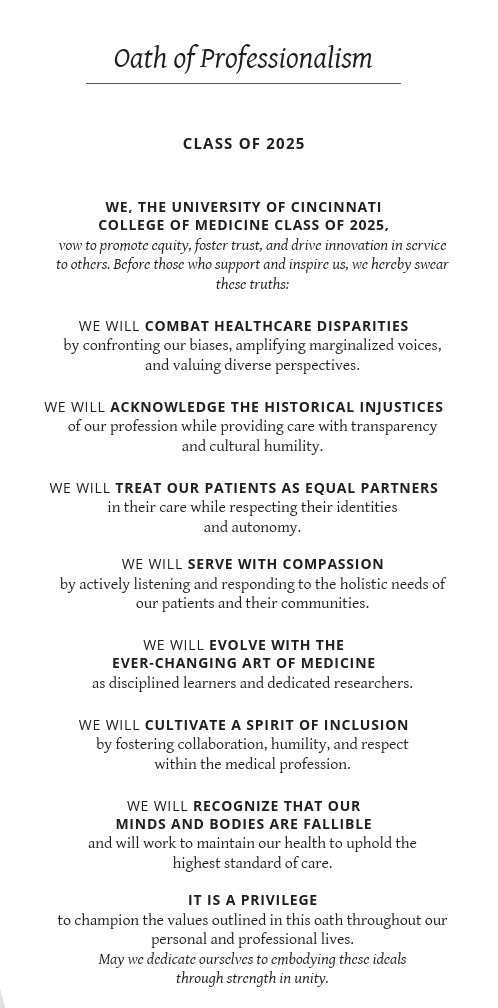
But the University of Cincinnati (UC) College of Medicine would also like its aspiring medical professionals to take a new oath: one that requires students to commit to combating “disparities,” acknowledging “historical injustices,” and cultivating “inclusion.”
According to the medical school’s website, students recited this oath, the “Oath of Professionalism” for the graduating Class of 2025, at the school’s Honor’s Day ceremony in May – alongside a variation of the Hippocratic Oath.
The very first line of the Oath of Professionalism affirms the students’ vow to “promote equity, foster trust, and drive innovation in service to others.”
Next, the oath contains a vow to “combat healthcare disparities by confronting our biases, amplifying marginalized voices, and valuing diverse perspectives.”
The oath goes on to ask students to “acknowledge the historical injustices of [the medical] profession while providing care with transparency and cultural humility.”
Figure 1. A screenshot of the Oath of Professionalism.
Taken together, these commitments subordinate the practice of medicine to the pursuit of, and the adherence to, social justice ideology.
However, the fact that the University of Cincinnati College of Medicine seems to view the profession of medicine as instrumental to achieving DEI goals is not surprising.
In June 2022, Do No Harm filed a complaintwith the U.S. Department of Education’s Office for Civil Rights regarding the University of Cincinnati College of Medicine’s “Underrepresented in Medicine Visiting Clerkship Program,” which conditioned awardson applicants’ racial and ethnic background.
Moreover, the university’s president Neville Pinto expressed subtle dismay at President Trump’s attempts to crack down on DEI in higher education earlier this year.
The University of Cincinnati College of Medicine should dispense with oaths to DEI and instead commit wholeheartedly to the ethical practice of medicine.
https://donoharmmedicine.org/wp-content/uploads/shutterstock_1701937552-3-scaled.jpg17072560Ailan Evanshttps://donoharmmedicine.org/wp-content/uploads/DNH_Logo_Stethescope-1.pngAilan Evans2025-08-12 15:32:362026-05-14 13:36:11University of Cincinnati Med School Asks Students to Swear an Oath to DEI
It might seem obvious that a medical school should teach students pertinent medical information, not promote ideological programming that downplays genuine health concerns.
The Lewis Katz School of Medicine at Temple University, however, appears to disagree.
This February, the school hosted a presentation that encourages acceptance of obesity and seems to dismiss the serious health risks associated with excess weight.
The presentation, which was offeredduring the school’s “Doctoring 1” class for first-year medical students, downplays the health risks of obesity and instead paints the focus on such risks as evidence of stigma, bias, and even racism.
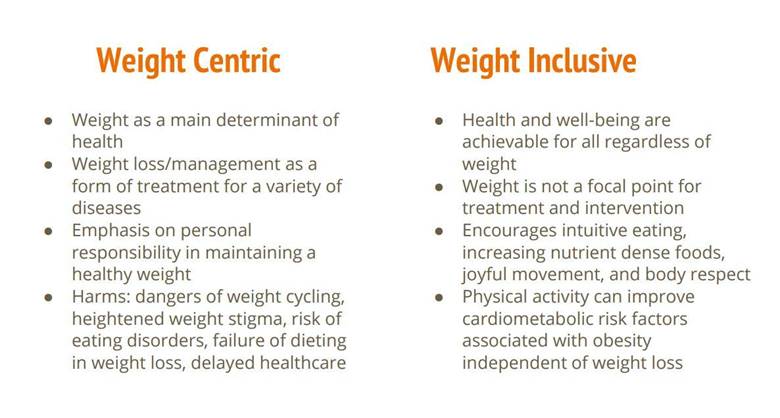
First, the presentation appears to endorse the “Weight Inclusive” approach to medical care, including the statement that “Health and well-being are achievable for all regardless of weight.”
It’s hard to believe that this is a genuine claim taught to future physicians at a medical school, but nevertheless it appears in the presentation.
Figure 1. A slide highlighting the “weight inclusive” approach to medical care.
To be clear, excess weight and obesity are strongly correlated with elevated mortality, with severe obesity potentially shortening life expectancy by up to 14 years. In many circumstances, properly selected patients with obesity who lose significant amounts of weight have been shown to live longer, with better quality of life.
In addition to neglecting the wealth of evidenceon the health risks and preventability of obesity, which make it highly irresponsible for a presentation at a medical school, the presentation’s claims are tinged with an ideological flavor.
“This course will make Coca-Cola, Pepsi, and other wealthy corporations very happy. So-called ‘fatphobia’ is ideologically driven science denial, specifically, denial of the adverse population-wide health effects of obesity,” said Kevin Jon Williams, MD, Professor of Cardiovascular Sciences and Professor of Medicine at the Lewis Katz School of Medicine. “We’re not talking about aesthetics, which change from year to year and culture to culture. Obesity makes people sick, shortens lives, and impairs quality of life.”
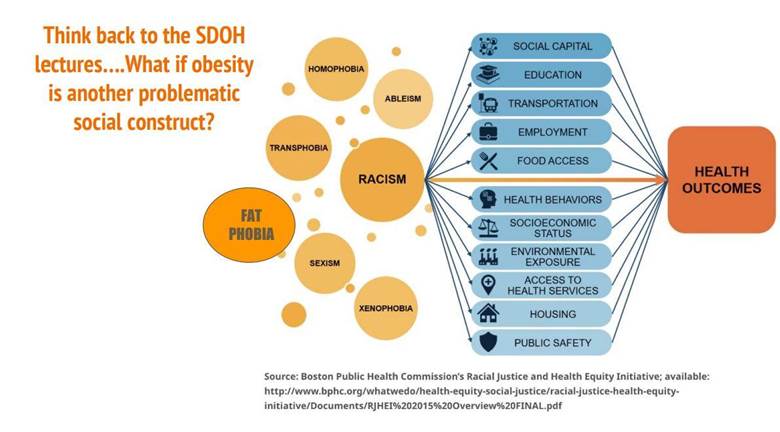
Several slides invoke concepts such as “social determinants of health” or SDOH and “implicit bias.”
For instance, the presentation dares to ask the question: “What if obesity is another problematic social construct?”
This framing obfuscates the empirical, physiological realities that obese people face, such as elevated mortality. Is heart disease a “social construct” as well?
Moreover, the presentation references social determinants of health (SDOH), which are social, economic, and environmental conditions that associate with individuals’ health. But associations do not prove causality.
Figure 2. A slide linking so-called “social determinants of health” to health outcomes.
The role that these so-called “determinants” actually play in determining health outcomes is not well supported.
Although SDOH may be correlated with disparities in health outcomes, the evidence that SDOH actually cause poor health outcomes is shoddy and weak, at best.
Much of the scholarship on the topic confuses social and economic conditions that correlate with poor health outcomes with the actual causes of those outcomes, ignoring other factors such as individual agency and health decisions that contribute to health outcomes. For example, despite its financial cost, smoking is more common among poor people and explains“much of the disparity in health outcomes.”
Unlike targeted interventions to improve obesity, high cholesterol, or high blood pressure, targeted interventions to improve SDOH have a poor record. To date, no study has been able to show that the introduction of a full-service supermarket in a so-called “food desert” lowers the body mass index (BMI) of nearby residents. Programs in 19 counties in Texas and Illinois addressed income disparities by establishing a Universal Basic Income (UBI). But recipients of UBI “reported no increase in access to or utilization of health care.” UBI did not lead to lasting “physical or mental health improvements,” and “recipients were four percentage points more likely to report a disability or health problem that limits the work they can do.”
In other words, SDOH have not been shown to “determine” outcomes, as the name implies; the more apt and accurate description would be “Social Associations of Health (SAOH).”
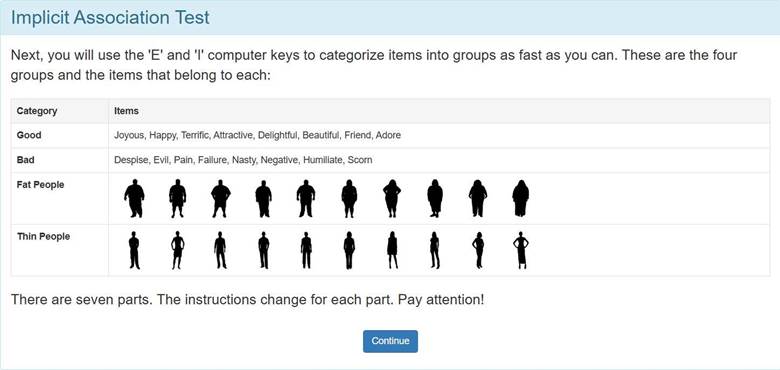
As another example of ideology over science, the presentation on obesity urged medical students in the audience to take an “Implicit Association Test” to evaluate their own biases toward overweight people.
Yet the notion that Implicit Association Tests predict real-world behavior is dubious: these testsfail to meet widely-accepted standards of reliability and validity. A lay summary of the problems with Implicit Association Tests can be found here.
Moreover, a 2013 meta-analysispublished in the Journal of Personality and Social Psychology found that Implicit Association Tests were “poor predictors” of real-world bias and discrimination.
Figures 3. A screenshot of the commonly-used Implicit Association Test.
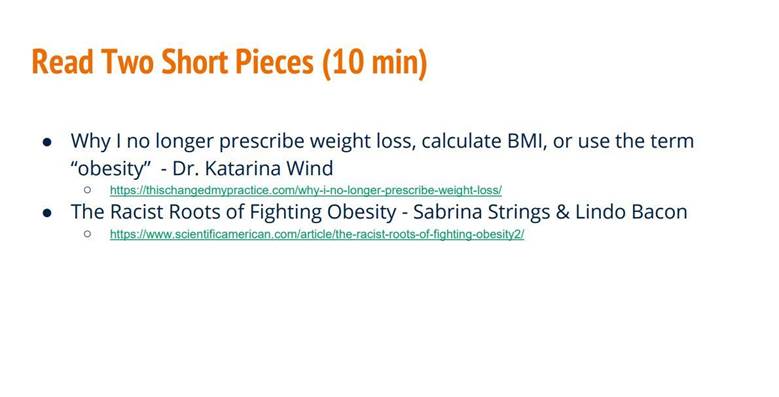
In another slide, the presentation on obesity recommends that the future physicians read two articles, including one titled “The Racist Roots of Fighting Obesity.”
Figure 4. A slide featuring links to two articles arguing that racism and fatphobia are connected.
That latter article argues, among other things, that many health concerns typically associated with obesity are in fact attributable to weight stigma – which, in the case of black women, is racially charged.
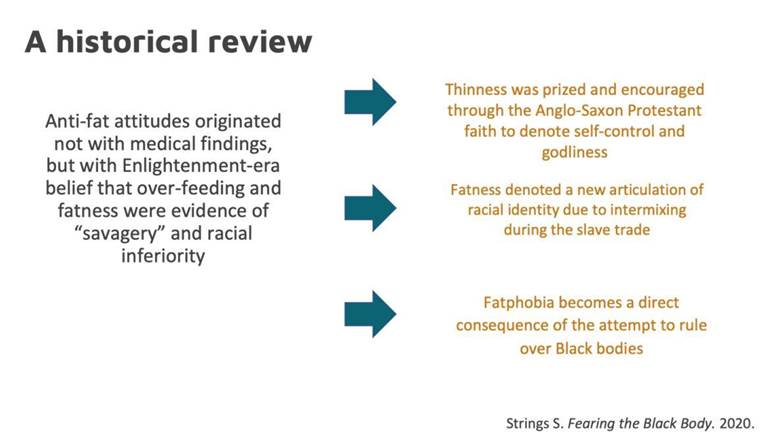
The presentation links “anti-fat attitudes” to racism, slavery, and the “Anglo-Saxon Protestant faith,” arguing that “fatphobia” is a “direct consequence of the attempt to rule over Black bodies.” The notion that “fatphobia” is a consequence of the slave trade, while slavery itself is a practice that has occurred across various ethnic groups and nations since the dawn of humanity, is dubious to say the least. Moreover, singling out an ethnicity and a branch of Christianity for this harsh criticism is historically inaccurate, possibly biased, and may engender ethnic and religious biases in these students.
Figure 5. A slide arguing that “anti-fat attitudes” are linked to racism and slavery.
Of course, it’s unclear how, exactly, these claims alter the reality that obesity poses health risks. And it’s exactly this reality that needs to be taught to medical students so that they can better care for their patients.
The presentation concludes with slides urging students to adopt weight-inclusive practices going forward, including a suggestion that they do not “blame” patients for their weight-related condition.
While physicians should not be cruel to their patients or belittle them, they likewise should not rob patients of their agency or their ability to change their health outcomes through personal choice. Avoiding highly-processed foods, for instance, is just one example. Yet the slides encourage “Increasing nutrient dense foods”.
Simply put, this presentation is full of claims that are politically charged and irrelevant to the practice of medicine at best, and inaccurate and dangerous at worst. It also plays into the hands of wealthy junk food, beverage, and agricultural interests that push harmful highly processed energy-dense foods and drink.
“The anti-science ideology of ‘fatphobia’ seeks to deny our patients the benefits of lifestyle improvements, medicines, and surgery to improve their lives and quality of life,” said Dr. Williams. “It is damaging and wrong.”
The Lewis Katz School of Medicine should not seek to inculcate its students in ideologies that promote harmful, misleading claims.
https://donoharmmedicine.org/wp-content/uploads/2025/08/image-2.jpeg432780Ailan Evanshttps://donoharmmedicine.org/wp-content/uploads/DNH_Logo_Stethescope-1.pngAilan Evans2025-08-11 18:54:022026-02-11 15:34:10Medical School Hosts Presentation Dismissing Adverse Health Consequences of Obesity
It’s been two years since the Supreme Court banned racial discrimination in college admissions. Nonetheless, at medical schools, evidence suggests that the discrimination continues.
That’s my conclusion after submitting Freedom of Information Act requests to all 93 public medical schools. I asked for several years of admissions data, including on students who matriculated in 2024, following the Supreme Court’s ruling against affirmative action in Students for Fair Admission v. Harvard. I sought data on race, undergraduate grades, MCAT scores, and admission status, in order to assess whether racial disparities in admission standards persisted after the decision.
Twenty-three medical schools have answered my request, including flagship institutions in states like Tennessee, Wisconsin, Missouri, New Mexico, and Colorado. The data they provided make it clear that schools are at least skirting the Supreme Court’s decision, if not violating it outright.
https://donoharmmedicine.org/wp-content/uploads/Op-EdA.png8441500Ailan Evanshttps://donoharmmedicine.org/wp-content/uploads/DNH_Logo_Stethescope-1.pngAilan Evans2025-08-07 20:12:532026-05-14 13:35:32Medical Schools Still Discriminate Based on Race, Records Show
The Trump administration is taking an enormous step toward ending child sex change interventions.
The Centers for Medicare and Medicaid Services is unveiling a proposed rule that would cut off Medicare and Medicaid funding to hospitals that perform child sex changes, according to reporting from National Review.
If finalized, the rule would make it so “hospitals cannot participate in Medicare or Medicaid if they provide sex trait modification services to minors,” National Review reported.
An administration official told the outlet that the rule would “effectively end sex-trait modifications for minors nationally.”
“Thanks to the leadership of the Trump administration, children will be safer from radical transgender ideology and the sex changes that threaten their bodies, minds, and futures,” said Do No Harm Medical Director Kurt Miceli, MD. “Taxpayer money has no place going towards hospitals and institutions that perform these experimental procedures on minors, and this new rule will help accelerate the closure of so-called pediatric gender clinics across the country. Congress should follow up on this strong action and further ensure taxpayer dollars don’t fund pediatric medical transition in the next reconciliation bill.”
This is just the start of the rulemaking process, but the proposed rule is an absolutely massive step toward dealing a crippling blow to the child transgender industry.
Almost every hospital depends on Medicare and Medicaid funding, and losing this funding would pose an existential threat to these hospitals’ operations.
This will thus strongly incentivize hospitals to no longer provide child sex change interventions.
Since Trump took office, and following an executive order targeting taxpayer funding of child sex change interventions, hospitals across the countryhave shuttered their child gender programs.
These include some of the most notorious and prolific providers of these procedures, such as Children’s Hospital Los Angeles and Seattle Children’s, who each made Do No Harm’s “Dirty Dozen” list of the worst offenders in the child transgender industry.
Additionally, the Department of Justice has subpoenaed numerous providers of child sex changes for information on their practices, while the Federal Trade Commission hosted a workshop – at which several Do No Harm fellows provided their expertise – on the child transgender industry’s deceptive practices.
Do No Harm welcomes this action from the Trump administration, and will continue our work protecting children from the harms of gender ideology.
https://donoharmmedicine.org/wp-content/uploads/shutterstock_165320348-scaled.jpg16962560Ailan Evanshttps://donoharmmedicine.org/wp-content/uploads/DNH_Logo_Stethescope-1.pngAilan Evans2025-08-07 19:53:392026-05-14 13:35:53Trump Admin to Block Medicare and Medicaid Funding to Hospitals Performing Child Sex Changes
To ensure institutions of higher education are not racially discriminating in the admissions process, President Trump is set to order them to hand over their admissions data, according to a recent report from The Daily Caller.
This is much-needed oversight and an important step toward ensuring that institutions of higher education are complying with federal law.
As revealed in the latest installmentin Do No Harm’s “Skirting SCOTUS” series, there is substantial evidence that medical schools are discriminating on the basis of race in the admissions process. This behavior has gone on despite the Supreme Court’s decision in Students for Fair Admissions v. Harvard, which ruled that race-conscious admissions violate the constitution.
However, Skirting SCOTUS Part III used public records requests to obtain admissions data that showed startling racial disparities between the test scores and GPAs of Asian and white applicants compared to black applicants.
Do No Harm submitted public records requests to 93 public medical schools for their 2024 admissions data; however, only 23 provided the requested data.
Those schools’ admissions data showed that accepted Asian and white applicants had higher MCAT scores than accepted black applicants at all but one school, while at 13 schools, the average MCAT score of rejected Asian or white applicants was higher than that of accepted black applicants.
Two schools had particularly egregious disparities: At the University of Wisconsin School of Medicine and Public Health, a black applicant had nearly 10 times the odds of admission compared to an Asian or white applicant with the same MCAT score and GPA.
And at Eastern Virginia Medical School, there was an eleven-fold increase in odds of acceptance for black applicants compared to GPA- and MCAT-equivalent Asian or white applicants.
This order will shine a light on medical schools’ admissions practices and potentially reveal any evidence of unlawful behavior.
https://donoharmmedicine.org/wp-content/uploads/2023/01/shutterstock_1204078630-scaled.jpg17082560Ailan Evanshttps://donoharmmedicine.org/wp-content/uploads/DNH_Logo_Stethescope-1.pngAilan Evans2025-08-07 17:34:292026-02-11 15:34:09Trump Puts University Admissions Data Under the Microscope
Common sense would dictate that healthcare education programs should seek the most qualified administrators and faculty, so as to produce the best possible education for future healthcare professionals.
But, at the University of New Mexico (UNM) Health Sciences Center, ideology and diversity are central considerations.
To direct the school’s Accelerated Bachelor of Science in Nursing (ABSN) program, UNM is searching forcandidates with qualifications including “[a] demonstrated commitment to diversity, equity, inclusion, and student success, as well as working with broadly diverse communities,” according to a job listing posted on UNM’s website.
Another position listing, for the New Mexico Nursing Education Consortium Partner Schools Director position, likewise states that applicants should have a “demonstrated commitment to diversity, equity, inclusion.”
This institutional posture extends to scholarships and clerkship programs for students as well.
The URiM for Visiting Studentsprogram at the UNM medical school’s OB/GYN department, for instance, is “designed to expose Underrepresented in Medicine (URiM) and non-traditional students from across the country to our outstanding residency training programs.”
The eligibility criteria links to the now-defunct definition of “underrepresented” promulgated by the Association of American Medical Colleges (AAMC), which defined underrepresented populations as “those racial and ethnic populations that are underrepresented in the medical profession relative to their numbers in the general population.”
As another example, the Department of Emergency Medicine offers a clerkship – which happens to come with a $2,000 stipend – to medical students, giving special preference to applicants who are “socioeconomically disadvantaged, first-generation medical students and/or who identify as part of a group underrepresented in medicine, or have themselves demonstrated support and advocacy for underrepresented groups in medicine.”
The clerkship description then cites the AAMC’s definition of “underrepresented” while adding the following caveats:
“Characteristics in addition to race and ethnicity are additionally considered. In New Mexico, for example, students of the following backgrounds could identify as underrepresented: African American and/or Black, Hispanic/Latino, Native American (American Indians, Alaska Natives, and Native Hawaiians), Pacific Islander, Vietnamese, mainland Puerto Rican, first general college student, socioeconomically disadvantaged, or part of a minority group related to gender or sexual orientation (LGBTQIA+).”
These preferences reflect UNM’s core institutional values, as UNM admits in a value statement on UNM’s DEI webpage.
“We are committed to addressing issues of under-representation in medicine and biomedical research,” the statement reads. “Under-representation most commonly refers to racial/ethnic populations that are under-represented in the medical and scientific research workforce relative to their numbers in the general population.”
“The Association of American Medical Colleges (AAMC) and the National Institutes of Health (NIH) have traditionally defined these groups as: Blacks/African Americans, Hispanics/Latinos, Alaska Natives/American Indians, Native Hawaiians, and Pacific Islanders,” the statement continues.
It’s clear from these programs and job descriptions that UNM not only seeks to use racial preferences when distributing opportunities to students, but wants to hire personnel on board with that agenda.
When opportunities are conditioned on an applicant’s “underrepresented” status or their commitment to diversity, future medical professionals suffer on the basis of their immutable characteristics.
Editor’s Note: Following the publication of this article, UNM removed its diversity webpage. The archived link can be found here.
https://donoharmmedicine.org/wp-content/uploads/shutterstock_1434131525-scaled.jpg17052560Ailan Evanshttps://donoharmmedicine.org/wp-content/uploads/DNH_Logo_Stethescope-1.pngAilan Evans2025-08-06 20:21:452026-05-14 13:34:02UNM Wants Administrators – and Students – to Be All-In on DEI
In Oregon, Medicaid no longer covers high-risk surgery to remove excess skin from the lower abdomen unless it’s part of “gender-affirming care,” raising questions about whether gender ideology is actually harming those it purports to help.
The Oregon Health Evidence Review Commission agreed June 12 to exclude panniculectomy surgery from its list of covered medical expenditures, citing concerns about the high rate of complications, except when performed as part of “gender-affirmation surgery.”
“Panniculectomy Surgery to remove extra skin after significant weight loss (panniculectomy) comes with high risks, including serious problems and even death,” the commission’s Value Based Subcommittee said in its meeting materials. “Staff recommend adding the codes for this treatment to the gender affirmation surgery line only. In other cases, these surgeries should not be covered because the risks are so serious.”
https://donoharmmedicine.org/wp-content/uploads/2025/01/Media_Mention_.jpg7961550Ailan Evanshttps://donoharmmedicine.org/wp-content/uploads/DNH_Logo_Stethescope-1.pngAilan Evans2025-08-05 20:08:312026-04-11 07:16:46Oregon drops Medicaid coverage for risky surgery except in cases of ‘gender affirmation’
President Donald Trump declared war on gender ideology and the corresponding child sex-change regime upon retaking office. Despite the efforts of non-straight activists and overreachingfederal judges, the campaign is off to a great start.
Pursuant to the president’s Jan. 28 executive order titled “Protecting Children From Chemical and Surgical Mutilation,” the Department of Justice has launched criminal investigations into several hospitals that have provided children with destructive sex-change procedures, and the administration has threatened offending medical institutions’ federal funding.
In the face of this crackdown, some of the worst institutional offenders listed in the medical advocacy group Do No Harm’s Stop the Harm Database have closed shop.
The Columbia University Vagelos College of Physicians and Surgeons (VP&S) is instructing faculty to adhere to curriculum guidelines that inject ideology into medical education, all in the name of “anti-bias” and inclusivity.
The guidelines, advertised on the VP&S website, are described by the school as a means to “combat systemic racism and bias which decrease our ability to provide equitable medical care, and to increase inclusion within our medical school.”
It’s not clear, exactly, how focusing on combatting “systemic racism” rather than on providing the best possible medical education improves one’s ability to provide medical care.
Regardless, the guidelines, justified on the basis of that premise, feature several principles that appear more concerned with promoting radical ideology than ensuring quality medical education.
These include a conception of gender as distinct from sex, with the statement that an individual identifying as a woman may have a penis.
Gender is rooted in socially constructed roles, behaviors, expressions, and identities of girls, women, boys, men, and gender non-binary people. In fact, the relationship between gender and an individual’s genetic makeup may be overdetermined.
For example, of two people who identify as women, one may carry a Y chromosome while the other does not; one may have a uterus or ovaries or breasts or a penis while the other does not.
Reinforcing this point, VP&S asks its faculty to refrain from using the term “women” in certain situations.
Us[e] precise gender-related language, e.g., “people with uteruses” instead of “women” if the relevant point is about the presence of a uterus rather than the person’s expressed gender identity.
Moreover, the guidelines instruct faculty to attribute differences in health outcomes between racial groups to factors such as “structural racism.”
Conversations that focus on the structural reasons for health outcomes (e.g. racism, education, housing, immigration status) may help students move from the misguided notion that genetic/biological differences between “races” drive such health disparities to developing a more nuanced understanding of how structural racism, socioeconomic status, unconscious bias, and other factors impact health care.
Dismissing wholesale the role of biological differences in health outcomes is misleading and harmful.
For instance, as Do No Harm’s Director of Research Ian Kingsbury notesusing the example of preeclampsia, in which about 55 percent of risk is estimated to be genetic, “West African ancestry is linked to risk variants in a gene called alipoprotein L1 (APOL1) that dramatically increase the likelihood of developing preeclampsia or kidney disease.”
Unfortunately, the VP&S guidelines appear to simply be one of the more visible manifestations of the school’s commitment to woke ideology.
According to a documenthosted on the VP&S website dated from October 2024, the medical school is advertising a number of student research opportunities – many of which include substantial funding – that are targeted at “underrepresented” students.
The vast majority of these programs are offered externally, and VP&S appears to be promoting them rather than administering them.
These include the since-rebrandedAmerican Society of Hematology (ASH) Minority Medical Student Award Program, which was the subject of a Do No Harm civil rights complaint. The program, which was part of ASH’s Minority Recruitment Initiative, was restricted to “Indigenous American Indians or Alaska Natives, Blacks or African Americans, Hispanics or Latinos, Native Hawaiians or other Pacific Islanders, African Canadians, Inuit, and First Nation Peoples.”
Now, however, the program has become part of ASH’s Hematology Inclusion Pathway (HIP) Initiative, which still aims to advance DEI.
As ASH recently described it, “t]he new HIP Initiative better aligns with ASH’s commitment to diversity, equity, and inclusion and reflects an evolving understanding of the communities that are underrepresented in hematology.” That language has since been removed from the HIP website.
Other programs are less explicit, but nonetheless invoke language commonly used to refer to programs targeted toward racial minorities.
For instance, per the description of the Medical Student Summer Research Fellowship in Psychiatry at Columbia University, the fellowship “aims to expose students who belong to historically underrepresented groups to the breadth of career opportunities in psychiatry.”
The program’s eligibility criteria note that individuals will receive special consideration if they have, “either as a result of their socio-economic background, their status as a member of an historically underrepresented group in medical school, their disability status, their LGBTQ status, or other challenging life experiences, overcome obstacles on their journey to medical school.”
VP&S should focus on providing the medical education necessary to train the next generation of competent physicians – not force radical politics into the school curriculum.
https://donoharmmedicine.org/wp-content/uploads/shutterstock_56365900-scaled.jpg17072560Ailan Evanshttps://donoharmmedicine.org/wp-content/uploads/DNH_Logo_Stethescope-1.pngAilan Evans2025-08-05 19:40:162026-05-14 13:33:00Columbia Med School’s Ideological ‘Anti-Bias’ Guidelines
Here’s some good news you may not have heard. From coast to coast, child gender clinics are shutting down, thanks to the leadership of the Trump administration. Children are safer because of these closures – protected from radical transgender ideology and the sex changes that threaten their bodies, minds, and futures.
The latest gender clinic to announce its closure is at Connecticut Children’s Medical Center, which confirmed this news on July 23. Justone day earlier, the gender clinic at the Children’s Hospital in Los Angeles closed. The L.A. clinic was one of the first and largest in the country, subjecting hundreds of children to invasive and irreversible transgender treatments, including hormones and surgeries. Do No Harm, where I work, has documented nearly 20 gender clinics and programs either pausing child sex changes or shutting down since the start of the year.