Rates of slavery in a Southern county in 1860 are the root cause of modern health disparities, claims a new study published in the Proceedings of the National Academy of Sciences. According to the article, “Our model estimates ~22 additional deaths per 100,000 among Black Americans relative to White Americans for every 10% increase in the 1860 enslaved population. […] Our analyses held even after controlling for a comprehensive suite of historical and contemporary covariates. These findings are consistent with a model wherein slavery’s legacy continues to shape present-day Black–White racial health disparities via enduring structural inequities.”
If it seems hard to believe that slavery in 1860 is killing black people today, that’s because these findings are simply not credible. A careful examination of the authors’ own results reveals that variation in modern health outcomes is caused by current health practices and behaviors and not by the enduring legacy of slavery.
The authors are aware that “counties with more slavery in 1860 may differ in other ways that shape health today, so an association between slavery and mortality need not be causal.” To overcome this concern and convince the reader that historic slavery is the actual cause of recent health disparities, they conduct an instrumental variable (IV) analysis in which cotton suitability of the land predicts the rate of enslaved people in a county in 1860. They then use the predicted rate of slaveholding to account for disparities in all-cause mortality rates during 2010–2020, controlling for other observed factors.
The key to this type of analysis is that the instrument, in this case cotton suitability, should be predictive of the independent variable of interest (rates of slavery) but not empirically or theoretically associated with the dependent variable (disparities in mortality rates). The authors attempt to justify their use of cotton suitability as an instrument to isolate the causal effects of slavery on modern health disparities by arguing that “there is no obvious reason why soil properties that favor cotton cultivation should be associated with mortality disparities if not through slavery. However, this exclusion restriction assumption cannot be directly tested and may only be inferred through failed attempts to falsify it.”
The authors, and apparently the reviewers and editors at PNAS, must have been so attracted to the conclusion of this study that they failed to devote any time to considering why it is not “obvious” that soil properties couldn’t influence modern health other than through the effects of slavery. In fact, it should be fairly obvious that the favorable soil conditions for the production of cotton would continue to shape economic arrangements and migration patterns in these areas for many years, with direct implications for health disparities.
Because the land was suitable for cotton, and because a railroad infrastructure had been built for bringing the crop to ports, there were reasons to continue growing and exporting it after slavery ended. Without enslaved labor to grow the cotton, cotton production turned to sharecropping. About two-thirds of sharecroppers were white, and about one-third were black, but all were very poor and, relatedly, had weak health outcomes. In more recent decades, however, factories began to locate in these areas to take advantage of the low cost of land, the absence of organized labor, and railroad access to ports. That brought into these areas higher-skilled, predominantly white and Hispanic workers, who tended to have better health outcomes than the “native” sharecroppers. In other words, the suitability of the land for cotton led to the construction of railroads, which attracted factories and exacerbated health disparities in a previously low-income and predominantly agricultural area. In this scenario, the railroad, not slavery, was the mechanism by which cotton suitability caused health disparities.
In addition to the differential effects of cotton suitability on attracting healthier white workers in recent years, areas that were good for growing cotton had differential effects on black migration. Critically, the decision whether to stay or pursue economic opportunities elsewhere was not random. Rather, it was informed in part by the reality that high-quality cotton soils produced stronger economic incentives for both landowners and laborers to establish an arrangement that kept former slaves on the plantation. The result is that those who were enslaved in regions with better soil would have been less likely or slower to migrate out of the rural South. Specifically, according to a 1989 economics study, “Tenants and sharecroppers in the plantation regions of the South tended to move far less frequently than those outside the plantation regions…. Southern tenants on plantations had on average been living on their present farm roughly twice as long as tenants not on plantations in the 1930s.”
Postbellum migration patterns and their link to soil quality mean that, on average, those who were enslaved in areas with better soil and their descendants would have been less mobile due to decisions made after emancipation. This means that rural areas that were less suitable for cotton would have lost more of their population to the Great Migration. At the same time, more recent opportunities in Southern cities would have attracted back from the North, as well as from the Caribbean and Africa, wealthier blacks with better health outcomes on average. These migratory patterns, correlated with cotton suitability but not caused by the legacy of slavery, could account for modern health disparities and clearly violate the “exclusion restriction” required for the instrumental variable to render causal estimates.
Additional evidence of the absurdity of this new study is found in “Supplemental Analysis S9,” where the researchers predict the effect of slavery on black–white disparities in mortality in 1968–1978 rather than during the years 2010–2020, as they report in the main text of their study. Oddly, they find that “higher instrumented slavery predicted lower Black-White mortality disparities in 1968–1978 and higher disparities in 2010–2020. This pattern is consistent with the historical record: the civil rights era brought convergence in racial health outcomes in high-slavery counties, while the post-civil-rights period saw a reversal of those gains as structural inequalities reasserted themselves.”
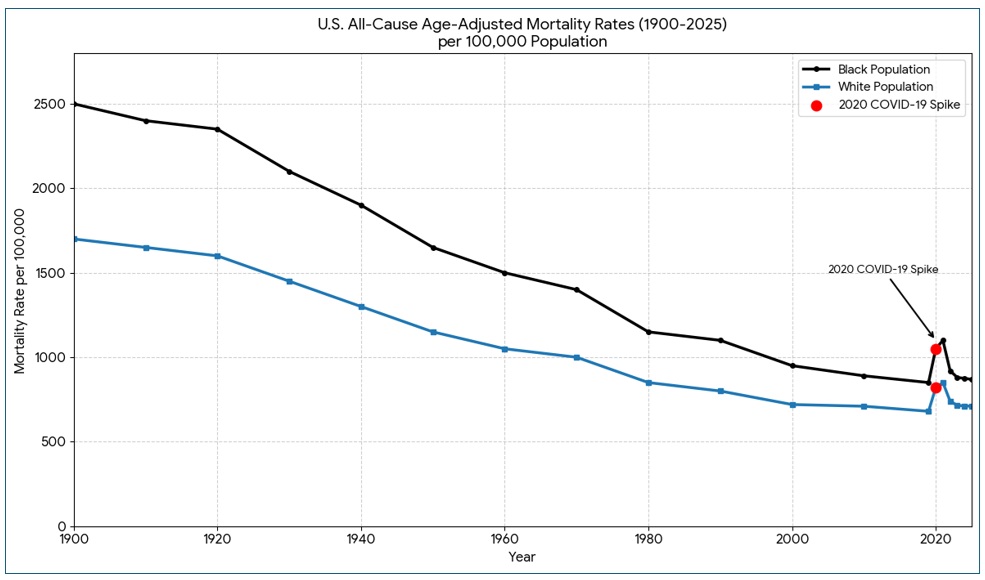
This is both historical and medical nonsense. Mortality rates during the period 1968–1978 would be the cumulative result of health practices and behaviors over several decades. The passage of the Civil Rights Act of 1964 and the Voting Rights Act of 1965 did not cure black Southerners of the health problems they had acquired over time and that might have caused their deaths over the following decade. Nor does the “historical record” show that structural inequalities reasserted themselves to impact mortality outcomes from 2010–2020, resulting in a reversal in mortality rates. In fact, national data on black and white mortality rates clearly show a gradual and persistent closing of that gap over time. (See figure below generated by AI from CDC data.)
In addition, claiming that slavery caused lower mortality disparities between 1968–1978 but also caused higher mortality disparities between 2010–2020 because of a change in the progressivity of the civil-rights environment concedes that gains or reversals in civil rights, not slavery, cause mortality gaps. Slavery couldn’t flip the direction of its causal effect, since it long ago ceased to exist. The authors might try to contend that slavery has an enduring effect, but slavery did not cause progress or reversals in civil rights and therefore cannot be described as the cause by the authors’ own interpretation of their own results.
Of course, our alternative railroad explanation is perfectly consistent with the results they report in “Supplemental Analysis S9.” Areas that were suitable for growing cotton had low disparities in mortality because black and white sharecroppers shared poor outcomes. Those areas historically had slavery, but it was sharecropping that drove low disparities in mortality rates well into the 20th century. By the end of the 20th century, however, the existence of cheap land and railroads attracted factories that also drew higher-skilled white and Hispanic workers who tended to have better health outcomes, exacerbating mortality disparities.
Just because researchers use an instrument variable and declare that they cannot think of another mechanism by which cotton suitability might contribute to health disparities other than through the legacy of slavery, that doesn’t mean that they have demonstrated a causal relationship. A little bit of thought easily yields other paths by which areas suitable for growing cotton might generate economic systems and migration patterns that cause modern health disparities. And finding that slavery actually had a positive effect on disparities in 1968–1978 undermines the authors’ claim that they are observing the enduring legacy of slavery rather than the varying responses to current economic and political conditions.

The American College of Obstetricians & Gynecologists Should Abandon Ideology
COMMENTARY DEI, Gender Ideology Medical association Commentary Do No Harm StaffIf one ever needed proof that medical associations are subject to institutional capture by activists, the American College of Obstetricians & Gynecologists (ACOG) provides it.
Boasting 62,000 members, ACOG is, according to its own materials, “the leading professional membership organization for ob-gyns.”
The association states that it provides “comprehensive, expert-reviewed practice guidelines” to its members and that those practitioners “maintain the highest professional standards and are united in their delivery of exceptional, respectful, science-backed care for patients.”
Yet these encouraging pledges are joined on the same webpage by ACOG’s commitment to “equitable” care, a now-familiar indicator of politicization.
Moreover, the organization’s self-defined mission is to “support our members to improve the lives of all people” — not women — “seeking obstetric and gynecologic care.”
That particular word choice is explained on ACOG’s “Inclusive Language” page, which argues that “[v]aluing, respecting, and affirming an individual’s identity contribute to improved health outcomes.”
Later on the same page, the association declares, “To be inclusive of women and all patients in need of obstetric and gynecologic care, ACOG will move beyond the exclusive use of gendered language and definitions.”
Do No Harm notes with alarm the irreconcilability of the organization’s commitment to “science-backed care” and its assertion that “all people” may benefit from gynecologic medicine. (We concede that gynecologists may occasionally treat biologically male patients for sexually transmitted infections or screen biological men for anal cancer, but that has been the case since well before ACOG’s revision of its mission-statement language. The revision is about transgenderism.)
We note, furthermore, that ACOG’s policies and practices impact not only adult patients but minor children.
Among ACOG’s resources is a committee opinion titled “Health Care for Transgender and Gender Diverse Individuals,” which explicitly concerns both adults and adolescents and which directs site visitors to the radical World Professional Association for Transgender Health (WPATH) “[f]or guidance on the medical and surgical care of transgender adolescents.”
Elsewhere, on its “Adolescent Health” page, ACOG advocates for “privacy and the ability of adolescents to consent to health-care procedures” and argues that “education about … gender … empowers and prepares children, adolescents, and young adults to make educated decisions about their health and their relationships.”
Simply put, the organization’s embrace of transgender ideology is not limited to the “adult” corner of its operations. Minors, too, are necessarily implicated in ACOG’s woke “gender”-related ideas.
On the matter of DEI, the association is little better. As its “Diversity, Equity, and Inclusive Excellence at ACOG” page makes clear, the organization believes it “essential that the culture of our organization, membership, leadership, and fellowship be diverse, equitable, inclusive, and just.”
A “Collective Action Strategy” page condemns the “racial inequities present in our field,” while a statement of policy titled “Racism in Obstetrics and Gynecology” argues that “[r]acism has been and continues to be systemically embedded into our society and the practice of medicine.”
Echoing the totalism to which ideological progressives often fall prey, the second of those pages insists that “[r]acial and ethnic inequities in obstetrics and gynecology cannot be reversed without addressing all aspects of racism and racial bias, including the sociopolitical forces that perpetuate them” (emphasis added).
So much is wrong with these claims that one hardly knows where to begin. Most obviously, they substitute unfalsifiable, quasi-magical forces (“systemic racism”) for matters that physicians are equipped to address (e.g., patient behavior and medical discovery).
They encourage doctors to engage in policy work outside of their realms of expertise, thus lending the authority of medicine to policy prescriptions that may not be reasonable or practical.
Most importantly, they compromise the aforementioned standard of “science-backed care” to which ACOG pledges itself and to which all medical associations should be held.
Happily, the solution to these problems lies in plain sight: ACOG should depoliticize its activities and webpages and return to the irreplaceable business of providing evidence-based obstetric and gynecologic care to women and girls.
Do No Harm joins all who oppose the politicization of medicine in eagerly awaiting such a move.
How Monopolistic Accreditors Enforce Ideology
COMMENTARY DEI American Psychological Association accrediting organization Commentary Stanley Goldfarb, MD[Editor’s note: This piece originally appeared as a letter to the editor in response to “Busting the ABA’s Accreditation Monopoly,” published Aug. 29 in the Wall Street Journal.]
The American Bar Association unfortunately isn’t alone in having an accreditation monopoly (“Busting the ABA’s Accreditation Monopoly,” Review & Outlook, Aug. 29). The same is true for many other organizations, including the American Psychological Association Commission on Accreditation, whose status as an accreditor is now up for renewal. Like the American Bar Association, the American Psychological Association is a professional association with an in-house accreditation arm. And, like the ABA, the APA temporarily suspended its DEI standards in 2025. But suspension isn’t the same as removal, and the Education Department is right to see to it that these standards are eliminated, as has been done by accreditors for schools of medicine, podiatry and optometry.
Read the full piece in the Wall Street Journal.
Do No Harm’s Center for Accountability in Medicine Releases Second Medical School Rankings Based on Excellence and Merit
COMMENTARY DEI Medical School Press Release Do No Harm StaffSALT LAKE CITY, UTAH: September 3, 2026 – Today, Do No Harm’s Center for Accountability in Medicine (CAM) released the second edition of its Medical School Excellence Index.
The Medical School Excellence Index is the only definitive ranking of U.S. medical schools based on their commitment to academic excellence, transparency, and opposition to divisive identity politics. The Index offers prospective medical students, medical schools, residency programs, and other interested parties an alternative to the traditional rankings systems that often favor schools with DEI programs or ignore their detrimental effects.
“We created the Medical School Excellence Index so that patients and aspiring medical school students have clear information about which schools are doing the best job of recruiting and training physicians,” said Ian Kingsbury, PhD, Senior Director of the Center for Accountability in Medicine. “Since launching the Index last year, we’ve seen several schools change their mission statements and applicant essay prompts in ways that eschew DEI-aligned activism. Unfortunately, we’ve also seen some backsliding by schools that infuse DEI into admissions and student grading policies. As we continue to make progress to restore excellence to medical education, this tool will be invaluable to the public and students who want medical schools to focus on training the next generation of highly qualified medical professionals.”
The Medical School Excellence Index was launched last year and is updated annually. It identifies the best and worst medical schools in the country by ranking each institution on three criteria: academic excellence, transparency, and the rejection of DEI.
Top 5 Medical Schools:
Bottom 5 Medical Schools:
The full rankings can be found here.
Do No Harm, established in April 2022, has rapidly gained recognition and made significant strides in its mission to safeguard healthcare from ideological threats. It has over 50,000 members, including doctors, nurses, physicians, and concerned citizens across all 50 states and 26 countries.
A ‘Do-It-Yourself’ Hormone Website May Be Catering to Gender-Dysphoric Children
COMMENTARY Gender Ideology Federal government, Healthcare resource Commentary Executive Do No Harm StaffEarlier this year, Do No Harm released a report demonstrating the ease with which minors may be able to purchase sex-rejecting pharmacological agents on the internet.
While some of the websites we mentioned appear to have since shut down, our more recent trips across the web indicate that gender-dysphoric children can still access inappropriate advice and supplies.
Take, for example, the website diyhrt.wiki. (The acronym stands for “do it yourself hormone-replacement therapy.) Visitors to the site need only click a button attesting “I am 18 or older” to gain access to the main page.
From there, anyone who wishes may view such subpages as “Transmasc Guide,” “Transfem Guide,” and “Injection Supplies.”
Lest anyone be confused, the last of those pages opens with a note: “All the links for injection needles are for 1 inch needles intended for intramuscular injection. Please consider using 0.5 inch needles if you wish to inject subcutaneously.”
And what will the self-professed “adults” in question be putting into their bodies? The homepage makes it clear: “This website intends to teach transgender people how to safely perform DIY Hormone Replacement Therapy.”
Websites of this kind are among those to which we drew attention in our March report, “The Lack of Barriers to Minors Ordering Cross-Sex Hormones Online.”
Included in our findings were a number of resources directing users to online pharmacies, distribution networks for “homebrew” hormones, and guides on self-administering cross-sex hormones once one has secured them.
Diyhrt.wiki is exactly this sort of project. In addition to providing sources for “pharmaceutical grade” hormones, the site links to “Homebrew Sourcing” involving the international shipping of, e.g., estradiol injections and transdermal gels.
(Note: Vanna Pharma appears at least temporarily to have closed. Otokonoko Pharmaceuticals’ URL has changed, but the site is easily searchable and relies on an effortlessly bypassed age-verification self-assessment.)
The site also offers advice (e.g., “Is this illegal?” and “What do I do if my package is seized?”) and tells “transfem” and “transmasc” site visitors what levels of estradiol and testosterone to aim for.
Perhaps most disturbingly, it advises secrecy among its users, some of whom could be underage given the absence of meaningful gatekeeping.
“Share the site with those who need it, but not to transphobes: use common sense!,” the homepage warns.
If your package is seized, “do not tell customs what is inside the package.”
Such winking and nodding appears to be a concession to the fact that Americans of any age shouldn’t be buying prescription drugs online without a valid doctor’s order. (Additionally, more than half of states have enacted laws specifically limiting minors’ access to “gender-affirming care.”) Yet the behavior being promoted is not only legally questionable but dangerous on its face.
Because vendors of “homebrew” hormones exist to allow customers (including minors) to bypass legal restrictions on sex-denying interventions, they necessarily sidestep oversight by the Food and Drug Administration (FDA), thus exposing children to unknown risks.
This is unsafe, offers no benefits, and must be stopped.
The FDA should continue investigating online pharmacies selling unprescribed hormones, including the “homebrew” variety.
Moreover, individual states should investigate and prosecute unlawful online sellers to the extent permitted by law. Indeed, new legislation may be necessary if vendors continue circumventing state restrictions on cross-sex hormones for minors.
Finally, U.S. Customs and Border Protection should exercise its legal authority to inspect inbound international cargo as circumstances warrant. “A trans woman in Brazil” should not be providing American children with “medicine” cooked up on “her” kitchen stove.
What we are calling for is common sense. Children mustn’t have unprescribed access to pharmacological agents, and websites that facilitate that access must be shut down.
That solution may not be politically easy, but we should aim for it nonetheless.
An Activist Physician Is Spreading a Debunked ‘Racism’ Narrative
COMMENTARY Wyoming DEI Medical School Commentary Do No Harm StaffA popular narrative blaming racism for black maternal health disparities has been the subject of debunking efforts for years. Nevertheless, a top advocate of that conspiracy theory remains a celebrated speaker, writer, and continuing medical education (CME) contributor.
Later this week, Joia Crear-Perry, MD, will serve as keynote speaker at the inaugural Wyoming Maternal Health Summit, sponsored by the University of Wyoming College of Health Sciences’ Rural Health Institute.
Crear-Perry’s remarks will contribute to the summit’s theme, “Closing the Distance: Maternal Health Access and Innovation in Wyoming,” and will consider the alleged “challenges Wyoming faces” including “systemic factors driving preventable maternal deaths.”
In one sense, Crear-Perry is an obvious choice for such an event, having founded the National Birth Equity Collaborative (NBEC), a “nationally recognized organization on the front lines of the Black maternal health & infant mortality crises.”
Yet the “highly sought-after trainer & speaker” is, in another sense, a strange and disappointing choice. The theory of systemic racism and black maternal mortality that she advances relies on bad science and a misunderstanding of statistical data.
Do No Harm staffers have done much of the necessary debunking ourselves.
Whereas Crear-Perry argues that “Race Isn’t a Risk Factor in Maternal Health. Racism Is,” we demonstrate that having a doctor of the same race doesn’t improve patients’ healthcare outcomes.
Whereas Crear-Perry’s NBEC states that, “[i]n comparison to other high-income countries, the U.S. has the highest maternal … mortality rates despite the most healthcare spending, & [that] most of these deaths are preventable,” we explain that the U.S. rate may result from a reporting system that overestimates maternal deaths and whose metrics are not fully comparable to those of other developed nations given how deaths are ascertained.
Whereas Crear-Perry blames “exposure to racism” for the alleged fact that “Black women in the United States are the most likely of this country’s women to die from pregnancy-related complications,” we show that such a claim diverts resources from proper channels in an attempt to address “a nonexistent factor in poor health outcomes.”
Moreover, we explain how activists have traditionally misinterpreted the CDC data that undergird the systemic-racism theory of black maternal mortality. To wit,
Given the flaws in her argument, Crear-Perry ought not to be the fêted and “highly sought-after” medical “expert” (read: activist) that contemporary racial anxieties have made her. Alas, her work as a speaker, educator, and medical celebrity is going smashingly.
In addition to her upcoming Wyoming address, Crear-Perry has participated in a CME opportunity offered to physicians by the American Medical Association. In that video session, “Prioritizing Equity: The Root Cause,” Crear-Perry contends that “[r]acism, classism, and gender oppression” are the “root causes” not only of health inequities but of “most all inequities in the United States of America.”
Crear-Perry has been celebrated in a 2021 Lancet article, “Joia Crear-Perry: collaborating for racial and reproductive justice,” which boasts that she “works on ‘reframing the conversation’ about race to develop a ‘shared vocabulary and understanding of why health inequities exist’ because ‘it’s really racism that is causing the harm.’”
We will not argue that there is any insincerity in Crear-Perry’s “racism” theorizing. She very clearly believes what she preaches.
And let’s also be clear: Maternal mortality is a serious matter deserving of thoughtful, evidence-based study. As Do No Harm has previously written, policymakers and the medical community ought to be focusing their efforts on better hospital training programs for responding to complications and greater use of prenatal care, not looking around every corner for alleged physician bias.
Yet it is just as obviously the case that the woke takeover of the medical establishment has made Crear-Perry’s message irresistible, never mind its poor basis in science.
Crear-Perry’s fame, in other words, is a mere symptom. The widespread — indeed, the “systemic” — eagerness to embrace progressive ideological narratives in medicine is the disease.
Children With Gender Dysphoria Deserve Real Treatment
COMMENTARY Gender Ideology Federal government Commentary Executive Kurt Miceli, MD[Editor’s note: This piece originally appeared as a letter to the editor in response to “Medicaid and Transgender Treatments for Kids,” published Aug. 18 in the Wall Street Journal.]
Your editorial “Medicaid and Transgender Treatments for Kids” (Aug. 18) correctly notes that public funding will continue to support the mental-health needs of children with gender dysphoria after the Trump administration’s recent rule change for Medicaid and the Children’s Health Insurance Program. Funds through those programs simply can no longer go to puberty blockers, hormone therapies or gender surgeries for minors. This is good news. Let’s hope that in general mental-health services stop perpetuating the “affirmative” model of care that has already led so many children to use these irreversible, invasive medical practices.
Read the full piece in the Wall Street Journal.
University of Illinois College of Medicine’s DEI Evolution Is Unconvincing
COMMENTARY Illinois DEI Medical School Commentary Do No Harm StaffAnother day, another DEI office name change. Yet this one has been so halfheartedly done that we question the point of the exercise.
Until at least May 24 of this year, the University of Illinois College of Medicine (UI COM) operated a “Diversity, Equity and Inclusion” office dedicated to “foster[ing] a diverse, equitable, and inclusive UI COM-munity.”
In recent months, however, that unit has been renamed the “Advocacy and Engagement” office.
A few things have indeed been altered as a result of the shift. Whereas the DEI office’s homepage previously noted that UI COM meant to “[d]evelop and implement a diversity, equity and inclusion framework that [would] coordinate efforts at the individual, unit, department, campus and college level,” that particular language has now vanished.
So has UI COM’s pledge to “[e]nrich faculty/staff diversity through recruiting by growing the diverse candidate pool and improving the conversion rate (i.e., hires) of candidates.”
A third commitment has been reworded. Previously, UI COM promised to “[r]ecruit, matriculate, support and graduate a diverse body of students and trainees who embrace UI COM’s vision and values.”
Now, however, the institution will recruit “students and trainees from economically and educationally disadvantaged communities who reflect the communities we serve and uphold UI COM’s vision and values.”
We concede that these revisions modestly soften the institution’s DEI-related language. A tour of the renamed office’s website, however, gives us reason to wonder if cosmetic edits have been the extent of the change.
For instance, the office continues to be run by Gloria Elam, previously associate dean of diversity & inclusion and now associate dean for advocacy and engagement. Dean Elam’s four listed colleagues remain the same, though several of their titles have been altered along similar lines.
Both the old site and the new link to “Strategic Planning” pages that boast of DEI-related accomplishments. In the case of the old, one representative example is “Conducted Implicit Bias Training for UI COM faculty and staff.” The new, meanwhile, lists as a highlight “Developed and Conducted Unconscious Bias Training for UI COM faculty and staff through the BRIDgE Program.”
Though the acronym “DEI” has given way to “AACE,” both the old site and the new link to a “Collaborators” page listing many of the same academic and administrative units. One of these, the Odehmenan Health Equity Center, offers such events as “‘There can never really be justice on stolen land’ – An Indigenous Methodology Approach to Police Violence.”
Finally, both sites include a “Land Acknowledgement” recognizing “the traditional birthright of indigenous peoples who were forcibly removed.” The particular language therein has not changed at all.
Given these similarities in both resources and personnel, we have our suspicions about UI COM’s evolution. Had the institution unwound its public DEI commitments or reassigned (or parted ways with) its DEI staff, we would celebrate the depoliticization of the education it offers.
Because it clearly did neither, we must simply roll our eyes. Call it whatever you like: A DEI office by any name remains an affront to unideological medical education.
Do No Harm Files EEOC Comment on Rescinding Racial-Reporting Requirements
COMMENTARY DEI Federal government Commentary Executive Do No Harm StaffLast week, Do No Harm submitted an official comment in support of a proposed rule from the U.S. Equal Employment Opportunity Commission (EEOC).
The rule in question would rescind certain racial-reporting requirements to which American employers have been held for 60 years. In doing so, it would eliminate a process that exceeds what Title VII of the Civil Rights Acts of 1964 authorizes, that cannot survive strict scrutiny, that costs more than a quarter of a billion dollars a year, and that corrodes the merit principle on which American medicine and American business depends.
We strongly support the new rule rescinding these requirements and urge the EEOC to finalize it.
For six decades, the Commission has warned employers that asking an applicant’s race is evidence of discriminatory intent, while in the same breath requiring employers to record the race of everyone they hire. This tension cannot be resolved and must end.
Please read the full comment here or below.
Continuing Medical Education Shouldn’t Include Activist Rants
COMMENTARY DEI, Gender Ideology American Medical Association Medical association Commentary Do No Harm StaffWhat do you get when political activists shape continuing medical education (CME)? Whatever the answer is, it has very little to do with science.
Take, for example, “When Identity and Genetics Intersect,” a 34-minute podcast and quiz offered by the American Medical Association (AMA) for 0.5 credits of CME.
While the activity’s learning objectives themselves raise our hackles — containing as they do the woke claim that “research in human genetics can cause harm to underrepresented populations” — perusal of the podcast transcript produces much greater alarm.
The troubling comments in question proceed from podcast guest Kellan Baker, at recording time the executive director of the Whitman-Walker Institute (WWI). According to Baker,
These are ideological talking points barely disguised as scientific discourse. Nevertheless, as the following screen capture indicates, the AMA provides not only CME but “[m]edical [k]nowledge” points for physicians enrolled in the American Board of Internal Medicine’s Maintenance of Certification program, to name just one institutional participant.
Perhaps we ought not to be surprised by Baker’s thinly veiled activism. After all, the now-former WWI executive director currently works for the progressive Movement Advancement Project as senior advisor for health policy, helping that organization to “advance equity” by, e.g., releasing a “Talking About Transgender Youth Participation in Sports” educational messaging guide.
The far-left opinion journal Mother Jones recently quoted Baker’s lament that the Department of Health & Human Services’ August report on the financial incentives behind “gender medicine” is “part of a broader pattern from this administration: [u]sing the power of government to attack science and target health care providers instead of helping families get the care they need.”
No, the real surprise lies in the fact that the AMA continues to endorse Baker’s CME even now, despite its obvious politicization and lack of scientific content. That decision should shock anyone who cares about the actual continuing-education needs of physicians and the grounding of medicine in actual facts.
But perhaps we should say we wish we were surprised. Given the now-decades-long intrusion of wokeness into the medical establishment, the sad truth is that we’re not.
Debunking Bad Research: Slavery Is Not the Cause of Modern Health Disparities
COMMENTARY DEI Medical Journal Commentary Ian Kingsbury, PhD, Jay Greene, PhDRates of slavery in a Southern county in 1860 are the root cause of modern health disparities, claims a new study published in the Proceedings of the National Academy of Sciences. According to the article, “Our model estimates ~22 additional deaths per 100,000 among Black Americans relative to White Americans for every 10% increase in the 1860 enslaved population. […] Our analyses held even after controlling for a comprehensive suite of historical and contemporary covariates. These findings are consistent with a model wherein slavery’s legacy continues to shape present-day Black–White racial health disparities via enduring structural inequities.”
If it seems hard to believe that slavery in 1860 is killing black people today, that’s because these findings are simply not credible. A careful examination of the authors’ own results reveals that variation in modern health outcomes is caused by current health practices and behaviors and not by the enduring legacy of slavery.
The authors are aware that “counties with more slavery in 1860 may differ in other ways that shape health today, so an association between slavery and mortality need not be causal.” To overcome this concern and convince the reader that historic slavery is the actual cause of recent health disparities, they conduct an instrumental variable (IV) analysis in which cotton suitability of the land predicts the rate of enslaved people in a county in 1860. They then use the predicted rate of slaveholding to account for disparities in all-cause mortality rates during 2010–2020, controlling for other observed factors.
The key to this type of analysis is that the instrument, in this case cotton suitability, should be predictive of the independent variable of interest (rates of slavery) but not empirically or theoretically associated with the dependent variable (disparities in mortality rates). The authors attempt to justify their use of cotton suitability as an instrument to isolate the causal effects of slavery on modern health disparities by arguing that “there is no obvious reason why soil properties that favor cotton cultivation should be associated with mortality disparities if not through slavery. However, this exclusion restriction assumption cannot be directly tested and may only be inferred through failed attempts to falsify it.”
The authors, and apparently the reviewers and editors at PNAS, must have been so attracted to the conclusion of this study that they failed to devote any time to considering why it is not “obvious” that soil properties couldn’t influence modern health other than through the effects of slavery. In fact, it should be fairly obvious that the favorable soil conditions for the production of cotton would continue to shape economic arrangements and migration patterns in these areas for many years, with direct implications for health disparities.
Because the land was suitable for cotton, and because a railroad infrastructure had been built for bringing the crop to ports, there were reasons to continue growing and exporting it after slavery ended. Without enslaved labor to grow the cotton, cotton production turned to sharecropping. About two-thirds of sharecroppers were white, and about one-third were black, but all were very poor and, relatedly, had weak health outcomes. In more recent decades, however, factories began to locate in these areas to take advantage of the low cost of land, the absence of organized labor, and railroad access to ports. That brought into these areas higher-skilled, predominantly white and Hispanic workers, who tended to have better health outcomes than the “native” sharecroppers. In other words, the suitability of the land for cotton led to the construction of railroads, which attracted factories and exacerbated health disparities in a previously low-income and predominantly agricultural area. In this scenario, the railroad, not slavery, was the mechanism by which cotton suitability caused health disparities.
In addition to the differential effects of cotton suitability on attracting healthier white workers in recent years, areas that were good for growing cotton had differential effects on black migration. Critically, the decision whether to stay or pursue economic opportunities elsewhere was not random. Rather, it was informed in part by the reality that high-quality cotton soils produced stronger economic incentives for both landowners and laborers to establish an arrangement that kept former slaves on the plantation. The result is that those who were enslaved in regions with better soil would have been less likely or slower to migrate out of the rural South. Specifically, according to a 1989 economics study, “Tenants and sharecroppers in the plantation regions of the South tended to move far less frequently than those outside the plantation regions…. Southern tenants on plantations had on average been living on their present farm roughly twice as long as tenants not on plantations in the 1930s.”
Postbellum migration patterns and their link to soil quality mean that, on average, those who were enslaved in areas with better soil and their descendants would have been less mobile due to decisions made after emancipation. This means that rural areas that were less suitable for cotton would have lost more of their population to the Great Migration. At the same time, more recent opportunities in Southern cities would have attracted back from the North, as well as from the Caribbean and Africa, wealthier blacks with better health outcomes on average. These migratory patterns, correlated with cotton suitability but not caused by the legacy of slavery, could account for modern health disparities and clearly violate the “exclusion restriction” required for the instrumental variable to render causal estimates.
Additional evidence of the absurdity of this new study is found in “Supplemental Analysis S9,” where the researchers predict the effect of slavery on black–white disparities in mortality in 1968–1978 rather than during the years 2010–2020, as they report in the main text of their study. Oddly, they find that “higher instrumented slavery predicted lower Black-White mortality disparities in 1968–1978 and higher disparities in 2010–2020. This pattern is consistent with the historical record: the civil rights era brought convergence in racial health outcomes in high-slavery counties, while the post-civil-rights period saw a reversal of those gains as structural inequalities reasserted themselves.”
This is both historical and medical nonsense. Mortality rates during the period 1968–1978 would be the cumulative result of health practices and behaviors over several decades. The passage of the Civil Rights Act of 1964 and the Voting Rights Act of 1965 did not cure black Southerners of the health problems they had acquired over time and that might have caused their deaths over the following decade. Nor does the “historical record” show that structural inequalities reasserted themselves to impact mortality outcomes from 2010–2020, resulting in a reversal in mortality rates. In fact, national data on black and white mortality rates clearly show a gradual and persistent closing of that gap over time. (See figure below generated by AI from CDC data.)
In addition, claiming that slavery caused lower mortality disparities between 1968–1978 but also caused higher mortality disparities between 2010–2020 because of a change in the progressivity of the civil-rights environment concedes that gains or reversals in civil rights, not slavery, cause mortality gaps. Slavery couldn’t flip the direction of its causal effect, since it long ago ceased to exist. The authors might try to contend that slavery has an enduring effect, but slavery did not cause progress or reversals in civil rights and therefore cannot be described as the cause by the authors’ own interpretation of their own results.
Of course, our alternative railroad explanation is perfectly consistent with the results they report in “Supplemental Analysis S9.” Areas that were suitable for growing cotton had low disparities in mortality because black and white sharecroppers shared poor outcomes. Those areas historically had slavery, but it was sharecropping that drove low disparities in mortality rates well into the 20th century. By the end of the 20th century, however, the existence of cheap land and railroads attracted factories that also drew higher-skilled white and Hispanic workers who tended to have better health outcomes, exacerbating mortality disparities.
Just because researchers use an instrument variable and declare that they cannot think of another mechanism by which cotton suitability might contribute to health disparities other than through the legacy of slavery, that doesn’t mean that they have demonstrated a causal relationship. A little bit of thought easily yields other paths by which areas suitable for growing cotton might generate economic systems and migration patterns that cause modern health disparities. And finding that slavery actually had a positive effect on disparities in 1968–1978 undermines the authors’ claim that they are observing the enduring legacy of slavery rather than the varying responses to current economic and political conditions.
A Taxpayer Win on Pediatric ‘Gender-Affirming Care’
COMMENTARY Gender Ideology Centers for Medicare and Medicaid Services Federal government Commentary Executive Do No Harm StaffDo No Harm is celebrating. Under a rule finalized last week by the Centers for Medicare and Medicaid Services (CMS), the bill for irreversibly damaging sex-denying interventions for children will no longer fall on federal taxpayers.
We have long called for such a measure. Earlier this year, for example, in response to CMS’s request for comment on the proposed rule, Do No Harm submitted a response arguing that the potential regulation was praiseworthy for two central reasons.
First, because so-called gender-affirming care is a “medical scandal,” the proposed rule was a critical step to protect children, interrupting as it did the funding pipeline by which harmful interventions were frequently performed.
Second, because cracks had already begun to appear — in both the U.S. and Europe — in the alleged transgender consensus, it was inaccurate to say that the medical establishment uniformly supported “gender-affirming care” for minors.
CMS has now accepted this reasoning. As the new rule’s “summary” makes clear, “[s]tate Medicaid plan[s] must provide that the Medicaid agency will not make payment under the plan for sex-rejecting procedures for children under 18.” Moreover, the rule “prohibits the use of Federal Medicaid dollars to fund sex-rejecting procedures for individuals under the age of 18” (emphasis added).
And there’s more. State Children’s Health Insurance Program plans (CHIP) must also henceforth “provide that the CHIP agency will not make payment under the plan for sex-rejecting procedures for children under 19.” Here, too, the prohibition is also federal: The new rule “prohibits the use of Federal CHIP dollars to fund sex-rejecting procedures for individuals under the age of 19.”
Do No Harm lauds CMS and Administrator Mehmet Oz, MD. Yet we also look forward to a future in which sex-rejecting procedures will no longer be performed on minors at all.
Until then, the question of payment is an important one. Taxpayers shouldn’t be made to open their wallets for false and detrimental “care.”
Government Science Websites Shouldn’t Apologize for Scientists
COMMENTARY DEI National Institutes of Health Federal government Commentary Executive Do No Harm StaffThe job of a government science website is to inform the public about what science has discovered, not to pass judgment on historical figures for their alleged failure to live up to contemporary progressive standards of opinion.
Someone should make that distinction clear to the men and women at the National Human Genome Research Institute (NHGRI).
The NHGRI is one of 27 separate centers or institutes comprising the National Institutes of Health (NIH). Its particular role is to “collaborat[e] with the scientific and medical communities to catalyze genomic breakthroughs and suppor[t] the robust study and treatment of specific diseases.”
Nowhere in this self-description do we find an obligation to engage in ideological gatekeeping. Yet the NHGRI’s treatment of James Watson, the institute’s first director and the proposer, with Francis Crick, of the now-famous double-helical model of DNA, suggests that the institute feels exactly that responsibility.
A tour of the NHGRI’s website demonstrates the point. According to the institute’s Deoxyribonucleic Acid (DNA) Fact Sheet page, “[t]he importance of DNA became clear in 1953 thanks to the work of James Watson, Francis Crick, Maurice Wilkins and Rosalind Franklin.” Watson’s name, however, is appended with an asterisk:
This is poor work on the part of the NHGRI and the leaders who oversee it. Never mind that the apology, as written, makes little sense. (It is unlikely that Watson made “erroneous comments about his beliefs,” as we read here.) The very existence of the statement introduces politics into science unnecessarily and suggests that scientific discovery can be respectably made only by men and women who hold, at all times, opinions suitable to a particular, and increasingly radical, political ideology.
That is not true. Moreover, it betrays a fundamental misunderstanding of how science works. Presumably Isaac Newton subscribed to ideals that today’s progressives would find unpleasant. But we don’t need to litigate them every time we talk about gravity.
The Watson disclaimer appears elsewhere on NHGRI’s site, as well. One finds it on the NHGRI History and Timeline of Events page, on a page listing current and former NHGRI directors, on a page “Reflecting On More Than Two Decades Of The Elsi Experiment,” and on the institute’s Human Genome Project Timeline page.
To be clear, Watson did indeed make statements that fall awkwardly on today’s ears. For example, his 2007 remarks on race, made at the age of 79, are particularly difficult to excuse.
Nevertheless, it is not the NHGRI’s business to litigate the social sins of important scientists. Its job, at least on its website, is to present and celebrate science.
Visitors to many of the NHGRI’s pages are greeted with a banner declaring that NIH websites are changing this fall. Good. The Trump administration should ensure that ideological disclaimers don’t make the move.
ThrivingCampus Is Directing Students to Politicized Mental-Health Care
COMMENTARY DEI Healthcare resource Commentary Do No Harm StaffAn online portal connecting college students with mental-health professionals promises access to “over 25,000 licensed and vetted therapists and prescribers.” Sadly, the vetting in question has not resulted in an ideology-free user experience or eliminated woke providers.
According to its webpage, ThrivingCampus.com partners with universities to help students navigate a “daunting” mental-health landscape. As such, the organization “walk[s] [students] through the process” of seeking care, not only explaining “the ins and outs of therapy” but helping clients “choos[e] a provider” in the first place.
Some of these services are useful, especially for those individuals who have never previously sought assistance with their mental health. For example, a ThrivingCampus “Student Guide” explains to potential care-seekers the broad differences between therapists, psychologists, and psychiatrists. It tells students what to expect when they first speak to a clinician and even advises them on how to leave a voicemail for a mental-health professional.
The organization’s problems, however, are evident the moment one glances at its search filters. Students in need of therapy may sort healthcare professionals according to such apolitical criteria as “Setting” (in-person or online), “Specialties” (e.g., anxiety), or “Insurances.” But they may also produce a list based on “Genders,” “Community Expertise,” or “Race & Ethnicity,” options in which progressive ideological assumptions are deeply embedded.
For instance, a drop-down menu under the “Genders” filter produces a whopping 13 choices: not only the often-seen “Transgender” and “Non-binary” but such boutique possibilities as “Femme” and “Masc.”
Using the “Community Expertise” menu, prospective patients may find providers who specialize in treating “Activists,” a category of uncertain clinical validity to say the least.
Most troubling is the “Race & Ethnicity” menu, the existence of which is presumably based on the debunked “racial-concordance” theory — the disproven idea that patients do better when their doctors share their racial or ethnic heritage. Never mind that some therapists on ThrivingCampus list nearly a dozen races in their profile. The point appears to be giving therapy-seekers an opportunity to choose their providers according to the color of their skin.
Perhaps unsurprisingly, an organization with these ideological priors offers plenty of woke healthcare professionals from which to choose. To wit, clicking the aforementioned “Activists” box (for a variety of zip codes) produces the following results:
And we could go on and on.
These self-descriptions are buzzwordy virtue signaling. Indeed, we worry that “activists” seeking mental-health treatment will be so “affirmed” by these and similar providers that few of their problems will be solved.
Yet our graver concern is for the politically naïve college student who stumbles upon ThrivingCampus.com and takes its promise of “vetted” care seriously.
That young person had better tread very carefully.
Why the CDC’s New ICD-10 Codes Matter for Detransitioners
COMMENTARY Gender Ideology Federal government Commentary Executive Do No Harm StaffDetransitioners and their advocates have just received good news from the Centers for Disease Control and Prevention (CDC). Beginning October 1, updates to the diagnosis codes used by physicians, insurance companies, and researchers will help ensure that those who desist from their gender dysphoria are seen and counted.
ICD-10 codes allow doctors to categorize patients’ diagnoses for the purposes of medical recordkeeping, billing, and health data collection. Yet, as Do No Harm senior fellow Aida Cerundolo, MD, wrote for the Hill earlier today, there have been until now “no diagnosis codes for patients who resolve their discomfort with their biological gender” or who “want to reverse an attempted sex change.”
One consequence of this absence has been a lamentable official blindness to the very existence of detransitioners. As Dr. Cerundolo wryly notes, a medical system that has a code for “sucked into jet engine” has no excuse for ignoring the clinical reality of desistance or turning a blind eye to detransitioners.
This oversight will henceforth be corrected. Among the ICD-10-CM code updates is F64.A, “Gender Identity Disorder, in remission,” otherwise termed “Gender dysphoria, in remission (desistance).” This code will be applicable to those patients who no longer meet the diagnostic criteria for gender dysphoria — that is, those for whom a marked incongruence no longer exists between their “experienced/expressed gender” and their “assigned gender.”
Other new codes will do good, as well. The trio “Personal history of social gender transition” (Z87.8901), “Personal history of medical gender transition” (Z87.8902), and “Personal history of surgical gender transition” (Z87.8903) will be added for further specificity under the already existing header “Personal History of Sex Reassignment.” This will allow for more accurate recordkeeping and thus improve real-world data collection on the status of patients’ “gender transitions.” (Within this section, two additional codes will also be available to providers: “Personal history of intersex surgery” (Z87.8904) and “Personal history of unspecified gender transition” (Z87.8909).)
Finally, the new code “Personal history of gender detransition” (Z87.893) will be available to describe those who revert back to living in conformity with their sex after having previously “transitioned.”
These ICD-10-CM updates represent a major win for those who oppose pediatric transgender ideology. But they are a victory, too, for those who merely want to see medicine practiced compassionately and with a basis in science.
Thanks to the new diagnosis codes, physicians will be able to more accurately document an individual’s clinical state to support the appropriate delivery of care. The clinical data they provide will have a similar effect, helping to inform future practice and guidelines.
Public-health officials will benefit, too. The new codes will allow researchers to collect valuable real-world health information that has previously been hidden and understand public-health needs in an evolving (and highly politicized) area of medicine.
Finally, the CDC’s move will give visibility to those facing these clinical conditions. As Dr. Cerundolo notes in her aforementioned article, “Well over 14,000 children have received sex-change treatments in recent years. As they get older, many will realize they have made a mistake and understandably want to go back.”
“[T]hese patients deserve a medical system that recognizes them,” Cerundolo continues, “because recognition is the first step to ensuring they get the right care.”
Exactly so. Do No Harm stands with detransitioners and applauds the CDC for taking this significant step.
Nemours Children’s Health and Atlantic Health System Scrub Offending Webpages
COMMENTARY Health system Commentary Do No Harm StaffScrubbing race-based programs from the web after being called out isn’t quite an admission of guilt, but neither does it look particularly innocent. Someone should tell Nemours Children’s Health and Atlantic Health System that opponents of discrimination in medicine aren’t so easily fooled.
On July 28, 2026, Do No Harm filed a complaint with the U.S. Department of Health and Human Services Office for Civil Rights (HHS-OCR) against Nemours Children’s Health for operating a racially discriminatory pediatric training program for medical students.
The program in question, Nemours’ “Visiting Student Scholar Program,” offers fourth-year medical students clinical and educational opportunities, professional mentorship, and a competitive stipend.
As our complaint charges, the program limits eligibility to medical students who are “underrepresented in medicine,” including certain racial and ethnic groups, in violation of both Title VI of the Civil Rights Act of 1964 and Section 1557 of the Affordable Care Act.
Since our complaint, a webpage dedicated to the Visiting Student Scholar Program has been taken offline. One could be forgiven for seeing in this clean-up job an attempt to dodge responsibility, blunt any potential HHS-OCR investigation, and throw reformers such as Do No Harm off the scent.
Atlantic Health System has gotten into the deletion game, as well. Also on July 28, Do No Harm filed a complaint with HHS-OCR alleging that Atlantic Health System operates a racially discriminatory pediatric training program for medical students.
As detailed in our complaint, that offering, a “Minority Visiting Clerkship Program,” provides training in pediatric medicine and various educational benefits to fourth-year medical students. To prioritize “diversity” and “inclusion,” eligibility is restricted to members of certain racial groups purportedly underrepresented in medicine, another direct violation of both Title VI and Section 1557 of the Affordable Care Act.
Sure enough, Atlantic Health System’s page in question now also omits any mention of the offending program. At least from the Pediatrics page that previously hosted it, the Minority Visiting Clerkship Program has simply vanished.
Interestingly, Atlantic Health System’s program still shows up as a search result on its site, despite the fact that clicking on the link in question produces no mention of it.
These half measures are insufficient and make no guarantee that the discrimination has actually ended or will stay that way. Do No Harm isn’t fooled, and HHS-OCR shouldn’t be, either.
New Do No Harm Report Exposes Colorado’s Sex-Rejecting Medical Pipeline
COMMENTARY Colorado Gender Ideology University of Colorado School of Medicine Public university Press Release Do No Harm StaffSALT LAKE CITY, UTAH: August 10, 2026 — Today, Do No Harm released a new report exposing the wide-ranging scope of Colorado’s institutional support for sex-rejecting procedures for minors, including the use of public funds to market sex-rejecting services and resources to minors.
The report, titled “The Colorado ‘Gender-Affirming’ Pipeline,” exposes how Colorado medical, academic, and advocacy networks have created a pipeline for sex-rejecting interventions for children. The findings are based on a review of several thousand pages obtained by Do No Harm through the Colorado Open Records Act.
“Something unsettling is happening in Colorado,” said Kurt Miceli, MD, chief medical officer at Do No Harm. “A publicly funded network of Colorado organizations is pushing resources that promote youth gender ideology on vulnerable children. Our report is a case study examining how the transgender industrial complex has pushed further and further into the lives of children, reaching even as far as school-based health centers in the state. Do No Harm urges Colorado leaders to prioritize evidence-based medicine and protect minors from a harmful ideology. Patients and families deserve medical care rooted in evidence, not ideology.”
Key Findings
Click here to read the report.
Do No Harm, established in April 2022, has rapidly gained recognition and made significant strides in its mission to safeguard healthcare from ideological threats. It has over 50,000 members, including doctors, nurses, physicians, and concerned citizens across all 50 states and 26 countries.
Another DOJ Win in the Fight Against Pediatric ‘Gender’ Radicalism
COMMENTARY Connecticut Gender Ideology Federal government, Hospital System Commentary Executive Do No Harm StaffThe movement to stop hospitals from performing sex-rejecting procedures on children — and to commit funds for the medical care of detransitioners — has just racked up another win. Following investigation by the U.S. Department of Justice, Connecticut Children’s Medical Center has agreed to both terms.
The Hartford institution had long been one of the nation’s top practitioners of so-called gender-affirming care for minors. As its archived webpages make clear, the hospital’s “Gender Program” provided not only hormone therapy and puberty blockers but “sex-change” surgeries for children under the age of 18.
Moreover, Connecticut Children’s served as an evangelist for pediatric transgender services, creating, for example, a “portal” whereby children from states that banned sex-rejecting procedures for minors could access “gender-affirming” information and “care.”
The institution published a list of reading resources, including explicit material, for children, arguing that “there is no age that’s ‘too young’ to start teaching kids to be allies for gender and pronoun diversity.” The reading recommendations included The Pronoun Book for children ages 0–3, The Bare Naked Book for children ages 3–6, and Sex Is a Funny Word for children ages 8–10, all of which present transgender messaging to minors too young to critique it.
Now, thanks to the DOJ’s efforts, Connecticut Children’s will no longer perform “gender-affirming” procedures or surgeries on minors. Additionally, the institution will pay an undisclosed monetary penalty and will provide $500,000 in medical care for detransitioners — men and women who, as the DOJ’s press release puts it, are “living with the harmful consequences of ‘gender affirming care.’”
This is a victory for the children and adolescents who will not now be subjected to irreversible, life-changing interventions based on a damaging ideology.
It is also a victory for Do No Harm, which operated on the ground in Hartford to put a stop to Connecticut Children’s harmful activities — creating, for example, a robust public-awareness campaign of digital and billboard advertising that exposed Connecticut Children’s outsized role in promoting sex-rejecting procedures across the country.
The win comes on the heels of similar triumphs in Texas and Ohio. In May, Texas Children’s Hospital agreed to fund a “detransition clinic” for men and women who regret the harm done to them by transgender interventions. (That settlement was finalized earlier this week.) In June, the Cleveland Clinic Foundation made a similar move, agreeing to “provide detransition care” to patients.
These are major breakthroughs in the fight against pediatric transgender ideology, a phenomenon based not in science but in politics. If hospitals and “gender clinics” can be made to understand that a bill may eventually come due, they will be less likely to prescribe life-altering hormones to children or remove the healthy body parts of adolescents.
Do No Harm awaits the day when such interventions on minors will once again be what they were for most of human history: unthinkable.
Play DEI Games, Win DEI Prizes
COMMENTARY Florida, Kentucky, New Mexico DEI Florida Atlantic University Schmidt College of Medicine, University of Kentucky College of Medicine, University of New Mexico School of Medicine Medical School Commentary Do No Harm StaffFor any number of reasons, medical schools should tear down the DEI industrial complex that has made inroads on so many campuses. Yet one largely unmentioned motive might be simple self-preservation.
As the case of Anita Fernander, the “Decolonizing Doc,” illustrates, DEI hires may not always have their institutions’ best interests at heart.
Fernander was the subject, in 2024, of a blockbuster Daily Caller exclusive detailing her work “implement[ing] left-wing policies on race and healthcare across three different medical schools.”
At the University of Kentucky College of Medicine, for example, Fernander founded Black Boys and Men in Medicine, a “mentorship pipeline program” that eventually became the subject of a Do No Harm civil-rights complaint due to its alleged “illegal race-based and sex-based discrimination in violation of Title VI and Title IX.” (The institution has since taken down the program’s website.)
At Florida Atlantic University’s (FAU) Charles E. Schmidt College of Medicine, Fernander’s work purported to help “students, researchers and health care professionals understand that race plays and [sic] important role in health care” and to “inform[] the public regarding the political and social determinants of health.”
At the University of New Mexico (UNM) School of Medicine, Fernander was paid $243,915 a year, according to a document obtained by Do No Harm, for tasks that included leading
These divisive and unscientific activities should not be taking place at, or paid for by, taxpayer-funded American medical schools.
Nor, for that matter, should the faculty and staff “training” that Fernander presented at FAU’s Schmidt College of Medicine, an ideological tutorial previously covered by Do No Harm. (Sample line: “The application of [Critical Race Theory] to academic medicine provides a contextual medium for understanding racial disparities.”)
Yet Fernander’s activities since the publication of the Daily Caller story provide their own illustration of the DEI road’s serious dangers.
In addition to condemning her previous employers on social media, Fernander has since filed suit against both a then-director of language equity initiatives in the UNM School of Medicine’s Office for Diversity, Equity and Inclusion and the UNM Board of Regents, alleging, respectively, “intentional infliction of emotional distress” and “violations of the New Mexico Human Rights Act.”
While the rights and wrongs of these cases are not yet known, Fernander’s social-media allegations are damaging merely on the basis of having been made.
A LinkedIn video filmed on the one-year anniversary of Fernander’s departure from UNM, for instance, accuses her former employers of “causing [her] more harm than benefit” (1:29) and creating an “expectation that [she] would educate people about racism while simultaneously enduring it” (1:36).
Fernander goes on: “I was sacrificing my mental and physical health in service to white supremacist systems in academic medicine that were not committed to my purpose, nor me, as an academician” (3:08).
These are painful ironies. Medical schools that have explicitly embraced DEI now stand accused of forcing an employee of color to “endur[e]” racism. The same institutions that enriched Fernander for years are now exemplars of “white supremacist systems in academic medicine.”
Unpleasant as it is, however, this turnabout reveals what can happen when medical schools embrace a poisonous racialist ideology at the expense of simply training future physicians.
To put it another way, is your medical school employing a “Decolonizing Doc”? And what might he or she one day say about you?