The nation’s largest not-for-profit healthcare organization is pushing “gender” radicalism on teens. This represents an unacceptable substitution of progressive ideology for medical science.
Among Kaiser Permanente’s patient offerings in its Northern California region are “Well Visits for Teens 12 to 18,” recommended every one to two years and focused on “keeping your teen healthy.”
According to the organization’s website, these visits largely involve standard care. Doctors “[c]heck your teen’s growth and development,” “[d]o a physical exam,” “[p]erform standard screening tests,” and “[m]ake sure vaccinations are up to date.”
All well and good so far — these are necessary, beneficial procedures. The trouble comes with the “brief questionnaire” that teens complete before their visit, a copy of which was recently obtained by Do No Harm.
The questionnaire introduces grossly inappropriate “gender” nudges into the doctor-and-minor-patient relationship.
Scattered among its mostly anodyne queries (e.g., “Do you usually eat at least 5 servings of fruits and vegetables each day?”) are items that present transgenderism as a normal possibility that every teen should confront.
Specifically, the questionnaire lists, on page two, in items 12 and 13, a series of “gender” options that are entirely at one with the ideology of the radical Left.
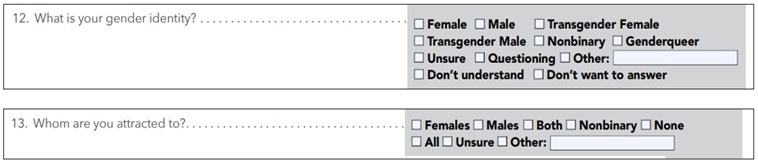
Imagine the 12-year-old faced with these questions and prospective answers.
Perhaps he or she has read about “gender identity” online and absorbed the generalities of the debate, but here is a physician coming in full authority to settle the matter.
“Genderqueer,” for example, is no longer an abstract category but something that an authoritative, highly trained adult thinks our young patient might reasonably be.
One needn’t spend a lifetime studying human nature to grasp that children are suggestible and that even to ask these questions is to put one’s finger on the scale of a fraught culture-war debate that has far less to do with medicine than with politics.
Moreover, the page of the questionnaire dealing with “gender” issues is explicitly presented as our little secret.
Whereas questions about diet, exercise, grades, and seat-belt usage are marked “Non-Confidential,” the aforementioned “gender” queries have a “Confidential” designation — as do questions about suicidal ideation, sexual activity, and intimate-partner violence.
This aligns with a notice posted back on the “Well Visits” page: “To respect your teen’s independence and privacy, we’ll see your teen alone for part or all of the visit.”
To an extent, this makes sense. If a 17-year-old is sexually active, he or she is taking on health risks and responsibilities that his or her physician conceivably ought to know about.
A real discussion is needed, and, at least in some families, the presence of Mom or Dad in the examination room might inhibit it.
This is a far cry, however, from the sneaky introduction of “gender” ideology to a 12-year-old. Not for nothing have states begun enacting parental-notification laws addressing the social “transitioning” of minors and opening up medical records to legal guardians. Parents have every right to know whether, when, and how their kids are being made to question the “alignment” of their biological sex and “gender identity.”
Finally, maneuvering of this kind on the part of physicians is destructive for broader reasons. It is a good thing if Americans trust their doctors. But how will we if healthcare providers come to be seen as ideological agents who can’t be trusted in a room with our kids?
In short, what Kaiser is doing isn’t just bad news for minor patients and their families. It is a threat to the basic trust that makes clinical care possible.