Future historians hoping to understand the Age of Wokeness will turn gratefully to the American Psychological Association’s “Inclusive Language Guide.” As a marker of progressive ideological anxiety and complaint, the 51-page document may be impossible to top.
Updated in 2023, the guide is intended by the APA to “dismantle the destructive hierarchies that have marginalized people from equitable representation and participation in society.”
So confident is the association that “certain terms are harmful to marginalized communities” that it includes a preemptive apology of its own: “We … understand that some of the terms and concepts that are included [in the guide] may be offensive and painful to different groups.”
What is this potentially debilitating language? A number of the words and phrases listed in the opening “General Terms Related to Equity and Power” section have long been a part of the American and international political conversation (e.g., “antisemitism”). Others have been popularized more recently, as theoretical academic discourse has filtered down to newspapers, magazines, public-radio broadcasts, and K-12 classrooms (e.g., “cultural competence”).
None are in any way provocative.
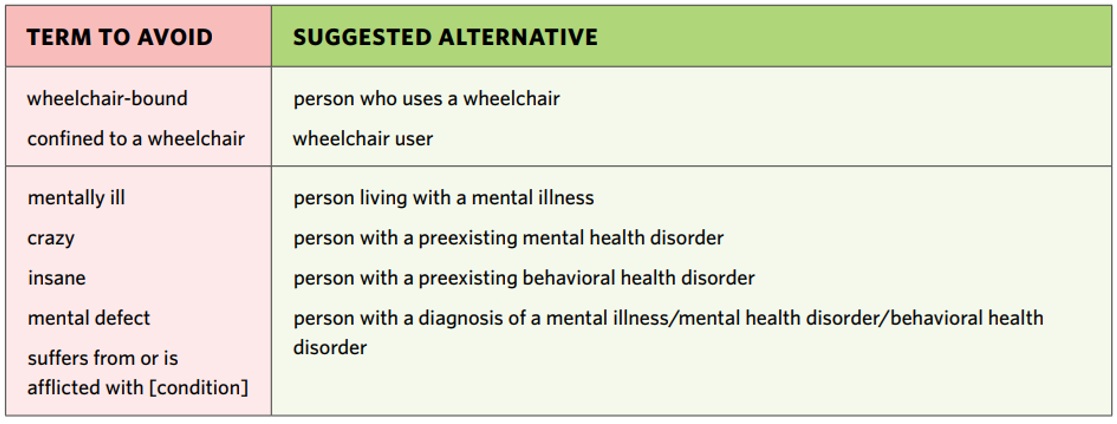
Or perhaps the APA has in mind the allegedly harmful language listed on an accompanying “Term to Avoid” / “Suggested Alternative” chart. There, for instance, readers learn that one ought not to say “mentally ill” when what one really means (or should mean, anyway) is “person living with a mental illness.”
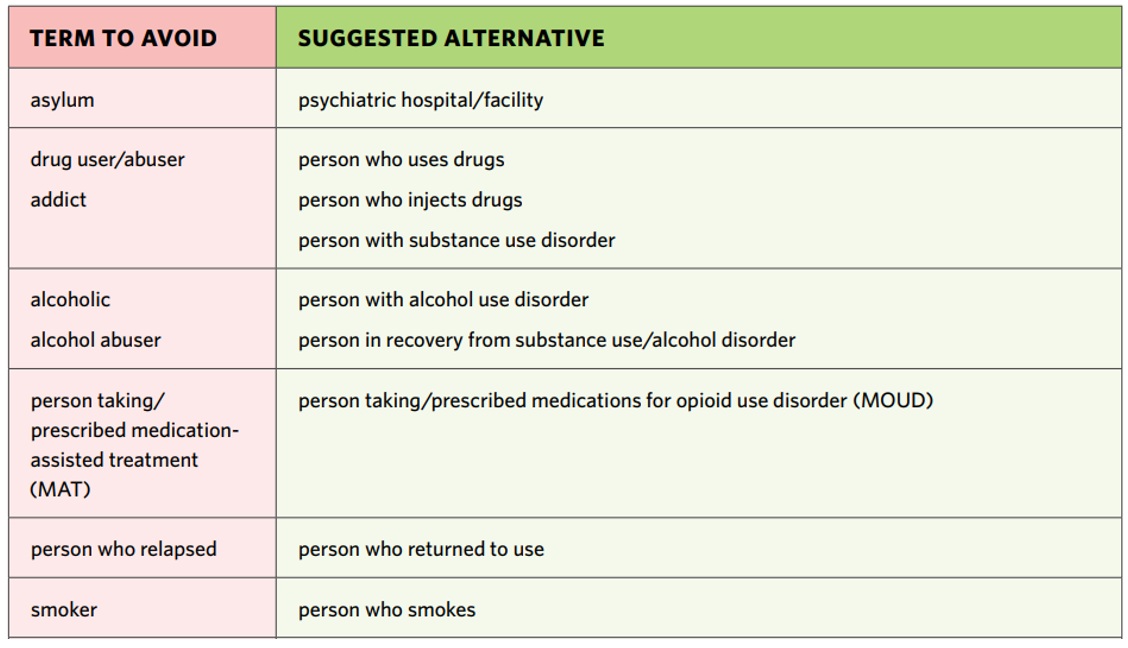
Readers learn that, e.g., “smoker” is no longer in vogue. The preferred linguistic alternative is now “person who smokes.”
We linger on this point because the APA’s exaggerated fear of giving offense is at the heart of its Inclusive Language Guide’s intellectual misjudgments. The document’s very foundation is the unfalsifiable (and therefore unscientific) belief that delicate terminology somehow improves the lot of racial, ethnic, and religious minorities and the physically and mentally handicapped (apologies: we mean “persons with disabilities”).
Because this premise is irredeemably flawed, those committed to it have no choice but to search farther and farther afield for “acceptable” alternatives, as yesterday’s preferred terms inevitably become today’s rank abuse.
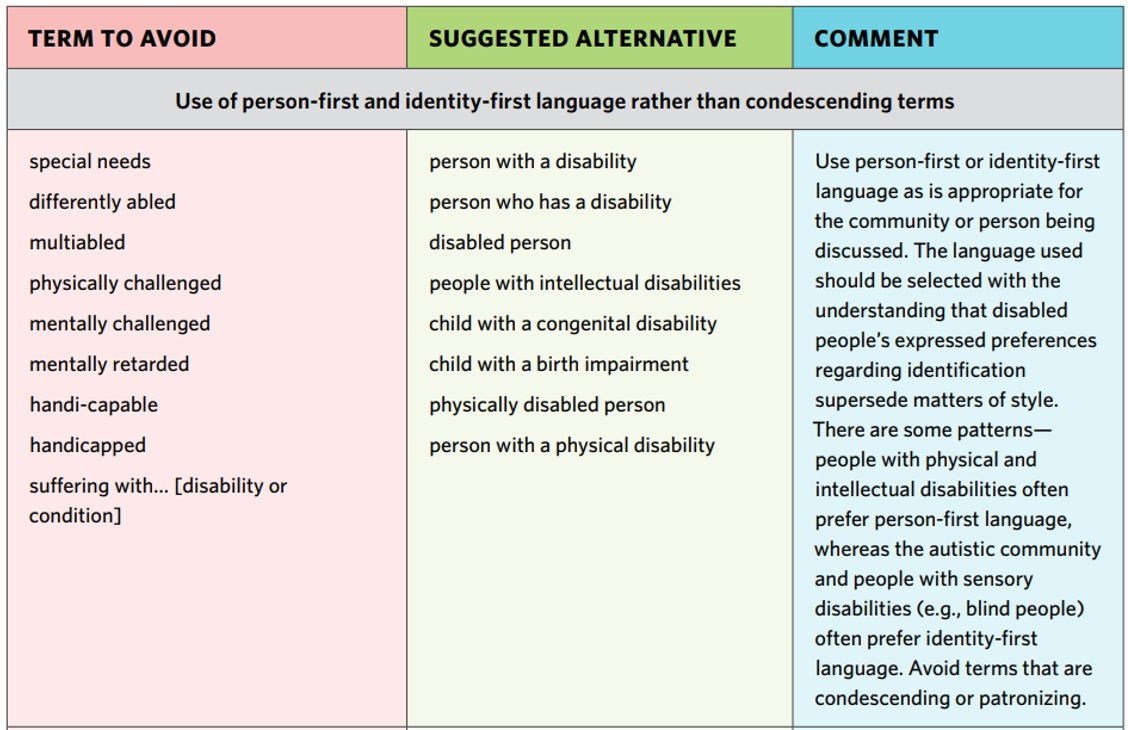
Consider, for example, the troubled career of “differently abled,” a phrase that once represented the height of good taste but is now one of the APA’s explicitly named “term[s] to avoid.”
Without question, that phrase has lost its stylishness. To argue that it is actively offensive, however, is to engage in unserious intellectual contortions. It is moral preening, not the mitigation of harm — clubbishness, not profitable advice.
Indeed, one gets the decided impression, reading the APA’s document, that the point is to create and maintain a clerisy rather than to look out for the needs of those whom the APA ostensibly wishes to help. All but the most uncouth members of society know that the phrase “mentally retarded” ought not to be used in polite company. Yet only an elite few know that “special needs” is now outré, as well. Thus does the APA maintain its professional exclusivity.
To be sure, the consequences of this way of thinking are sometimes comic. When, in January 2023, the Associated Press tweeted that writers ought not to “dehumanize[e]” their reporting subjects by referring to, e.g., “the poor, the mentally ill, the French, the disabled, [or] the college-educated,” the French Embassy to the United States jokingly suggested changing its name to the “Embassy of Frenchness in the US.”
“Handi-capable,” another verboten term as of the APA’s 2023 update, was, from the moment of its origination, a seeming parody of woke cluelessness.
Perhaps the APA is right to remind its members and site visitors to “[a]void terms that are condescending or patronizing,” as the final image above declares. Certainly all speakers and writers should treat others with respect.
There is a fine line, however, between that project and the policing of normal, harmless words. In its pursuit of progressive social outcomes, the APA has left that border far in the rear-view mirror.