Earlier this year, we lamented the dual role of Lindia Willies-Jacobo, MD, who serves as both senior associate dean for admissions and senior associate dean for inclusive excellence (i.e., DEI chief) at Kaiser Permanente’s Bernard J. Tyson School of Medicine.
This unseemly combination is more prevalent than we then reported.
According to a widely available list maintained by the Association of American Medical Colleges (AAMC), 11 medical schools in the 50 states and D.C. designated a senior admissions officer as their named “diversity contact” official as recently as 2025.
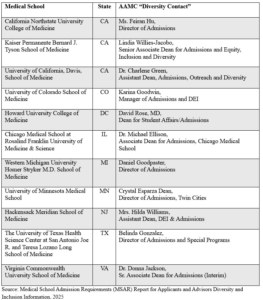
If, as such a designation implies, the institutions in question have merged their DEI and admissions functions in whole or in part, then reformers can rightly ask whether these schools are violating the letter or spirit of Students for Fair Admissions v. Harvard.
That 2023 Supreme Court decision demanded that institutions of higher learning abandon the “race-conscious” admissions protocols that had long favored minority candidates. Yet DEI ideology demands exactly the opposite: sorting men and women by such immutable characteristics as race, gender, or national origin, then elevating those markers above academic or intellectual merit.
Medical schools ought not to tolerate DEI at all and should instead dismiss it as an unscientific, divisive distraction from the work of training future physicians.
At a minimum, DEI most certainly shouldn’t be present in medical-school admissions processes. Allowing its precepts into that part of a school’s operations risks violating the law and compromising the efficacy of tomorrow’s doctors.
Further investigation of AAMC’s list reveals too many instances in which admissions work and DEI thinking overlap.
- Feiran Hu, director of admissions at California Northstate University College of Medicine, boasts on LinkedIn that her work includes “[c]ollaborat[ing] with the Admissions Committee members to craft effective admission strategies that foster equity, diversity and inclusivity.”
- Michael Ellison, MD, associate dean for admissions at Chicago Medical School at Rosalind Franklin University, remarked in a 2023 interview that his institution is using “a more holistic approach” to admissions, in which “the MCAT is not the be-all to whether or not a student is going to be admitted to the program.” Instead, Dr. Ellison continued, decisionmakers look “at a student’s … attributes and how they’re going to be able to contribute to the diversity of the class.”
- Daniel Goodpaster, director of admissions at Western Michigan University’s Homer Stryker M.D. School of Medicine, oversees an admissions process whose “criteria are holistic and broad-based, aligned with our mission and values, and promote multiple dimensions of diversity as essential to achieving excellence.”
- Crystal Esparza Dean, until this year director of admissions at the University of Minnesota Medical School, describes on LinkedIn her “intentional focus on … increasing diversity, justice, equity, inclusion, [and] wellbeing.”
- Willies-Jacobo, about whom we previously wrote, recently remarked at a NAAMA NextGen Med School Admissions Series event that her institution wants applicants who have “at least begun to think about the concept of advancing equity in health.”
It is difficult to believe, given these self-characterizations, that DEI officials who serve an admissions function (or vice versa) are placing that controversial ideology to one side when ranking student applicants.
Far more likely is the possibility that DEI beliefs are informing admissions practice. To bring one’s principles to bear on one’s work is, after all, human nature.
Sadly, it is also bad news for a nation that desperately needs a trustworthy, professional, and apolitical medical establishment. Medical schools should put a stop to the intrusion of DEI thinking in admissions.