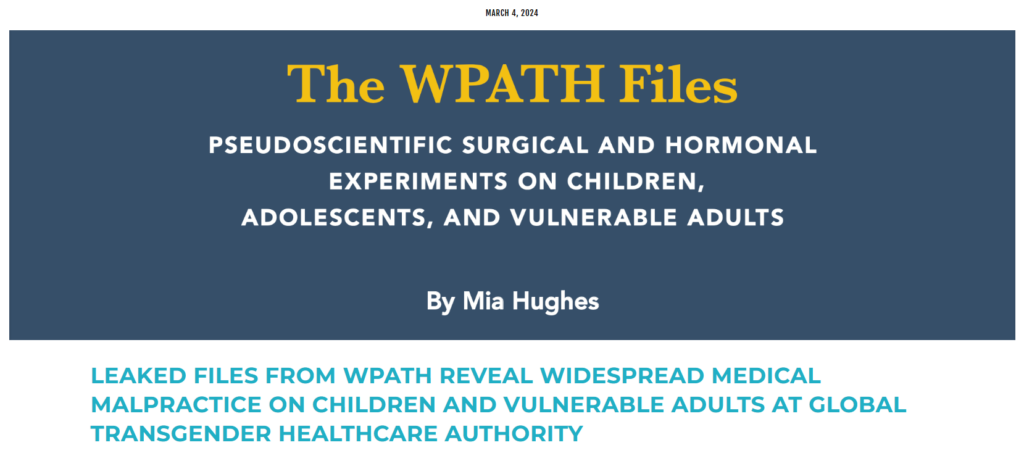
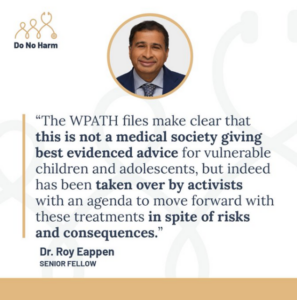
You may have heard about the release of internal files from the World Professional Association for Transgender Health (WPATH) on March 4. The files expose the disturbing depths WPATH has gone to in its efforts to continue the dangerous, unregulated, and unscientific practices of so-called “gender-affirming care.”
The documents show that, at the hands of these “treatments,” WPATH is aware that children are developing cancer, experiencing sterilization, are adopting disordered eating, and more.
Figure 1. From “The WPATH Files,” March 4, 2024.
We encourage you to read the files, watch the videos, and fully digest the fact that WPATH covered up the lack of scientific evidence behind its claims in favor of advancing dangerous treatments and woke ideology.
https://donoharmmedicine.org/wp-content/uploads/shutterstock_703164724-scaled.jpg17072560Laura Morganhttps://donoharmmedicine.org/wp-content/uploads/DNH_Logo_Stethescope-1.pngLaura Morgan2024-03-05 23:54:002026-05-06 14:46:18The WPATH Files Expose the Truth About the Dangers of So-Called “Gender-Affirming Care”
Earlier this month, Do No Harm posted a commentary piece highlighting a recent American Hospital Association (AHA) report. This report found that many hospitals across the United States have fully embraced DEI, including through signing the AHA’s “equity pledge” and even allocating a portion of their budgets towards DEI goals.
However, it appears hospitals’ endorsements of identity politics in medicine run much deeper than just pledges. In fact, a brand new AHA report underscores the growing influence of woke-ism in fundamentally altering hospital governance and management.
According to the AHA, more than half of all hospitals responding to an internal survey identified that their board is focused on “increase[ing] the number of diverse members” as it pertains to race, sex, and ethnicity. More than 40 percent indicate the same is true for age, and more than a quarter echo the same sentiment for gender identity. In other words, hospital boards are putting equity above merit or relevant experience in the quest for new board members.
Figure 1. From “DEI Data Insights” (February 2024), page 4.
A large portion of hospitals also indicated their organization has implemented similar diversity “approaches” in both C-suite leadership and hospital management. Similarly, more than half of hospitals are implementing a strategy to “hire individuals from historically marginalized populations”.
Figure 2. From “DEI Data Insights” (February 2024), page 5.
Unsurprisingly, the AHA is only interested in its own narrow definition of diversity that conforms to the organizations’ interests. Any comments on intellectual diversity, ideological diversity, or diversity of rural versus urban backgrounds are nowhere to be found. And, ironically, the AHA is failing to meet its own diversity standards: more than half of the AHA Board of Trustees is composed of white males; less than 40 percent are female, while just 15 percent are non-white. So much for leading by example.
For all the so-called “progress” that hospitals have yet to make, the AHA is clearly ready to do its part to enable the woke takeover of America’s hospitals. Indeed, the AHA posted a separate model case study on hospitals recruiting diverse board members. The case study includes three examples of hospitals achieving “board diversity” through a variety of mechanisms, such as hiring a search firm, networking, and even “less formal” methods of identifying prospective board members, such as “through a friendly exchange at a local restaurant.”
The AHA is also sure to emphasize how the Centers for Medicare and Medicaid Services (CMS) is “adopting health equity-focused measures” as part of “growing recognition by regulatory agencies and accrediting bodies for the demonstration of greater board involvement in equity issues and addressing health disparities.” In other words, the AHA is implying that hospitals should get on board the DEI train today—because tomorrow the government might be mandating it.
Of course, the AHA does not include any metrics to indicate governance and management diversity improves medical outcomes for patients, or even bolsters experiences for hospital employees. Rather, the opposite is true: every dollar wasted on DEI efforts to advance board equity or improve managerial diversity is a dollar that isn’t being put towards actually providing quality health care. This is the secret that DEI departments in America’s hospitals don’t want patients—or even providers—to discuss, because it undercuts their entire governance model.
One sliver of good news is that even many of America’s fully-woke hospitals are slow to embrace certain aspects of diversity targets. For example, less than a quarter of U.S. hospitals report a strategy to increase the sexual orientation diversity on their boards. Nor should they, since sexual orientation obviously has no effect whatsoever on the effectiveness of hospital governance. Indeed, the AHA’s subtle implication to the contrary could be interpreted as a form of reverse discrimination. Yet even these hospitals fail to apply the same logic to more widely-accepted diversity categories, such as race, sex, and ethnicity. Why are diversity targets appropriate in certain areas, but not in others?
Put simply, the latest AHA report is yet another sign of the slow degradation of America’s medical institutions into politicized bureaucracies. No matter which category of diversity is being considered, the more hospitals resist embracing identity politics, the better.
https://donoharmmedicine.org/wp-content/uploads/shutterstock_110304980-scaled.jpg17072560Laura Morganhttps://donoharmmedicine.org/wp-content/uploads/DNH_Logo_Stethescope-1.pngLaura Morgan2024-03-05 19:57:002026-05-06 14:45:11DEI Sentiments Dominate In U.S. Hospitals (Part 2)
https://donoharmmedicine.org/wp-content/uploads/DNH_Logo_Stethescope-1.png00dnhprodhttps://donoharmmedicine.org/wp-content/uploads/DNH_Logo_Stethescope-1.pngdnhprod2024-03-05 08:08:482025-10-03 10:26:36Single – Research
The “Coloring Psychoanalysts” online periodical wants your contributions—but only if you are a member of the “BIPOC” community (black, indigenous, or person of color).
Coloring Psychoanalysts describes itself as an online community periodical that “seek[s] to dismantle the ways in which psychoanalytic theory has both ignored and pathologized BIPOC people, justified and reinforced systemic oppression, and affects our practice and our communities today.”
The organization’s “About” page contains a defense of limiting “white” participants, asserting the BIPOC-only periodical is a way to “divest BIPOC time, emotional labor, and intellectual contribution from spaces that too often diminish and devalue us.” In arriving at this conclusion, Coloring Psychologists cites a 2018 article entitled “Why People of Color Need Spaces Without White People”. Indeed, the organization makes it clear they are interested in seeing “psychoanalysis shift away from a White, colonial center.”
Figure 1. From the “About” page of Coloring Psychoanalysis.
Coloring Psychologists wants submissions, not just from writers, but from “poets, artists, dancers, musicians, and other creators” too. But if you are white, don’t bother clicking on the application form, which requires you to affirm that “I self-identify as BIPOC (Black, Indigenous, and People of Color) and understand that the intention of this space is to foster psychoanalytically-oriented dialogue by and for BIPOC.”
Figure 2. Required response on the Coloring Psychoanalysis interest form.
Notably, the organization relies on self-identification of race to uphold its discriminatory practices. How Coloring Psychologists deals with inappropriate cases of self-identification is unclear, but is a built-in flaw to virtually all of these types of racial screenings.
And if you are white, the organization’s response is very clear: go elsewhere. Or, as they so lovingly put it, “seek alternative spaces” for submissions. Even supposed “allies” to the BIPOC community are not welcome.
As Do No Harm has previously reported, not only are the consequences of these practices discriminatory, but they are entirely ineffective. The implied notion that psychologists should align with their patients on the basis of race rather than merit has been a consistently disproved practice. There is absolutely no evidence that having a black psychologist for a black patient—or a white psychologist for a white patient—leads to improved medical outcomes. Yet, that does not stop woke organizations from continuing to push for racial concordance in order to undermine our existing medical system.
However, in perhaps an encouraging sign of the organization’s potentially waning influence, they still have their submission page open for a project whose deadline expired more than four months ago. Perhaps limiting submissions to only self-identified BIPOC individuals has not panned out the way the organization had hoped.
Coloring Psychoanalysts was founded by clinical psychologist Meiyang Liu Kadaba, who claims to live “on the unceded ancestral homeland of the Ramatyush Ohlone Peoples…who were the original inhabitants of the area that includes San Francisco, CA.” That’s a very long—and very woke—way of saying she lives in San Francisco.
Frighteningly, but perhaps unsurprisingly, Kadaba has been an adjunct faculty member at the Wright Institute, a graduate school of psychology located in Berkeley, CA. She also worked in Wright’s DEI office. In other words, she is passing her politicized worldview of medicine onto the next generation of psychologists, indoctrinating them with the same toxic worldview.
However, Coloring Psychoanalysts is hardly the only entity in the medical arena to be engaging in these types of practices. From internships at medical non-profits, to admissions at major medical programs, to scholarships sponsored by private entities, Do No Harm has documented countless cases of discriminatory operations. It appears the use of blatantly racist criteria to screen-out unwanted racial groups is quickly becoming the norm. This bears a frightening resemblance to the pre-Civil Rights era’s “separate, but equal” practices used to justify the same types of discriminatory actions against black Americans.
In practical terms, locking out non-BIPOC members limits the dialogue in a critical medical field, stifles the free exchange of ideas, and places race on a pedestal above all-else. However, it is very likely that these outcomes reflect the goals of Coloring Psychoanalysts and similar organizations, rather than unintended consequences.
Whether it is Coloring Psychoanalysts or another entity, these types of racial screenings have no place in any field of modern medicine. They are relics of a discriminatory system that belong to the ash heap of history. Instead, they are unfortunately gaining traction among non-profits, colleges and universities, and private sector organizations. The sooner these inherently racist practices are repudiated and abandoned, the better.
https://donoharmmedicine.org/wp-content/uploads/2024/03/shutterstock_241730350-1280x720-1.jpg7201280Laura Morganhttps://donoharmmedicine.org/wp-content/uploads/DNH_Logo_Stethescope-1.pngLaura Morgan2024-03-04 14:41:002026-02-11 15:33:45Not a Minority? You Need Not Apply
Psychoanalysis, at its core, aims to understand the origin points for suffering. Dr. Lucas A. Klein wants you to know that if radical DEI initiatives collapse the field of psychoanalysis, the Holmes Commission was the origin point.
Dr. Klein is a clinical psychologist, adult psychoanalyst, former forensic psychologist, the host of Real Clear Podcast, and a visiting fellow at Do No Harm. He knows a thing or two about the human condition, and he believes the principles underlying DEI are not only illogical—they’re dangerous.
“Psychoanalysis is among the last in the field of mental health to enter this battle, and it deserves some congratulations for having held out this long. Other professions fell long, long ago,” he says.
“But DEI activists are coming for my profession, and it’s making a mockery of it. I’m not going to give up the seriousness of my field without a fight.”
In 2020, the American Psychoanalytic Association (APsA) created the Holmes Commission to find evidence of racism within the association. Three years later, it released a stunning 421-page report calling for the restructuring of the entire field of psychoanalysis.
It instructed therapists to “apply an analytic lens to the matters of race, racism, and white supremacy.” It also tasked entities associated with the field to hire a DEI ombudsman and “monitor resistance to change.”
Amazingly, the authors of the report themselves admitted they don’t have any data to prove or disprove systemic racism in the field, and that the report’s findings were enhancedwith the “personal experiences of commission members.”
For Dr. Klein, enough was enough. He published a pointed takedown of the report’s findings on his professional APsA listserv. It set the field ablaze for a few weeks.
“I received a torrent of private support from psychoanalysts throughout the country and throughout the world, and I’m still getting positive responses from analysts,” he says. “It’s not surprising, but it is sad they felt they had to do so privately.”
Dr. Klein expanded on the hazards of critical social justice for an op-ed in the City Journal, in which he warned against making race central to the patient experience:
“Such racial fixation contributes to the unmaking of psychoanalysis. The point of our craft is to help people delve deep into the true and specific cause of their problems, not tell them that they’re victims or evildoers whose problems are unsolvable. We’re supposed to empower people with a truer sense of who they are, not immobilize them by shoving them into a predetermined spot in a power structure.”
“That approach cultivates helplessness, anger, and obsession—not empathy, understanding, and resolution. Mental problems worsen when the unconscious goes unconfronted.”
Sadly, Dr. Klein is watching his warnings come to life at work. He often meets new patients who walk in the door feeling anxious about the possible politicization of their experiences.
“I’ve had patients come to me worried I’m going to view their experiences through the lens of race. I’ve had parents of teenagers worried I’m going to trans their kids,” he says. “Each went to other therapists first who brought up concepts about race and gender when they were not applicable.”
Dr. Klein is not sure that APsA will ever get back on track, but he steadfastly believes the intellectual foundation of psychoanalysis is worth saving.
“We may need to start a new organization that reaffirms classical psychoanalytic values and theories to the exclusion of modern woke ideas. Those cannot be entertained. You really can’t middle around on this,” he warns.
We couldn’t agree more.
https://donoharmmedicine.org/wp-content/uploads/2024/02/shutterstock_315368747-scaled.jpg17062560Laura Morganhttps://donoharmmedicine.org/wp-content/uploads/DNH_Logo_Stethescope-1.pngLaura Morgan2024-03-04 13:00:002026-02-11 15:33:44Dr. Lucas Klein: “DEI Activists Are Coming for My Profession”
The Kansas mother of three told lawmakers Thursday that her now 14-year-old child attempted suicide after coming out as transgender.
She also told them that gender affirming medication, testosterone, left him “happier and healthier” than she’s seen him in years. Starting hormone therapy, Poland told The Star, wasn’t a decision her family made lightly but instead one that came after extensive therapy and detailed conversations with doctors.
https://donoharmmedicine.org/wp-content/uploads/2025/01/Media_Mention_.jpg7961550rededge-rachelhttps://donoharmmedicine.org/wp-content/uploads/DNH_Logo_Stethescope-1.pngrededge-rachel2024-03-01 20:14:102026-04-10 14:33:24Kansas Republicans push to ban gender-affirming care for trans minors, label it abusive
Many organizations—including in the medical field—make assurances not to discriminate on the basis of race, ethnicity, gender, age, and a variety of other factors. These types of statements are fairly commonplace in both the private and public sector.
However, what is less common is an explicit codification of discrimination included in the very same paragraph as an anti-discrimination statement. Yet, this is precisely the situation with the American Heart Association (AHA).
In one of its funding opportunities for grantees, the AHA is offering a four-year award of up to $4.4 million for organizations addressing the role of inflammation in cardiac and neurovascular diseases. In their applications, potential grantees are supposed to include requests for funding of postdoctoral fellows related to the program. Upon first glance, the idea sounds innocent enough.
In fact, the AHA assures applicants that its aim is to end the treatment of “people inequitably based on race, ethnicity, gender, sexual orientation, age, ability, veteran status or other factors.” But the very next sentence codifies this type of mistreatment by mandating that “at least 50% of the fellows named must be from a racial or ethnic group that is under-represented in science (Black/African American; Hispanic/Latino; Native American or Alaska Native; and/or Hawaiian or other Pacific Islander); or an LGBTQ+ person, or a woman.”
But it does not end there. The AHA goes onto require that “at least 25% of key personnel of the research team must be from groups who are under-represented in science and medicine.”
The AHA’s message could not be any more contradictory: they are against discrimination, except when they are in favor of it.
This type of reverse discrimination and racial balancing has no place in medicine, or in any related field. However, given the AHA’s long history of endorsing DEI and woke concepts, its discriminatory requirements should come as no huge surprise.
A search for “equity” on the AHA’s website brings up nearly 9,000 results, from news articles to health equity guidelines and more. Included in these results is the AHA’s “Office of Health Equity” which is supposedly dedicated to “leveraging diversity, equity and inclusion to drive the AHA’s mission to be a relentless force for a world of longer, healthier lives.”
As part of the AHA’s Office of Health Equity, the organization has issued several position statements on “health equity, social justice and structural racism.” They are also supplemented by several policy positions held by the organization, guided by “principles for addressing structural racism through public policy advocacy”.
For example, the AHA published a more than 14,000-word report outlining a variety of positions held by the organization designed to “advance antiracist strategies”. These include several policies entirely unrelated to health or medical outcomes, such as “advance[ing] policies that support the preservation of trust in and the integrity of our electoral process” and “work[ing] to mitigate implicit and explicit bias among school staff and to examine disciplinary policies and the role of law enforcement in schools”, among others.
Also included in the report is an endorsement of “provid[ing] complementary, culturally concordant prevention services for patients and historically excluded populations.” This is an implicit and buried endorsement of racial concordance in medicine, the disproven idea that patients should see providers of the same race.
Put simply, the AHA’s embrace of politicized concepts runs wide and deep, even encroaching upon areas that are completely unrelated to health and medicine. The codification of discriminatory practices in a recent grant opportunity is merely a symptom of a much deeper problem brewing within the organization.
The AHA is certainly not alone in advancing a woke ideology or incorporating discrimination in its funding opportunities. However, the extent to which these concepts have infiltrated the organization’s mission and operations is a serious cause for concern—and one that deserves careful monitoring going forward.
https://donoharmmedicine.org/wp-content/uploads/DNH_Logo_Stethescope-1.png00dnhprodhttps://donoharmmedicine.org/wp-content/uploads/DNH_Logo_Stethescope-1.pngdnhprod2024-02-29 11:39:272025-10-03 10:26:36Single – Story
https://donoharmmedicine.org/wp-content/uploads/DNH_Logo_Stethescope-1.png00dnhprodhttps://donoharmmedicine.org/wp-content/uploads/DNH_Logo_Stethescope-1.pngdnhprod2024-02-29 11:39:262026-01-20 14:32:32Page – Team