In the wake of the Supreme Court’s ruling which prohibits race-conscious college admissions, is West Virginia University School of Medicine following the law? Maybe. But materials included in an admissions committee training workshop raise serious questions. And the school’s leadership owes applicants, lawmakers, and the public clear answers.
The training slideshow, obtained by Do No Harm through a public records request, offers mixed signals about the school’s understanding of the Court’s decision in Students for Fair Admissions v. Harvard (2023). In summarizing the decision, a slide first notes that applicants “must be treated based on his or her experiences as an individual – not on the basis of race.” This is, of course, true. However, it goes on to claim that race is considered “as one factor among many, in an effort to assemble a student body that is diverse in ways broader than race.”
Figure 1. From “2023 Committee on Admissions Training Workshop,” WVU School of Medicine.
This language can be traced to a different Supreme Court ruling, Grutter v. Bollinger (2003), the very decision that SFFA explicitly overruled. And that most recent ruling made it clear: Race can’t be a factor in the admissions process at all.
Other slides suggest that the admissions committee understands the Court’s decision and intends to comply with it. For example, the updated diversity policy removes references to race-conscious admissions and instead affirms a focus on selecting “a diverse student body, faculty, and staff, including the socioeconomically disadvantaged rural Appalachian population.”
Figure 2. From “2023 Committee on Admissions Training Workshop,” WVU School of Medicine.
Previously, in 2022, the policy stated that “the School endeavors to select a gender-balanced and diverse student body, faculty, and staff including underrepresented in medicine groups, including those who identify as African-American, Hispanic, and Native American/Pacific Islander.”
Figure 3. From “2023 Committee on Admissions Training Workshop,” WVU School of Medicine.
Hopefully the attribution of a quote from Bollinger to SFFA is an honest mistake and the admissions committee understands that race-conscious admissions are a violation of the Fourteenth Amendment’s Equal Protection Clause. Either way, WVU has some explaining to do.
https://donoharmmedicine.org/wp-content/uploads/shutterstock_2373313565-scaled.jpg19202560Laura Morganhttps://donoharmmedicine.org/wp-content/uploads/DNH_Logo_Stethescope-1.pngLaura Morgan2024-05-13 14:59:092026-05-07 12:52:10WVU Has Some Explaining To Do
I recently toured the now-defunct Project Greek Island at the Greenbrier Resort. Built in 1958, this top-secret government facility was a fortified bunker into which the U.S. Congress would relocate in the event of a national emergency, i.e., nuclear war.
Today, advocates for equality and fair, non-discriminatory competition for positions in schools or the workplace hide in another kind of bunker. They shelter in place avoiding the DEI (Diversity, Equity, Inclusion) storm. They are safe from being looked upon by their peers with faux moral revulsion, being labelled a racist or a Neanderthal for not pledging fealty to the 21st Century diversity movement. But their bunker is one of silence, not concrete. And it is only a matter of time before the risk they are avoiding reaches them.
The quest to expand the American Dream to all Americans has made progress. Sometimes, it is organic as people are exposed to those with different backgrounds and ethnicities. Other advancements required legal or political action. President Truman desegregated the armed services. President Eisenhower desegregated the federal workplace. The Supreme Court desegregated public schools. Congress passed laws in the 1960s that ensured de jure non-discrimination in many facets of American life.
Disturbingly, the movement toward harmony has morphed into a campaign that promotes racial stereotyping and drives us apart. As early as kindergarten, children are grouped by race for certain activities and lessons. In higher education, students are placed in affinity groups—Newspeak for segregation.
In short, DEI adherents are echoing the 1950s rhetoric of the opponents to integrated schools: people of different races learn better in separate environments where they can be their true selves. How is this diversity and inclusion?
Like the Cold War that necessitated a bunker in West Virginia, I thought the Red Scare-inspired loyalty oaths to root out communists were in history’s dustbin. Not true. Despite a prohibition against political tests for employment in the California public college system, at U.C. Davis, for example, the application for a faculty position as a surgical oncologist requires a “Statement of Contributions to Diversity, Equity, and Inclusion” while a statement of research or teaching is optional.
Thankfully, a return to fairness is on the march. Do No Harm, a non-profit organization fighting identity politics in medicine has filed civil rights complaints and lawsuits attacking, among other things, racial quotas on medical boards and discriminatory hiring incentive programs that exclude qualified individuals. Full disclosure: I am a plaintiff in the California lawsuitagainst mandatory implicit bias training.
But too many Americans who believe in merit, evidence-based healthcare, and equal treatment under the law remain silent. Racial silos rob all individuals, but especially black persons, of their dignity. When we lose our individuality, we lose our true selves. Let’s get out of our bunkers and fight this fight before it’s too late.
https://donoharmmedicine.org/wp-content/uploads/shutterstock_104025983-scaled.jpg17072560Laura Morganhttps://donoharmmedicine.org/wp-content/uploads/DNH_Logo_Stethescope-1.pngLaura Morgan2024-05-08 19:46:372026-05-07 12:50:53Advocates for Equality Must Emerge from the Bunker and Speak Up
The American Academy of Psychiatry and the Law (AAPL) is promoting a scholarship for early career forensic psychiatrists to attend its annual conference in Vancouver, Canada later this year. The Charles Dike Scholarship, established by AAPL in 2021 and named after its now-president, is not, however, available to all young psychiatrists—only “people of color” may apply. Scholarships such as this have become increasingly common among institutions that support diversity, equity, and inclusion by specifically excluding white applicants from consideration.
The AAPL’s diversity, equity, and inclusion efforts accelerated after a self-critical article was published in the Journal of the American Academy of Psychiatry and the Law (JAAPL) in 2019. The authors examined nearly a decade’s worth of AAPL newsletters and found no mentions of the value of diversity in their field. Despite finding more than 500 JAAPL articles containing references to diversity, the authors further criticized the AAPL because only ten of those articles specifically addressed why diversity is important to their field. They also pointed to broader indicators of “underrepresentation” among black, “Latinx,” Native American, and “LGBTQ” people in the psychiatric field. The solution, the authors argued, was to follow the model of the American Psychiatric Association, which pursued a “structural reorganization plan with inclusivity, diversity, and effectiveness as guiding principles.” The APA also incorporated DEI concepts into its Diagnostic and Statistical Manual.
The AAPL had anticipated these criticisms, forming a Diversity Committee and creating designated seats on its governing Council for minorities and women before the article was published by JAAPL.
The most recent newsletter from AAPL echoes these sentiments. The incoming medical director for AAPL wrote that “concepts of radical inclusion and attention to diversity” are at the core of AAPL’s educational mission. AAPL’s Membership Engagement, Recruitment, and Retention Task Force extended this mission even further, citing the need for AAPL to engage to a greater degree with social issues, based on insights from its leadership team.
Yet, insights from AAPL’s membership suggest these efforts are quite unpopular. The newsletter also noted a 2022 survey of AAPL’s membership, which found that members were most satisfied with the organization’s professional education, networking opportunities, and scholarly activities. Social issue advocacy ranked lowest. More than one in five members reported that they had considered ending their association with AAPL, and the top reasons were related to disagreement with the organization’s activities, concerns about politicization, and loss of objectivity in search of advocacy.
AAPL’s drift into social justice is clearly driving away some members who object to the discriminatory and political practices that it entails. But another reason might be that these efforts are simply not necessary to meaningfully improve the field, even on some of the race-based metrics outlined by DEI initiatives. In the thirty years prior to these explicit efforts to diversify the field, underrepresentation in psychiatry was actually diminishing. AAPL makes no mention of this organic success, but only of its continued shortcomings and need for structural change.
Yet, structural changes such as diversity policies, DEI committees, and discriminatory eligibility criteria have proven to be as ineffective as they are unfair. Explicitly race-based diversity policies reduce the complexity of psychiatrists and patients alike to their immutable racial characteristics. And these practices do so at the expense of identifying the types of skills and talents that might prove to be innovative or especially worthy of elevation or praise. Despite the mounting evidence against their usefulness, organizations like AAPL continue to insist on expanding DEI into their policies, governance structures, and scholarships.
Elevating characteristics based on race or ethnicity does little to promote excellence in the field or reward exceptional individuals on an even playing field; instead, they create unnecessary cleavages within the medical community. If AAPL continues to ignore its membership by expanding discriminatory practices like race-based scholarships, the divisions among its members will only grow wider—which is precisely the opposite of the welcoming environment that AAPL’s leadership pays lip service when rolling out these efforts.
https://donoharmmedicine.org/wp-content/uploads/shutterstock_795328336-scaled.jpg17072560Laura Morganhttps://donoharmmedicine.org/wp-content/uploads/DNH_Logo_Stethescope-1.pngLaura Morgan2024-05-02 09:52:002026-05-07 12:49:42White Doctors Need Not Apply to AAPL Scholarship
In recent years, Florida has been on the cutting edge of pushing back against DEI and other woke concepts, including in medicine. Last year, Governor DeSantis signed two bills into law which prohibited colleges and universities (including medical schools) from spending state or federal dollars on DEI initiatives, while also banning “loyalty tests” and creating freedom of conscience protections in higher education. This was followed up by an outright ban on DEI in the entire Florida College System by the State Board of Education in early 2024.
But now, certain faculty at the University of Florida are expected to participate in a questionable survey produced by the Accreditation Council for Graduate Medical Education (ACGME). The survey includes questions that specifically investigate the prevalence of DEI concepts related to the “diversity” of fellows at the school.
Now, both the University of Florida and ACGME have been repeat offenders when it comes to their fixation on DEI. Time and time again, the University of Florida has repeatedly followed a highly politicized agenda that has rightfully drawn sharp scrutiny. Do No Harm even filed a civil rights complaint after the University targeted scholarships available only to members of certain racial and ethnic groups. After media reports—including articles by Do No Harm—called the school out, the college quickly took to scrubbing its webpages of woke content.
(However, it appears the University may have missed a few webpages when completing its broad scrub.)
ACGME is seemingly no better. The organization has placed pressure on residency program directors to prove their allegiance to DEI, all while adding a series of head-scratching sessions on topics like “addressing structural racism to promote equity” to their annual education conference.
Interestingly, this past March, ACGME was in Orlando partnering with the Orlando Veterans Affairs Healthcare System and another Florida medical school – the University of Central Florida – on an event entitled “ACGME Paving the Path to Medicine: Promoting Diversity, Equity, and Inclusion”. According to ACGME, over 78 college students attended the event—as well as 22 University of Central Florida medical student volunteers—in order to “gain first-hand experience participating in a pathway program they can replicate at their own institutions for a lasting impact on diversifying the physician workforce.” The day substituted for a full day of classes. In other words, ACGME’s DEI meddling is not limited to just the University of Florida, nor is the University of Florida the only school that seems to engage with these divisive—and in some cases, prohibited—concepts.
But the ACGME’s 2024 annual survey, which faculty members in medical residency programs are asked to complete, contains some queries that raise concerns about DEI-related expectations. A link to complete the survey was recently sent to certain medical faculty at the University of Florida, illustrating a potential continued collaboration on these controversial ideas between the two organizations.
While the initial survey questions ask faculty members about their perspectives on the quality of their programs, effectiveness of program leadership, and their specific work with residents, others are more concerned about applying DEI principles to recruitment and retention.
Figure 1. From the 2024 ACGME survey for medical residency programs.
Notably, the survey form does not allow a responder to skip a question. Although he or she could answer “not at all” and still be in compliance with Florida law, the fact remains that these DEI-related questions from the ACGME are mandatory.
Since the University of Florida—the state’s flagship university—accepts and uses taxpayer dollars, they would inherently be covered by the legislation signed last year prohibiting the use of any such dollars on DEI initiatives.
This raises several questions. Why is the ACGME inquiring about activities that are ostensibly banned at Florida schools? Does ACGME have knowledge that the University of Florida and other Florida schools are circumventing the new laws? Have other Florida medical schools received the same questions? And have faculty provided answers to the survey questions that suggest non-compliance with this new legislation?
Put simply, ACGME asked a lot of its survey participants. But as it turns out, the survey sparked even more questions that need answering.
https://donoharmmedicine.org/wp-content/uploads/shutterstock_2156078833-scaled.jpg17072560Laura Morganhttps://donoharmmedicine.org/wp-content/uploads/DNH_Logo_Stethescope-1.pngLaura Morgan2024-05-01 11:52:522026-05-07 12:46:44ACGME Survey for the University of Florida Raises Questions and Eyebrows
DNH’s course will teach the failures and dangers of implicit bias training
Richmond VA, 4/30/2024: On May 1, Do No Harm launched a first-of-its-kind Continuing Medical Education (CME) course that fulfills the “implicit bias training” requirements of Michigan’s licensing agency. The course was launched in response and as an alternative to the many mandatory CME courses that require doctors and nurses to attest to carrying racial biases to maintain their licenses.
“Michigan’s government has injected DEI into healthcare by forcing doctors, nurses, and other healthcare providers to undertake so-called ‘implicit bias training,’” said Do No Harm Chairman Dr. Stanley Goldfarb. “These programs medical professionals of racism and paves the way for discriminatory care, which is dangerous for both patients and doctors. At Do No Harm, we are committed to shining a light on these bad policies and offering programs, research, model legislation, and other tools that advance our mission of depoliticizing healthcare and medical training. Racial discrimination and identity politics have no place in medicine, and we will continue to provide the resources necessary to stop it.”
Do No Harm is the leading voice in the movement to eliminate divisive identity politics in medicine. With this new CME course, Do No Harm proves there are viable alternatives to the radical indoctrination accepted and practiced by the medical establishment.
This training is offered as an on-demand, internet-based course for medical professionals who are required to take a qualifying implicit bias training course as a condition of licensure.
Part 1
Definitions for and research on implicit bias and the Implicit Association Test (IAT)
Access to care, health outcomes metrics, and the evidence related to health equity
How Critical Race Theory relates to implicit bias training
The evidence on CRT
Part 2
Anti-racism and how it manifests in healthcare and education
Systemic and structural racism in healthcare
Serving a diverse population; “cultural competency”
Racial bias and healthcare data systems
Research on implicit bias outside of the IAT
Part 3
Interview with Rebecca Wall, CRNA in Kentucky, recounts her state board mandating implicit bias training for its nurses, then reversing course
Racial concordance: how it’s related to implicit bias concepts
Discussion on racial concordance with Stanley Goldfarb, MD
https://donoharmmedicine.org/wp-content/uploads/2022/11/DNH_ContentCards_PressRelease.png6751200Laura Morganhttps://donoharmmedicine.org/wp-content/uploads/DNH_Logo_Stethescope-1.pngLaura Morgan2024-04-30 15:00:002026-02-11 15:33:47Do No Harm Launches First-Of-Its-Kind Continuing Medical Education Course to Fulfill Michigan’s Implicit Bias Training Requirement
A bill moving its way through the Missouri Senate would make huge strides in curtailing the role of DEI in enrollment and hiring decisions at the state’s public colleges and universities.
The bill, SB 1125, would prevent state institutions of higher education from enforcing any discriminatory ideology that treats individuals differently on the basis of race, ethnicity, gender, religion, and other immutable characteristics. Perhaps most importantly, the legislation would prohibit Missouri’s public colleges and universities from requiring employees and student applicants alike to submit a DEI inclusion statement, or from giving preferential treatment to applicants on the basis of an unsolicited DEI statement.
Individuals who are compelled to submit any discriminatory statement in violation of the proposed law would be eligible for legal remedy, and employees who break the law would face unpaid leave or even termination.
A recent April 23 hearing on the bill highlighted the strong arguments made to rid higher education of DEI, and also the concerns by vested interests who are frightened over the prospect of removing the ability of colleges and universities to discriminate.
Do No Harm Action Senior Fellow Raheem Williams testified in support of the bill, noting how mandatory DEI inclusion statements are essentially modern-day loyalty oaths, reminiscent of the loyalty oaths during McCarthyism.
Williams also pointed out two critical points that the pro-DEI establishment would love to ignore: First, when colleges pledge their adherence to DEI, the results typically hurt minority students and applicants. And second, in states that have restrictions on DEI, colleges and universities have thrived in terms of minority applicants and enrollment.
A not-so-surprising list of subjects testified in opposition of the bill in order to protect the woke status quo. For example, the NAACP claimed the legislation would disadvantage students who couldn’t tell their full life’s story—even though the bill would have no bearing on preventing students from expressing their views and would simply prevent them from being compelled to pledge a loyalty oath.
The Council on Public Higher Education claimed that the bill should be cast aside because they have allegedly never seen loyalty oaths in Missouri. But whether or not the Council has personally observed such oaths is no reason to delay advancing meaningful protections for students and faculty alike. Moreover, Senator Ben Brown—the bill’s sponsor—dismissed this baseless concern, noting, “In ten minutes I found three university jobs that require DEI oaths with their application. In another ten minutes I bet I can find more.”
Senator Brown is right. In fact, the influence of DEI at colleges and universities in Missouri is far more severe than DEI proponents would admit.
For example, the Washington University School of Medicine in St. Louis has pushed the idea that nutrition is racist, as is body mass index. The University of Missouri School of Medicine has pushed out DEI events and training materials, had a federal civil rights complaint filed against it by Do No Harm for a racially discriminatory scholarship program, and spent nearly $40,000 on parties and swag to recruit minority students.
Put simply, the false notion that DEI is somehow absent from Missouri colleges and universities is nothing but a myth.
If the legislation passes, Missouri will join other states that have recently cracked down on the pervasive influence of DEI in higher education. Last year, Florida passed similar legislation banning loyalty oaths in admissions and hiring practices at state colleges and universities, while also restricting spending on other DEI initiatives. Texas also passed among the strongest anti-DEI legislation in the nation last year, which restricted DEI in hiring and training and eliminated DEI offices, among other provisions. Utah passed a similar bill earlier this year cracking down on DEI at state institutions of higher education.
Missouri is primed to follow the lead of other states in combatting the pro-DEI establishment. If passed, Missouri will join the growing coalition of states rejecting the antiquated and morally repugnant use of loyalty oaths in college admissions and hiring—a practice that should have been abandoned long ago.
https://donoharmmedicine.org/wp-content/uploads/shutterstock_650292331-scaled.jpg14412560Laura Morganhttps://donoharmmedicine.org/wp-content/uploads/DNH_Logo_Stethescope-1.pngLaura Morgan2024-04-29 15:38:072026-05-06 17:00:23Missouri Moves Closer to Cracking Down on DEI in Higher Education
On April 18 and 19, the Iowa General Assembly passed the Education Appropriations bill – one of the strongest pieces of legislation pushing back on DEI in the country – thanks to leadership from Speaker Grassley and Representative Collins.
The bill effectively prohibits all public colleges and universities from maintaining a DEI office, compelling any person to provide a DEI statement, or giving preferential treatment to anyone on the basis of DEI principles. The bill also requires every public college and university to report on their compliance with this legislation each year, and gives the attorney general enforcement powers.
This legislation would build on the already-strong actions taken by the Board of Regents, and further codify protections against DEI at Iowa’s institutions of higher education.
The bill passed the Iowa House of Representatives by a vote of 52 to 43 on April 18, followed shortly by the Senate concurring on April 19 by a vote of 32 to 14. It will now head to Gov. Reynolds desk to be signed into law.
After the legislation passed, Rep. Collins praised Do No Harm and others for helping Iowa “kneecap these ideological enforcement centers with some of the strongest DEI language in the country.”
The field of osteopathic medicine may have been slow to initially jump on the DEI bandwagon, but, unfortunately, it appears that is quickly changing. The Northwest Osteopathic Medical Foundation is the latest entity to incorporate the DEI ideology into its organizational practices through discriminatory means.
The Foundation, located in Oregon, is a nonprofit organization that grants scholarship and other forms of aid to aspiring Doctors of Osteopathic Medicine (DOs). One of these scholarships—the “Scholarship To Support Students of Color from Historically Underrepresented Groups (HUG)”—has employed blatantly discriminatory criteria. According to the scholarship’s description, “In general, our scholarship is intended to support osteopathic medical school students identifying themselves as African American and/or Black, Hispanic/Latino, Native American (American Indians, Alaska Natives, and Native Hawaiians), Pacific Islander, and/or mainland Puerto Rican.”
In justification of this criteria, the organization claims in a quote from one supporter, that “…having a physician one can trust often means having a physician who looks like you. If you do not trust your physician, you will not seek preventative care, will not follow instructions, and will not have the best health outcomes.”
Figure 1. Northwest Osteopathic Medical Foundation HUG scholarships information.
If interpreted literally, this statement could be taken to mean that white doctors should treat white patients, black doctors should treat black patients, and so on. The fact that such a racially-charged statement could appear on an academic scholarship’s page in 2024 is truly shocking. However, this is yet another example of how the disproven concept of racial concordance—which advocates doctors and patients being of the same racial background—has infiltrated modern medicine.
In fact, the Foundation asks its applicants to submit “selfie-style” videos as part of the application process, which could very well be used to help screen for certain racial groups, given the stated purpose behind the grant.
The organization also has a similar grant program titled the “Scholarship To Support LGBTQ+ Healthcare”. Again, the organization makes it clear that this scholarship is for one group of students only, based on their sexual orientation or which gender they identify as. And since the organization is structured as a 501(c)3, donations to support these DEI-based programs are tax deductible.
While the Foundation is hardly the first entity to adopt discriminatory application criteria, it represents a recent alarming spike in such incidents among osteopathic organizations. This is likely, in part, attributable to pressure or signaling from the top-down. As Do No Harm previously reported, the American Association of Colleges of Osteopathic Medicine (AACOM) requires osteopathic medical schools to include an adherence to DEI in its mission, designate an individual as responsible for DEI initiatives, publish a strategic plan that includes the advancement of DEI, and much more.
As a result, it is of no huge surprise that DEI ideology has begun to rear its head at osteopathic medical organizations again and again over the last year and a half. One school—the Ohio University Heritage College of Osteopathic Medicine—has even found itself the subject of a federal civil rights investigation as a result of its actions.
Thankfully, however, there have been some isolated cases of good news. For example, following the U.S. Supreme Court’s 2023 decision on affirmative action, Sam Houston State University’s osteopathic college indicated its intention to “…completely remove race and ethnicity from the system until after offers are sent.” Yet, these types of positive shifts are still few and far between.
Until and unless osteopathic medicine—starting with leadership and organizations at the very top—indicates a shift in their thinking away from allegiance to DEI, these concerning programs are only likely to become even more prevalent. It is time for these organizations to be held accountable and for their racial theories from the early 20th century to be cast aside.
https://donoharmmedicine.org/wp-content/uploads/2024/01/shutterstock_1395115268-scaled.jpg17092560Laura Morganhttps://donoharmmedicine.org/wp-content/uploads/DNH_Logo_Stethescope-1.pngLaura Morgan2024-04-19 21:39:352026-05-06 16:58:49Uptick in Osteopathic Adherence to DEI
On Monday, April 15, the Supreme Court ruled that the State of Idaho can enforce its ban on gender transitions for minors. The ban applies to all Idaho healthcare providers, with the limited exception of the doctors prescribing cross-sex hormones to the two plaintiffs in the case.
In response, Do No Harm Board Chair Dr. Stanley Goldfarb stated:
“This is a welcome development that ensures the State of Idaho can protect the vast majority of its children from these dangerous and wholly unproven medical interventions while the case proceeds.
The Court rejected the argument that these two plaintiffs could prevent the State of Idaho from enforcing its ban against other doctors or other interventions—meaning that Idaho’s ban on surgeries for minors, cross-sex hormones, and puberty blockers is now in effect for everyone not involved in the case.”
https://donoharmmedicine.org/wp-content/uploads/shutterstock_2163513925-scaled.jpg13502560Laura Morganhttps://donoharmmedicine.org/wp-content/uploads/DNH_Logo_Stethescope-1.pngLaura Morgan2024-04-17 13:58:202026-05-06 16:56:38Dr. Stanley Goldfarb Comments on SCOTUS Decision to Uphold Idaho Ban on Gender Transitions for Minors
What response to a federal civil rights investigation implicates a medical school with illegal discrimination and failure to properly review new programs for compliance with federal civil rights laws? Delete the evidence!
It seems the Charles Drew University (CDU) of Medicine and Science in Los Angeles, California is the latest educational institution to apply this tactic.
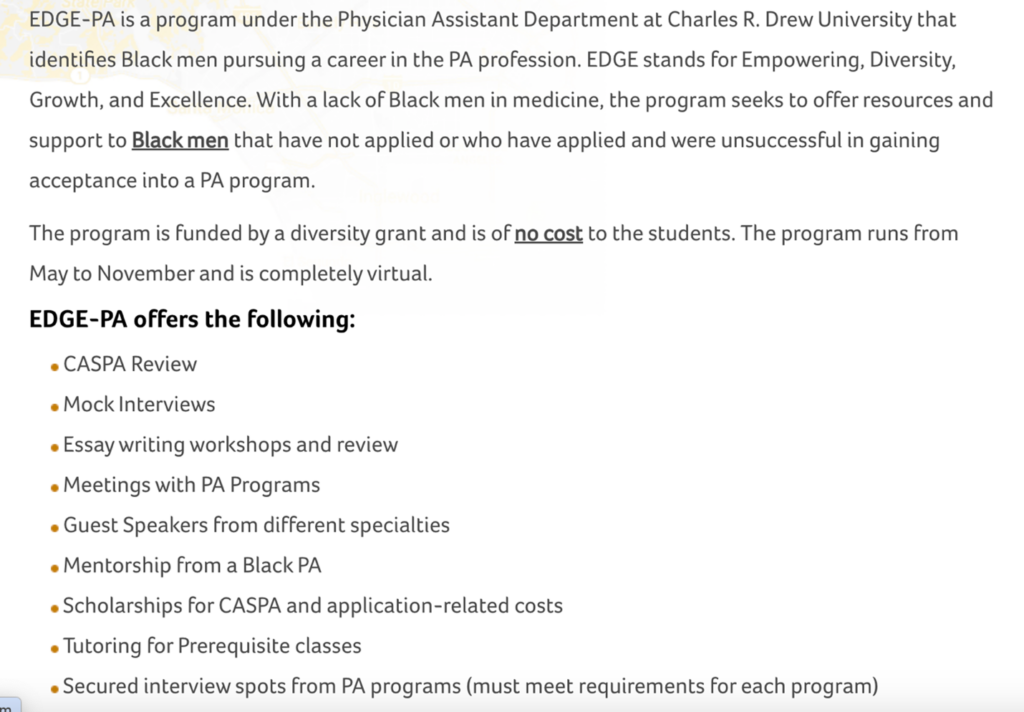
In July of 2023, Do No Harm filed a complaint with the U.S. Department of Education’s Office for Civil Rights (OCR) in response to the University’s operation of a discriminatory program. Specifically, CDU ran a scheme known as “EDGE-PA”, which offers “resources and support” only to “Black men” facing difficulty in getting accepted into a physician’s assistant program.
Figure 1. Charles Drew University EDGE program webpage as it appeared on July 29, 2023 (archived page here).
Included in the long list of “resources” offered exclusively to black men are mentorships, workshops, tutoring, scholarships, guest speakers, and much more.
In justifying the creation of the program, CDU professor and admissions chair Samuel Paik argued that “2% of the entire PA workforce are Black men. It’s no wonder why Black men have one of the highest morbidity and mortality rates in this country.”
This flawed line of logic attempts to connect a racial group’s representation in the medical workforce with that group’s average medical outcomes. This absurd theory is based on the conclusively disproven and archaic idea of racial concordance—e.g. that there is some medical benefit to seeing a physician of the same race. Do No Harm has repeatedly and decisively demonstrated the stunning lack of evidence to support racial concordance. In fact, overwhelming evidence suggests that racial concordance is nothing but a myth.
If that was not bad enough, CDU was not just looking for “black men” to participate in the EDGE-PA program—it was looking for black men who demonstrate, among other things, “a passion for social justice”. In other words, the program was not just racially discriminatory but also sought candidates who fit a very particular ideological mold.
Do No Harm was able to take screengrabs of the EDGE-PA website around the time the OCR complaint was filed. This turned out to be a worthwhile effort, as it seems CDU has deactivated the URL that linked to the EDGE-PA program. Today, that link directs the user to a “page can’t be found” screen.
Figure 2. CDU EDGE program page as it appeared on April 8, 2024.
CDU is not the first educational institution to try and delete the evidence after learning they were under a civil rights investigation. For example, in 2023, the University of Colorado School of Medicine (CUSOM) scrubbed its website following the submission of an OCR complaint by Do No Harm regarding discriminatory scholarships run by the school. Similarly, the University of Nebraska College of Medicine (UNCOM) quietly removed two discriminatory programs from its website following the initiation of an OCR investigation.
In other instances, colleges and universities have substantially altered the criteria for certain programs after an OCR investigation began but before it was concluded. Deleting or modifying evidence of discrimination is a typical response by schools after being notified they are under a federal civil rights investigation, and implicates the school with discrimination that they know is legally indefensible. It’s inexcusable and disappointing that medical schools routinely introduce illegal discriminatory programs without conducting a proper legal review for compliance with federal civil rights laws. Perhaps these schools didn’t expect their illegal discrimination to ever be challenged, and didn’t count on watchdog organizations like Do No Harm to come along and actively challenge their violations of Title VI and Title IX.
At the conclusion of 2023, Do No Harm had successfully prompted 40 federal civil rights investigations into various discriminatory programs, and multiple favorable outcomes were achieved as a result. So far in 2024, seven additional investigations have been opened. In cases when the offending material is removed or amended during the federal investigation, it’s an indication that the school has acknowledged its illegal discrimination and is taking corrective action to resolve the investigation.
In the case of CDU, the initial response to the federal investigation is a step in the right direction: any and all traces of the discriminatory EDGE-PA program have vanished. When the OCR concludes its investigation and holds CDU accountable for illegal discrimination, CDU will simply have to live with treating all aspiring physician assistants equally and not discriminating based on the color of their skin.
It is a sad day when a university resorts to blatantly discriminatory criteria reminiscent of 1950s prejudice in its programming. But, even if it is the result of a deletion during a federal investigation, it is a tremendous success when this type of programming is tossed into the trash bin.
https://donoharmmedicine.org/wp-content/uploads/shutterstock_767827396-scaled.jpg17072560Laura Morganhttps://donoharmmedicine.org/wp-content/uploads/DNH_Logo_Stethescope-1.pngLaura Morgan2024-04-12 10:48:512026-05-06 16:55:33Deleting Evidence During An Investigation Implicates Medical Schools
Mainstream gender theory is about to have its foundation shattered thanks to a new groundbreaking report.
Dr. Hilary Cass recently published a nearly 400-page report on “gender identity services for children and young people”. The report, which was commissioned by the National Health Service (NHS) England roughly four years ago, found “remarkably weak evidence” to support the use of puberty blockers and hormone treatments for gender distressed children. The report also includes 32 specific recommendations on how gender services should operate in England.
Dr. Cass is not someone whose opinions can be easily dismissed. She enters this politically-charged arena with impressive credentials. Not only is Dr. Cass Chair of the Independent Review of Gender Identity Services, but she is past President of the Royal College of Pediatrics and Child Health, past Chair of the British Academy of Childhood Disability, and was awarded an Order of the British Empire (OBE) for her services and accomplishments. Her opinion carries some significant weight.
In conducting the review, Dr. Cass examined 50 studies on puberty blockers and 53 on hormone treatments. The “remarkably weak evidence” that these studies provide lead her to call for “extreme caution” in treating gender distressed kids. This echoes the calls that Do No Harm has made to “review the research” behind pediatric gender medicine.
Dr. Cass also found that external factors have influenced and stifled conversation around gender identity treatments. For example, Dr. Cass suggests that parents may “unconsciously influence the child’s gender expression.” Similarly, health professionals are “afraid to openly discuss their views” on these issues due to fear of the social repercussions.
We’ve let them down because the research isn’t good enough and we haven’t got good data…The toxicity of the debate is perpetuated by adults, and that itself is unfair to the children who are caught in the middle of it. The children are being used as a football and this is a group that we should be showing more compassion to.
For years, those with the courage to express trepidation about pediatric gender medicine have had targets placed on their backs. Now, Dr. Cass confirms that attempts to stifle debate not only run counter to the spirit of open scientific inquiry but endangered kids who might have benefited from public skepticism and debate.
Dr. Cass details numerous suggestions for moving toward safer practices, including reviewing and scrutinizing the use of hormones and puberty blockers on young people; elevating the standards for gender services to the same standards that other medical procedures must abide by; taking a “holistic approach” to any gender-related interventions (including a mental health assessment and autism screening); and encouraging workplace supports to foster candid engagements by health professionals on the clinical treatment of gender-questioning children.
Other specific recommendations include:
Dramatically improving the supply of available research on gender-related medical interventions;
Offering children fertility counseling and preservation before proceeding to a medical pathway;
Establishing follow-through services for 17- to 25-year-olds;
Improving guardrails around the dispensing of relevant prescription medications;
Dr. Cass is not alone in sounding the alarm. Other European countries including Denmark, Finland, Sweden, Ireland, and Italy have either imposed restrictions on pediatric gender medicine or are currently debating it. That these countries already took a more conservative approach than the United States makes the continued insistence of safety and efficacy in the United States all the more absurd and untenable.
Our children deserve better than to be used as a football in a political debate. Dr. Cass rightfully acknowledges that the medical pathway is not the best way to manage gender-related distress in young people and that it is impossible to identify which children might persist in their feeling of gender dysphoria. Preventing children from accessing these irreversible interventions is the only sensible path forward.
https://donoharmmedicine.org/wp-content/uploads/shutterstock_1429387109-scaled.jpg17092560Laura Morganhttps://donoharmmedicine.org/wp-content/uploads/DNH_Logo_Stethescope-1.pngLaura Morgan2024-04-11 19:41:002026-05-06 16:53:50The Cass Report Is Out—An Early Analysis of Findings and Recommendations
DNH S2 SPECIAL: In this special episode of the Do No Harm podcast, scholar Yascha Mounk explains the origins of identity politics, how it undermines free societies, and how we can fight back.
https://donoharmmedicine.org/wp-content/uploads/2024/04/DNH-Podcast-Graphic-Yascha-Mounk.png10801920rededge-rachelhttps://donoharmmedicine.org/wp-content/uploads/DNH_Logo_Stethescope-1.pngrededge-rachel2024-04-10 20:42:352026-02-11 15:33:46S2 SPECIAL INTERVIEW: Yascha Mounk on Escaping the “Identity Trap”
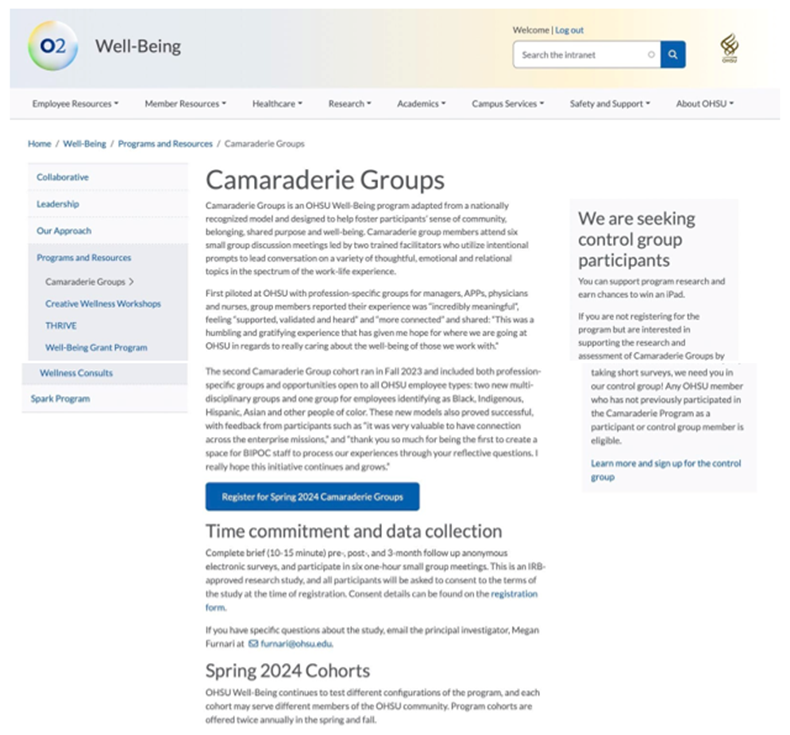
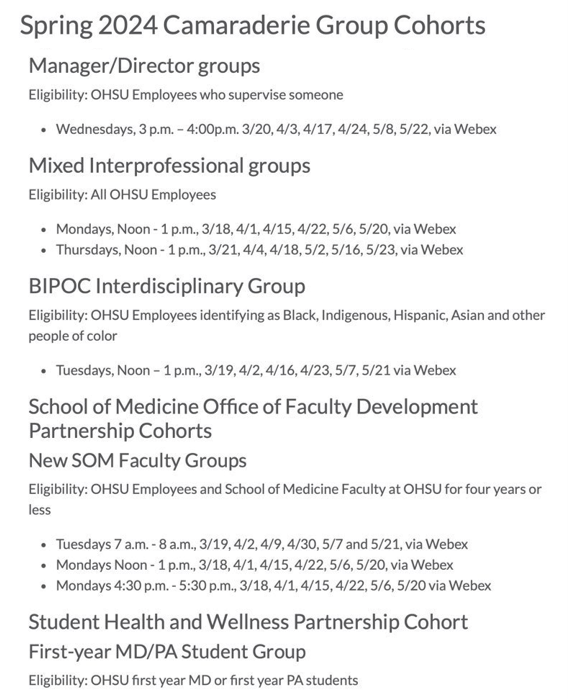
At the Oregon Health and Science University (OHSU), the school launched “Camaraderie Groups” as a pilot in 2023 to facilitate “small group discussion meetings” as a means to “lead conversation on a variety of thoughtful, emotional, and relational topics in the spectrum of the work-life experience.”
Upon first glance, this may sound innocent enough. But through anonymous reporting by a Do No Harm associate and the school’s response to a Freedom of Information Act (FOIA) request, Do No Harm learned that these “Camaraderie Groups” are a lot more concerning than their name suggests.
Here’s the kicker: one of the three groups in the program is only for OHSU employees who identify as “Black, Indigenous, Hispanic, Asian, and other people of color.” Put simply, despite OHSU’s statement that “All OHSU employees are eligible to participate”, in reality non-minorities are unwelcome to join in these discussions.
Figure 1. “Camaraderie groups” at Oregon Health and Science University.
Interestingly, the University does not provide any justification or reasoning as to why they needed to segregate-out a separate racially based group. It appears the utility from these conversations would be just as productive—if not even more so—if individuals from all walks of life were welcome to participate.
Figure 2. Spring 2024 Camaraderie Group Cohorts at OHSU.
This is yet another example of an American medical school implementing discriminatory practices by excluding certain racial groups from participating in offered programs. However, this is not all that much of a surprise coming from OHSU given the school’s track record.
In August 2022, Do No Harm asked the Office of Civil Rights (OCR) in the U.S. Department of Education to investigate OHSU for violating the Civil Rights Act. Specifically, the school operated a “diversity” program which was restricted to junior medical faculty applicants who are “underrepresented” in medicine and belong to select racial groups. Roughly a month following the OCR complaint, OHSU completely disabled the links to the program in question.
Additionally, in 2023, Doernbecher Children’s Hospital—which is affiliated with OHSU—came under fire for offering consultations on transgender treatments to children under 10 years of age. At the time, Do No Harm Founder Dr. Stanley Goldfarb noted that “The Oregon [H]ealth and [S]cience Children’s Hospital gender clinic provides a detailed series of descriptions of the various maneuvers that children may receive at the clinic during their gender transition…Nowhere in the descriptions for children is an opportunity for these often depressed, anxious, perhaps autistic children to receive psychological counseling or psychiatric therapy to help him deal with the incredibly complex and difficult transition that the unit continuously advocates.”
Now, yet again, OHSU is demonstrating an instance of the very worst of DEI activism on its campus through the creation of racially based camaraderie groups. The sooner this discriminatory experiment is ended, the better.
https://donoharmmedicine.org/wp-content/uploads/shutterstock_2167341865-scaled.jpg13502560Laura Morganhttps://donoharmmedicine.org/wp-content/uploads/DNH_Logo_Stethescope-1.pngLaura Morgan2024-04-10 20:26:012026-05-06 16:52:49What’s In a Name? Turns Out a Lot, When You’re Trying to Hide Discriminatory Activities
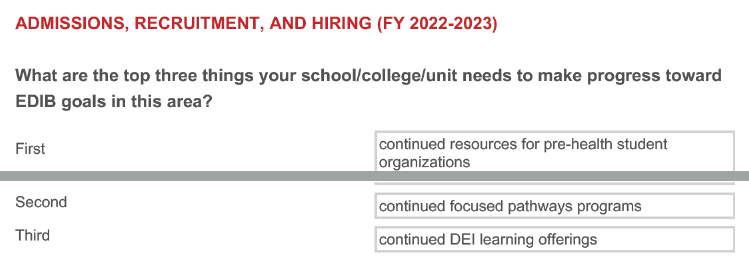
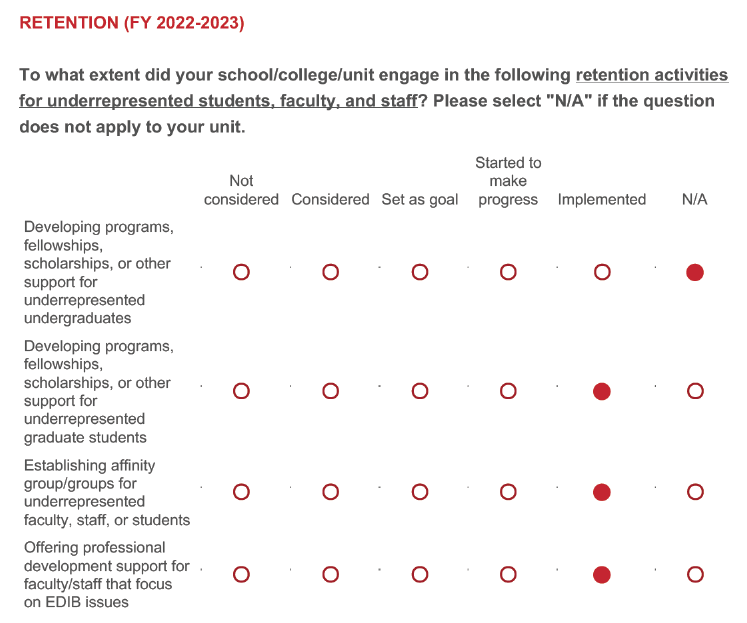
The School of Medicine and Public Health (SMPH) at the University of Wisconsin-Madison has adopted a set of concerning policies, according to an internal Equity, Diversity, Inclusion, and Belonging (EDIB) survey conducted in 2023. SMPH’s responses indicated that the school has successfully implemented nearly all of the model policies outlined in the survey. Many of these policies are controversial because of their potential to discriminate against faculty and students based on race or other identity characteristics.
The EDIB survey at UW-Madison is similar to other DEI-inventories, such as the DICE survey conducted by the Association of American Medical Colleges. These surveys offer alarming insight into the practices and goals of leading medical institutions that appear to prioritize diversity goals over merit and rigor. Moreover, many diversity, equity, and inclusion policies are shown to increase divisiveness in organizations after they are adopted and implemented.
Figure 1. From UW-Madison SMPH EDIB survey.
According to the EDIB survey results, here are some of the practices embraced by SMPH:
SMPH has incorporated DEI standards into merit and performance reviews for staff and faculty.
This policy dilutes and undermines the effectiveness of meritocratic promotions for faculty and staff by including metrics that are based in ideology rather than performance. As a result, faculty and staff are required to promote DEI ideology as a condition for professional advancement, eroding academic freedom and free speech.
SMPH has created senior leadership and support staff roles focused on DEI and diversity-related outreach in the community.
These policies create a permanent woke bureaucracy pushing ideology on faculty, students, and other top administrators. In addition to consuming substantial resources that could otherwise be used for academics, these programs pursue politically motivated activities within the university and the broader community.
SMPH issues statements of support in response to diversity-related situations in the community.
This policy alienates students, faculty, and community members who hold different views from the school on political issues that are otherwise irrelevant to the operations of the medical school. Further, SMPH imperils the reputation of their medical school by publicly reflecting the radical views of a small group of DEI bureaucrats within the institution.
SMPH has developed initiatives and programs dedicated to diversifying its graduate student-body, including fellowships and scholarships for underrepresented demographics.
Under this policy, Wisconsin’s taxpayers are funding programs that disadvantage people of certain racial and ethnic backgrounds. While these programs are separate from race-based admissions policies, they are comparably effective at limiting opportunities for demographics of students who are not chosen as priorities by woke bureaucrats.
Figure 2. From UW-Madison SMPH EDIB survey.
SMPH’s DEI policies warrant concern from the medical community, policymakers, and the public. These practices are increasingly at odds with state legislators, who held a hearing earlier this year to address a bill that would limit certain types of DEI policies in Wisconsin’s institutions of higher learning. In her testimony, a policy expert from the Cicero Institute promoted a national study from the Bipartisan Policy Institute that found that two-thirds of students in the U.S. believe that diversity, equity, and inclusion initiatives undermine free speech.
SMPH has moved quickly to adopt and scale its DEI programming, as indicated by its high score on the EDIB survey. While these results might seem daunting for those seeking to roll back DEI, the EDIB survey actually creates a roadmap for reform. One of the most challenging aspects of creating legislation to counteract DEI is the sheer variety of policies that need to be targeted. Surveys like this one identify the specific areas into which DEI has permeated for state leaders. Undoubtedly, diversity surveys like EDIB and DICE promote DEI and pressure institutions to expand their initiatives to maintain alignment with peer institutions. But they also present opportunities for proper transparency and oversight that could prove valuable to policymakers looking to reintegrate meritocracy and rigorous academics into medical schools and other institutions of higher learning.
https://donoharmmedicine.org/wp-content/uploads/shutterstock_250883302-scaled.jpg17092560Laura Morganhttps://donoharmmedicine.org/wp-content/uploads/DNH_Logo_Stethescope-1.pngLaura Morgan2024-04-07 13:30:042026-05-06 16:51:40UW-Madison’s Medical School Adopts Divisive DEI Policies, According to Internal Survey
Like many universities across the United States, the University of Wisconsin-Madison is revising its admissions policies to comply with the U.S. Supreme Court decision in Students for Fair Admissions v. Harvard (2023). While the university’s leadership has made clear its intention to comply with the basic contours of the law, UW-Madison intends to follow peer institutions in using its holistic admissions process to continue towards its diversity and equity goals.
Following the Supreme Court’s ruling, the new strategy of admissions reviewers is to create essay questions for applicants that evoke characteristics, experiences, and beliefs aligned with diversity, equity, and inclusion goals for the institution. This strategy is not illegal as long as it is not used as a simple proxy for race in the admissions process. Moving away from data-driven race-based admissions practices is progress, but using essay questions to accomplish related goals raises other problems. UW-Madison’s approach is an instructive case study for these issues and the tradeoffs of transitioning from affirmative action to different strategies to increase diversity.
UW-Madison’s leadership announced three specific changes to its admissions practices in an internal email to graduate school faculty, department chairs, and admissions coordinators in August 2023. First, the university will still collect race and ethnicity information, but application reviewers will not be able to view or consider those data in the admissions process. Second, graduate programs will be permitted to add supplementary essay questions focused on diversity, equity, and inclusion to their applications. Third, departments are encouraged to use a holistic review of applications for admission that includes how applicants can contribute to diversity, equity, and inclusion.
To support departments in this transition, the university’s Office of Legal Affairs developed a list of approved DEI essay questions that were vetted to comply with the Supreme Court’s ruling in Students for Fair Admissions v. Harvard (2023). These questions ask students to define their “role and/or contribution to create a more diverse, accepting, and stimulating” environment on campus and in the community, or to describe how they have “further[ed] [their] knowledge about building or enhancing a community of inclusion, belonging, and respect.” While these essay questions offer students the opportunity to provide racial and ethnic information about themselves that could be misused in the admissions process, it is of far greater concern how these questions can be used to gauge an applicant’s loyalty to the ideological principles of diversity, equity, and inclusion.
Over the last decade, colleges and universities across the country have started to use similar essay questions to ensure allegiance to diversity, equity, and inclusion among its faculty. According to a legislator’s testimony for a Wisconsin State Assembly hearing on a 2024 assembly bill to ban such practices, nearly half of all large universities require potential faculty members to write statements in support of DEI. A representative from the Cicero Institute, a Texas-based think tank that has worked extensively to ban DEI academic loyalty oaths in state universities, offered additional testimony that noted that the University of Wisconsin removed such requirements for faculty, but other Wisconsin universities, like Madison Area Technical College, have not.
The UW—Madison may have removed requirements for potential faculty to write DEI statements during the hiring process, but under new admissions policies, the university’s graduate departments may now require prospective students to fulfill similar requirements. Other universities are likely to follow this path, replacing race-based admissions practices with ideology-based admissions practices. The result could be catastrophic for free speech and academic freedom among students.
States like Florida, Tennessee, and Texas have passed laws like the one being considered in Wisconsin which ban DEI in hiring and training at institutions of higher learning. These laws, however, do not specifically include admissions practices for undergraduate or graduate students. Universities are likely to exploit this gap in states that have already passed DEI reforms, and legislators may need to revisit their legislation. In states like Wisconsin that are still developing their reforms, legislators ought to consider whether or not universities should be permitted to require student DEI loyalty oaths. Universities appear to be accommodating the new requirements for admissions practices under the Supreme Court’s ruling, but a new frontier in perverse admissions practices has opened, and policymakers must remain vigilant.
https://donoharmmedicine.org/wp-content/uploads/shutterstock_351708407-scaled.jpg17002560Laura Morganhttps://donoharmmedicine.org/wp-content/uploads/DNH_Logo_Stethescope-1.pngLaura Morgan2024-04-07 12:59:122026-05-06 15:44:48After Affirmative Action, DEI Opens a New Frontier in University Admissions
Kansas lawmaker and physician Rep. Ron Bryce shares a simple and powerful message: gender transitions for children are child abuse. He believes the procedures are unsafe, unproven, and unethical for kids—and he’s sponsoring a bill that would ban them for anyone under 18.
https://donoharmmedicine.org/wp-content/uploads/2024/04/DNH-Podcast-Graphic-General-Bryce-1.png10801920rededge-rachelhttps://donoharmmedicine.org/wp-content/uploads/DNH_Logo_Stethescope-1.pngrededge-rachel2024-04-03 19:28:202026-02-11 15:33:46S2E12: Rep. Ron Bryce on Working to Ban Abusive Gender Transitions for Children
On January 13, 2024, Duquesne University announced that it was opening a new osteopathic medical school on its Pittsburgh campus. Consistent with the trends seen in medical schools today, its website announced its support for “Diversity, Equity and Inclusion” (DEI). But when a medical school like Duquesne endorses DEI, it is not endorsing the ordinary meanings of the individual words. Rather, it is laundering a radical ideology using the words “diversity, equity, and inclusion” as cover.
Beneath DEI’s noble-sounding words lurks a terrifying reality: oppressed identity is more important than competence. Now, with recent evidence that osteopathic medical schools are embracing DEI, Duquesne now only the most recent case, DEI has spread through virtually all of medical education. So why is Duquesne moving forward with this agenda?
In July 2022, the Association of American Medical Colleges (AAMC)–the nonprofit responsible for allopathic medical school accreditation–published the official guidance document called “Diversity, Equity, and Inclusion Competencies Across the Learning Continuum”. This document states that America is currently governed by a “system of oppression” called “white supremacy”, and declares, “The call for an anti-racist health care system — one which recognizes and addresses the intersectionality of systems of oppression — amplifies every day. [sic]”
This is alarming and disorienting. Yet less than one year after the AAMC guidance was published, the American Association of Colleges of Osteopathic Medicine (AACOM) followed suit. In 2023, AACOM began requiring that every osteopathic medical school’s mission statement contain a political oath declaring fealty to DEI, and hire a full-time administrator trained in the political orthodoxies of DEI.
This brings us back to Duquesne University’s new medical school. On its website, it declaredthat it is “committed to increasing diversity within medicine”, which in practice means the selective lowering of achievement standards for certain favored groups. The website recites a standard catechism: “Studies show…”.
But ideology, not evidence, is leading the way here.
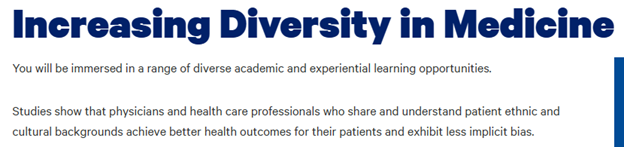
Among other things that the “studies show”, the Duquesne website states that: “health care professionals who share and understand patient ethnic and cultural backgrounds achieve better health outcomes for their patients.” This is called racial concordance theory. As we carefully documented, the preponderance of evidence rejects the idea that patients receive better care from doctors of the same race.
Duquesne also makes a sweeping appeal to “exhibit less implicit bias”, implying that physicians that are ethnic minorities have less implicit bias than whites. Yet the data on implicit bias theory are even more damning, with multiple studies clarifying that the implicit association test is afflicted with profound issues of reliability (whether scores are similar over repeated tests) and validity (whether scores predict real world behavior).
Figure 1. From the Duquesne University College of Osteopathic Medicine website.
But it gets worse. As part of its commitment to “diversity”, Duquesne’s website says it is committed to “attracting medical school candidates who have a basic understanding of the importance of DEI and a demonstrated desire to learn more.” This alludes to a dubious but widespread practice among medical schools of asking about an applicant’s agreement with DEI-related concepts in their secondary applications. As we reported last year, 36 of 50 top medical schools engaged in this practice.
There are a few ways forward to eliminate DEI initiatives in higher education, such as the ones that Duquesne is currently embracing. In 2023, anti-DEI legislation for America’s universities began sweeping across the country, especially in Texas, Tennessee, and Florida. A bill recently introducedin the U.S. House of Representatives by Congressman Dr. Greg Murphy called the EDUCATE Act would cut federal funding for medical schools that teach and promote divisive DEI concepts; compel students or faculty to take loyalty oaths such as in medical school applications; racially discriminate for scholarships, classes, or other opportunities; or maintain DEI offices, departments, or other equivalent bureaucracies or administrative positions. Duquesne University would be well-served by adopting this strategy, ensuring a more ideologically diverse–and scientifically inclined–student body while safeguarding the integrity of healthcare and the lives of patients.
https://donoharmmedicine.org/wp-content/uploads/shutterstock_722835706-scaled.jpg17072560Laura Morganhttps://donoharmmedicine.org/wp-content/uploads/DNH_Logo_Stethescope-1.pngLaura Morgan2024-04-02 21:29:422026-05-06 15:43:47Duquesne University Opens New Osteopathic Medical School – But Puts DEI at the Forefront
Two respected psychiatrists who work with transgender-identified youths are calling out the American Psychiatric Association’s latest guidance on gender ideology for what it is: a political manifesto dressed up as science.
https://donoharmmedicine.org/wp-content/uploads/2024/03/DNH_Podcast_Graphic_Schwartz_Grossman.png10801920rededge-rachelhttps://donoharmmedicine.org/wp-content/uploads/DNH_Logo_Stethescope-1.pngrededge-rachel2024-03-27 13:42:352026-02-11 15:33:46S2E11: Drs. Lauren Schwartz and Miriam Grossman on challenging the American Psychiatric Association’s new manifesto on gender ideology