
• HAVE YOU SEEN OR EXPERIENCED THE IMPACT OF DEI OR RADICAL GENDER IDEOLOGY AT YOUR INSTITUTION? CLICK HERE TO SHARE YOUR STORY.
Do No Harm
  • About Us
    • ABOUT
    • TEAM
    • FAQS
    • WHAT OTHERS SAY
    • VOICES OF DO NO HARM
  • OUR WORK
    • NEWSROOM
    • ISSUE AWARENESS
      • IDENTITY POLITICS (DEI)
      • GENDER IDEOLOGY
    • POLICY WORK
    • LEGAL ACTION
    • RESEARCH
    • RESOURCES
    • CENTERS
  • GET INVOLVED
    • SUBMIT A TIP
    • BECOME A MEMBER
    • CAREERS
    • INTERNSHIPS
  • MEDIA INQUIRIES
  • Search
  • DONATE
  • Menu Menu
Doctors,,Nurse,Or,Laptop,In,Night,Healthcare,,Planning,Research,Or

The Perils of Reductionism

Uncategorized United States DEI Commentary Howard Fenn, Kurt Miceli, MD

In their article, “Neighborhood Social Vulnerability and Racial Disparities in Schizophrenia Spectrum Disorder Prevalence,” Deidre Anglin and colleagues posit that disparities in schizophrenia spectrum disorders (SSDs) between the black population and non-Hispanic whites are explained by structural racism.[1] The claim is made with generalities, broadly referencing “racially inequitable policies” related to housing, education, and economic structures. Doing so unfortunately fulfills an ideologically one-sided narrative that diverts attention from medically actionable practices such as prenatal care during pregnancy and psychiatric treatment for substance use disorders. 

More specifically, in outlining “racially inequitable policies,” Anglin and colleagues reference unsubstantiated claims like “police victimization,” including two footnotes which provide no evidence linking such to the development of SSDs. They also offer a series of risk factors, including “childhood trauma, prenatal and perinatal complications induced by stress in mothers, and chronic environmental stress.” While we take no issue with exploring these variables, the connection to “structural racism” itself is not established. 

Despite this lack of clarity, the authors are quick to collect any contributor to population differences within the construct of “structural racism.” This preoccupation with a singular, overarching explanation for disease also adds a political valence to the discussion. In doing so, the authors overlook additional researchable risk factors, some of which are modifiable, including: parental age, low birth weight, obstetric complications, maternal malnutrition, maternal infections, brain structural abnormalities, and cannabis use – all of which have been related to SSDs.[2]

This study feeds a divisive narrative that neither encourages individual agency nor examines critical non-racial factors that contribute to the formation of SSDs. Its  conclusions misguide public health efforts and limit the development of targeted interventions that could address the complex interplay of genetic, behavioral, and environmental influences on mental health. Should we follow this reductionist presumption for the etiology of SSDs, we will be limiting rational and scientifically sound medical care for many individuals.

References


[1] Anglin D, et al. Neighborhood Social Vulnerability and Racial Disparities in Schizophrenia Spectrum Disorder Prevalence. Am J Psychiatry. 2025 Sep;182(9):850-860. doi: 10.1176/appi.ajp.20240906.

[2] Schmitt A, Falkai P, Papiol S. Neurodevelopmental disturbances in schizophrenia: evidence from genetic and environmental factors. J Neural Transm (Vienna). 2023 Mar;130(3):195-205. doi: 10.1007/s00702-022-02567-5. Epub 2022 Nov 12. PMID: 36370183; PMCID: PMC9660136.

https://donoharmmedicine.org/wp-content/uploads/2024/07/shutterstock_2256248491-scaled.jpg 1563 2560 Naomi Risch https://donoharmmedicine.org/wp-content/uploads/DNH_Logo_Stethescope-1.png Naomi Risch2025-11-12 16:26:042026-02-11 15:34:14The Perils of Reductionism
Concept,Of,Medical,Education,And,Medical,Books

Dustup at Washington State University Underscores the Politicization of Continuing Medical Education

Uncategorized United States DEI, Gender Ideology Accreditation Council for Continuing Medical Education, Washington State University Elson S. Floyd College of Medicine Medical association, Medical School Commentary Naomi Risch

Continuing Medical Education (CME) is a requirement for maintaining a medical license and is meant to promote professional growth and improve patient care. In practice, a recent dust-up at a Washington medical school reveals that it has become yet another vehicle for injecting and enforcing far-left ideological orthodoxies into American medicine.

Washington State University’s medical school took the commendable step of providing access to CME courses developed by the Society for Evidence Based Gender Medicine, a nonprofit that aspires to bring reason, rigor, and healthy skepticism into debates about so-called “gender affirming care” for minors. 

Unfortunately that decision drew the attention and ire of transgender activists as well as the Accreditation Council for Continuing Medical Education (ACCME), the organization tasked with determining which entities can provide continuing medical education. Recently, the ACCME initiated an investigation into WSU’s vetting of SEGM courses and ordered them to pull those courses even before the investigation concludes. 

While skeptics of pediatric sex changes are scrutinized by the ACCME, those who toe the line for transgender activists appear to enjoy full autonomy. 

A module provided by the American Medical Association claims that “Access to gender-affirming care is associated with increased quality of life and decreased rates of self-harm…in transgender adults and youth” and that “For some, gender-affirming surgery may be the only effective treatment.” The module fails to note that the evidence used to support these claims is weak and has a high risk of bias, the precise problems that health authorities in the United Kingdom, Sweden, and Finland acknowledged in their u-turn on pediatric sex changes.

Meanwhile, the AMA doesn’t feature a single module dedicated to understanding the significant risks of “gender-affirming care.” At best, some courses mention risks in passing. There is just one lone module on detransitioning, compared to 22 modules that mention “gender-affirming care,” which flies in the face of “giving a fair and balanced view of diagnostic and therapeutic options.”

Standard 1 in ACCME’s accreditation requirements is “Ensure Content is Valid,” and mandates that “recommendations for patient care…must be based on current science, evidence, and clinical reasoning, while giving a fair and balanced view of diagnostic and therapeutic options.” Meanwhile, the Standards for Integrity and Independence in Accredited Continuing Education are supposed to “present learners with only accurate, balanced, scientifically justified recommendations.” In practice, it’s clear that ACCME “standards” are wielded as political cudgels and not mechanisms for rigorous, apolitical gatekeeping. 

The problem doesn’t appear to be unique to transgender issues. In a module on the American Medical Association’s website entitled ‘Five Ways Health Care Can Be Better for Fat People,’ sociologist Kristen A. Hardy, who does not hold a medical degree, writes, “Medical or surgical treatments that intentionally attempt to manipulate body weight should not be offered and should be recognized as manifestations of a biased (and racist) cultural mindset…”

There is no attempt in this article to find balance, alternative viewpoints, or scientific justification. Instead, it privileges “cultural mindset” over actual science. This shouldn’t come as a surprise; ACCME’s Strategic Goals for 2022 – 2026 call for “incorporating the issues of diversity, equity, and inclusion into all aspects of accredited education.” Regrettably, this has only exacerbated political agendas permeating medical education. 

While CME holds promise for advancing medical care, we must demand that the ACCME uphold their standards of “only accurate, balanced, scientifically justified recommendations,” lest we waste doctors’ valuable time, contribute to their indoctrination or—much worse—risk harming patients.

https://donoharmmedicine.org/wp-content/uploads/2024/07/shutterstock_2269385773-scaled.jpg 1707 2560 Naomi Risch https://donoharmmedicine.org/wp-content/uploads/DNH_Logo_Stethescope-1.png Naomi Risch2025-11-10 17:54:072026-02-11 15:34:14Dustup at Washington State University Underscores the Politicization of Continuing Medical Education
DNH_ContentCards_PressRelease

Do No Harm Notches Legal Victory After HHS Scraps Discriminatory Biden-Era Rule

Uncategorized United States DEI Department of Health and Human Services Federal government Press Release Executive Do No Harm Staff

RICHMOND, VA; November 10, 2025 – Do No Harm achieved another significant legal victory after the Department of Health and Human Services (HHS) reversed a Biden-era regulation that offered higher federal payments for physicians who implement an “anti-racism” plan. Aimed at treating broad societal disparities regardless of their cause, the “anti-racism” rule encouraged doctors to use race as a primary factor in care over individualized medical treatment.

In 2022, Do No Harm took issue with the rule, supporting a lawsuit against the Biden administration’s HHS Secretary Xavier Becerra and Centers for Medicare and Medicaid Services (CMS) Administrator Chiquita Brooks-Lasure. Specifically, the lawsuit argued that CMS’s adoption of the “anti-racism” rule unlawfully exceeded the agency’s permissible authority under the Medicare Access and CHIP Reauthorization Act of 2015 (MACRA).

Following the Trump administration’s reconsideration of its position in the case, CMS removed the challenged racial equity provisions in a new final rule published on November 5, 2025.

“Do No Harm applauds HHS Secretary Robert F. Kennedy and CMS Administrator Dr. Mehmet Oz for undoing the unscientific and discriminatory Biden-era rule,” said Stanley Goldfarb, MD, Chairman at Do No Harm. “While masquerading under the misleading ‘anti-racist’ moniker, in practice, these policies injected race-based decision making into the doctor-patient relationship. Such racial discrimination has no place in healthcare. By prioritizing evidence-based policies, HHS is working to rebuild public trust in our medical system.”

Additional Details:

  • The case was brought by a Do No Harm Visiting Fellow, Dr. Amber Colville, and a group of states.
  • Given CMS’s new rule removing the challenged racial equity provisions, the lawsuit is expected to be voluntarily concluded in the coming weeks.

Click here to read the original complaint.

Click here to read the new rule.

###

Do No Harm, established in April 2022, has rapidly gained recognition and made significant strides in its mission to safeguard healthcare from ideological threats. It has over 50,000 members, including doctors, nurses, physicians, and concerned citizens across all 50 states and 14 countries.

https://donoharmmedicine.org/wp-content/uploads/2022/11/DNH_ContentCards_PressRelease.png 675 1200 Naomi Risch https://donoharmmedicine.org/wp-content/uploads/DNH_Logo_Stethescope-1.png Naomi Risch2025-11-10 17:47:242026-02-11 15:34:14Do No Harm Notches Legal Victory After HHS Scraps Discriminatory Biden-Era Rule
Personal,Opinions,Prejudice,Bias.,Concept,Of,Facts,And,Biases,On

The Unfortunate March to Wokeness by March of Dimes

Uncategorized United States DEI March of Dimes Nonprofit Commentary Greg Drobny

Continuing education modules in medicine may, at times, reveal the ideological goals of the organization hosting them. The March of Dimes (MoD), a nonprofit originally founded to combat polio, and now ostensibly devoted to maternal and infant health, is no exception.

In its course titled “Awareness to Action: Dismantling Bias in Maternal and Infant Healthcare®,” MoD finds a way to include as much wokeness as it possibly can. From the beginning, one of its four goals is to “Explain how structural racism has played a key role in shaping care settings within the U.S. and contributes to implicit biases in patient/provider encounters.”

This trope is all too familiar at this point, but deserves pointing out again: simply saying “structural racism” over and over does not make it real, even though the curriculum writers claim it is. 

Do they make any attempt to prove this assertion?

Within the context of “structural racism,” several slides are shared by MoD focusing on the disparity between black and white maternal mortality, yet their own graphs do not offer the full context, and they do not back up the implied connection between disparities and “structural racism.” 

As Do No Harm reported three years ago, a data set of 800 people out of over 3.5 million births is too small to draw society-wide conclusions, especially when the CDC data and research demonstrates that many of these deaths were not as preventable as is often claimed.

To be clear, even a single death of a pregnant woman is one too many. But the overwhelming majority of women survive motherhood, and highlighting the extremely rare instances of maternal death does not, in itself, indicate an inherent problem with the way society functions.

In other words, simply showing a disparity between racial groups does not prove claims of “structural racism,” especially when such analyses fail to account for medical co-morbidities and other contributing factors in maternal mortality. For example, Do No Harm reported on a detailed study by the CDC showing that 42% of deaths related to pregnancy were not preventable, having to do with conditions such as cardiovascular disease and pulmonary embolism. Other contributing factors, such as hypertension and kidney disease, are often genetic.

These facts are conveniently left out of the presentation shared by MoD.

The course continues with a distinction between equality and equity, stating:

Equality

Treating everyone the same, no matter where they’re starting from or whether outcomes remain unequal. Equality has to do with giving everyone the exact same resources.

Equity

Equity involves distributing resources based on the needs of the recipients.

To that end, MoD pushes learners to “establish a culture of equity” as another one of its educational objectives. This drive for equity – instead of equality – rests on the unproven premise that there is continuing “structural racism” throughout healthcare.  And, consequently some people must be treated more favorably than others based on their identity. 

Another word for this is discrimination.

Offering terms like equality and equity in this way, and defining them as they do, demonstrates a desire to turn medical professionals into social justice warriors rather than improve their skills as healthcare providers. 

Moving on to a section titled “Implication of Bias,” we are told:

Bias can influence behaviors and actions that are discriminatory. When these behaviors and actions are consistently repeated without being interrupted, it can lead to inequitable practices on a systemic and structural level. As you continue with this learning activity, you will learn more about the impact of structural racism in care settings and research.

Structural racism is a key driver of unequal outcomes for people of color in the United States. It has resulted in political and economic setbacks especially among Indigenous and Black populations. It also contributes to health disparities among these groups.

First, it does not follow that ‘structural racism’ is the chief cause of racial disparities because of the false claim that healthcare professionals have unconscious biases that ‘can’ influence their behaviors. But more importantly, the notion that implicit bias predicts real-world behaviors, much less health outcomes, is simply false and has been repeatedly debunked.

In popular terminology, this is called a bait-and-switch. We are told that bias can influence behaviors and actions, but then again assured that “structural racism” is foundational to the way healthcare operates.

Structural racism is the historical, cultural, social, psychological, and legal system of racial bias across society and institutions that disadvantage certain racial groups.

The claim that “structural racism” drives maternal mortality disparities is bold and far-reaching, yet the mechanism behind it is never clearly explained or supported by evidence.

To bolster this, we are given examples of Dr. James Marion Sims operating on women of color (in the mid-1800s, which MoD conveniently leaves out) and Puerto Rican women taking part in high-dose hormonal contraceptives studies (more than half a century ago), as if these stories prove their point. 

How might isolated historical references demonstrate “structural racism”? While we certainly want to appreciate past events for what they are – acknowledging wrongdoings while simultaneously also understanding them in historical context – citing a 19th-century surgeon  and unethical studies from the 1950s is hardly sufficient evidence to label the modern healthcare system as fundamentally racist. To state that their evidence is cherry-picked would be too kind.

From here, the class moves further towards promoting political activism. Section titles such as “Race Forward: Framework for advancing racial equity in the federal government” point directly toward a goal that goes well beyond the scope of maternal care by, once again, attempting to turn medical professionals into social justice warriors. 

If the goal were truly scientific education, then MoD’s class would provide evidence-based information, not ideological rhetoric that shifts focus from patient care to political advocacy.

For those truly focused on improving maternal care a “framework for advancing racial equity in the federal government” is simply unnecessary – unless the goal is to prioritize ideology over the actions that can be taken to mitigate medical co-morbidities and improve access to care.

Yet, this focus on advocacy shouldn’t come as a surprise. Throughout the course MoD can’t even use the term “mothers.” Instead, it opts for phrases like “birthing people” or “people with uteruses,” demonstrating far more concern for being woke than maternal health. 

It’s disheartening to witness a once-respected organization like the March of Dimes shift so drastically toward political advocacy. Sadly, this course – led by so-called professionals in maternal and infant health – offers little more than an attempt at ideological indoctrination. Instead of providing clear, evidence-based medical guidance to support mothers as they bring new life into the world, it delivers confusing, politically charged messaging that undermines its stated purpose.

https://donoharmmedicine.org/wp-content/uploads/2024/02/shutterstock_2044515767-scaled.jpg 1705 2560 Naomi Risch https://donoharmmedicine.org/wp-content/uploads/DNH_Logo_Stethescope-1.png Naomi Risch2025-11-07 16:18:442026-02-11 15:34:14The Unfortunate March to Wokeness by March of Dimes
The,Students,Were,Doing,The,Exams,Inside,The,Classroom,With

Medical College of Wisconsin Subjects Students to DEI Workshop

Uncategorized Wisconsin DEI Medical College of Wisconsin Medical School Commentary Do No Harm Staff

In early October, the Medical College of Wisconsin (MCW) subjected medical students to a workshop aimed at inculcating students into the DEI ideology.

The “Race Matters Workshop” was included in MCW’s “The Good Doctor” course, which is intended to instruct students on professionalism, ethics, and other soft skills in the medical workplace.

According to a description of the workshop obtained by Do No Harm, its learning objectives are replete with references to DEI and implicit bias. These objectives make clear that medical students are expected to agree with the premises of radical identity politics.

For instance, one objective is that students “[d]emonstrate knowledge of inherent biases and how they affect the way we interact with patients and advocate for them.”

There is no evidence that “implicit biases” explain racial health disparities, and the tests used to evaluate implicit bias fail to meet widely-accepted standards of reliability and validity.

For instance, a 2013 meta-analysis published in the Journal of Personality and Social Psychology found that Implicit Association Tests (IATs) were “poor predictors” of real-world bias and discrimination.

Nevertheless, other course objectives include: “Describe the role that providers have in addressing racism as a health issue in clinic settings and discuss some of the challenges and barriers faced when doing so”; and “Discuss ways that participants can be the voice for patients who are affected by health disparities created by racism.”

To be clear, it is not the role of a medical provider to serve as an activist; a physician’s goal is to provide the best possible care to his or her patients. 

Moreover, redefining the responsibilities and mission of healthcare professionals so that they moonlight as “racism ombudsmen” is harmful and naturally politicizes the workplace. It erodes trust, creating a presumption that healthcare is inherently racist, and encourages healthcare professionals to adopt the premises of political ideology. It encourages providers to be on the hunt for structural boogeymen rather than focusing on promoting the good health of individual patients.

Additionally, the workshop asks students to read a resolution from the Wisconsin Public Health Association (WPHA) declaring that “Racism is a Public Health Crisis.”

The resolution states that “public health’s responsibilities to address racism include reshaping our discourse and agenda so that we all actively engage in racial justice work.”

Additionally, the resolution commits the WPHA to “creat[ing] an equity and justice oriented organization” and “identifying specific activities to increase diversity and to incorporate antiracism principles across WPHA membership, leadership, staffing and contracting.”

Other commitments include: “Advocat[ing] for relevant policies that improve health in communities of color, and supports local, state, and federal initiatives that advance social justice.”

This resolution is presumably the MCW’s model for its students: promoting DEI in the workplace, including through discriminatory means, and engaging in political activism.

But that’s not all.

According to the workshop’s agenda, students were then subjected to various DEI-related activities. 

These included a video titled “Allegories on Racism,” as well as a quiz on “equity/diversity awareness.”

In sum, it’s clear that MCW is intent on injecting radical identity politics into its curriculum.

This is not the function of medical education, pure and simple. MCW should focus on educating the best possible physicians, not training the next generation of radical activists.

https://donoharmmedicine.org/wp-content/uploads/2024/12/shutterstock_2315342143-scaled.jpg 1440 2560 Ailan Evans https://donoharmmedicine.org/wp-content/uploads/DNH_Logo_Stethescope-1.png Ailan Evans2025-10-30 15:34:222026-02-11 15:34:14Medical College of Wisconsin Subjects Students to DEI Workshop
image-6

The Society for Academic Emergency Medicine Hosts DEI Activism Discussion

Uncategorized California DEI Medical association Commentary Do No Harm Staff

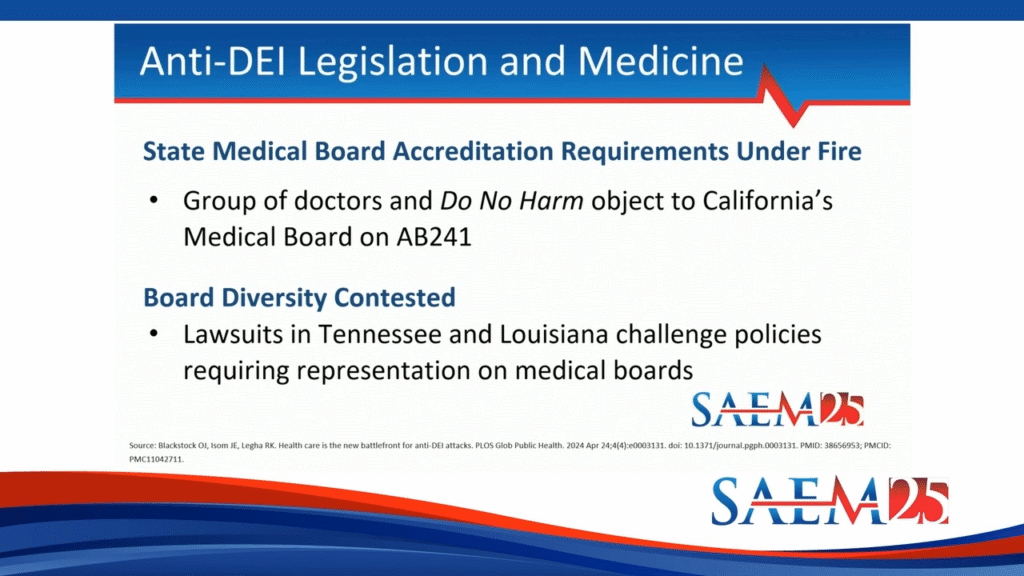
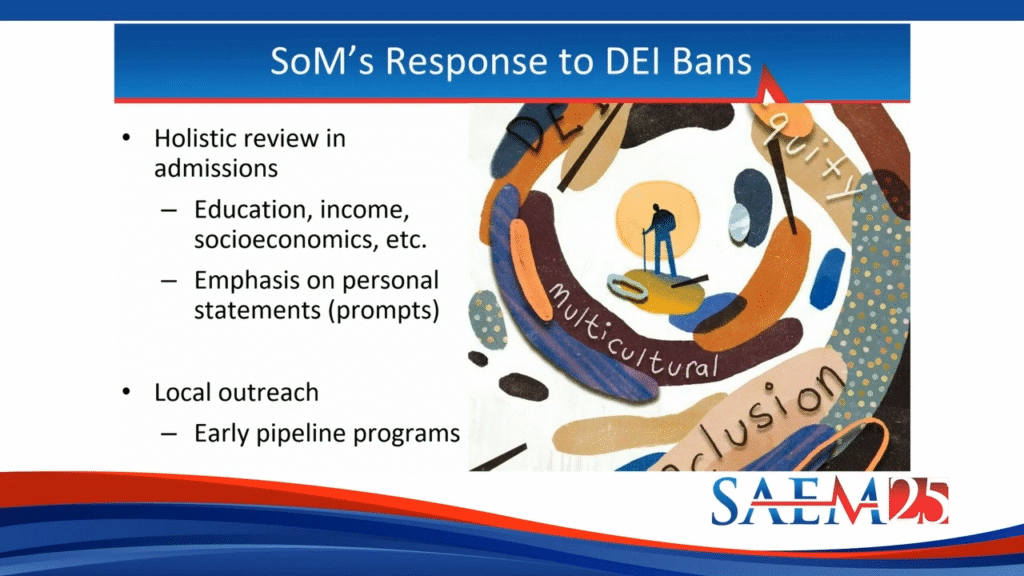
Earlier this year, the Society for Academic Emergency Medicine (SAEM) hosted a discussion overviewing recent laws restricting DEI – and discussing strategies to skirt these new policies. SAEM is a membership organization representing clinicians, educators, students, and others involved in academic emergency medicine.

The discussion, titled “Shhh! Don’t Say DEI: An Open Dialogue to Address DEI in Academic Emergency Medicine” focused on the impact of legislation, litigation, and other efforts that prevent medical schools from engaging in discriminatory behavior. 

According to the video description, the goals of the event included: “discuss strategies used by residencies that successfully maintained or expanded DEI efforts despite opposition”; “discuss approaches to creating psychologically safe spaces for trainees to discuss DEI concerns”; and “discuss collaborative ways to sustain DEI work in the face of institutional and political challenges.”

In other words, the discussion would focus on ways in which medical schools could continue DEI activities despite recent legislation, executive orders, and the Supreme Court’s decision in Students for Fair Admission v. Harvard that race-based admissions are unconstitutional.

Although the speakers identified themselves at the start of the discussion, due to the audio quality of the recording coupled with Do No Harm’s interest in accuracy, Do No Harm has refrained from attributing specific quotes to individual speakers.

The discussion began with an ostensible justification for DEI in medical education: the theory that racial concordance – when patients are treated by physicians of the same race – improves health outcomes. 

“It’s known that whenever you have a patient and a provider and they look similar or they share an identity characteristic, something really powerful happens,” one of the speakers began.

“And it’s not just about these behavioral changes; it’s literally about survival,” the speaker continued. “So, black newborns are more than twice as likely to survive whenever they are cared for by a black physician. It also increases lifespan.”

First, the argument that racial concordance improves health outcomes is not supported by the existing evidence. As Do No Harm’s own research has shown, five out of six systematic reviews find that racial concordance has no impact on health outcomes

Second, the claim referring to black newborn mortality appears to be referring to a long-debunked study, “Physician–patient racial concordance and disparities in birthing mortality for newborns,” which found no race concordant effect when the proper controls were applied.

Nevertheless, the speaker repeats arguments for racial concordance further on in the video, arguing that DEI programming and a more diverse student body contribute to better health outcomes. 

“So, it is known that at med schools where they have more DEI programming, that the student body is more diverse,” the speaker said. “We already showed, diverse student body, diverse physicians; better patient outcomes, better science.”

Again, the premise of this argument is the notion that minority patients receive better care when treated by physicians of the same race.

This is simply false.

Further in the discussion, another speaker discusses “anti-DEI” litigation and legislation, explicitly mentioning efforts by Do No Harm. 

The speaker mentions Do No Harm’s ongoing effort to challenge California’s law requiring all continuing medical education (CME) courses involving direct patient care to include implicit bias training.

Next, the speaker refers to litigation challenging state laws requiring that medical boards contain racial minorities. Do No Harm sued Tennessee over its racial quota law, and dismissed its lawsuit after Tennessee passed legislation removing the discriminatory requirement.

Racial quotas, by definition, prioritize innate characteristics over aptitude and merit. Medical boards cannot properly safeguard public health when membership is based on the color of board members’ skin over medical expertise. Moreover, treating people differently on the basis of race violates the very notion of equality before the law.

“California currently has AB241, which is a requirement that all physicians, in order to be recertified every two years, have to undergo one single hour of implicit bias training,” the speaker said. “However, a group of doctors, and also the nonprofit Do No Harm […] are actually suing the California medical board to get that requirement removed.”

In actuality, the law requires that all CME include implicit bias training; a far cry from one single hour. To be clear, there is no evidence supporting the claim that these perceived “biases” have any impact on real-world health outcomes.

The final part of the discussion centered on strategies medical schools could take to continue implementing DEI and achieving diversity goals. 

These included “local outreach” and “holistic review,” in which schools de-emphasize the metrics that should determine admission to medical school (e.g., GPA and MCAT scores) and place greater focus on other non-merit-related factors such as socioeconomic background or personality traits.

One speaker noted that these strategies could further diversity goals, with personal statements by applicants used as a proxy for determining their “diverse” status.

As the speaker put it, medical school admissions departments are “placing more of an emphasis and more points on personal statements in the prompts and how people answer questions, how they do in interviews, and so forth.”

The speaker later discussed strategies that emergency medicine departments in medical schools are employing to deal with DEI bans, including scrubbing websites to remove mentions of DEI.

In short, SAEM should not be agitating against efforts to remove divisive, discriminatory practices and policies from medical education.

Eliminating these discriminatory abuses is necessary to promote excellence and merit in the medical field.

https://donoharmmedicine.org/wp-content/uploads/image-6.png 720 1280 Ailan Evans https://donoharmmedicine.org/wp-content/uploads/DNH_Logo_Stethescope-1.png Ailan Evans2025-10-29 19:33:252026-02-11 15:34:14The Society for Academic Emergency Medicine Hosts DEI Activism Discussion
DNH_ContentCards_PressRelease

New Do No Harm Report Exposes How Parents Are Being Denied Access to Children’s Medical Records

Uncategorized United States Gender Ideology Health system, Hospital System Press Release Do No Harm Staff

RICHMOND, VA; October 28, 2025 — Today, medical watchdog Do No Harm released a new report exposing how prominent medical systems and providers use electronic healthcare records (EHRs) to restrict parental access to children’s medical records, enabling providers to hide aspects of pediatric medical transition from parents.

The report, “Parental Access to Their Children’s Medical Records is Under Attack,” reveals how woke medical systems are limiting parents’ “proxy” access to their children’s medical records. These include restrictions that have been extended well beyond the limits of the law, thereby opening the door for hospitals to push a harmful gender ideology and sex change interventions on children.

“There is a heavy responsibility linked to medical decision making, one that children are not equipped to bear alone—nor should they,” said Kurt Miceli, MD, Medical Director of Do No Harm. “Our report calls out the policies, systems, and proxy configurations that put children directly in harm’s way by removing parental protection. The Privacy Law does not permit, nor is it intended to remove lawful parental access during their child’s developmental years. We are calling upon our colleagues in healthcare, to remember that their first and most important commitment is to do no harm, and to stop putting children at great risk during an age of confusion and vulnerability, particularly when they lack full cognitive maturity.”

“The Epic-Oracle duopoly provides the framework for activist physicians to funnel minors into the gender cult without parental knowledge or consent,” said Michelle Havrilla, CRNP, Director of Programs of Do No Harm. “From doctors asking kids about their sexuality to parents being blocked from their child’s medical decisions, transgender politics are increasingly pushed on children—and EHR companies design the systems that enable and sometimes encourage this. This report should be a wake-up call to legislators and medical professionals across the country: empower parents, protect kids, fix the system.”

Main Takeaways from the Report:

  • Epic, the most used electronic health record system, holds 41% of the US hospital EHR market. Oracle is the second most used system and holds 22% of the market.
  • Both systems embed gender ideology within their functionality by asking patients their preferred pronouns, sex “assigned” at birth, and gender identity.
  • EHR companies across the country are recommending the ages at which parents’ “proxy” access might be removed or limited due to their own understanding of how federal and state legislation guarantees privacy rights for children.
  • For instance, Oracle Health uses 13 as the default protected status age, enabling minors to be influenced by gender ideology without the knowledge of their parents.
  • Health systems in Florida, Georgia, North Carolina, and Washington State all exhibit evidence of limiting parents’ medical record access. Children as young as 12 have independent access and control over their medical records.
  • In Florida and Oregon, health systems ask parents of toddlers to fill out surveys asking for their child’s “sex at birth,” “preferred pronouns,” and their “internal sense of self.”

Read the full report here. 


Do No Harm, established in April 2022, has rapidly gained recognition and made significant strides in its mission to safeguard healthcare from ideological threats. It has over 50,000 members, including doctors, nurses, physicians, and concerned citizens across all 50 states and 14 countries. 


https://donoharmmedicine.org/wp-content/uploads/2022/11/DNH_ContentCards_PressRelease.png 675 1200 Ailan Evans https://donoharmmedicine.org/wp-content/uploads/DNH_Logo_Stethescope-1.png Ailan Evans2025-10-28 12:26:422026-02-11 15:34:14New Do No Harm Report Exposes How Parents Are Being Denied Access to Children’s Medical Records
Eating,Disorder.,Sad,Woman,Sitting,Near,Scale,And,Measuring,Tape

Eating Disorder Organization Pushes Gender Ideology on Minors

Uncategorized United States Gender Ideology Medical association Commentary Do No Harm Staff

Individuals with eating disorders, especially those who are not yet adults, often struggle with the psychological complexities of anxiety, depression, and body image. It is therefore particularly worrying that a group would impose a dangerous ideology onto a child who is psychologically and physically suffering. 

And yet, that appears to be what is happening at the Eating Recovery Center (ERC), a nationwide eating disorder treatment center with numerous facilities and a great deal of online resources.

Although ERC’s website appears to be geared towards eating disorders, it only takes one click to find the following page, titled “Supporting Trans People with Eating Disorders: A Guide for Providers.”

This header appears cleverly crafted. There is a noticeable difference between these words on the webpage and the actual URL, which ends with “family-based-treatment-for-trans-youth-with-eating disorders [emphasis ours].”

The headline hides what the rest of the page explicitly says – namely, that the content is primarily centered on youth. 

To begin, ERC centers its care around the so-called “gender-affirming” model. It endorses the “right to be affirmed” and the right to “receive gender-affirming medical care and gender-affirming mental health care. Full stop.”

It continues:

Eating disorders in transgender teens

First, let’s talk about trans youth. Adolescence is a time of blossoming gender identity and expression…For trans youth, when the body image doesn’t quite line up with who they want to portray in the world, like when a trans male begins to grow larger hips and breasts, gender dysphoria can arise. And it is extremely painful.

An organization that ostensibly seeks to treat eating disorders should not be rushing to “affirm” the self-professed gender of a distressed child; doing so pushes children onto the transgender medicalization pathway and encourages further harmful interventions. This is important, given the ERC’s explicit advice:

As eating disorder professionals, we must ask ourselves if the person we see in our office has a true eating disorder or sub-threshold eating disorder behaviors that are intended to increase acceptance and affirmation as their identified gender. Is the eating disorder about losing weight or is it about aligning with one’s identified gender?

This poses a serious concern: why does ERC advocate for “affirming” a youth’s gender identity, yet encourage scrutiny of an eating disorder to determine if it might be masking gender dysphoria?

Could ERC’s approach suggest to a patient that his or her eating disorder might stem from being transgender?

As concerning as this sounds (and also being at odds with solid, medically-based mental health care), there is solid reason to believe ERC is doing exactly that. Consider the following from the same page:

Benefits of gender-affirming treatment for trans individuals

Here’s one of our favorite data pieces to share.

When trans individuals take part in gender-affirming gender reassignment and gender dysphoria treatment, there is often a reduction in eating disorder behaviors. When one’s gender is affirmed and gender dysphoria is reduced, eating disorder symptoms decrease.

Isn’t that amazing? Treating underlying gender dysphoria is critical to supporting the health of transgender individuals, and this is supported by the data.[10, 11] By starting hormone treatment and gender-affirming surgery, body dissatisfaction decreases along with eating disorder symptoms.

First, the claims here are dubious.

Large-scale analyses such as the Cass Review and the Department of Health and Human Services’ “Treatment for Pediatric Gender Dysphoria: Review of Evidence and Best Practices” demonstrate that the evidence supporting so-called “gender-affirming care” to treat sex-confused children is greatly lacking.

Second, the way in which ERC makes these claims (“Isn’t that amazing?”) indicates an almost cheerleader-like endorsement of gender ideology. It’s as though ERC is so committed to the so-called “gender-affirming” approach that it resists even entertaining the possibility of an alternative being valid.

And is ERC so intent on this being true that the idea is suggested to patients when it may not even be a relevant clinical consideration? Imagine what that would do to a young mind.

But then ERC reveals its position by explicitly admitting that it’s doing exactly that:

Screen all patients with gender dysphoria for eating disorders and vice versa

Further, every patient you talk to who has gender dysphoria should be screened for eating disorders. Every patient you see for an eating disorder should be asked about gender dysphoria.

An example of a question that you might consider asking would be, “From head to toe, what do you like/not like about your gender?”

For the record, screening for co-morbid psychiatric disorders and conditions is perfectly acceptable. Pushing gender ideology onto children through that process is not.

As if that were not enough to be appalled at the actions of ERC, it gets worse. In the section on the same page titled “Family-based treatment for trans youth with eating disorders,” ERC informs readers:

Here at Eating Recovery Center, we believe, and research has indicated, that the core tenets of family-based treatment (FBT) are essential to helping people recover from eating disorders. When it comes to trans youth, however, we must be cautious. We cannot assume that trans teens are fully supported by their family. We cannot assume that families will affirm their child’s preferred gender, name, and pronouns. If the trans patient does not feel affirmed, respected, and seen, they may struggle to do hard work with their family of origin in a family therapy setting and eating disorder recovery may stall.

Creating a warm and accepting environment in treatment is an essential component to support recovery.

For FBT and Emotion-Focused Family Therapy (EFFT) to work, the family must be in a place where healing can occur. Keep the options open for trans patients to work with a “family of choice” if their “family of origin” is not affirming because, while we do put some individual life activities on hold during treatment, we don’t want to put a patient’s gender development on hold [emphasis ours].

This comes across as painting the family of the patient as a potential enemy – or just plain ignorant. ERC is sending a message here that starts with an assumption that many parents are not acting in their children’s best interests.

Is ERC suggesting that it is better equipped to serve as a parent than the actual parents themselves? Does ERC truly believe that a child’s family should effectively be “replaced” simply because the parents question immediate “affirmation?”

By this model, it is de facto decided before you even arrive that if you question ERC, you are harming your own child.

This isn’t treatment based in science. It’s more akin to the power of suggestion used at an illusionist’s show, except in this case, the audience is the minds of our youth. 

Rather than relying on fleeting social trends or unproven theories, ERC should stop promoting gender ideology on kids when the evidence simply isn’t there. Children struggling with legitimate problems deserve better. 

https://donoharmmedicine.org/wp-content/uploads/2024/09/shutterstock_2487808491-scaled.jpg 1707 2560 Ailan Evans https://donoharmmedicine.org/wp-content/uploads/DNH_Logo_Stethescope-1.png Ailan Evans2025-10-28 12:19:032026-02-11 15:34:14Eating Disorder Organization Pushes Gender Ideology on Minors
Media_Mention_

Texas health system faces racial discrimination civil rights complaint

Uncategorized Texas DEI Health system, Hospital System Media Mention Do No Harm Staff

Medical group Do No Harm filed a federal civil rights complaint against a Texas healthcare system for using “racially discriminatory criteria” when selecting its vendors, some stipulations being that a vendor must be minority- or woman-owned.

Do No Harm’s medical director Kurt Miceli told The Center Square: “By using racially discriminatory criteria to select vendors, JPS Health Network is depriving well-deserving businesses of a fair opportunity to contract with the health system.”

“Such unjust criteria damage the integrity of the medical field and promote a culture of mediocrity in this critical industry,” Miceli said.

Read the full story at The Center Square.


https://donoharmmedicine.org/wp-content/uploads/2025/01/Media_Mention_.jpg 796 1550 Ailan Evans https://donoharmmedicine.org/wp-content/uploads/DNH_Logo_Stethescope-1.png Ailan Evans2025-10-27 20:12:492026-04-11 07:13:11Texas health system faces racial discrimination civil rights complaint
Doctor,Using,Computer,Document,Management,System,(dms),,Online,Documentation,Database

Case Management Society of America Embeds DEI Into Standards of Practices

Uncategorized United States DEI Medical association Commentary Do No Harm Staff

The Case Management Society of America (CMSA) is a membership association representing case managers – healthcare professionals who help coordinate care for patients – in the United States.

Yet the organization clearly believes that an essential part of this function is promoting DEI and promoting identity politics.

In 2024, CMSA added an addendum to its standards of practice called “Standard Q” that incorporates DEI into the organization’s professional standards.

“At CMSA, we believe that Diversity, Equity, Inclusion, and Belonging (DEIB) are essential components of professional case management. Standard Q serves as a vital resource for case managers, empowering them to make an impact by dismantling barriers to healthcare access and advancing health equity across all communities,” said CMSA President Janet Coulter in a press release announcing the addition.

What does this mean in practice? 

Well, first, case managers must demonstrate a commitment to DEI.

“The professional case manager shall demonstrate a commitment to the principles of Diversity, Equity, Inclusion, and Belonging, and Health Equity in practice,” the standards state.

Next, case managers must gear their jobs toward advancing “health equity.”

“The professional case manager shall provide case management services and interventions that eliminate health disparities and inequalities,” the standards state.

“Health equity must be pursued as an intentional strategy since it will not necessarily happen as a by-product of other initiatives,” the standards continue. “Professional case managers in all healthcare settings (such as health plans, workers’ compensation, health systems, clinics, and individual practitioners) shall make every effort to improve health equity for all clients regardless of the demographics of the individuals, communities, or populations served.”

In short, the standards expect case managers to be evangelists for “health equity” in the workplace. Health equity, by its definition, calls for the equalizing of outcomes between particular identity (including racial) groups, invariably encouraging providers to engage in discriminatory behavior.

But that’s not all.

“The professional case manager shall participate in public policy activities and legislative efforts related to equity,” the standards state.

You read that right. Case managers are literally expected to become political activists in support of DEI and radical identity politics.

Moreover, the standards appear to suggest that case managers should promote discriminatory hiring and recruitment practices in the name of advancing diversity.

“The professional case manager shall engage in initiatives that support diverse teams throughout the entire employee lifecycle, including recruiting, hiring practices, promotions and career advancements, mentoring and sponsoring, and departures,” the standards read. “Diversity” here refers to the diversity of “social identity groups,” which are demarcated by “race, ethnicity, culture, gender, gender identity and expression, sexual orientation, socioeconomic status, religion, spirituality, disability, age, national origin, immigration status, and language.”

It’s hard to imagine how this could be achieved except through overt racial discrimination.

In summary, the CMSA standards seek to radically alter the profession of case management into a vehicle for ideological activism. Case managers are expected to become foot soldiers for the DEI ideology.

This is utterly antithetical to proper healthcare practices and a dereliction of healthcare professionals’ fundamental duties to patients and society at large.

https://donoharmmedicine.org/wp-content/uploads/2024/07/shutterstock_2280390393-scaled.jpg 1703 2560 Ailan Evans https://donoharmmedicine.org/wp-content/uploads/DNH_Logo_Stethescope-1.png Ailan Evans2025-10-24 13:25:452026-02-11 15:34:14Case Management Society of America Embeds DEI Into Standards of Practices
Hands,Of,Woman,Filling,Document,At,Appointment,In,Doctor,Office.

The Council on Social Work Education’s DEI-Infused Standards

Uncategorized United States DEI accrediting organization Commentary Do No Harm Staff

If you thought the goal of social work education programs was to train the best possible social workers, think again. 

The field’s accrediting body, the Council on Social Work Education (CSWE), is infusing divisive identity politics into social work education programs and transforming them into vehicles for political and ideological activism.

The CSWE accredits baccalaureate, master’s, and doctoral programs in social work across the United States. Many of these programs specifically focus on social work in the healthcare context; social workers are important figures in the healthcare landscape, connecting patients with valuable medical resources and helping them better manage their medical conditions.

In theory, accreditation bodies should ensure that programs meet professional and ethical standards. But the CSWE is more interested in enforcing an ideology centered around “anti-racism,” “equity,” and “social justice.”

The CSWE’s 2022 Educational Policy and Accreditation Standards, the most recent iteration of the organization’s standards, include two competencies specifically geared toward DEI. Competency 2 requires programs to ensure students “Advance Human Rights and Social, Racial, Economic, and Environmental Justice,” while Competency 3 mandates that they “Engage Anti-Racism, Diversity, Equity, and Inclusion (ADEI) in Practice.”

Social workers should “demonstrate anti-racist and anti-oppressive social work practice at the individual, family, group, organizational, community, research, and policy levels,” the description for Competency 3 states.

The CSWE ensures social work programs achieve these goals by requiring them to meet certain DEI-centered standards.

For instance, Accreditation Policy 2.0 mandates programs to engage “in specific and continuous efforts within the explicit curriculum related to anti-racism, diversity, equity, and inclusion.”

“Social work education is grounded in the liberal arts and a commitment to anti-racism, diversity, equity, and inclusion, which together provide the intellectual basis for the professional curriculum and inform its design,” Educational Policy 3.0 reads. “The integration of anti-racism, diversity, equity, and inclusion principles across the explicit curriculum includes anti-oppression and global positionality, interdisciplinary perspectives, and comparative analysis regarding policy, practice, and research.”

Educational Policy 2.0, meanwhile, instructs programs to “provide the context through which students learn about their positionality, power, privilege, and difference and develop a commitment to dismantling systems of oppression, such as racism, that affect diverse populations.”

Additionally, programs must “recognize the pervasive impact of White supremacy and privilege and prepare students to have the knowledge, awareness, and skills necessary to engage in anti-racist practice.”

The influence of this ideology isn’t just limited to the curriculum; Educational Policy 4.3: Administrative and Governance Structure requires that programs develop “an administrative and leadership structure that reflects and affirms respect for anti-racism, diversity, equity, and inclusion.”

This embrace of DEI mirrors the larger trend in social work; earlier this year, the National Association of Social Workers published an article titled “Targeting Diversity, Equity and Inclusion: What It Means for Social Work Education,” that bemoaned the Trump administration’s efforts to remove DEI from higher education.

And sadly, the CSWE is far from the only accreditor that has pushed DEI on education programs. Do No Harm reported on healthcare education accreditors who were encouraging medical schools and universities to implement discriminatory admissions, hiring, and/or recruiting practices. And in April, President Trump issued an executive order targeting accreditors for injecting DEI into higher education. Thankfully, many of these accreditors have since walked back their programs following our investigation and the executive order.

Due to their unique position, accreditors have enormous power over the content of curricula and the policies and practices of higher education programs. This power simply cannot be abused to push radical identity politics and degrade the quality of education. This harms students, future social workers, and patients alike.

https://donoharmmedicine.org/wp-content/uploads/2024/07/shutterstock_2036344139-scaled.jpg 1707 2560 Ailan Evans https://donoharmmedicine.org/wp-content/uploads/DNH_Logo_Stethescope-1.png Ailan Evans2025-10-24 13:07:282026-02-11 15:34:14The Council on Social Work Education’s DEI-Infused Standards
Stethoscope,And,Capsules,,Digital,Composition,With,The,Text,National,Institutes

Lawsuit Seeks Data Behind Taxpayer-Funded Study That Undercuts Support For Puberty Blockers

Uncategorized United States Gender Ideology Federal government Commentary Do No Harm Staff

Today, the American Accountability Foundation (AAF) filed a lawsuit seeking data from a taxpayer-funded study on the efficacy of puberty blockers to treat children with gender dysphoria.

The study was funded by a National Institutes of Health (NIH) grant and helmed by Dr. Johanna OIson-Kennedy, who formerly led the pediatric gender clinic at Children’s Hospital Los Angeles (which until recently was a prolific provider of child sex change interventions).

However, according to a New York Times report, Dr. Olson-Kennedy had initially refused to publish the results of the study as it found that “puberty blockers did not lead to mental health improvements” in children.

The Times reported that Dr. Olson-Kennedy’s decision was due to fears that the results could undermine the argument for “gender-affirming care.” 

That same month, AAF submitted a Freedom of Information Act (FOIA) request to the NIH for the study’s underlying data, but received a response that was incomplete and rife with redactions. 

“Though the NIH sent a response and produced some records in November 2024, NIH’s production appeared incomplete, as it didn’t include Dr. Olson-Kennedy’s data and contained redactions throughout,” the suit states. “NIH’s response also appeared incomplete and insufficient because it didn’t justify any of the redactions, nor did it explain how the search was conducted to find responsive records pertaining to the data set.”

Subsequent efforts to obtain the data through the FOIA process were similarly stymied. 

As a result, AAF filed its lawsuit against the NIH and Department of Health and Human Services (HHS), alleging that the bureaucrats are improperly withholding the data.

“For over a year, HHS has been hiding a bombshell study that confirms what we’ve known all along: transgender therapy is a failure,” American Accountability Foundation President Tom Jones told The Daily Wire. “The lead researcher herself admitted that the findings challenge the effectiveness of these drugs. HHS bureaucrats are playing woke political games, ignoring science and common sense.”

The lawsuit seeks injunctive relief in the form of a court order requiring the defendants to produce the data in question.

A preprint of the study was finally released earlier this year, finding that children’s depression symptoms and emotional health “did not change significantly over 24 months” of being on puberty blockers.

Do No Harm applauds AAF for fighting to expose this important data and pull back the curtain on the harms of sex-rejecting interventions. Sunlight is the best disinfectant, and Do No Harm supports this effort for transparency.

https://donoharmmedicine.org/wp-content/uploads/2024/07/shutterstock_773282173-scaled.jpg 1841 2560 Ailan Evans https://donoharmmedicine.org/wp-content/uploads/DNH_Logo_Stethescope-1.png Ailan Evans2025-10-22 21:52:432026-02-11 15:34:14Lawsuit Seeks Data Behind Taxpayer-Funded Study That Undercuts Support For Puberty Blockers
Serious,Professional,Senior,Elderly,Doctor,Doing,Paperwork,Checking,Medical,Documents

Commitment to DEI Required If You Want to Work at UNLV

Uncategorized Nevada DEI University of Nevada Las Vegas Medical School Commentary Do No Harm Staff

The University of Nevada, Las Vegas (UNLV), by Do No Harm’s count, has more than two dozen healthcare-related instructional positions that require a commitment to DEI in some form or fashion. 

These positions span several different schools at UNLV, including the School of Medicine, the School of Nursing, the School of Public Health, the School of Integrated Health Sciences, and the School of Dental Medicine.

For example, the position of “Surgery- Surgical Oncology, Assistant/Associate Professor” at the Kirk Kerkorian School of Medicine requires applicants to “demonstrate support for diversity, equity and inclusiveness.” 

Similarly, the role of Assistant Professor-in-Residence, Department of Epidemiology & Biostatistics at the School of Public Health demands support for “diversity, equity, and inclusiveness.”

Additionally, many postings require applicants to adhere to “Campus Values” that include concepts like “equity,” “compassion & inclusion,” and more.

So, not interested in DEI? Then you need not apply.

Do No Harm has previously documented UNLV’s activities related to DEI; in 2023, the school initially refused to hand over key information regarding their commitments to DEI in response to a public records request by Do No Harm.

What is surprising is that, just earlier this month, UNLV went to painstaking lengths to “erase” references to DEI on its website. Those webpages now produce a “page not found” error message:

Critically, in a statement, UNLV noted they have “not ended” DEI programs but merely “modified” the “organizational structures supporting them” in order to “build a climate of engagement and collaboration among all members of the university community.” 

So UNLV made it appear as if they were doing the right thing, but in reality it is nothing more than a reframing of verbiage.

All of this comes on the heels of UNLV being investigated earlier this year for using “racial preferences and stereotypes in education programs and activities.” 

Put simply, UNLV has a long track record of embracing DEI wholeheartedly. 

Instead of simply scrubbing its website, UNLV should actually distance itself from DEI. There is no better place to start than getting rid of ideological litmus tests for DEI in its hiring practices.

https://donoharmmedicine.org/wp-content/uploads/2023/09/shutterstock_1720780129-scaled.jpg 1707 2560 Ailan Evans https://donoharmmedicine.org/wp-content/uploads/DNH_Logo_Stethescope-1.png Ailan Evans2025-10-22 21:11:042026-02-11 15:34:14Commitment to DEI Required If You Want to Work at UNLV
stethoscope

Stop Forcing Taxpayers to Pay for DEI Politics

Uncategorized United States DEI Medical Journal Commentary Kurt Miceli, MD

Editor’s note: This comment is in response to “Structural and Scientific Racism, Science, and Health — Evidence versus Ideology,” published by The New England Journal of Medicine in September 2025.

Krieger and Bassett’s Perspective, Structural and Scientific Racism, Science, and Health — Evidence versus Ideology, unintentionally makes a compelling case for why DEI research shouldn’t be funded by taxpayers. The article rehashes political claims that solely see the world through the lens of race.

For starters, the article is divisive; opposition to Medicaid expansion is deemed to be “rooted in racially discriminatory beliefs.” How did a legitimate debate over government-run healthcare – centered on cost, market impact, and efficiency – get miscast as racism?

Likewise, the authors go back over 400 years to criticize colonial America. While slavery was a grave evil, dwelling only on past wrongs and ignoring decades of progress hinders healing and keeps us stuck in history. It also does nothing to improve healthcare.

Yet, the authors insist that denying government funding for DEI projects amounts to “racial discrimination,” reflecting a sense of entitlement echoing Ibram Kendi’s controversial antiracism perspective. But private efforts aren’t banned, and public funding isn’t owed. Framing the opposition, however, as racist is simply unproductive, inappropriate, and un-American.

https://donoharmmedicine.org/wp-content/uploads/2023/09/shutterstock_165320348-scaled.jpg 1696 2560 Ailan Evans https://donoharmmedicine.org/wp-content/uploads/DNH_Logo_Stethescope-1.png Ailan Evans2025-10-22 12:53:342026-02-11 15:34:14Stop Forcing Taxpayers to Pay for DEI Politics
Hands,Of,A,Female,Doctor,Holding,A,Medical,Journal,In

A Call to Reclaim Scientific Debate

Uncategorized United States DEI Medical Journal Letter Howard Fenn, Kurt Miceli, MD

Editor’s note: This comment originally appeared as a response to the editorial, “The Importance of Health Equity Scholarship in Uncertain Times,” published in JAMA Health Forum.

Healthy scientific discourse thrives on skepticism and debate. The scientific process advances when it avoids premature closure or pseudo-certainty. JAMA’s editorial policy, however, as stated in “The Importance of Health Equity Scholarship in Uncertain Times,” promises to publish only articles based upon an unproven assumption—that health equity research will “allow all people to live longer, healthier lives.” The policy presumes a wide consensus and declares that there is, and, ominously, should be, “alignment across journals, institutions, and disciplines around the goals that animate health equity work.”

Read the full comment at JAMA Health Forum.

https://donoharmmedicine.org/wp-content/uploads/2022/05/shutterstock_1686925927-scaled.jpg 1707 2560 Ailan Evans https://donoharmmedicine.org/wp-content/uploads/DNH_Logo_Stethescope-1.png Ailan Evans2025-10-21 21:48:122026-02-11 15:34:14A Call to Reclaim Scientific Debate
Parenthood,,Pregnancy,,Motherhood,,Pregnant,,Birth,,Childbirth,,Human,,Mother,,Parenting,,Stomach.

State-Backed Pregnancy Course is Chock-Full of DEI 

Uncategorized Minnesota DEI Health system Commentary Do No Harm Staff

Back in 2023, Do No Harm research revealed that the University of Minnesota had paid an organization called Diversity Science (now the Humanitas Institute) $219,633 to create a continuing medical education course whose purpose was to “empower perinatal care providers with the foundational knowledge, insights and skills they need to ensure that Black and Indigenous women and birthing people receive fully equitable patient-centered, respectful, high-quality care free of bias and discrimination.”

The course, called “Dignity in Pregnancy & Childbirth,” is intended for employees at Minnesota hospitals and birthing centers who work with pregnant or postpartum patients.

Now, the latest update of the course is out – and as one might expect, it’s rife with DEI, ideology, and dubious medical concepts. 

Central to the course’s themes is the notion that ameliorating “implicit/unconscious bias” in healthcare providers, specifically white healthcare providers, can improve health outcomes for minority patients. This argument in turn relies on the premise that providers’ unconscious biases negatively impact the health outcomes of minority patients.

For instance, the course opens with the graphic below suggesting that unconscious bias is a key driver for racial disparities in health outcomes.

Figure 1. A slide on health inequities and unconscious bias from the Dignity in Pregnancy & Childbirth course.

There is simply no evidence to support this claim. 

The primary tool to assess an individual’s ostensible implicit bias, the Implicit Association Test or IAT, has been shown to have little predictive value.

“Twenty years of research produced very little evidence that the IAT test predicts any real-world behaviour,” University of Toronto Mississauga psychology professor Ulrich Schimmack, who spent years studying implicit bias, said in 2019. “On top of that, some of the articles that claim it does, on close inspection, fail to show that.”

Nevertheless, the course suggests “evidence-based mind hacks” for healthcare professionals to employ to prevent this “unconscious bias” from affecting the care they provide.

Figure 2. A slide on unconscious bias from the Dignity in Pregnancy & Childbirth course.

This is so troubling as it’s a tacit accusation, utterly lacking in evidentiary basis, that healthcare professionals harbor secret prejudices.

Clearly, this sows distrust and division within the healthcare system.

But that’s not all; not satisfied with advancing the unsupported notion that implicit bias negatively affects health outcomes, the course dips its toes into racial concordance.

In a video that plays at the end, the course narrator makes the following claims:

“Furthermore, studies show that white doctors, nurses, and other healthcare professionals often display warmer and friendlier verbal and non-verbal behavior toward white patients than toward patients of other races and ethnicities. This means that your black and other minority or marginalized patients and their families may have had deeply disappointing experiences with healthcare. They may be afraid that provider bias will get in the way of their care.”

While it’s unclear exactly which studies the course is referring to, it doesn’t really matter: the implication that minority patients face worse health outcomes when treated by white healthcare professionals is completely false.

The course is gesturing at the notion that racial concordance – in which patients are treated by providers of the same race – improves health outcomes, a notion that runs against the weight of the current evidence.

Do No Harm’s December 2023 report on this issue examined the literature on racial concordance and highlighted the fact that four out of five systematic reviews found no evidence to support the claim that racial concordance produces positive health outcomes.

Another recent review published in the Substance Use & Addiction Journal found inadequate evidence to support the notion that racial concordance improves health outcomes for black patients in addiction treatment.

Nevertheless, the course continues to suggest that biases held by white healthcare professionals negatively impact minority patients’ health outcomes.

Figure 3. A slide detailing “evidence-based” strategies to prevent racial biases in the Dignity in Pregnancy & Childbirth course.

For instance, the course proposes a hypothetical in which a white nurse tells a black male individual to “calm down” when begging for her to help a patient, and asks why the nurse acted that way.

Figure 4. A slide suggesting potential stereotypes in the Dignity in Pregnancy & Childbirth course.

One of the options is the following statement: “White people are prone to interpreting even neutral expressions on Black faces as angry or hostile.”

Course participants must select all of the options above if they wish to be completely correct.

Figure 5. A slide suggesting potential stereotypes in the Dignity in Pregnancy & Childbirth course.

In short, this course is advancing debunked academic concepts that reinforce a vision of the healthcare system completely divorced from reality.

This is in itself harmful, and has no place in medical education. 

https://donoharmmedicine.org/wp-content/uploads/2024/07/shutterstock_2467479131-scaled.jpg 1237 2560 Ailan Evans https://donoharmmedicine.org/wp-content/uploads/DNH_Logo_Stethescope-1.png Ailan Evans2025-10-21 16:16:592026-03-16 15:23:42State-Backed Pregnancy Course is Chock-Full of DEI 
DNH_ContentCards_PressRelease

Do No Harm Files Civil Rights Complaint Against JPS Health Network for Discriminatory Vendor Selection

Uncategorized Texas DEI Health system Press Release Do No Harm Staff

RICHMOND, VA; October 21, 2025 – Today, Do No Harm filed a federal civil rights complaint with the U.S. Department of Health and Human Services (HHS) Office for Civil Rights against Texas’ JPS Health Network for using racially discriminatory criteria in its vendor selection.

JPS solicits proposals from vendors offering consulting services; however, to satisfy JPS’s criteria, vendors must be a minority, woman, or veteran-owned business enterprise (MWVBE) or demonstrate “efforts” to subcontract with such businesses. Once selected, JPS continues to assess the vendor’s minority participation and may exclude the vendor from future contract opportunities if it fails to meet the criteria at any point.

“JPS Health System’s conduct is unjust and unacceptable,” said Stanley Goldfarb, MD, Chairman at Do No Harm. “By racially and sexually discriminating against potential vendors, the health system is rejecting excellence and merit and embracing divisive identity politics. JPS should prioritize consultants who enhance the network’s ability to provide high-quality care for patients, rather than vendors that merely fit an ideological checklist. We are confident HHS will take immediate action to hold JPS accountable.”

Details

  • JPS Health Network, also known as Tarrant County Hospital District, oversees 582 acute care hospitals and 25 community health centers.
  • JPS’s MWVBE requirement is part of its Request for Proposals for Healthcare Strategy Consulting Services. The contract is lucrative and involves an initial term of six months, which JPS can extend.
  • Because JPS Health System is federally funded, its vendor criteria violate Title VI of the Civil Rights Act of 1964 and Section 1557 of the Affordable Care Act, which prohibit racial discrimination by healthcare providers receiving federal funds. The criteria also violate 42 U.S.C § 1981, which prohibits racial discrimination in making contracts.

Click here to view the complaint.


Do No Harm, established in April 2022, has rapidly gained recognition and made significant strides in its mission to safeguard healthcare from ideological threats. With over 40,000 members, including doctors, nurses, physicians, and concerned citizens across all 50 states and 14 countries, DNH has achieved over 10,000 media hits in top-tier publications and garnered widespread attention through numerous broadcast news appearances.


https://donoharmmedicine.org/wp-content/uploads/2022/11/DNH_ContentCards_PressRelease.png 675 1200 Ailan Evans https://donoharmmedicine.org/wp-content/uploads/DNH_Logo_Stethescope-1.png Ailan Evans2025-10-21 15:34:062026-02-11 15:34:13Do No Harm Files Civil Rights Complaint Against JPS Health Network for Discriminatory Vendor Selection
Close,Up,Cropped,Young,African,American,Male,Doctor,Handwriting,Notes

Medical Journal Operates Discriminatory ‘Mentorship’ Program for ‘Underrepresented’ Minorities

Uncategorized United States DEI Medical Journal Commentary Do No Harm Staff

The Journal of Allergy and Clinical Immunology (JACI): In Practice is operating a mentorship program that is only open to members of certain racial groups.

The program, titled “JACI: In Practice Underrepresented in Medicine (UIM) Reviewer Mentorship Program,” is expressly intended to increase the number of ethnic minorities in editorial positions at the journal.

“The purpose of the program is to increase the diversity and expertise of the JACI: In Practice reviewer pool and Editorial Boards,” the program description states.

The program offers selected scholars considerable opportunities to develop their careers.

These include “high level didactic training regarding how to provide optimal journal article reviews” as well as the chance to “work with four Editorial Board members on four Original Article reviews during the year.”

Moreover, “special efforts will be made to allow mentees to have the opportunity for continued reviews so as to potentially quality (sic) for Editorial Board Membership.”

However, these opportunities are restricted on the basis of race.

The program’s eligibility criteria reads as follows:

“For the purposes of this program, members of the following UIM demographic groups (as defined by the National Science Foundation and the Association of American Medical Colleges) are eligible: American Indian/native Alaskan, Black or African American, Hispanic/Latino, Native Hawaiian/Pacific islander, Underrepresented Southeast Asian populations.”

In other words, white applicants are excluded.

This is blatant racial discrimination that is not only unethical but antithetical to the purpose of medical journals to advance medical science.

It’s difficult to see how the racial composition of a journal’s editorial board will improve the quality of its product; instead, selecting these positions on the basis of race rather than merit risks degrading its quality.

JACI should select the most qualified applicants, not dole out opportunities on the basis of race.

https://donoharmmedicine.org/wp-content/uploads/shutterstock_2032673585-scaled-1.jpg 1707 2560 Ailan Evans https://donoharmmedicine.org/wp-content/uploads/DNH_Logo_Stethescope-1.png Ailan Evans2025-10-20 20:32:452026-02-11 15:34:13Medical Journal Operates Discriminatory ‘Mentorship’ Program for ‘Underrepresented’ Minorities
Page 5 of 56«‹34567›»
COPYRIGHT © DO NO HARM 2026. ALL RIGHTS RESERVED.
  • Contact
  • Privacy
  • Disclaimer
  • Link to X
  • Link to Facebook
  • Link to Instagram
  • Link to LinkedIn
  • Link to Youtube
Scroll to top Scroll to top Scroll to top