Do No Harm lays out five key areas where the Utah Report falls short:
The Utah Report fails to meet the basic requirements for being considered a systematic review.
While the report references a large volume of data, it fails to acknowledge the data’s low quality.
The Utah Report accepts so-called guidelines for so-called “gender-affirming care” from major medical organizations at face value without scrutinizing them, even though previous systematic reviews had debunked these “guidelines.”
The report neglects significant adverse side effects associated with “gender-affirming hormone therapy,” such as infertility, sterility, and sexual dysfunction.
The Utah Report required the Utah Department of Health and Human Services (UDHSS) to consult with “advisors” who promoted so-called “gender-affirming care” and failed to disclose their biases.
“This Utah Report is unreliable, unscientific, and fails to meet the standards of a systematic review,” said Michelle Havrilla, CRNP, Director of Programs – Gender Ideology for Do No Harm. “The Report’s inaccuracies and bias diminish its credibility and allow left-wing activists to weaponize it for their political machinations. Utah legislators must not rely on a report that clearly undermines the safety and well-being of minors.”
The UDHHS conducted the Utah Report in response to S.B. 16 Transgender Medical Treatments and Procedures Amendments, signed into law in January of 2023. Although the Utah Report spans more than 1,000 pages of academic and technical language, it relies on sheer volume rather than on the quality of the evidence.
Do No Harm, established in April 2022, has rapidly gained recognition and made significant strides in its mission to safeguard healthcare from ideological threats. It has over 50,000 members, including doctors, nurses, physicians, and concerned citizens across all 50 states and 14 countries.
https://donoharmmedicine.org/wp-content/uploads/2022/11/DNH_ContentCards_PressRelease.png6751200Ailan Evanshttps://donoharmmedicine.org/wp-content/uploads/DNH_Logo_Stethescope-1.pngAilan Evans2025-12-09 14:35:592026-02-11 15:34:17Do No Harm Report Debunks Utah Study on So-Called ‘Gender-Affirming Care’
Earlier this year, Duke University Health System and Duke University School of Medicine were under the magnifying glass for a host of discriminatory DEI programs and policies.
First, in March, Do No Harm submitted a federal civil rights complaint against Duke Health for racially discriminatory practices in its admissions and scholarship decisions. Duke Health’s diversity plan had explicitly called for adapting admissions processes to increase acceptance of underrepresented minority applicants, even pairing prospective minority candidates with current minority students during the admissions process.
What’s more, the Washington Free Beacon reportedin July that the School of Medicine had adopted promotion guidelines designed to “foster a diverse pipeline of potential learners from BIPOC and other marginalized groups” and “measurably increase the number of BIPOC learners.”
Next, Secretary of Health and Human Services Robert F. Kennedy, Jr. and Secretary of Education Linda McMahon demandedDuke Health end its discriminatory practices and implement measures to ensure merit is prioritized.
However, throughout 2025, Duke has undertaken something of a public-facing rebrand regarding DEI, scrubbing or moderating much of its more overt endorsements of race-based programming and identity politics.
For instance, Duke ditched its “anti-racism pledge” that featured attestations including a recognition of “our own implicit biases,” an affirmation “that excellent research and health care cannot happen without equity,” and a promise to “actively engag[e] members of diverse populations to guide and lead our research.”
And according to The Duke Chronicle, the School of MedicineshutteredDEI programs, including its “Inclusion, Diversity, Equity, Advancement and Leadership in the Sciences” or IDEALS office, in September.
The medical school also maintains the Office for Culture, Engagement, and Impact, which appears to be distinct from the Culture, Engagement, and Community program, despite similarities in name.
However, much objectionable programming remains within the Office for Culture, Engagement, and Impact.
The school’s “ME² Black Employee Resource Group,” for example, aims “to foster a community focused on networking, professional development, and leadership opportunities for Black staff.” Its webpage does include a disclaimer stating that all are welcome to attend its meetings, but a group focused on the professional development of a specific racial group is disturbing nonetheless.
Additionally, the school maintains an awards programthat recognizes contributions to “equity” and “inclusion.”
Given Duke’s long history of overt racial discrimination and the fact that much racialized programming remains, it’s hard to believe that these changes aren’t closer to cosmetic attempts at damage control rather than substantive, institutional shifts in the school’s priorities.
Duke should make clear, publicly and proudly, that it will no longer engage in any radical identity politics, and end its DEI programming for good.
https://donoharmmedicine.org/wp-content/uploads/dukemed.jpg5811144Ailan Evanshttps://donoharmmedicine.org/wp-content/uploads/DNH_Logo_Stethescope-1.pngAilan Evans2025-12-09 13:39:552026-02-11 15:34:17Duke’s DEI Rebrand Leaves Something to be Desired
In December 2024, Do No Harm submitted an application to the Oregon Health Authority — the agency overseeing most of Oregon’s heath care programs — to provide a “cultural competency” training course. Basically, Do No Harm sought to provide a healthcare education opportunity that breaks down identity politics and replaces it with a focus on patients’ unique situations and clinical presentations.
As you can imagine, Oregon officials were not thrilled.
Perhaps the questions on their application form were a giveaway as to their attitude on DEI in medicine. For example, one question asked:
“How does your training explore concepts of power, privilege and oppression across personal identities? Please be inclusive of individuals who hold multiple social/cultural identities which intersect in unique ways for each individual (e.g. racial, ethnic, culturally-based, LGBTQ, people with disabilities, limited English proficient, etc.)?”
Translation: tell us what we want to hear, not what you actually believe. And, as expected, our responses were not what Oregon bureaucrats had in mind.
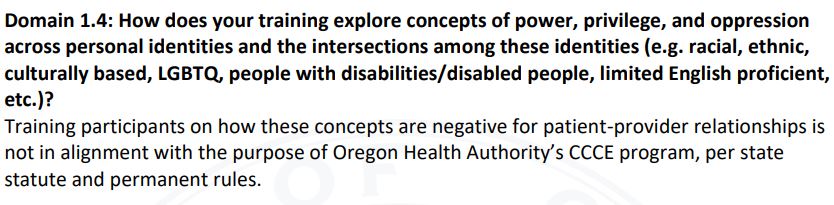
In their six-page rejection letter of Do No Harm’s application, the Oregon Health Authority described in great detail why Do No Harm’s course was not acceptable. In doing so, the Authority revealed its own bias.
Figure 1. An excerpt from the Oregon Health Authority’s rejection letter.
For example, the Authority noted “While evaluators appreciate the importance of focusing on the patient in the room and their specific needs, it seems harmful to not acknowledge implicit bias, systemic racism, and other forms of oppression, which very much impact a patient’s experience of the world and of the healthcare system.” They went on to assert that “The DO NO HARM organization appears to believe their counter perspective to be factual and any other perspective that does not align with their thinking as ‘ideological’ and without merit.”
In other words, DEI, implicit bias training, and racial concordance theories are “sound, scientific criteria.” But daring to question them is indicative of a “pervasive ideology.”
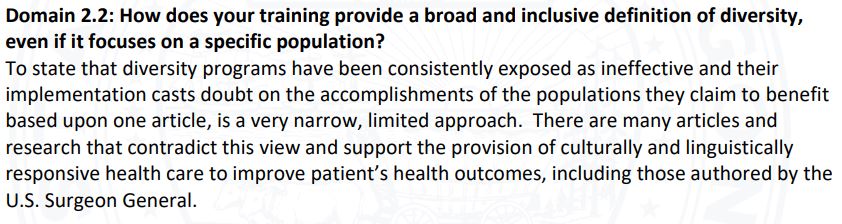
Maybe it’s the Oregon Health Authority who is being ideological, and not the other way around?
Figure 2. An excerpt from the Oregon Health Authority’s rejection letter.
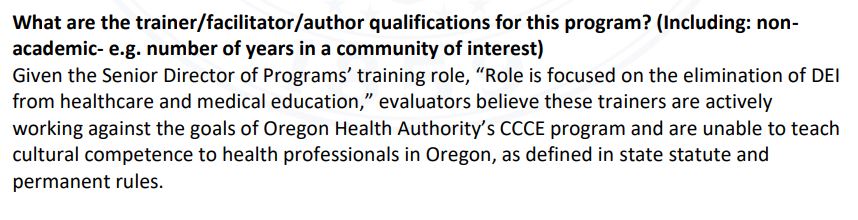
The rejection letter concluded by noting that “Given the Senior Director of Programs’ training role, ‘Role is focused on the elimination of DEI from healthcare and medical education,’ evaluators believe these trainers are actively working against the goals of Oregon Health Authority’s CCCE [cultural competence continuing education] program.”
Figure 3. An excerpt from the Oregon Health Authority’s rejection letter.
If the “goals” of the program are to indoctrinate healthcare professionals with DEI, treat woke concepts as indisputable facts, and dismiss any alternative viewpoint as a “pervasive ideology,” then perhaps the Authority has a point: Do No Harm does indeed dispute those goals.
None of this is entirely surprising given Oregon’s past missteps when it comes to medical regulation and licensure.
For example, in July 2024, Do No Harm reportedthat the Oregon Medical Board was seeking to revoke providers’ medical licenses if they were alleged to have engaged in “microaggressions.” Even doctors who simply failed to report microaggressions would have been stripped of licensure.
Just a few weeks later, the Oregon Medical Authority did a complete 180 and updated its proposed rule, with all references to “microaggressions” removed.
But while that reversal was encouraging at the time, the rejection of Do No Harm’s course application demonstrates that meaningful change among Oregon’s healthcare bureaucracy simply has not occurred. Rather than realizing that the concepts they are promoting are actively harmful — or even just permitting alternative viewpoints to be considered — officials have doubled-down on the same activist-infused standards that unfortunately are all-too-common among state healthcare agencies.
The sooner Oregon makes a real, substantive attempt to reverse course in a truly lasting way, the better. But until then, the underlying problems in Oregon’s healthcare environment will only grow worse.
https://donoharmmedicine.org/wp-content/uploads/shutterstock_249441406-scaled.jpg17072560Ailan Evanshttps://donoharmmedicine.org/wp-content/uploads/DNH_Logo_Stethescope-1.pngAilan Evans2025-12-08 14:11:502026-05-14 14:39:08Do No Harm Applied to Provide Training in Oregon. State Officials Weren’t Pleased
The article by Lawrence, et al. echoes a recurring narrative in academic medicine: America’s history, dating back to colonial times, has created disparities that shape current racial health inequities, & in this case, cardiovascular (CV) health. The authors report that neighborhoods ranked highest on the Structural Racism Effect Index (SREI) have greater prevalence of hypertension, obesity, diabetes, smoking, & lack of physical activity.
Indeed, Lawrence, et al. single out structural racism as the explanation for these observed health disparities. By doing so they disregard other factors like geography, access, comorbidities, choice, & genetics. And while they acknowledge their study is limited by ecological fallacy, recall bias, & potentially missing covariates, they nevertheless conclude that CV risk factors and CV disease are associated with racism.
Dr. Stanley Goldfarb’s Doing Great Harm? isn’t another anti-woke broadside. It’s something rarer: a first-hand dispatch from a man who spent half a century inside the medical establishment, watched it lose its bearings, and decided to do something about it.
The story begins with his own cancellation at the University of Pennsylvania’s medical school and the online medical encyclopedia UpToDate, banished for the crime of asking whether lowering standards in the name of diversity might, in fact, harm patients. The fallout was predictable — what followed was not. Rather than retreat quietly, Goldfarb founded Do No Harm, a national network of physicians, nurses, and patients determined to push back against what he calls the “ideological capture” of medicine.
https://donoharmmedicine.org/wp-content/uploads/2025/01/Media_Mention_.jpg7961550Ailan Evanshttps://donoharmmedicine.org/wp-content/uploads/DNH_Logo_Stethescope-1.pngAilan Evans2025-12-05 13:41:552026-04-11 07:10:21The fight to keep politics out of medicine
Earlier this year, Do No Harm published a report examining how parental access to their children’s medical records has been undermined by hospitals. The report also identifies the ways in which health records technology has been used to shield children’s health information from their parents.
For instance, major electronic health record system provider Oracle Health sets age 13 as the default protected status age, enabling providers to hide important health information from children’s parents.
As Do No Harm’s report notes, these restrictions pose enormous problems, as they could conceal harmful medical interventions such as so-called “gender-affirming care” from parents. Indeed, many gender activists who practice in the “Adolescent Medicine” subspecialty even advocate for limiting parental access to children’s medical records.
And what’s more, these restrictions are not in line with the Health Insurance Portability and Accountability Act (HIPAA) Privacy Rule that governs access to personal health information.
Now, the Department of Health and Human Services (HHS) Office for Civil Rights issued a Dear Colleague letterthis week reminding hospitals and other HIPAA-related entities of their obligations under the rule.
And according to the Daily Wire, HHS “was first made aware of ‘Adolescent Medicine’ and its dangers through a report issued by ‘Do No Harm.’”
“[P]arents, as the personal representative of their minor children, may be denied access to their minor children’s medical records, or a covered entity may be requiring minor children to authorize parental access before such access will be granted, when no such requirement exists under applicable law and, thus, under the Privacy Rule,” the letter states. “Denial of access in those circumstances may be a violation of the Privacy Rule.”
The letter reiterates the three limited situations in which a child’s parent is not eligible to access their personal health information:
When the child consents to health care and the consent of the parent is not required under state or other applicable law. In this situation, the parent is not the child’s personal representative with respect to PHI related to that health care.
When the child obtains health care at the direction of a court, or a person appointed by the court. In this situation, the parent is not the child’s personal representative with respect to PHI related to that health care.
When, and to the extent that, the parent agrees that the child and the health care provider may have a confidential relationship. In this situation, the scope of the parent’s agreement to the confidential relationship determines the degree to which the parent is the child’s personal representative for purposes of PHI maintained by that health care provider.
The letter goes on to state that, absent these exceptions and other conditions imposed by state law, hospitals may not prevent parents from accessing their child’s medical records.
“Providing parents who are their children’s personal representatives with easy access to their children’s PHI empowers parents to be more in control of decisions regarding their children’s health and well-being,” the letter states.
Do No Harm applauds HHS’s attention to this important issue. It’s essential that parents be able to access such crucial health information about their child. Preventing them from doing so infringes upon their core parental rights.
https://donoharmmedicine.org/wp-content/uploads/2022/06/shutterstock_797358901-scaled.jpg17042560Ailan Evanshttps://donoharmmedicine.org/wp-content/uploads/DNH_Logo_Stethescope-1.pngAilan Evans2025-12-04 22:52:482026-02-11 15:34:16HHS Reminds Hospitals: Let Parents Access Their Children’s Medical Records
HHS Office of Civil Rights Director Paula Stannard told The Daily Wire in a phone interview that the department was first made aware of “Adolescent Medicine” and its dangers through a report issued by “Do No Harm,” a group that fights back against gender ideology, and has raised many concerns about the medical community transitioning children without parental consent. Stannard called this activist push for “Adolescent Medicine” very “concerning,” particularly from her perspective and her role in enforcing HIPAA.
[…]
The HHS Office of Civil Rights is reminding health care providers, in very plain terms, of a parent’s right to access their child’s health information under the Health Insurance Portability and Accountability Act of 1996 (HIPAA) Privacy Rule, which states that a parent is the personal representative of their child and has the legal authority to make health care decisions for the child. In the department’s “Dear Colleague” letter, HHS emphasized that parents are indeed their children’s personal representatives and absolutely have the right of access to their child’s health information.
https://donoharmmedicine.org/wp-content/uploads/2022/04/Media_Mention_.jpg7961550Ailan Evanshttps://donoharmmedicine.org/wp-content/uploads/DNH_Logo_Stethescope-1.pngAilan Evans2025-12-04 22:00:452026-02-11 15:34:16HHS To Investigate Midwestern School Accused Of Vaccinating Child Against Parents’ Wishes
During a March discussionhosted by the Urban Institute and Georgetown University Law School, faculty members from law and medical schools discussed plans to continue “increasing physician diversity” through DEI initiatives.
The event, titled “Equal Protection and the Future of the Physician Workforce,” was premised on the notion that a decline in minority enrollment in medical schools, following the Supreme Court’s decision in Students for Fair Admissions v. Harvard (SFFA), would lead to negative health outcomes.
“[R]esearch shows that diversity among health professionals improves patient access, trust, and outcomes,” the event description reads. “Join the Urban Institute and Georgetown Law for a discussion of declining diversity in medicine, the worrisome health implications, and legal strategies for increasing physician diversity.”
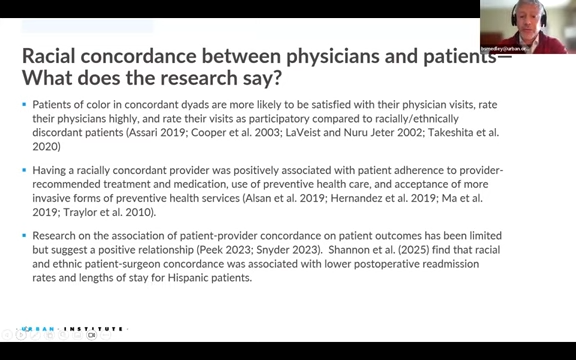
To support this premise, Urban Institute Senior Fellow Brian Smedley overviewed a report, “Racially Minoritized Patients Can Benefit from Racially Concordant Providers but Struggle to Find Them,” which argued that racial concordance improves health outcomes and thus diversity initiatives in medicine are justified.
Figure 1. Screenshot of “Equal Protection and the Future of the Physician Workforce.”
The notion that racial concordance – when patients are treated by physicians of the same race – improves health outcomes is not supported by the preponderance of existing evidence; five out six systematic reviews find that racial concordance has no impact on health outcomes.
Moreover, the Urban Institute report cites along-debunkedstudy to justify its claims that racial concordance improves health outcomes. That study, “Physician–patient racial concordance and disparities in birthing mortality for newborns,” failed to control for the effect of very low birth weight on mortality; researchers at the Manhattan Institute attempted to replicate the study using the same data while applying that control, andfoundthat the racial concordance effect disappeared.
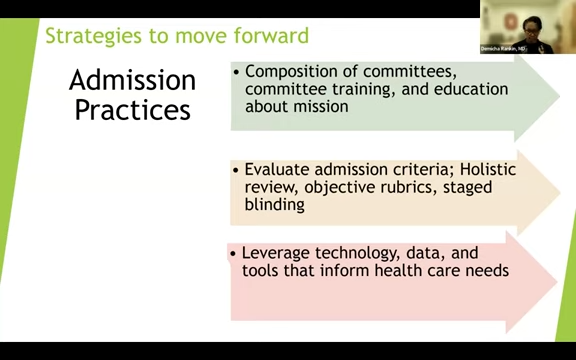
Next, Demicha Rankin, MD, the associate dean for Admissions at The Ohio State University College of Medicine, discussed ways in which medical schools could continue to diversify their student body, despite no longer being able to engage in racial discrimination in admissions.
These included recruitment and admissions strategies.
When discussing recruiting, Dr. Rankin argued that while the SFFA decision prevented racial discrimination in admissions, it did not prevent the targeting of race in recruiting outreach.
“In many instances, recruitment can be targeted for specific demographics, so long as it is open to all,” Dr. Rankin said.
Next, when discussing admissions decisions, Dr. Rankin appeared to argue that a more “diverse” admissions committee would lead to more diversity among accepted students.
“Really lean into who is on the committee, how can you diversify the committee, because if there’s representation there and if there’s broad-lived experiences, this can influence the decisions that a committee is making in terms of who is accepted,” she said.
Next, Dr. Rankin discussed how “holistic review” (in which admission is determined by weighing factors unrelated to academic achievement) could be a tool for diversifying the student body.
Figure 2. Screenshot of “Equal Protection and the Future of the Physician Workforce.”
“I think the biggest takeaway is leaning into holistic review,” she said. “It takes more than just a perfect MCAT or GPA to matriculate into medical school.”
“They also have to have compassion, empathy, resiliency, grit; and that is not measured by an academic metric,” she continued.
The next speaker, Ruqaiijah Yearby, a law professor at Saint Louis University, argued that medical schools should not “pre-comply” with guidance from the Trump administration to end discriminatory DEI practices, stating that schools that do so are “violating” federal and state antidiscrimination laws.
To be clear, racial discrimination in scholarships, funding decisions, and so on is illegal under the United States Constitution as well as federal civil rights law.
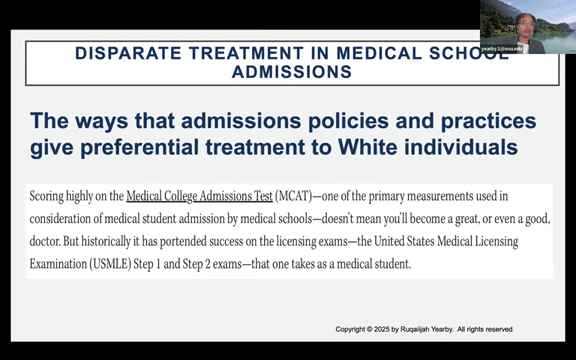
Next, Yearby argued that medical schools already employ “admissions policies and practices that give preferential treatment to white individuals, even though they are not connected to the ability of people to actually be great doctors.”
In explaining this point, Yearby pointed to the MCAT, with the apparent but unspoken implication that because white applicants tend to score higher on the MCAT than applicants of other racial groups, considering the MCAT gives preferential treatment to white applicants.
Figure 3. Screenshot of “Equal Protection and the Future of the Physician Workforce.”
This notion is truly disturbing. It does not logically follow that considering a test in the admissions process is somehow giving the group that performed better on that test a leg up.
Yearby’s argument would essentially treat any consideration of objective measures of merit as giving “preferential treatment” to whichever racial group happened to perform better. Any disparity would be evidence of bias. This is not sound reasoning.
Next, Yearby appeared to devalue the MCAT entirely, arguing that “research has shown that [high MCAT scores] does not necessarily track” to applicants with high MCAT scores “being great doctors.” She then argued to deprioritize the MCAT in admissions decisions.
It’s certainly true that one is not necessarily guaranteed to be a great doctor solely because of his or her MCAT score. Yet that is irrelevant; the question is whether MCAT scores correlate with the future ability to show clinical mastery.
“There is a strong correlation between MCAT scores and clerkship or ‘shelf’ exams, as well as United States Medical Licensing Examination (USMLE) clinical knowledge exams. This means that, in general, the better a student’s MCAT scores, the better they will perform in medical school and the more mastery of clinical knowledge they will exhibit. In short, students with better MCAT scores tend to be better medical students.”
Taken together, the comments of the event’s participants reveal a shocking and disturbing vision of medical education as a tool not for producing the best possible physicians, but for advancing the DEI agenda.
These ideas have no place anywhere near medical education.
https://donoharmmedicine.org/wp-content/uploads/2023/02/image-1.png3791484Ailan Evanshttps://donoharmmedicine.org/wp-content/uploads/DNH_Logo_Stethescope-1.pngAilan Evans2025-12-04 18:33:522026-02-11 15:34:16Med School Official, Academics Plot Ways to Continue DEI Initiatives in Wake of Supreme Court Decision
It’s not news that the American Medical Association (AMA) has a history of endorsing radical wokenessand remaining out-of-touch with the vast majority of physicians. However, one would hope that the AMA would at least refrain from adopting policies that appear to support blatant racial discrimination.
At its interim meeting in November the AMA House of Delegates voted on a resolution that will allocate resources specifically for “Black male physicians” in order to help them attain “the skills and knowledge to assume leadership roles in academic medicine, healthcare administration, and public health.”
RESOLVED, that, consistent with applicable laws, our American Medical Association support the development and funding of comprehensive mentorship programs connecting Black male pre-medical students with physician mentors, guiding academic preparation, MCAT preparation, the medical school application process, and career development; and be it further
RESOLVED, that, consistent with applicable laws, our AMA support the development of leadership training programs for Black male physicians, equipping them with the skills and knowledge to assume leadership roles in academic medicine, healthcare administration, and public health; and be it further
RESOLVED, that our AMA encourage collaboration between our AMA, medical schools, HBCUs, and community organizations to increase pathways for Black male students in medicine.
Given anti-discrimination laws, like the Civil Rights Act of 1964, it is interesting that the resolution repeatedly emphasizes a race-based prioritization while suggesting “consisten[cy] with applicable laws.”
Specifically, Title VI “prohibits discrimination on the basis of race, color, and national origin in programs and activities receiving federal financial assistance.”
The Federal Government’s overview clearly states:
If a recipient of federal assistance is found to have discriminated and voluntary compliance cannot be achieved, the federal agency providing the assistance should either initiate fund termination proceedings or refer the matter to the Department of Justice for appropriate legal action.
Furthermore, Title IXof the Education Amendments of 1972 states:
No person in the United States shall, on the basis of sex, be excluded from participation in, be denied the benefits of, or be subjected to discrimination under any education program or activity receiving Federal financial assistance[.]
Do No Harm members are well aware of the AMA’s activism, as we have recently shown. Despite its claims to the contrary, the AMA has a record of putting politics way ahead of science.
This time it appears the AMA is attempting to draw on the debunked theory of racial concordance, which alleges that patients fare better when treated by doctors of the same race. But, the claim that racial concordance improves health outcomes is utterly without merit – a notion that Do No Harm has not only thoroughly disproved from a scientific perspective, but also has addressed through legal measuresto advance care for all patients.
The AMA appears to be on the verge of flaunting its disregard both for science and the law, given the explicit wording of the adopted resolution. After all, if the AMA explicitly pledges to “support the development of leadership training programs for Black male physicians,” such a prioritization could by design exclude non-black males and all females.
Title VI of the Civil Rights Act and Title IX of the 1972 Education Amendments explicitly prohibit discrimination based on race and sex by entities receiving federal funds.
The resolution was voted on by the AMA’s House and notes that this “preliminary report of actions… should not be considered final.”
If the AMA truly wants to improve health outcomes for patients, then it would do well to ensure that it offers these programs to all students and physicians and does not prioritize or divide individuals by race or gender.
https://donoharmmedicine.org/wp-content/uploads/shutterstock_1132200044-scaled.jpg17072560Ailan Evanshttps://donoharmmedicine.org/wp-content/uploads/DNH_Logo_Stethescope-1.pngAilan Evans2025-12-04 16:33:272026-05-14 14:42:00Did the AMA House of Delegates Forget About the Civil Rights Act?
In medical education, where future physicians are meant to learn the art and science of healing, one might expect a focus on evidence-based medicine, rigorous diagnostics, and unbiased patient care.
Instead, at Drexel University College of Medicine, students are being educated in content chock-full of radical identity politics.The school’s “Antiracism in Healthcare” module, a free resource offered by the school’s Center for Professionalism and Communication in Health Care, serves as a vehicle for Critical Race Theory (CRT) dogma, discriminatory rhetoric, and unsubstantiated claims about “structural racism” as the root of all health ills.
By prioritizing ideological indoctrination over scientific inquiry, Drexel is training a generation of doctors more attuned to grievance politics than to genuine medical excellence.
At its heart, the “Antiracism in Healthcare” module promises to equip students with tools to “explain how structural, cultural, and individual racism have shaped our common history and led to vast societal disparities in education, policing, wealth and healthcare.” In fact, the course is explicitly a primer on CRT, the theory which posits racism as a deeply embedded structural feature of American societywhere “whiteness” is an oppressive force and health outcomes are less about biology or behavior than about invisible “power structures.”
Drexel’s module, with its numerous appeals to “antiracism,” pushes physicians to engage in activism and thus erodes trust in medicine as patients sense doctors more focused on politics than pulses.
For instance, the module’s learning goals demand that students “commit to being antiracist in [their] attitudes and behaviors,” a phrase that echoes Ibram X. Kendi’s How to Be an Antiracist, where not being actively “anti-racist” (read: engaging in racial discrimination to achieve “equity”) makes youracist by default.
This attitude is put into an ethical framework that presupposes “responsibility.” From the section “Medicine and the Myth of Race”:
“In this modern era of racial reckoning, we recognize that we are moral agents in healthcare. We not only have responsibilities to put our patients first and to treat all individuals as equals, but to work for social justice. We have a responsibility to become aware of and change our biases and behaviors to reflect the highest ideals of our professions. We have a responsibility to contribute to changing our institutions and laws to realize the potential and benefits of diversity, equity and inclusion.”
In short, the course is essentially claiming that being a physician requires political activism.
This is downright irresponsible – it requires spending excessive time teaching students to be better activists, promoting harmful and discriminatory ideas in the political arena, rather than the advancement of medical knowledge.
Next, Drexel endorses embedding Critical Race Theory into medical education:
“[M]any conservative politicians have demonized the teaching of critical race theory. Yet this teaching is essential for healthcare students, who are learning their professions in an unequal and unjust healthcare settings, and who need to advocate for change. Tsai, Wesp and their colleagues describe how CRT education can transform medical and nursing education (Tsai et al., 2021; Wesp et al., 2018).”
The reasons for rejecting CRT are quite extensiveand very robust.
CRT teaches physicians to view patients on the basis of their race and identity, and promotes the notion that every racial and gender group should have the exact same social and economic outcomes. To achieve this, racial discrimination is required.
The module takes this ideological activism a step further, arguing that “social justice” should be a “core principle in clinical ethics” in its “Ethics & Antiracism” section:
“As modern bioethics emerged during the 1960s and 1970s, the principle of social justice featured as another fundamental, guiding principle. The interpretation and application of this principle has continued to develop and has gained increasing prominence and significance. Applications of the social justice principle have always included the equitable distribution of limited healthcare resources (distributive justice). Social justice also always informed the negotiation between individual autonomy and health of the public: individual autonomy must be curtailed at times in the service of public health (e.g., quarantine, mandated vaccinations, mandatory reporting of certain diseases and conditions). Belatedly, mainstream clinical ethics has now intensified and broadened its understanding of social justice to also address structures of racism and other social oppression and practitioner bias as they relate to patient care and outcomes and the health of communities.”
Following the logic through here, this would have social justice as much of a fundamental part of medicine as the Hippocratic Oath.
Moreover, Drexel’s endorsement of distributing healthcare resources on the basis of “social justice” seems a lot like discrimination. And when such discrimination occurs in the field of healthcare, it’s a matter of life and death.
Unfortunately, Drexel isn’t an outlier; it’s simply another example ofa problem Do No Harm regularly documents. But it is almost as if Drexel is trying to one-up everyone else, given some of the material in this class.
The result of all of this is that patients suffer most: when trust crumbles, they skip care, widening real disparities.Drexel’s “Antiracism in Healthcare” module isn’t education — it’s indoctrination and a Trojan horse for CRT’s assault on medicine. Drexel should replace this education with evidence-based training, not race-obsessed rants. A core ethical principle of medicine is primum non nocere — first, do no harm. Drexel is doing the opposite, harming students, patients, and the profession. Let medicine be medicine again.
https://donoharmmedicine.org/wp-content/uploads/shutterstock_762719617-1-scaled.jpg17072560Ailan Evanshttps://donoharmmedicine.org/wp-content/uploads/DNH_Logo_Stethescope-1.pngAilan Evans2025-12-03 22:12:232026-05-14 14:42:12How Drexel Medical School’s ‘Antiracism in Healthcare’ Module Pushes Radical Ideology Over Science
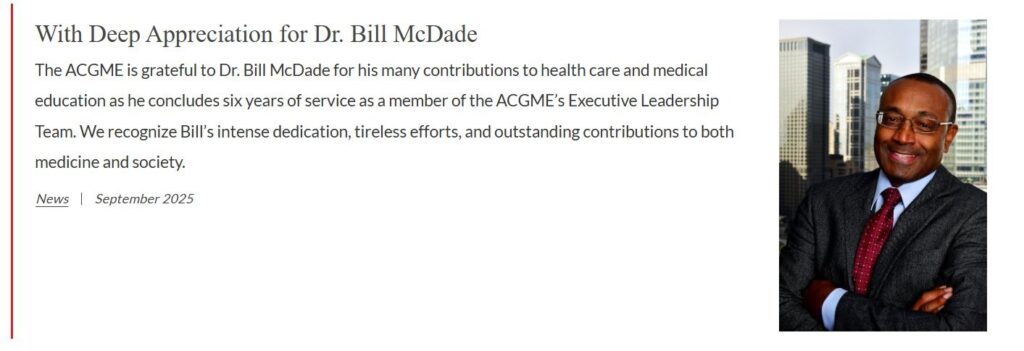
In September of this year, the Accreditation Council for Graduate Medical Education (ACGME), the accrediting body for medical residency programs, eliminatedits DEI department and removed DEI requirements from its accreditation standards.
And around the same time, the ACGME’s then-Chief DEI Officer, Dr. William McDade, left the organization.
These actions, undertaken at least partly in light of the Trump administration’s executive ordercracking down on accreditors’ DEI mandates, were incredibly significant and a huge step toward getting DEI out of medical education. Because the ACGME accredits residency programs, its DEI standards effectively mandated programs to engage in diversity hiring practices (which, in practice, is effectively racial discrimination) as a condition of their accreditation.
But new information shines a light on what may have motivated the ACGME’s commitment to DEI.
A Do No Harm member recently flagged a webinarhosted by the National Medical Association that took place in March 2024 titled “Navigating the Horizons – Understanding the Impact of DEI Legislation on Medical Training.”
That webinar featured Dr. McDade (then still serving as the ACGME’s DEI czar) and the American Medical Association’s Vice President of Equity, Diversity, and Belonging for Medical Education Dr. David Henderson, and discussed the EDUCATE Act, a critical piece of legislation endorsed by Do No Harm that would defund DEI programs that would, among other things, defund medical schools that have diversity, equity, and inclusion (DEI) offices or any functional equivalent.
During the webinar, panelists bemoaned the potential impact of the legislation and fretted about the future of DEI efforts with Dr. McDade even focusing on Do No Harm specifically.
“What disturbs me about this […] Do No Harm group is the proponents are physicians; they’re people in our own profession,” Dr. McDade said.
“Just a week ago the American Academy of Dermatology had a resolution that said that dermatologists should disband their DEI programs; well how insane is that?” Dr. McDade continued, appearing to refer to a March proposalto disband the organization’s DEI activities that was defeated. “I mean African Americans represent about two or three percent of dermatologists, and yet they feel that they need to get rid of their DEI programs.”
The implication here that a disparity in representation between racial groups justifies discriminatory policies is disturbing.
Removing DEI programs, which in practice often function as vehicles for discriminatory hiring, recruiting, admissions, and promotion, in most cases simply means that institutions return to treating future physicians on the basis of merit, rather than race.
Earlier in the webinar, Dr. McDade justified DEI policies on the grounds that racial concordance, in which patients are treated by physicians of the same race, produces positive health outcomes.
“The idea that racially concordant care is built into the fabric of medical education […] is what we’ve used over the last 112 years now in order to guide our pathway in medical education as a country,” McDade said.
“And that’s one of the problems I think is that we are rooted in a history that this legislation for instance wants to deny,” he continued, referring to the EDUCATE Act.
As Do No Harm and others have repeatedly shown, the notion that racial concordance produces better health outcomes is simply not supported by the existing evidence.
Do No Harm’s December 2023 reporton this issue examined the literature on racial concordance and highlighted the fact that four out of five systematic reviews found no evidence to support the claim that racial concordance produces positive health outcomes.
Another recent reviewpublished in the Substance Use & Addiction Journal found inadequate evidence to support the notion that racial concordance improves health outcomes for black patients in addiction treatment.
Despite this, Dr. McDade believes that racially concordant care should be and is built into the “fabric of medical education”; it’s not hard to see how such a premise could then be used to justify discriminatory hiring practices aimed at promoting racial concordance.
McDade’s reliance on debunked concepts and opposition to common-sense legislation that merely seeks to promote equality and end discrimination obviously reflects on the ACGME itself.
And it’s further evidence that the ACGME is taking the correct steps to ditch the harmful DEI agenda.
https://donoharmmedicine.org/wp-content/uploads/videoframe_22376.png7201280Ailan Evanshttps://donoharmmedicine.org/wp-content/uploads/DNH_Logo_Stethescope-1.pngAilan Evans2025-12-03 19:48:122026-02-11 15:34:16‘How Insane Is That’? A Peek Inside the ACGME’s Past DEI Agenda
Do No Harm Medical Director Dr. Kurt Miceli told The Fix that the suspension is a threat to both medicine and academic freedom.
“Activists have inflicted a terrible injustice upon SEGM and the broader physician community … These activists have revealed their true priorities—not the advancement of knowledge that could improve care for children struggling with gender confusion, but the preservation of ideology at any cost,” Miceli said.
He also said, “It is deeply troubling that the medical establishment, in concert with radicals, has so aggressively silenced dissenting perspectives.”
https://donoharmmedicine.org/wp-content/uploads/2025/01/Media_Mention_.jpg7961550Ailan Evanshttps://donoharmmedicine.org/wp-content/uploads/DNH_Logo_Stethescope-1.pngAilan Evans2025-12-03 14:12:482026-04-11 07:10:05Washington State U. halts courses on risks, ethics of gender medicine after activist pressure
Last week, Do No Harm filed an amicus briefsupporting the plaintiffs in Wailes v. Jefferson County Public Schools, acasecurrently before the Tenth Circuit Court of Appeals, laying out how policies aimed at promoting the “social transition” of minors lack an evidentiary basis.
The plaintiffs in the case, several concerned parents, are challengingtheir children’s school district policy that requires students to be “assigned to share overnight accommodations with other students that share the student’s gender identity” rather than sex.
Among other claims, they allege that the policy violates their parental rights under the Fourteenth Amendment. However, the district court dismissed the case. In doing so, the court relied upon a previous Third Circuit decision that, as Do No Harm’s brief argues, “rested on a seven-year old amicus brief submitted by politicized medical interest groups” supporting “gender-affirming care” and social policies for children. That brief, which the Third Circuit essentially accepted as determining the constitutional standard, was submitted by medical associations including the American Academy of Pediatrics (AAP) and the American Medical Association (AMA), two of the more prominent proponents of child sex change interventions.
Do No Harm’s amicus briefhighlights the ideological agenda motivating these groups; explains why evidence-based medicine doesn’t support “gender-affirming care” such as “social transition” policies to address gender dysphoria; and urges the Tenth Circuit to reject unreliable evidence when setting the constitutional standard and reverse the district court’s decision.
More specifically, Do No Harm’s brief first demonstrates the lack of evidence supporting “gender-affirming care” policies similar to that of Jefferson County Public Schools.
As the Department of Health and Human Services (HHS)found in its comprehensive evidence review earlier this year, “the impact of social transition on long-term [gender dysphoria], psychological outcomes and well-being, and future treatment decisions such as hormones or surgeries remains poorly understood.” Do No Harm’s brief then references the two available systematic reviews evaluating the impact of social transition, citing the systematic reviewconducted by researchers from York University. Finding social transition as a means of treating gender dysphoria to be unsupported, the researchers further noted that social transition may potentially worsen gender dysphoria.
Do No Harm’s brief also reveals the ideological biases of the medical associations upon which the Third Circuit’s decision relied. Examples include statements and materials from these groups endorsing hot button social issues that have no relation to the groups’ purported expertise, ranging from critical race theory andrace-based admissions in higher education to immigration,climate change, and beyond.
Finally, the brief explains how Jefferson County Public Schools relied upon the declaration of one Dr. Jack Turban, an activist in favor of gender ideology who has been “regularly criticized for producing deeply flawed research.”
In short, Do No Harm’s brief explains that reliable scientific evidence simply does not support “social transition” policies, like the defendant-school’s policy forcing girls to share a bed or bedroom with trans-students who are biological boys.
In practice, “social transition” is a waystop along the transgender medicalization pathway, encouraging children to undergo life-altering medical interventions to “transition” into the opposite sex and attempting to drag bystanders along for the process as well.
For the aforementioned reasons, Do No Harm’s brief urges the Tenth Circuit to reverse the district court’s dismissal of the case.
https://donoharmmedicine.org/wp-content/uploads/Litigation_Amicus_2.jpg6311101Ailan Evanshttps://donoharmmedicine.org/wp-content/uploads/DNH_Logo_Stethescope-1.pngAilan Evans2025-12-02 15:55:502026-05-14 14:43:23Do No Harm Tells Federal Appeals Court ‘There Is No Reliable Evidence’ For Policies Supporting ‘Social Transition’
The American Medical Association (AMA) has fully eschewed any pretense of representing physician interests. Instead, it has unfortunately become a tool for far left advocacy that uses its once-noble mission as cover to advance leftist policy. While many physicians see through the charade, the organization responsible for overseeing continuing medical education (CME) ostensibly does not.
Case in point: The AMA Ed Hub Continuing Medical Education module, ‘LGBTQ+ Patient-Centered Practices, clearly violates the Accreditation Council for Continuing Medical Education’s standards. This is especially true regarding Standard 1, which requires that all educational recommendations for patient care be grounded in current science, supported by clinical reasoning, and presented in a fair and balanced manner. It also prohibits the promotion of practices that lack sufficient evidence or pose risks outweighing benefits.
Consider:
1. Claims Without Clear Citation of Evidence
The Accreditation Council for Continuing Medical Education (ACCME) requires that “all recommendations for patient care … must be based on current science, evidence, and clinical reasoning” and that “all scientific research referred to … must conform to generally accepted standards.”
However, the module presents interventions such as hormone therapy and surgical procedures under the umbrella of “gender-affirming care” without acknowledging any consideration that the overall quality of evidence for benefit is very low in the pediatric population. Similarly, the CME makes the claim that “research consistently shows that access to gender-affirming care is associated with better mental health outcomes for transgender and gender-diverse youth.” High quality systematic reviews, as noted in the U.S. Department of Health and Human Services (HHS) Report, do not show this to be the case. This lack of transparency violates the ACCME mandate for evidence-based clinical recommendations.
Additionally, the module recommends “focus[ing] on social transition and reversible interventions for younger children,” ignoring all research demonstrating that hormonal interventions are generallyirreversible. Even social transition, such as going by a different name or different pronouns, is an extremely slippery slope; experts warn that it is “not a neutral act,” but a powerful signal that validates the child’s gender distress. It’s no wonder that five years after transitioning socially, nearly two-thirds of children in a 2022 study were using puberty blockers or receiving cross-sex hormones.
2. Lack of Balanced View of Diagnostic and Therapeutic Options
Standard 1 also requires providers to ensure their content “is fair and balanced and that any clinical content presented supports safe, effective patient care.” Standard 1.3 permits debate on “new and evolving topics,” but clearly prohibits providers from “promoting practices that are not, or not yet, adequately based on current science, evidence, and clinical reasoning.” New or evolving topics must be “clearly identified as such.”
Yet, the AMA module frames “gender-affirming care” as a best practice without acknowledging controversies in the scientific community and limitations of current evidence, or even mentioning alternative approaches (e.g., watchful waiting, psychotherapy, non-medical support). By not identifying areas where evidence remains emerging or contested, the module is taking an advocacy stance rather than a neutral educational perspective.
3. Advocacy of Practices Without Clear Evidence
ACCME states: “Organizations cannot be accredited if … education promotes recommendations, treatment, or manners of practicing healthcare that are determined to have risks or dangers that outweigh the benefits or are known to be ineffective.”
The module advises clinicians on when and how to implement “gender-affirming” interventions, particularly in minors, but does not discuss potential long-term risks. Providers, for instance, are told to tell parents the “benefits of gender-affirming care” without any mention of the risks.
More so, these same providers–according to the module–are to inform administrators of the “medical necessity of gender-affirming care,” which certainly does not exist when it comes to caring for gender confused children. As noted in the HHS Report, the World Professional Association for Transgender Health’s use of the term “medical necessity” was a “strategic move” that “remove[d] key safeguarding criteria” and “compel[ed] insurance coverage.” Clinical rationale was lacking.
Unfortunately, the AMA’s CME reads more like an advocacy directive than balanced guidance, straying from ACCME’s expectation to differentiate between established science and evolving or experimental practices.
4. Lack of Content Validation
ACCME clarifies that accredited providers must ensure content validity through “generally accepted standards of experimental design, data collection, analysis, and interpretation.”
There is no indication in the module description of a process or methodology that confirms clinical reasoning and ensures validity. In fact, many of the organizations it cites are not medical organizations, but left-leaning advocacy groups, including the ACLU, Human Rights Campaign, the Trevor Project, Pronouns.org and GLAAD. The module also cites the AMA several times, employing a sort of circular logic that undermines its credibility.
By presenting unsubstantiated interventions as best practices, omitting discussion of risks and alternative approaches, and lacking transparency, the module prioritizes advocacy over scientific rigor.
CME is supposed to make doctors better at their occupation. Instead, the AMA, with the apparent blessing of the ACCME, is corrupting the process so that it places political agendas ahead of scientific rigor. Unless that corruption is ended, patients will inevitably pay the price.
https://donoharmmedicine.org/wp-content/uploads/shutterstock_2536192881-1-scaled.jpg17072560Naomi Rischhttps://donoharmmedicine.org/wp-content/uploads/DNH_Logo_Stethescope-1.pngNaomi Risch2025-11-25 17:21:582026-05-14 14:36:13When Advocacy Replaces Science: Political Agendas Masquerading as Medical Education
RICHMOND, VA; November 24, 2025: Today, The Center for Accountability in Medicine released the results of a survey conducted of voters and doctors across the state of Florida. The survey aimed to compare the views of medical professionals with major medical organizations’ stances on gender ideology and DEI in medicine. The results of the survey are revealed in a report entitled, “What rank-and-file physicians think about DEI and pediatric ‘gender-affirming care’: Evidence from Florida.”
The results indicate a notable disconnect between physicians and the organizations that represent them. More specifically, doctors recognize the harm affirmative action, racial concordance, and pediatric transgender interventions present to patients when pushed aggressively through the system.
“Our survey revealed that there are loud, radical voices in healthcare organizations drowning out the thoughts and opinions of everyday physicians,” said Ian Kingsbury, Director of CAM. “We see that a strong majority of doctors believe sex-change interventions should be prohibited for minors. That same group believes school admissions should be decided on merit only and disagrees with the disproven racial concordance theory. This overlap in opinion is no coincidence, but a clear call to re-center medicine around common sense and sound science. We cannot allow harmful ideologies pushed by woke activists to sully the integrity of medicine any longer. Instead, we must reinstitute excellence and integrity within our medical organizations, schools, and hospital systems.”
A large majority, 66%, of surveyed doctors showed support for Florida’s policies of protecting minors from sex-change interventions (puberty blockers, hormones, and surgery), and 75% support protecting women from being forced to compete against men in sports.
Only 31% of surveyed doctors agree with the theory of racial concordance and think that patients experience better health outcomes when treated by doctors of the same race.
The proportion of respondents who believed admissions to medical school should be based solely on merit reflects the proportion who reject the racial concordance theory.
68% believe in merit-based acceptance into school and 69% reject the racial concordance theory.
64% of surveyed doctors found that the increase in diagnosis of gender dysphoria among youth should be a cause for concern.
###
Do No Harm, established in April 2022, has rapidly gained recognition and made significant strides in its mission to safeguard healthcare from ideological threats. It has over 50,000 members, including doctors, nurses, physicians, and concerned citizens across all 50 states and 14 countries.
https://donoharmmedicine.org/wp-content/uploads/2022/11/DNH_ContentCards_PressRelease.png6751200Naomi Rischhttps://donoharmmedicine.org/wp-content/uploads/DNH_Logo_Stethescope-1.pngNaomi Risch2025-11-24 14:57:192026-02-11 15:34:15Do No Harm Survey Reveals Divide Between Physicians and Medical Establishment on Identity Politics in Medicine
Oregon Health & Science University (OHSU) has surrendered its academic mission to a radical DEI regime that appears to care more about promoting ideology and policing language than it does patient care.
For health sciences students at OHSU, the indoctrination begins early and continues throughout their education. The2024-2025 Course Guide shows the curricula at OHSU to be saturated with DEI classes:
Dentistry students can take Community Dentistry 705 Social Determinants of Health, Social Justice and Equity, which “challenge[s] the dental students to reflect on any incorrect assumptions that poor oral health is primarily an individual consequence due to self-neglect”—likely placing the blame on social conditions with little regard for personal accountability.
The School of Medicine offers Clinical Psychology 615 Cultural Considerations & Diversity, centering “equity in the practice of psychology with individuals from diverse backgrounds.”
The School of Medicine pushes Food Systems & Society 511 Food in Culture, “discuss[ing] the role of cultural meanings and practices in food systems through the lenses of cultural studies and social equity” and “investigat[ing] frameworks, issues and representations of race-ethnicity, class and gender.”
The School of Medicine also offers Neuroscience 644 Racial Equity in Scientific Research & Beyond, training students to see “systemic racism” everywhere and become “active agents of change.”
Public Health offers Health Behavior 522 Health & Social Inequalities, teaching the “‘embodiment’ of social forces” and examining actions, including “legislative and political” to “eliminate health inequities.”
Physician assistants have the opportunity to take Physician Assistant Studies 518A Principles of Professional Practice I, drilling “bias in medicine” and “cultural humility.”
Undergraduate Medical Education courses like Family Medicine 705NA Introduction to Native Health compel students to “consider and discuss how colonialism, bias, and historical trauma have shaped health systems and experiences for Native patients.”
Another Undergraduate Medical Education course, General Internal Medicine 709B Health Equity Elective, sends students to work with specific ethnic community partners to witness “structural inequality.”
Nursing devotes an entire series—Nursing 546A through 546C Clarifying Racism—to “institutional racism,” “bias,” and “unequal treatment,” forcing students to master “inclusive communication practices with regard to racism and diversity issues in health care.”
These are just a few of the courses taught at OHSU. Some are more blatantly ideological than others, but there are too many to discount any one of them as being fringe, and several take a significant departure from clinical practice placing the student squarely in the world of activism.
For example, the nursing series listed above elicits a serious question: Why are no fewer than three 500-level classes needed to clarify racism?
Nursing is a complex profession that requires understanding a wide range of conditions from which people suffer. At the same time, nurses must be able to gain their patients’ confidence and trust. The ability to synthesize knowledge in a high-paced environment while maintaining therapeutic relationships with patients is paramount to nursing.
However, when a school responsible for the foundational education of these young professionals spends a great deal of time indoctrinating them with continued assertions of “institutional racism,” then how much trust will they place in their preceptors, supervisors, and the profession itself?
Nursing is just one example of many, unfortunately. The sampling of courses here demonstrates a focus of the OHSU curriculum on seeing future patients as victims of oppression rather than individuals seeking objective care.
Equally concerning is OHSU’s still-active Inclusive Language Guide, a “say this, not that” type of speech code that runs roughshod over biologically accurate terms. After instructing readers with a deeply confused assertion that discourse is “dominated by the majority point of view” and, in America, “people who are white, heterosexual and cisgender” are at the center of this discourse, the guide informs and cautions on various fronts:
Students and teachers are instructed to say “pregnant people or person”—not “pregnant women or woman,” because that would be exclusionary.
“Biological male/female” is “derogatory”; say “assigned male/female at birth.”
“Obese” and “fat” are stigmatizing—use “higher weight” or “larger body” unless the patient “reclaims” the term “fat.”
“Minority” is forbidden because it allegedly “centers people… usually white people.”
The logic is absurd: in addition to creating a false construct that demonizes white people and puts students of different backgrounds unnecessarily at odds with one another, students are taught that saying “pregnant woman,” for example, supposedly “suppresses diversity,” while terms like “noncompliant” must be replaced by “did not complete treatment” just to avoid any perceived offense.
Precision in health care saves lives; OHSU demands its students to twist language to appease ideology. Patients deserve care based on science and merit, not guilt and grievance.
Do No Harm stands firmly against the ideological capture of academic medicine and health care education. OHSU would far better serve its students—and their future patients—by truly focusing on the health sciences, not activist indoctrination.
https://donoharmmedicine.org/wp-content/uploads/shutterstock_249441406-scaled.jpg17072560Naomi Rischhttps://donoharmmedicine.org/wp-content/uploads/DNH_Logo_Stethescope-1.pngNaomi Risch2025-11-21 20:28:452026-05-14 14:35:53OHSU’s Radical DEI Regime: Indoctrinating Future Health Care Professionals
Michigan State University (MSU) is hardly the first institution of higher education to post a medical-related professorship with a DEI twist. But its“1855 Associate/Full Professor-Tenure System” job posting within the College of Human Medicine is riddled with so much woke jargon, it’s hard to ascertain what exactly the job entails.
Consider the following portion of the job description: “This 1855 Professorship offers a unique opportunity for an established researcher who seeks to continue their highly impactful, community engaged health equity research to drive change in areas both relevant to Flint and widely applicable. These include increasing equity in social determinants of health, behavioral health, healthy behaviors, chronic disease, maternal-child health, and environmental justice, among others.”
Other than some vague language about researching equity, it is anyone’s guess as to what the 1855 Professorship does. But what is clear is that the job listing mentions “equity” eight times.
The program is financed by a “$25 million gift from the Flint-based Charles Stewart Mott Foundation [which] allows [MSU] to largely or fully guarantee salary coverage for researchers who are willing to move their substantial research portfolios to MSU.” The Charles Stewart Mott Foundation’s mission is, of course, “Promoting a just, equitable and sustainable society.”
Upon further peeling back the layers, it is clear that this is only a small sample of the College of Human Medicine’s fixation with DEI concepts. From their “Dean’s Advisory Committee on Diversity” to their “Health Quality and Equity Team” to their “Center for Cancer Health Equity Research” and more, it is no wonder why they feel the need to hire even more equity specialists. There is no shortage of tasks to carry out and committees to serve on to advance their pet cause.
But the problem isn’t just limited to the College of Human Medicine—it is emblematic of a broader challenge with Michigan State University as a whole. For example, in 2023,Do No Harm reported that a job posting in the College of Osteopathic Medicine required the submission of a “Diversity, Equity, and Inclusion (DEI) statement” as a condition of an application for a faculty-level position. Yes, you read that right—no DEI statement, no chance at a job.
At the time of that blog’s publication, the job posting had been removed—but the College’s Diversity and Inclusion Initiatives webpage was still active (archived link). Now it appearsthat link is broken as well.
While the 1855 Professorship position does not list a DEI statement among its required application materials, it might as well—because for all practical purposes, the College (and University as a whole) have made it clear they are looking for candidates who conform to their ideology and way of thinking, and not someone who will disrupt the comfort of their status quo mindset.
In fact, using the University’s career search tool, the keyword “equity” returns75 different open positions—i.e., positions that reference equity in at least some portion of the job description. For the keyword “diversity,”91 open positions are listed.
It is unlikely that Michigan State University is going to change its commitment to woke practices and hiring standards anytime soon, even as other colleges and universities around the country have moved away from these concepts. But it would not be entirely unsurprising—or without precedent—if some of these job postings begin to change or become inactive following greater scrutiny.
In any case, one can only hope, for the applicants’ sake, that they do not need to include “equity” eight different times in their cover letters. However, with the type of candidates MSU is apparently looking for, that task might be a welcome one for a prospective future employee that fits the University’s mold.
Texas state laws ban doctors from giving guidance on transgender medicine and procedures on minors — but the Texas Medical Association is still doing it.
“Sometimes I even think, ‘Well, that’s behind us now.’ It’s actually not. Even here in the state of Texas because despite the fact that Texas outlawed this awful, brutal practice mutilating healthy body parts of children … there still seem to be doctors and associations that are trying to carry out this disgusting, brutal torture ritual,” BlazeTV host Sara Gonzales says on “Sara Gonzales Unfiltered.”