Do No Harm submitted this request for comment by the Centers for Medicare & Medicaid Services.
Do No Harm, a national association of medical professionals united in protecting medicine from harmful and divisive political ideologies, shares CMS’ goal to advance “the attainment of the highest level of health for all people…regardless of race, ethnicity, disability, sexual orientation, gender identity, socioeconomic status, geography, preferred language, or other factors that affect access to care and health outcomes.” We appreciate the opportunity to comment on CMS’ request for information regarding this goal in the context of Medicare Advantage.
However, we are concerned that this request for information is rooted in a growing and deeply troubling political ideology which seeks to disembody the medical profession’s most powerful means to that end: our strong tradition, beginning with the Hippocratic Oath, of treating all individuals, regardless of race, background, or circumstances, with dignity and our utmost care.
The expansion of this practiced principle from medicine—rather than its modification or replacement—to other institutions and endeavors, is our government’s most realistic and effective tool toward advancing “health equity.” Whatever other problems persist in the provision of health care in the United States, on the issue of equity, the medical profession largely solved the problem long ago.
Put simply, the best way to advance “the highest level of health for all people…regardless of race, ethnicity, disability, sexual orientation, gender identity, socioeconomic status, geography, [or] preferred language” is to advance “the highest level of health for all people…regardless of race, ethnicity, disability, sexual orientation, gender identity, socioeconomic status, geography, [or] preferred language.”
Once, this could be fairly criticized as circular pablum. However, as anti-racism and DEI have soaked our politics, they have inevitably seeped into debates about health care and public health programs. The prompt for this comment suggests that these theories have reached the highest levels of government. Putting aside the merits of those theories in political and historical debates, they have no place in medicine, especially in publicly supported programs like Medicare Advantage.
Almost 30 million Americans rely on coverage provided through Medicare Advantage. Enrollment and support for the program continue to grow because of the program’s unique advantages: more choices for patients have, unsurprisingly, led to more patient-centered coverage and care.
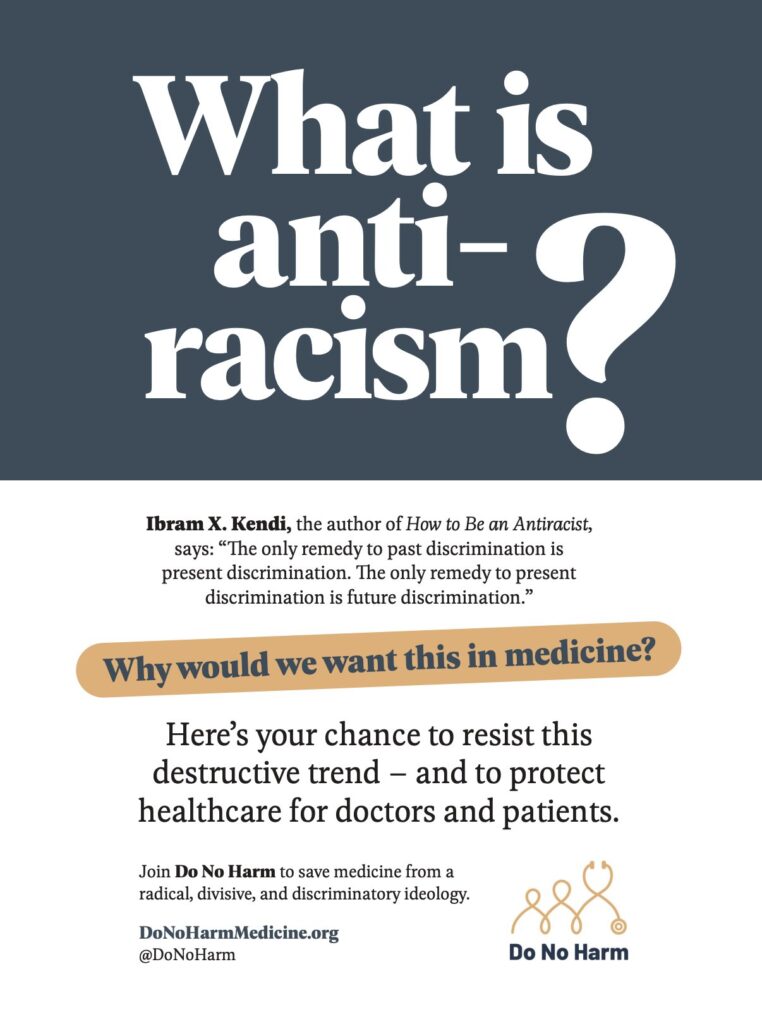
These Americans—the very source of the program’s funding—expect and deserve a program guided by the best ethics of the medical profession and not political ideology of any stripe, let alone ideologies such as anti-racism which promote future discrimination as a solution to past discrimination. No American should ever be subject to racial discrimination in a hospital bed, nursing home, doctor’s office, on the phone with a health insurance company, or any other context.
Reforms in Medicare Advantage should focus on how we can raise standards of care for all patients everywhere—not simply how to twist some knobs up and some knobs down so that eventual outcomes are even, however poor those outcomes may be.
After all, the issues raised in decisions regarding Medicare Advantage, like all coverage programs and health care more broadly—our shared pursuit of minimal pain, our shared desire of maximum dignity, and our shared mortality—transcend race in a way few other issues do.
In the medical context, it hardly needs to be said, efforts to single out certain races for special or different treatment can have perverse consequences whether the intent is pure or not. Even noble and successful efforts along these lines inevitably raise the question: if a certain course of treatment or care benefits racial minorities, why not increase the use of or access to that treatment or care among other groups?
For example, SCAN Health Plan, a not-for-profit Medicare Advantage plan with members in California, Arizona, and Nevada, noticed racial disparities in how often members took cholesterol and diabetes medications. The gaps were modest. For example, 86 percent of white members took their medications as prescribed, compared to 84 percent of Hispanics and 81 percent of Blacks. Nevertheless, over the course of eighteen months, SCAN Health Plan initiated incentives to close that gap, which it did by 35 percent.
The company tied senior executives’ bonuses to closing that gap, hired “more than 15 Black and Hispanic care navigators and pharmacists,” held cultural bias training, and prioritized vendor contracts which would increase targeted “outreach to members,” among other things. In all, SCAN Health Plan estimates that it spent “close to $1 million” on the effort.
Even if we stipulate that SCAN Health Plan’s efforts directly caused the change, it raises questions that go to the heart of this request for information. If the health and care of the 14 percent of white members who do not take their medications as prescribed is not less important than the lives of racial minorities, why did this effort only target minorities, instead of targeting all individuals who did not take medications as prescribed? Surely, there are efforts SCAN Health Plan could have taken, including the efforts they did take, which would have closed that gap too.
And, because all choices involve trade-offs, was $1 million worth spending on a program which modestly closed an already modest racial gap as compared to other health initiatives the Plan could have taken which did not target some racial groups over others?
This road leads to a dark place—one in which some Americans receive more care and attention than others. That is acceptable in a triage situation, in which some patients have conditions of different urgencies. It is unacceptable when the level of care and attention is only being determined by the color of the patient’s skin. It is racial discrimination and it has no place in medicine.
Instead, Do No Harm adheres to a succinct, now fifteen-year old formulation of Supreme Court Chief Justice John Roberts’: the “way to stop discrimination on the basis of race is to stop discriminating on the basis of race.”
To the extent racial discrimination persists in medicine, Do No Harm condemns it as a grotesque and inexcusable violation of the professional standards to which we hold ourselves. The solution, in the provision of coverage through Medicare Advantage or any other context in health care, is to enforce those standards. That is a core principle of our organization and the genesis of our founding.
Again, we appreciate the opportunity to provide this comment.
Sincerely,
Stanley Goldfarb, MD
Chairman, Board of Directors
Do No Harm