Included among the State University of New York’s (SUNY) constituent institutions are four medical schools. All four express a commitment to wokeness in the form of DEI.
- At Stony Brook University’s Renaissance School of Medicine, administrators make this allegiance clear in the form of a mission statement: “We are committed to recruiting and training diverse students, clinicians and physician-scientists in biomedical sciences.”
- At SUNY Upstate Medical University, site visitors learn that among the institution’s “Values” is a pledge “to embrace diversity and inclusion.”
- At the University of Buffalo’s Jacobs School of Medicine and Biomedical Sciences, professional planning is done in part by those “dedicated to community engagement, diversity, equity and inclusion.”
- And at SUNY Downstate Health Sciences University, the mission statement includes a promise “[t]o foster an environment that embraces cultural diversity.”
At best, these gestures are vogue frivolities — concessions to an activist class that demands ideological tribute from public institutions.
At worst, they are actively harmful, leading to discrimination in favor of some people and against others in an attempt to address different outcomes among racial groups.
Yet attempts by reformers to address this behavior at SUNY’s medical schools will necessarily be an uphill battle. The reason? SUNY itself has been captured by ideological forces intent on the widespread introduction and defense of DEI.
The evidence is unignorable:
- In 2020, the New York Association of Chief Academic Officers, a group comprising SUNY’s 64 campus academic leaders, released a formal statement in support of the Black Lives Matter movement and committed to “providing a structural and cultural campus experience of equity and inclusion.”
- Among SUNY’s Academic Affairs offerings is the “Diversity, Equity, Inclusion, and Social Justice Fellows” (DEISJ) program, committed to “developing, sustaining, and growing a community of practice on diversity, equity, inclusion, and social justice curricular issues across the SUNY system.”
- A DEISJ webinar series has included presentations on “Constructions of Class Identity and Power,” “Critical Disability Studies and Intersectional Ableism,” and “Developing DEISJ Content Across the Curriculum.”
- The Empire State Diversity Honors Scholarship Program awards tuition funds to undergraduates who have “overcome a disadvantage” or who will “contribute to the diversity of the student body by demonstrating a commitment to facilitating and enhancing diversity, equity and inclusion efforts.”
- SUNY’s “General Education Framework” mandates “Diversity: Equity, Inclusion, and Social Justice” instruction and asks students to “analyze the role that complex networks of social structures and systems play in the creation and perpetuation of the dynamics of power, privilege, oppression, and opportunity.”
Nor are things better at many of SUNY’s individual campuses:
- At SUNY Broome, the President’s Task Force on Diversity & Inclusion “promote[s] equity and diversity” and “make[s] recommendations [about] … hiring processes, campus policies and protocols, training and professional development, campus events, and overall campus climate.”
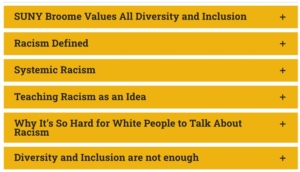
- Also at SUNY Broome: “All-gender restrooms provide equal access to public facilities for those regardless of gender identity or expression.” And: Unseemly racialist instruction abounds, including the claim that “It’s So Hard for White People to Talk About Racism.”
- At the time of this writing, SUNY Erie Community College is hiring an employee-relations manager and chief diversity officer who will “elevate inclusiveness and implement best practices related to diversity, equity, and inclusion, particularly as it pertains to the recruitment and retention of students, faculty, administrators, and staff.”
- Earlier this year, Binghampton University hosted an inaugural DEI Symposium, featuring “national and campus higher education professionals [and] highlighting the importance of diversity, equity and inclusion efforts.”
This is one of the ways in which activists perpetuate DEI ideology. By gaining a foothold both at the senior administrative level of SUNY and in the individual SUNY campuses, bad actors make it next to impossible for dissenting administrators and campuses to resist (assuming any such individuals or institutions exist).
In other words, a SUNY medical school that wished to dispense with unscientific DEI frippery would be swimming upstream. All the momentum is going in the other direction.
To be clear, this doesn’t mean that reformers’ task is hopeless. But it does mean that we have a long road ahead of us.