
Commentary
Medical College of Wisconsin Pushes Students to Engage in Climate Activism
Share:

The Medical College of Wisconsin sent a survey to its medical students intended to educate them about the effects of climate change on patient health, with a particular focus on nutrition.
The presentation accompanying the survey, titled “Climate Change, Gastroenteritis, and Malnutrition: What Physicians Should Know from the Inside Out,” discusses the various ways that “planetary health” can impact individual health, such as through pollution. Additionally, the presentation encourages students to get involved with climate activist groups.
The presentation contains the following learning objectives:
- Understand that human health and planetary health are directly linked, and climate change is a public health crisis
- Define climate justice and list populations most vulnerable to climate change
- Describe how climate change is changing the distribution and increasing prevalence of vector borne gastrointestinal infections
- Understand the impact of climate change on food security and associated nutrient deficiencies, particularly in vulnerable populations
- Identify that plant-based diets are mutually beneficial to patient health and planetary health
A keen reader may have noticed that many of these objectives have very little to do with the practice of medicine and seem more geared toward an audience of policymakers in the public health sphere.
Indeed, the presentation encourages students to track their own “carbon footprint,” also discouraging the consumption of red meat for its comparatively higher impact on emissions.

How this prepares students to become the best possible physicians is anyone’s guess.
Next, the presentation outright encourages students to “get involved” with local activist efforts.
The presentation links to the website of Healthy Climate Wisconsin, a policy and advocacy organization that pushes for legislation and candidates targeting the oil and gas industry.
It’s also worth noting that Healthy Climate Wisconsin’s website includes an “Anti-Racism” webpage that includes the following pledge: “We strive to make each of our working groups and each of our projects advance anti-racist ideals. By keeping Black, Indigenous, and People of Color at the forefront of climate action and transition plans we can help improve health disparities and create new economic opportunities for these vulnerable populations.”
That page also links to an article calling for racial discrimination in the distribution of vaccines during the COVID-19 pandemic.
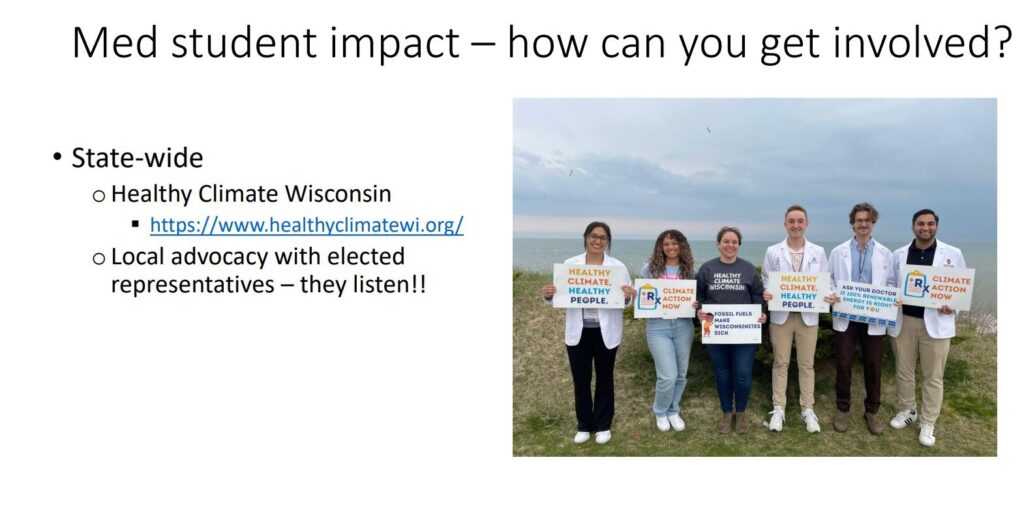
The presentation even urges students to engage in “Local advocacy with elected representatives.”
It should be common sense that the classroom is not the appropriate venue for activist recruitment efforts, much less a venue for radical identity politics.
It is simply not the province of medical schools to instruct students on these issues.
Rather, this presentation is yet another example of increasing mission creep, where all sorts of political, social, and cultural activism are justified under the auspices of improving public health.
That the course encourages students to involve themselves in climate activism represents a significant straying from the actual purpose of medical education.