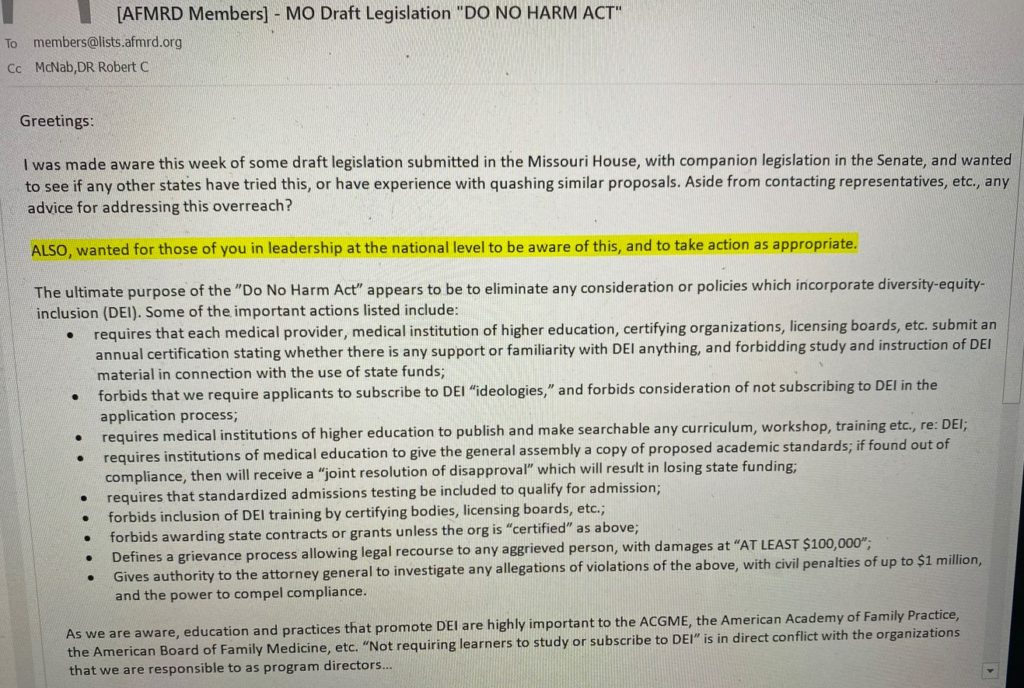
Missouri is moving to get divisive and discriminatory race-based ideology out of medical schools – and the medical establishment is throwing a fit. Look no further than a recent email Do No Harm obtained, which is from a listserv maintained by the Association of Family Medicine Residency Directors (AFMRD).
The email is in response to Rep. Ben Baker’s new bill that seeks to stop medical schools from forcing “Critical Race Theory” and “Diversity, Equity, and Inclusion” on students and faculty. The bill is a response to the rise of such dangerous ideas at the medical schools associated with Washington University and the University of Missouri, where indoctrination is increasingly common. The bill has been introduced in the Missouri House and Senate, with passage possibly coming later this year.
Cue the outrage from the medical establishment. A subscribing member of the listserv sent out an email to other AFMRD members nationwide attacking the bill and explicitly seeking to stop it. The email asks “if any other states have tried this, or have experience quashing similar proposals.”
Translation: Radicalized medical associations don’t want policymakers or taxpayers keeping medical schools focused on medicine – because they’d rather keep pushing their extreme ideas.
Email to AFMRD members, January 10, 2023.
The email lists all the Missouri bill’s provisions, all of which are common sense and would hold medical schools to higher standards – protecting future physicians and patients alike.
The sender then makes an extraordinary statement: “Not requiring learners to study or subscribe to DEI is in direct conflict with the organizations we are responsible to as program directors.” The meaning is clear: The medical establishment thinks radical indoctrination is now a crucial part of its job.
This backlash shows the urgent need for Missouri’s bill – and the same leadership is needed in other states. Here’s hoping Missouri lawmakers pass this legislation as soon as possible, for the sake of the state’s medical schools and patients.
https://donoharmmedicine.org/wp-content/uploads/2023/01/shutterstock_717783073-scaled.jpg17072560Laura Morganhttps://donoharmmedicine.org/wp-content/uploads/DNH_Logo_Stethescope-1.pngLaura Morgan2023-01-12 00:34:552026-02-11 15:33:20Missouri Takes On Medical Schools – And Medical Elites Hate It
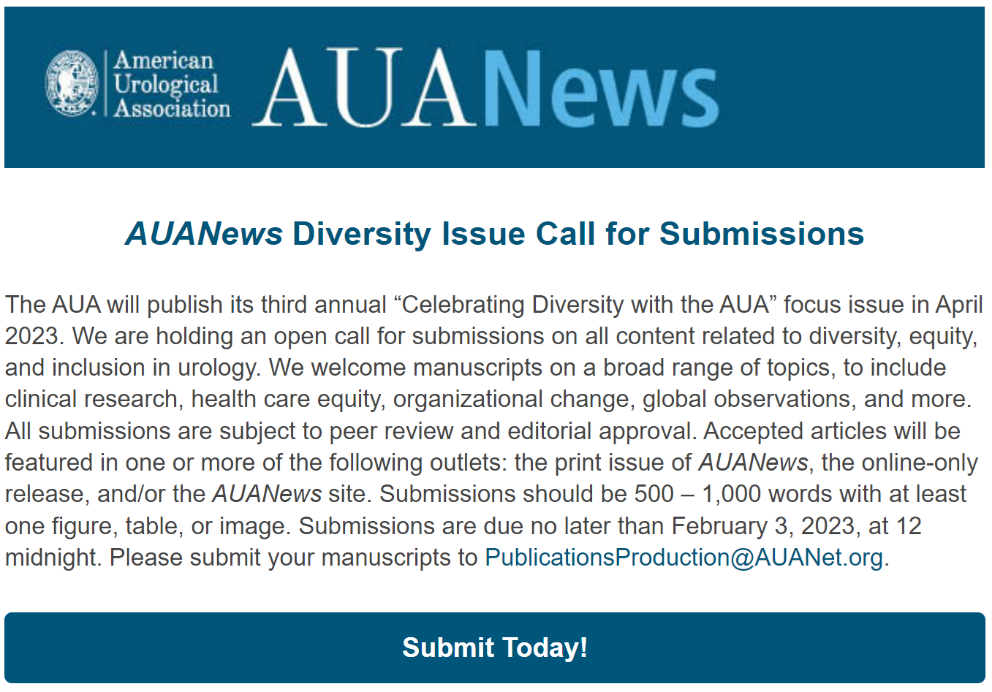
The American Urological Association (AUA) excitedly announced its upcoming “Celebrating Diversity with the AUA” initiative to its members this week. The AUANews will publish this special issue in April and is seeking submissions “on all content related to diversity, equity, and inclusion in urology.” Among the suggested topic areas are clinical research, healthcare equity, and organizational change, which “are subject to peer review and editorial approval.”
From an email to American Urological Association members.
Not all AUA members are as enthused about this announcement, however. Said one urologist: “Put a sock in it, please. I would rather read about urology.”
Put a sock in it, please. I would rather read about urology.
– AUA physician member
That’s sound advice.
https://donoharmmedicine.org/wp-content/uploads/2023/01/AUA.png692992Laura Morganhttps://donoharmmedicine.org/wp-content/uploads/DNH_Logo_Stethescope-1.pngLaura Morgan2023-01-11 13:47:382026-02-11 15:33:20Even the American Urological Association Has Gone Woke
Texas medical schools are discriminating on the basis of race – and that needs to stop. So says a new federal lawsuit filed on January 10th. It seeks to end the practice of so-called “affirmative action” at the Lone Star State’s medical schools and supports equality and fairness in applicant admission decisions.
The plaintiff is George Stewart, who “grew up in Texas with the desire to study science, become a physician and serve others with his gifting.” He “graduated from high school with a 4.39/4.0 GPA and from college at the University of Texas at Austin with a 3.96/4.0 unaudited GPA in Biology.” But he was rejected by six Texas medical schools, “while over 450 lesser qualified minority students, ranging as low as a GPA of 2.82 or an MCAT of 495, were offered admission.”
The lawsuit alleges that what’s really happening at these institutions is blatant racial discrimination:
“Each of the defendant medical schools and universities, along with nearly every medical school and university in the United States, discriminates on account of race and sex when admitting students by giving discriminatory preferences to females and non-Asian minorities, and by discriminating against whites, Asians, and men. This practice, popularly known as “affirmative action,” allows applicants with inferior academic credentials to obtain admission at the expense of rejected candidates with better academic credentials.”
Such discrimination is not only rampant, but also in clear violation of federal law:
“These race and sex preferences are illegal under the clear and unambiguous text of Title VI and Title IX, which prohibit all forms of race and sex discrimination at medical schools and universities that receive federal funds and make no exception for diversity-based affirmative-action programs.”
Do No Harm was quoted as part of a similar argument to the Supreme Court in a 2022 brief in the case Students for Fair Admissions, Inc. v. University of North Carolina. The Court is set to decide that case soon, potentially ending affirmative action at universities nationwide – including medical schools.
Racial discrimination is unacceptable in medical school admission and anywhere else. Here’s hoping the federal courts return the principles of objectivity and merit to the process.
https://donoharmmedicine.org/wp-content/uploads/2023/01/shutterstock_533282275-scaled.jpg16812560Laura Morganhttps://donoharmmedicine.org/wp-content/uploads/DNH_Logo_Stethescope-1.pngLaura Morgan2023-01-10 21:37:372026-02-11 15:33:20New Lawsuit: End Discrimination at Texas Med Schools
The Biden administration is withholding taxpayer money from hospitals that aren’t sufficiently woke – essentially bribing them to adopt divisive and discriminatory policies. That’s the reality of a little-known yet far-reaching rule the administration finalized last year. With a new Congress underway, investigating such blatant identity politics overreach is urgently needed.
The Biden rule comes from the Department of Health and Human Services (HHS) and its Secretary, Xavier Becerra, who promised to make “equity” a central part of the department’s mission. The concept of equity demands that any differences in outcome be eliminated, even to the point of using racial discrimination. Within the context of health care, equity threatens to lower the quality of care for some patients in the name of making care equal for all.
The Biden rule accomplishes this goal by tying federal money that hospitals receive to their level of wokeness. To get reimbursement rate increases under Medicare and Medicaid, hospitals have to send the federal government data proving their commitment to health equity. In other words, this regulation is forcing hospitals to fixate on patients’ race instead of just their individual medical needs.
At 720 pages long, the rule mentions equity 380 times – or more than once every two pages. It is predicated on the idea that health outcomes indicate racism and bigotry by health care professionals, despite a complete lack of valid evidence. Even so, the rule creates a system in which the more woke a hospital is, the more taxpayer money it gets.
The Biden administration received significant pushback from health care providers about the draft version of the rule. Most notably, hospitals and doctors rightly pointed out that it could hurt patient health. HHS acknowledges this fact in the final version of the rule, stating in one place:
“Several commenters stated that linking payment to equity is inconsistent with the statutory requirements for calculating payment reductions. Some of these commenters observed that the payment system was designed to ensure equitable payments for hospitals that treat high-risk patients, not to advance patient level equity in outcomes.”
In other words, the Biden administration is endangering the health of high-risk patients in service to divisive and discriminatory ideology. Another section states the problem even more bluntly:
“A commenter expressed concern that linking payment to performance on equity measures would change hospitals’ focus to factors outside of each patient’s medical diagnosis, thereby decreasing the quality of care.”
This criticism is spot on. By bribing hospitals to focus on race, the Biden administration is jeopardizing the world-class care that every patient of every race deserves. The only question now is when will Congress investigate this woke injustice?
https://donoharmmedicine.org/wp-content/uploads/2022/06/biden1.png6281200Laura Morganhttps://donoharmmedicine.org/wp-content/uploads/DNH_Logo_Stethescope-1.pngLaura Morgan2023-01-10 14:06:232026-02-11 15:33:20The Biden Administration Is Bribing Hospitals To Go Woke
Bemidji State University (BSU) in beautiful northern Minnesota has been infiltrated by some ugly philosophies that are intended to divide, indoctrinate, and misinform its students.
Do No Harm was contacted by a parent who, while researching the school for a family member with an interest in healthcare, became quite concerned about the degree of divisive and radical ideology seen on the BSU website. Indeed, a visit to the BSU Office of Diversity, Equity, and Inclusion confirms the school has a dedication to “transformative change” and “practices that center racial inequities within the classroom.” The strategic plan makes this even clearer with its priorities of infusing DEI into “academic curriculum and classroom conversations” and encouraging DEI-focused collaborations among campus departments.
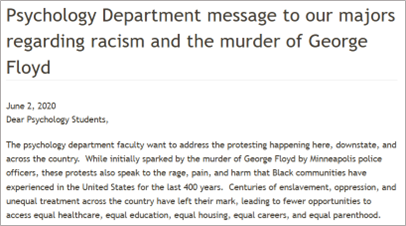
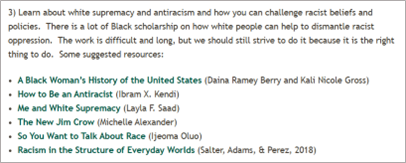
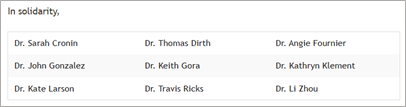
Those departments include several health sciences programs. The Psychology department places a particularly troubling emphasis on radical ideologies and anti-racism. An example of its social justice position is featured on its home page and features a link to “strategies and steps to be anti-racist.” This letter to BSU psychology students (signed by nine faculty members) directs them to some highly controversial websites and instructs them to “learn about white supremacy and anti-racism” by accessing resources “on how white people can help dismantle racist oppression.”
Letter to BSU psychology students from department faculty.
Our research also uncovered six scholarships or programs at BSU that excludes certain applicants on the basis of race/ethnicity, sex, or both. A federal civil rights complaint has been filed by Mark Perry, senior fellow at Do No Harm, for multiple violations of Title VI of the Civil Rights Act of 1964 and Title IX of the Education Amendments of 1972. The complaint asks the Department of Education’s Office for Civil Rights to investigate Bemidji State University for illegal discrimination.
It’s not surprising that our parent tipster eliminated BSU from consideration, and told us:
I have an interracial marriage and my child is of mixed race. My whole family does not subscribe to this DEI agenda and would like people to be judged on their merits as a human being and not by their race, gender, age, sexual orientation, etc.
These are words to live by, and Bemidji State University should take note. And, the Minnesota taxpayers who support this school must insist on it.
Have you found radical ideologies at colleges and universities that offer education in the healthcare sciences? Let us know about it via our secure platform.
https://donoharmmedicine.org/wp-content/uploads/2023/01/shutterstock_1678697074-scaled.jpg17072560Laura Morganhttps://donoharmmedicine.org/wp-content/uploads/DNH_Logo_Stethescope-1.pngLaura Morgan2023-01-07 00:49:012026-02-11 15:33:20Bemidji State University Has Embraced Some Disturbing Elements of Social Justice Ideology
Dr. Stanley Goldfarb and Senior Fellow Benita Cotton-Orr discuss how, when studies are corrupted to support a certain predisposed outcome or political ideology, trust in the quality and accuracy of research at large wanes.
https://donoharmmedicine.org/wp-content/uploads/2022/11/DNH_PA_01a.png7201280rededge-rachelhttps://donoharmmedicine.org/wp-content/uploads/DNH_Logo_Stethescope-1.pngrededge-rachel2023-01-06 13:25:172026-02-11 15:33:20S1E5: Does Trust in Medical Research Still Exist?
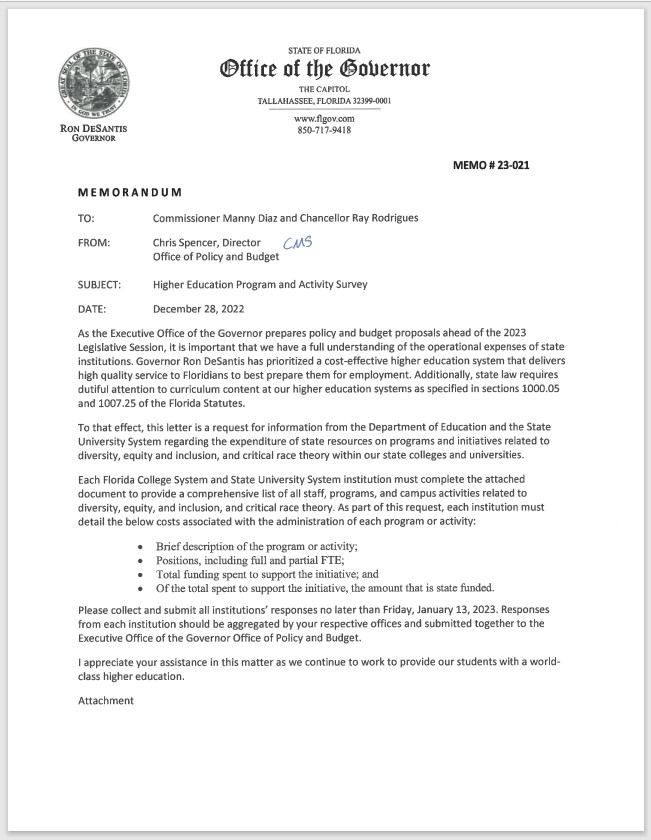
Good news: Florida Governor Ron DeSantis just ordered all state colleges and universities to detail their work on “diversity, equity, and inclusion” and Critical Race Theory.
This is especially important for medical schools, which are using divisive and discriminatory DEI and CRT ideologies in dangerous ways. Hopefully this investigation will kickstart the process of stopping woke indoctrination in Florida’s medical education.
The Governor’s order is crystal clear: All institutions must provide “a comprehensive list of all staff, programs, and campus activities related to diversity, equity, and inclusion and critical race theory.” Furthermore, “each institution must detail the costs of associated with the administration of each project or activity.” These responses are due on January 13th.
Govenor DeSantis’ memo to Florida Department of Education and the State University System (December 28, 2022).
The order doesn’t explicitly name medical schools, but they should absolutely be covered. We’ve detailed how Florida state medical schools are some of the most woke in the nation:
The University of Florida College of Medicine is infusing Critical Race Theory “anti-racism” into its entire Doctor of Medicine program, as we proved in a comprehensive report.
The UF College of Medicine also offered a scholarship that explicitly banned whites from applying, causing us to file to federal civil rights complaint that forced the school to abandon the scholarship.
Florida Atlantic University Schmidt College of Medicine forces applicants to prove how they believe in “anti-racism” and oppose “systemic racism.”
The list goes on. It’s all but certain that every Florida state medical school is pushing DEI and CRT on faculty and students. Kudos to Governor DeSantis for digging into this crisis. It’s the first step to getting divisive and discriminatory ideology out of medical school and all of health care.
https://donoharmmedicine.org/wp-content/uploads/2023/01/shutterstock_240583999.jpg15662362Laura Morganhttps://donoharmmedicine.org/wp-content/uploads/DNH_Logo_Stethescope-1.pngLaura Morgan2023-01-05 15:51:282026-02-11 15:33:20Florida Is Investigating DEI and CRT At Medical Schools
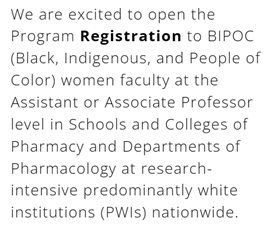
Do No Harm recently reported about our federal civil rights complaint filed against the University of North Carolina for promoting and offering the Fellowship for Exploring Research in Nutrition (FERN) program. Eligibility was limited to “Black, Indigenous, and People of Color (BIPOC)” students, which is prohibited by Title VI of the Civil Rights Act of 1964. UNC administrators acted to correct the information within 24 hours of learning about the complaint.
Yet, UNC-Chapel Hill has not addressed all its discriminatory programs. Mark Perry, senior fellow at Do No Harm, has filed an additional federal civil rights complaint against the university for multiple violations of Title VI, as well as Title IX of the Education Amendments of 1972.
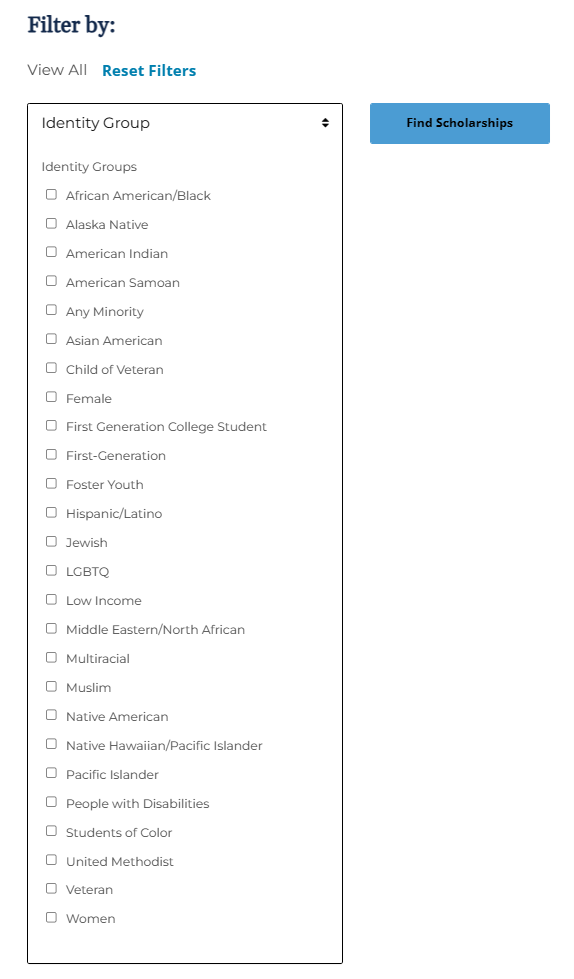
UNC-CH is using its Scholarship Resources page to assist its students to find external, third-party scholarships that discriminate on the basis of sex, gender identity, sexual orientation, race, color or national origin.
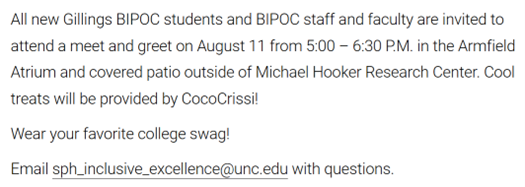
The Gillings School of Global Public Health held a racially discriminatory event on August 11, 2022, titled BIPOC New Student Meet and Greet. Non-BIPOC (Black, Indigenous, People of Color) students, staff, and faculty were not invited to the event.
This complaint is asking the Office for Civil Rights to promptly investigate and correct the illegal activities the University of North Carolina-Chapel Hill is engaging in with its scholarships and sponsored programs.
Have you been excluded from a scholarship or fellowship at your medical or nursing school because of discriminatory inclusion criteria? Do No Harm wants to hear from you, and you may remain anonymous if you wish.
https://donoharmmedicine.org/wp-content/uploads/2023/01/shutterstock_42140584-scaled.jpg11742560Laura Morganhttps://donoharmmedicine.org/wp-content/uploads/DNH_Logo_Stethescope-1.pngLaura Morgan2023-01-03 13:34:212026-02-11 15:33:20UNC-Chapel Hill’s Civil Rights Violations Just Keep Piling Up
The University of California-San Francisco School of Medicine is the latest medical program in the UC system to be investigated by the Department of Education’s Office for Civil Rights (OCR) for illegal race-based discrimination. The investigation was opened in response to a federal civil rights complaint filed by Mark Perry, senior fellow for Do No Harm.
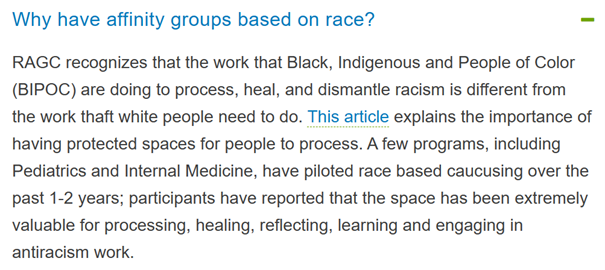
OCR is responsible for enforcing Title VI of the Civil Rights Act of 1964, which prohibits discrimination on the basis of race by academic programs that receive federal funding. UCSF School of Medicine is violating Title VI with its Racial Affinity Caucusing Groups (RACG; archived page here), which advertises its purpose on the School of Medicine’s website (bold added):
RAGC (sic) recognizes that the work that Black, Indigenous and People of Color (BIPOC) are doing to process, heal, and dismantle racism is different from the work thaft (sic) white people need to do. This article explains the importance of having protected spaces for people to process.
Racial Affinity Caucusing Groups at the UCSF School of Medicine.
UCSF School of Medicine is using these “protected” (i.e., segregated) spaces to engage in “anti-racism work.” Ibram X. Kendi, the main proponent of anti-racism, says, “The only remedy to past discrimination is present discrimination. The only remedy to present discrimination is future discrimination.” What types of discriminatory activities are the UCSF Racial Affinity Caucusing Groups conducting in these “protected spaces?” But the better question is the one the UCSF School of Medicine actually asks itself: Why have affinity groups based on race? The taxpayers of California deserve an answer.
https://donoharmmedicine.org/wp-content/uploads/2022/12/shutterstock_114083809-scaled.jpg17072560Laura Morganhttps://donoharmmedicine.org/wp-content/uploads/DNH_Logo_Stethescope-1.pngLaura Morgan2022-12-31 00:23:092026-02-11 15:33:20Yet Another UCSF Civil Rights Investigation is Underway
In response to a federal civil rights complaint filed in August by Do No Harm senior fellow Mark Perry, the U.S. Department of Education’s Office for Civil Rights has opened an investigation into illegal race-based discrimination by the University of Southern California Keck School of Medicine.
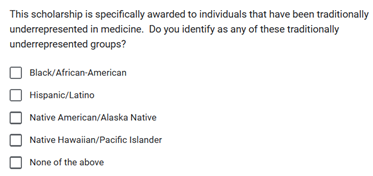
The Diversity in Medicine Visiting Clerkship Award supports fourth-year medical student groups who are “traditionally underrepresented in medicine (URiM).” The USC Keck School of Medicine defines URiM as “black/African-American, Hispanic/Latino, Native American/Alaska Native, and Native Hawaiian/Pacific Islander.”
Diversity in Medicine Visiting Clerkship Award, USC Keck School of Medicine.
Discrimination on the basis of race/ethnicity is a violation of Title VI of the Civil Rights Act of 1964. Further evidence that the clerkship is restricted to specific racial/ethnic groups is seen in the scholarship application link.
Diversity in Medicine Visiting Clerkship Award application.
Recipients of the Diversity in Medicine Visiting Clerkship Award in the Department of Emergency Medicine will receive a stipend of up to $2,000 to cover travel and housing.
Are you aware of a scholarship or fellowship at your medical or nursing school that contains discriminatory inclusion criteria? Do No Harm wants to hear from you, and you may remain anonymous if you wish.
https://donoharmmedicine.org/wp-content/uploads/2022/12/shutterstock_1209468139-scaled.jpg18922560Laura Morganhttps://donoharmmedicine.org/wp-content/uploads/DNH_Logo_Stethescope-1.pngLaura Morgan2022-12-29 23:15:022026-02-11 15:33:20The Office for Civil Rights is Investigating the USC Keck School of Medicine
Just how woke is Michigan’s Wayne State University School of Medicine? Very woke indeed, as it just confirmed to Do No Harm.
Here’s the background. In October 2022, the Association of American Medical Colleges released a report showing that the vast majority of medical schools have embraced identity politics, despite their divisive and even discriminatory nature. The report was based on surveys of specific medical schools, which the AAMC didn’t name.
For the sake of transparency and accountability, Do No Harm submitted freedom of information requests to public medical schools nationwide, including the Wayne State University School of Medicine. We asked for a copy of its survey response, so that Michigan taxpayers and policymakers could learn the truth about this institution.
Here’s what the WSU School of Medicine has self-reported:
It has adopted racially discriminatory admissions practices under the guise of “affirmative action.” This means it’s potentially lowering standards in the name of diversity, thereby threatening patient health.
It has a “dedicated office, staff, or resources” dedicated to DEI. This means there’s a permanent woke bureaucracy pushing ideology on faculty and students.
It lobbies for woke policies at the federal, state, and/or local levels. This means it’s wading into toxic public debates instead of fully focusing on educating future physicians.
Its administrators are active within local, regional, and national forums to promote equity, diversity, and inclusion. This means it’s wasting resources that would be better spent on real medical education.
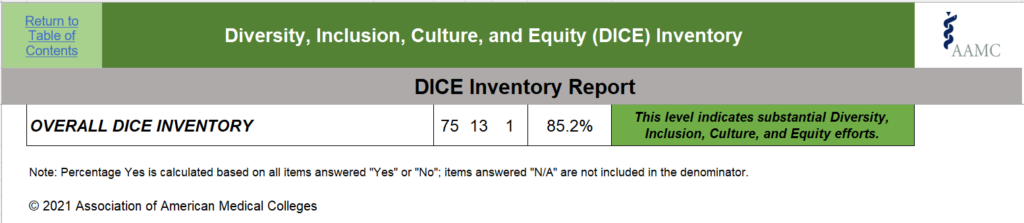
All told, WSUSOM has instituted 87.0% of the divisive and discriminatory woke policies listed by the AAMC. And you can bet it is feeling pressure from activists and outside groups to go even further down the radical rabbit hole – doing even more damage to faculty, medical students, and ultimately, the millions of patients they’ll see.
Wayne State University School of Medicine DICE Inventory score.
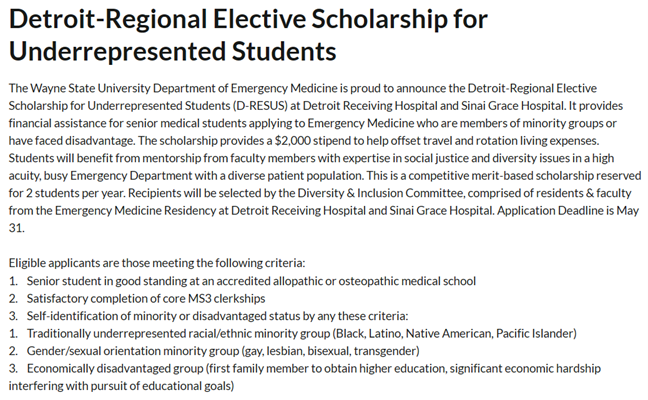
Interestingly, WSUSOM reported on its DICE Inventory that it does not provide scholarships for students from diverse backgrounds. However, the Department of Emergency Medicine sponsors the Detroit-Regional Elective Scholarship for Underrepresented Students, which has eligibility criteria that include self-identification as “Traditionally underrepresented racial/ethnic minority group (Black, Latino, Native American, Pacific Islander)” and/or “Gender/sexual orientation minority group (gay, lesbian, bisexual, transgender).”
WSUSOM Emergency Medicine D-RESUS eligibility criteria.
These eligibility criteria violate Title VI and Title IX of the Civil Rights Act of 1964, which prohibits such discrimination. Do No Harm senior fellow Mark Perry has filed a federal civil rights complaint with the U.S. Department of Education’s Office for Civil Rights for this discriminatory scholarship, which provides a $2,000 stipend to awardees. The application requires the submission of gender and race/ethnicity information, which is reviewed by emergency medicine residents and medical faculty on the Diversity & Inclusion Committee.
WSUSOM Emergency Medicine D-RESUS program application.
Michigan taxpayers help fund WSUSOM. They, and the policymakers who represent them, should ask why they’re giving so much money to an institution that’s putting divisive and discriminatory ideology at the heart of medical education. More importantly, they should ensure Wayne State University School of Medicine stops, and soon.
https://donoharmmedicine.org/wp-content/uploads/2022/12/shutterstock_1383847019-scaled.jpg17072560Laura Morganhttps://donoharmmedicine.org/wp-content/uploads/DNH_Logo_Stethescope-1.pngLaura Morgan2022-12-28 18:35:392026-02-11 15:33:20We Found Out How Woke Wayne State University School of Medicine Really Is
Just how woke is Texas’s TAMU School of Medicine? Very woke indeed, as it just confirmed to Do No Harm.
Here’s the background. In October 2022, the Association of American Medical Colleges released a report showing that the vast majority of medical schools have embraced identity politics, despite their divisive and even discriminatory nature. The report was based on surveys of specific medical schools, which the AAMC didn’t name.
For the sake of transparency and accountability, Do No Harm submitted freedom of information requests to public medical schools nationwide, including Texas A&M University School of Medicine. We asked for a copy of its survey response, so that Texas taxpayers and policymakers could learn the truth about this institution.
Here’s what the TAMU School of Medicine has self-reported:
It has adopted racially discriminatory admissions practices under the guise of “affirmative action.” This means it’s potentially lowering standards in the name of diversity, thereby threatening patient health.
It has a “dedicated office, staff, or resources” dedicated to DEI. This means there’s a permanent woke bureaucracy pushing ideology on faculty and students.
It lobbies for woke policies at the federal, state, and/or local levels. This means it’s wading into toxic public debates instead of fully focusing on educating future physicians.
Its administrators are active within local, regional, and national forums to promote equity, diversity, and inclusion. This means it’s wasting resources that would be better spent on real medical education.
All told, Texas A&M University School of Medicine has instituted 86.5% of the divisive and discriminatory woke policies listed by the AAMC. And you can bet it is feeling pressure from activists and outside groups to go even further down the radical rabbit hole – doing even more damage to faculty, medical students, and ultimately, the millions of patients they’ll see.
Texas A&M University School of Medicine DICE Inventory score.
Texas taxpayers help fund the TAMU School of Medicine. They, and the policymakers who represent them, should ask why they’re giving so much money to an institution that’s putting divisive and discriminatory ideology at the heart of medical education. More importantly, they should ensure the Texas A&M University School of Medicine stops, and soon.
https://donoharmmedicine.org/wp-content/uploads/2022/10/pete-alexopoulos-JFfDRKlI3hY-unsplash-scaled.jpg14412560Laura Morganhttps://donoharmmedicine.org/wp-content/uploads/DNH_Logo_Stethescope-1.pngLaura Morgan2022-12-28 01:40:222026-02-11 15:33:20We Found Out How Woke Texas A&M University School of Medicine Really Is
Just how woke is Texas’s University of Houston College of Medicine? Very woke indeed, as it just confirmed to Do No Harm.
Here’s the background. In October 2022, the Association of American Medical Colleges released a report showing that the vast majority of medical schools have embraced identity politics, despite their divisive and even discriminatory nature. The report was based on surveys of specific medical schools, which the AAMC didn’t name.
For the sake of transparency and accountability, Do No Harm submitted freedom of information requests to public medical schools nationwide, including UHCOM. We asked for a copy of its survey response, so that Texas taxpayers and policymakers could learn the truth about this institution.
Here’s what the University of Houston College of Medicine has self-reported:
It has a “dedicated office, staff, or resources” dedicated to DEI. This means there’s a permanent woke bureaucracy pushing ideology on faculty and students.
It lobbies for woke policies at the federal, state, and/or local levels. This means it’s wading into toxic public debates instead of fully focusing on educating future physicians.
It offers tenure and promotion to faculty who prove their commitment to extreme identity politics and woke priorities. This is a litmus test that requires faculty to toe the party line instead of teaching medicine at the highest level.
Its administrators are active within local, regional, and national forums to promote equity, diversity, and inclusion. This means it’s wasting resources that would be better spent on real medical education.
All told, UHCOM has instituted 85.1% of the divisive and discriminatory woke policies listed by the AAMC. And you can bet it is feeling pressure from activists and outside groups to go even further down the radical rabbit hole – doing even more damage to faculty, medical students, and ultimately, the millions of patients they’ll see.
University of Houston College of Medicine DICE Inventory score.
Texas taxpayers help fund UHCOM. They, and the policymakers who represent them, should ask why they’re giving so much money to an institution that’s putting divisive and discriminatory ideology at the heart of medical education. More importantly, they should ensure the University of Houston College of Medicine stops, and soon.
https://donoharmmedicine.org/wp-content/uploads/2022/12/shutterstock_1013712277-scaled.jpg17072560Laura Morganhttps://donoharmmedicine.org/wp-content/uploads/DNH_Logo_Stethescope-1.pngLaura Morgan2022-12-27 23:18:082026-02-11 15:33:20We Found Out How Woke the University of Houston College of Medicine Really Is
Just how woke is South Carolina’s USC School of Medicine? Very woke indeed, as it just confirmed to Do No Harm.
Here’s the background. In October 2022, the Association of American Medical Colleges released a report showing that the vast majority of medical schools have embraced identity politics, despite their divisive and even discriminatory nature. The report was based on surveys of specific medical schools, which the AAMC didn’t name.
For the sake of transparency and accountability, Do No Harm submitted freedom of information requests to public medical schools nationwide, including the University of South Carolina School of Medicine. We asked for a copy of its survey response, so that South Carolina taxpayers and policymakers could learn the truth about this institution.
Here’s what the USC School of Medicine has self-reported:
It has adopted racially discriminatory admissions practices under the guise of “affirmative action.” This means it’s potentially lowering standards in the name of diversity, thereby threatening patient health.
It has a “dedicated office, staff, or resources” dedicated to DEI. This means there’s a permanent woke bureaucracy pushing ideology on faculty and students.
It lobbies for woke policies at the federal, state, and/or local levels. This means it’s wading into toxic public debates instead of fully focusing on educating future physicians.
Its administrators are active within local, regional, and national forums to promote equity, diversity, and inclusion. This means it’s wasting resources that would be better spent on real medical education.
All told, the USC School of Medicine has instituted 85.2% of the divisive and discriminatory woke policies listed by the AAMC. And you can bet it is feeling pressure from activists and outside groups to go even further down the radical rabbit hole – doing even more damage to faculty, medical students, and ultimately, the millions of patients they’ll see.
University of South Carolina School of Medicine DICE Inventory score.
South Carolina taxpayers help fund the USC School of Medicine. They, and the policymakers who represent them, should ask why they’re giving so much money to an institution that’s putting divisive and discriminatory ideology at the heart of medical education. More importantly, they should ensure the University of South Carolina School of Medicine stops, and soon.
https://donoharmmedicine.org/wp-content/uploads/2022/12/shutterstock_109003565-scaled.jpg18562560Laura Morganhttps://donoharmmedicine.org/wp-content/uploads/DNH_Logo_Stethescope-1.pngLaura Morgan2022-12-26 14:39:292026-02-11 15:33:20We Found Out How Woke the University of South Carolina School of Medicine Really Is
The National Association of Diversity Officers in Higher Education (NADOHE) recently held a two-part webinar series that described potential outcome of the Students for Fair Admissions (SFFA) v. Harvard and University of North Carolina cases currently before the Supreme Court.
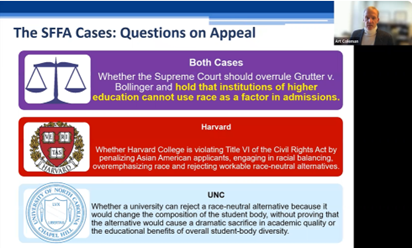
Do No Harm obtained the recording of Part 2, titled Challenges to Race in Higher Education Admissions: Understanding the Issues and Getting Ready for the Supreme Court’s Decisions in SFFA v. Harvard/UNC. The session, presented by Art Coleman, managing partner of EducationCounsel, advises academic diversity officers on how to prepare for and respond to the upcoming decision, which is considering race-based admissions in the context of “a full array of policy and practice.” He urges participants to keep two core questions in mind: “What are the interests these institutions are trying to advance, and then how are they advancing them through certain race-conscious policies and practices?”
From Challenges to Race in Higher Education Admissions: Understanding the Issues and Getting Ready for the Supreme Court’s Decisions in SFFA v. Harvard/UNC.
Coleman doesn’t stop with providing advice on what an institution must do and how much it must “sacrifice in its design to achieve diversity and not violate the law.” Nothing in the law, he says, requires an institution to sacrifice its mission and essential character to pursue diversity. However, how does “mission and essential character” align with Coleman’s recommendations for maintaining the status quo of race-based admissions?
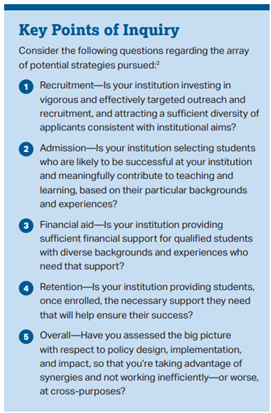
As a member of its leadership, Coleman urges participants to refer to the College Board Access & Diversity Collaborative as an important digital resource to use in the months leading up to the Court’s decision. A check of the website reveals that the organization is a champion for “comprehensive, evidence-based, and legally sound” policies on access and diversity to support “historically underrepresented populations.” Its Access & Diversity Toolkit contains the section labeled “Making Connections: A Holistic Review of Key Strategies,” which provides recommendations taken from the Association of American Colleges (AAMC) regarding recruitment, admission, and retention of students whose selection is targeted based on holistic review.
From Access & Diversity Toolkit (College Board/EducationCounsel).
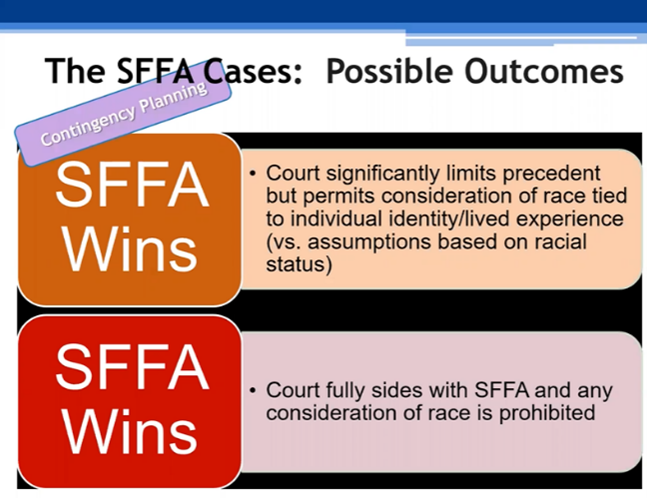
Over the course of the 90-minute presentation, Coleman explains how the Court’s decision could result in a “potential tsunami” (precedent is significantly limited, but the consideration of race within the individual’s lived experience is still permitted) and “Armageddon for us” (SFFA wins outright, and the Court overturns the order in its entirety). As an example of “Armageddon,” he commented that future students will “be forced to tell incomplete stories about who they are” on their college applications if the Court decides in favor of SFFA.
From Challenges to Race in Higher Education Admissions: Understanding the Issues and Getting Ready for the Supreme Court’s Decisions in SFFA v. Harvard/UNC.
While Coleman doesn’t want the DEI champions and public affairs officials at the academic institutions to be caught “flat-footed on the day of decision without much to say,” he has an even more intriguing recommendation. “A good catch-all exercise,” he says, “is engaging in the scrub of website language.” This involves avoiding descriptions of the institution’s policies or programs in a way that may communicate more legal risk or vulnerability than exists. This would be, as he put it, an “unforced error.” Coleman also instructs webinar participants to make it clear during on-campus conversations that this is not affirmative action or “a social justice remedial lane.” The primary message Coleman delivers is to “maintain our policies with minimal disruption” by developing a “set of enhancing policies.” He said that the Court’s decision is unlikely to have an effect on pathway programs and recruitment or outreach programs “as long as they are sort of open to all.” Is this an example of how he recommends institutions to “scrub” their website language in advance of the ruling?
Coleman closed the session with an impassioned response to the question, “Is there a proxy for race in admissions?” He replied that this question implies that the individual is “looking for a quick substitute that I don’t really care about, but I’ll do something just to get by with it.” Coleman referred to case law that that demonstrates the importance of being “grounded in authentic, mission-driven institutional interests,” and suggests that “looking for low-income students” or “students who have a specific affinity toward social justice” is a position that will generate more diversity than a neutral strategy.
NADOHE has long been a steadfast advocate of discriminatory DEI initiatives on college campuses and is dedicated to the promotion of practices that consider race in admission decisions. Providing a forum for Art Coleman to promote his brand of gamesmanship in this area is another in-kind contribution by NADOHE to the support of race-based discrimination in higher education institutions.
https://donoharmmedicine.org/wp-content/uploads/2022/08/shutterstock_216196921-scaled.jpg17002560Laura Morganhttps://donoharmmedicine.org/wp-content/uploads/DNH_Logo_Stethescope-1.pngLaura Morgan2022-12-23 19:36:462026-02-11 15:33:20NADOHE is Coaching Institutions to Prepare Their Responses to an Upcoming SCOTUS Decision
One December 17, PBS News Weekend ran a spot titled “How racial biases in medical algorithms lead to inequities in care.” In an interview with Dr. Jayne Morgan, president-elect of the Georgia-based biotech company Southeast Life Sciences, she was asked about “racial biases” in medical diagnostic algorithms. This included a reference to the glomerular filtration rate (eGFR), a blood test used to evaluate kidney function.
Dr. Morgan completely misunderstands the nature of the eGFR. She states that the use of the correction factor for black patients represents an example of racial bias. In fact, the 15% correction factor for black patients was derived empirically, and is necessary in the original equation in order to get an accurate value. This empirical observation was confirmed in several separate studies which always found the need for this calculation. Its abandonment was based on political ideology rather than a need to improve medical care. There is no evidence that patients were denied any life-saving therapies because of small differences in this calculation. It is well known by nephrologists that there is a great variance in any single determination of eGFR and a 10% to 15% difference would not have a clinical impact.
This is yet another example of misunderstanding and misinterpreting clinical information for the sake of affirming a nonexistent racial bias.
https://donoharmmedicine.org/wp-content/uploads/2022/12/Picture8.png171365Laura Morganhttps://donoharmmedicine.org/wp-content/uploads/DNH_Logo_Stethescope-1.pngLaura Morgan2022-12-23 19:02:362026-02-11 15:33:20PBS Promotes Faulty Racial Politics Over Sound Medical Judgment
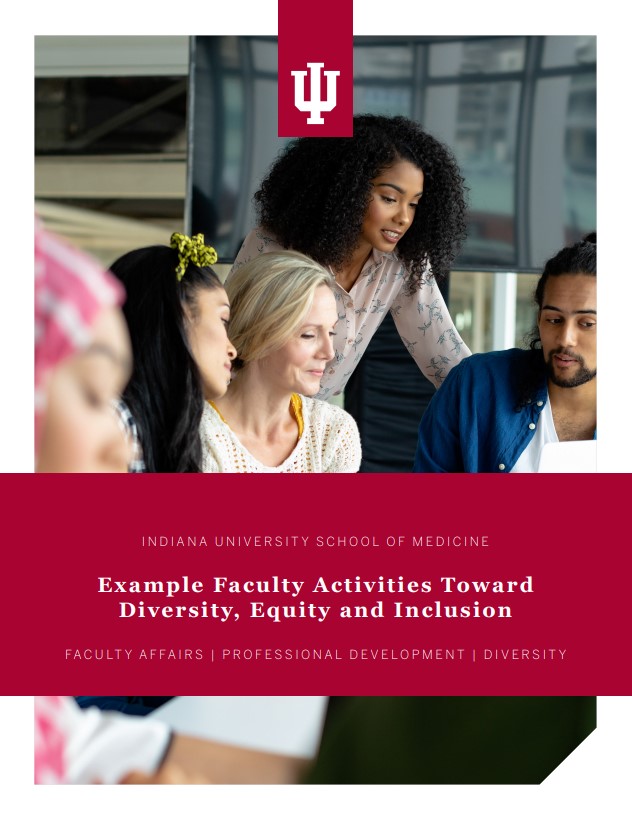
We’ve written about how the Indiana University School of Medicine is forcing faculty to prove their woke beliefs to get promoted or tenure. Yet even we didn’t know how bad things really are. IUSM just released a document laying out exactly what it wants to see – and it goes beyond compelled speech to compelled behavior.
The “Example Faculty Activities Toward Diversity, Equity and Inclusion” document is a thoroughly politicized and ideological creation, betraying IUSM’s complete commitment to race-based medicine. It conveys a clear expectation that faculty hold that same commitment and prove it through their actions.
In order to get tenure or promoted, faculty must engage in one or more of the following politicized activities:
Engage in “Curriculum development and/or revision related to DEI topics.”
“Leading/delivering DEI professional development programming.”
“Creating and/or leading programs related to DEI, on campus and/or beyond (e.g., efforts that create spaces/programs that facilitate greater sense of belonging and a welcoming environment for marginalized students, faculty, and/or staff).”
“Activities and consulting work (paid or unpaid) related to DEI community activities and organizations.”
“Providing peer review for journals and conferences that disseminate scholarship related to DEI, as well as granting agencies that fund DEI-related activities.”
Engaging in “Policy development, quality improvement efforts, and other service to the profession that has significant impact on DEI-related outcomes.”
Receive “National, international, local (campus), and/or community-based awards and/or recognitions for DEI research.”
Engage in “Recruitment and/or retention of diverse research teams/personnel.”
Demonstrate “Inclusive teaching practices (e.g., pedagogy, DEI content, multicultural courses, global perspectives).”
The list goes on. In each case, IUSM is indicating that current and prospective faculty need to hold not just specific political views, but translate those views into concrete action.
This is a violation of medical educators’ rights. Here’s hoping a faculty member sues IUSM – or the Indiana state government intervenes. IUSM shouldn’t be allowed to force faculty to engage in political activities.
https://donoharmmedicine.org/wp-content/uploads/2022/12/shutterstock_1757083934-scaled.jpg17072560Laura Morganhttps://donoharmmedicine.org/wp-content/uploads/DNH_Logo_Stethescope-1.pngLaura Morgan2022-12-22 18:23:032026-02-11 15:33:20IUSM Hits A New Woke Low
The activists pushing race-based medicine on America don’t just want to lower standards. They want to cancel and silence anyone who disagrees with their demands.
Do No Harm chairman Dr. Stanley Goldfarb knows this all too well, having been fired from the leading medical resource UpToDate after speaking out about the dangers of race-based medicine. Now, in the pages of the journal Clinical Orthopaedics and Related Research, he’s calling out the woke mob for trying to cancel a leading figure in the history of medicine: Abraham Flexner.
Flexner is being targeted for authoring a famous report in 1910 in which he argued for reforming medical schools to uphold the highest standards. Thanks to him, dozens of poor-quality institutions closed, including many that had a majority of minority students. Yet the results were beneficial for American health care: Medical education churned out better physicians who provided better care and conducted better research, leading to a new era of medical progress.
This fact hasn’t stopped woke activists from attacking Flexner and trying to get him written out of the history books – naturally on the grounds that he was racist. Yet as Dr. Goldfarb writes, all such accusations have been proven untrue:
The argument that he should have kept Black medical schools open simply because they trained Black students but were substandard is absurd and is an insult to the schools like Meharry and Howard, which remained open and produced accomplished physicians.
If we want medical education to have high standards, then we need to do the hard work of eliminating programs and even schools that fail to achieve that standard. Flexner understood that change of that sort was hard and demanded discipline and courage. We must speak the truth and reject mediocrity in medical training. Flexner showed the way.
Dr. Goldfarb is right. Not only should we refuse to lower standards in medicine, like the woke mob demands, but we should defend those who have advocated higher standards. That’s exactly what we’re doing at Do No Harm.