
• HAVE YOU SEEN OR EXPERIENCED THE IMPACT OF DEI OR RADICAL GENDER IDEOLOGY AT YOUR INSTITUTION? CLICK HERE TO SHARE YOUR STORY.
Do No Harm
  • About Us
    • ABOUT
    • TEAM
    • FAQS
    • WHAT OTHERS SAY
    • VOICES OF DO NO HARM
  • OUR WORK
    • NEWSROOM
    • ISSUE AWARENESS
      • IDENTITY POLITICS (DEI)
      • GENDER IDEOLOGY
    • POLICY WORK
    • LEGAL ACTION
    • RESEARCH
    • RESOURCES
    • CENTERS
  • GET INVOLVED
    • SUBMIT A TIP
    • BECOME A MEMBER
    • CAREERS
  • MEDIA INQUIRIES
  • Search
  • DONATE
  • Menu Menu

Motor City Malfeasance: Henry Ford Health Operates Discriminatory Scholarships

Uncategorized Michigan DEI Hospital System Commentary Do No Harm Staff

Earlier this week, Detroit hospital system Henry Ford Health was the subject of a scathing report by nonprofit watchdog Consumers’ Research highlighting the hospital’s DEI policies.

The report identified numerous instances of DEI at Henry Ford Health, including the use of “unconscious bias training,” its “supplier diversity” policy which prioritizes working with businesses that are at least “51% owned by LGBTQ+ persons or certain minority categories,” and various public statements avowing support for DEI.

But that’s not all.

A deep dive into Henry Ford Health’s various initiatives reveals the system operates scholarships targeted toward certain racial groups.

For instance, Henry Ford Health operates a program (spearheaded by the Emergency Medicine Diversity, Equity and Inclusion Committee) providing students interested in emergency medicine with $1,500 in scholarship funds. A prerequisite for the Underrepresented in Medicine Scholarship Program for Visiting Students, however, is that students “identify as a member of a group that is underrepresented in medicine.”

Henry Ford Health doesn’t define “underrepresented” explicitly, but notes that it refers to “racial and ethnic minorities, LGBTQI-identified or gender nonconforming individuals, individuals from disadvantaged backgrounds, and those with special needs.”

Additionally, Henry Ford Health sponsors the Clinical Excellence through Diversity Scholarship, which provides recipients with “priority access to our student rotations and $1,500 for travel, lodging, and other expenses associated with participating in the visiting rotation.”

Again, one of the prerequisites for this program is that students “identify as a member of a group that is underrepresented in medicine.”

And in yet another example, the listing for a scholarship for prospective urology residents (which has since be taken down) not only required students to “identify as a member of a group that is underrepresented in medicine” but required them to have “an interest and commitment to fostering activities related to healthcare diversity, health inequities, or serving underserved populations.”

These listings, coupled with the revelations from Consumers’ Research, reveal a deep institutional commitment to DEI explicitly affirmed by the hospital in its statement that DEI is “woven into the fabric of everything we do.”

However, according to Fox News, Henry Ford Health deleted several sections of its website that dealt with DEI after Fox News reached out for comment on their story about the Consumers’ Research report.

Perhaps Henry Ford Health is realizing that divisive and discriminatory ideology is not the best advertisement for an institution ostensibly concerned with providing quality healthcare.

https://donoharmmedicine.org/wp-content/uploads/2024/06/shutterstock_582412642-scaled.jpg 1707 2560 Ailan Evans https://donoharmmedicine.org/wp-content/uploads/dono-logo.png Ailan Evans2025-04-17 20:35:082025-04-17 20:35:08Motor City Malfeasance: Henry Ford Health Operates Discriminatory Scholarships

Following Do No Harm Lawsuit, National Association of Emergency Medical Technicians Agrees to Revise Discriminatory Scholarship

Uncategorized United States DEI National Association of Emergency Medical Technicians Medical association Press Release Do No Harm Staff

RICHMOND, VA; April 17, 2025 – Today, the National Association of Emergency Medical Technicians (NAEMT) agreed to remove racial requirements and preferences from its formerly discriminatory scholarship. Do No Harm sued NAEMT in January 2024 on behalf of a student who was excluded from the scholarship because of her race.

“We are pleased that the National Association of Emergency Medical Technicians is removing race-based requirements from its scholarship,” said Dr. Jared Ross, Senior Fellow at Do No Harm. “By prioritizing merit and expertise over racist identity politics, we can restore integrity to medicine and improve patient safety. Do No Harm continues to fight on behalf of its members in the courts and state capitols across this country, and this victory sends a clear message to other medical organizations that promote bias that we will not tolerate discriminatory practices or programs anywhere in medicine.”

NAEMT’s “Diversity Scholarship” awarded $1,250 to students to be used for tuition, fees, and books; however, the eligibility criteria stated that scholarships “will be awarded to students of color.” Other students were excluded based on their race.

The scholarship was illegal under federal law, including 42 U.S.C. Section 1981, which “protects the equal rights of all persons … to make and enforce contracts without respect to race.”

NAEMT agreed to remove “any eligibility requirement or preference based on applicants’ race or ethnicity” from the Diversity Scholarship after the district court ruled that Do No Harm stated a valid claim of racial discrimination under federal law.

To see the joint stipulation of dismissal, click here.

To see the original lawsuit, click here.


Do No Harm, established in April 2022, has rapidly gained recognition and made significant strides in its mission to safeguard healthcare from ideological threats. With 16,000 members, including doctors, nurses, physicians, and concerned citizens across all 50 states and 14 countries, DNH has achieved over 10,000 media hits in top-tier publications and garnered widespread attention through numerous broadcast news appearances.


https://donoharmmedicine.org/wp-content/uploads/2022/11/DNH_ContentCards_PressRelease.png 675 1200 Ailan Evans https://donoharmmedicine.org/wp-content/uploads/dono-logo.png Ailan Evans2025-04-17 15:58:382025-04-17 15:58:38Following Do No Harm Lawsuit, National Association of Emergency Medical Technicians Agrees to Revise Discriminatory Scholarship

Arizona’s Merit-Based Hiring Bill Moves Closer to Becoming Law

Uncategorized Arizona DEI State government, State legislature Commentary Do No Harm Staff

An Arizona bill, SB 1584, would prohibit state and local governments from imposing hiring policies that consider factors other than a candidate’s merit. The Arizona House approved the bill in a vote Tuesday; it had already passed the Senate last month.

In effect, the bill would prevent state governments from considering an applicant’s race, or using strategies that are roundabout ways of practicing race-conscious hiring. Now, Arizona’s  governor has a decision to make on whether to sign it or oppose it.

Additionally, government agencies would be prohibited from manipulating or influencing  “the composition of employees with reference to race, ethnicity, sex or national origin except to ensure color-blind and race-neutral hiring.” 

This addresses so-called “diversity” hiring practices that seek to increase racial diversity among employees, often without explicit admissions of racial discrimination.

The bill tackles a pernicious problem present in states across the country; state boards and agencies implement so-called “diversity” policies that effectively create racial quota systems in order to achieve the desired racial composition of a particular government body.

These policies are particularly damaging in the healthcare and medical fields, in which merit is essential to prevent harm and save lives. Do No Harm has even filed several lawsuits against state governments and government agencies over policies imposing racial requirements for state healthcare and medical bodies.

Overt racial discrimination in hiring is, of course, illegal, but these end-arounds have proliferated in recent years as DEI ideology has increased in prominence.

https://donoharmmedicine.org/wp-content/uploads/2024/03/shutterstock_34411390-scaled.jpg 1707 2560 Ailan Evans https://donoharmmedicine.org/wp-content/uploads/dono-logo.png Ailan Evans2025-04-16 17:29:582025-04-16 17:29:58Arizona’s Merit-Based Hiring Bill Moves Closer to Becoming Law

More Race Concordance Falsities

Uncategorized United States DEI Medical Journal Op-Ed Commentary Ian Kingsbury, PhD, PhD

The medical establishment is arguably the center of resistance to President Trump’s rollback of “diversity, equity, and inclusion.” While federal agencies and private companies alike are responding to the President’s actions by ditching DEI, medical schools, providers, and associations remain stubbornly committed to this divisive ideology.

The medical establishment argues that DEI – especially a diverse healthcare workforce – is critical for patient care. For example, the Association of American Medical Colleges insists that patients from groups “underrepresented in medicine” (i.e. black or Hispanic) benefit when patients can see doctors who share their skin color – a de facto form of segregation known as race concordant care.

But this claim is fallacious. Do No Harm recently discovered through a FOIA request that the study that forms the lynchpin of race concordance hysteria was produced by “scholars” who candidly admit to concealing certain data because they would “undermine the narrative” about “saving black infants.”

While the candor and lack of academic integrity among the researchers of that study is shocking, dishonesty and activism are the norm when race concordance is involved. The latest ideologically-driven, concocted attempt to peddle concordant care as a solution to health disparities comes via a recent systematic review published in the Journal of Racial and Ethnic Health Disparities. 

Systematic reviews can be a useful technique for aggregating evidence on a topic and then making a judgement based on the weight of the evidence. Five of six previous systematic reviews on racially concordant care concluded that it has no health benefits, while the one that purported to observe evidence of benefit was fraught with methodological problems. 

But this systematic review is unique from the others in that it only examines medication adherence as an outcome. Such a review could be valuable if properly executed. Unfortunately, it turns out to be woke agitprop.

The researchers identify five studies that fit the scope of the review. In describing those studies, the review claims that four observed better medication adherence among “BIPOC” (black, indigenous, and people of color) patients in concordant dyads. Based on these claims, the review concludes that race concordance is beneficial.

The description of the five studies is plainly inaccurate. Two of the studies – one by Adamson et al. (2017) and one by Traylor et al. (2010) – observe evidence of benefit for black patients, though not for Hispanic patients. Two other studies – one by Schoenthaler et al. (2012) and one by Schoenthaler et al. (2014) – only examined black patients and did not observe any benefit.

The fifth study was authored by Nguyen et al. (2020). The study was profiled in a Do No Harm report about methodological issues in studies that are regularly cited in defense of DEI. As the critique notes, “The sample’s demographics are not spelled out and results are not disaggregated by racial group. The authors could be hiding that the findings are not statistically significant when the analysis is limited to groups ‘underrepresented in medicine.’” The systematic review describes the outcome as “adherence increased for all races,” but this claim can’t possibly be inferred from the information provided in the Nguyen study. 

In total, then, two studies in the systematic review observe a race concordant benefit for black patients and two do not. The two studies that include Hispanic patients do not observe any benefit, while the Nguyen study obfuscates which groups benefit. The systematic review’s conclusion that “Four studies found that patient-provider race concordance was associated with higher cardiovascular and dermatological medication adherence rates in BIPOC patients” is plainly fictional. An honest review of the literature would reasonably conclude that evidence is mixed or inconclusive. 

So why all the dishonesty around race concordance? Because the idea of matching patients and physicians by race is essential to validating continued DEI efforts in medicine. If concordant care is seen as beneficial, then racial preferences in medical school admissions are simply a matter of “following the science.” Similarly, the concordance hypothesis would help justify efforts to train doctors on “implicit bias” by implicating the alleged bigotry of Asian and white doctors when it comes to health disparities.

As the Schoenthaler et al. (2014) study observes, trust is important for medication adherence. The medical establishment is sacrificing trust on the altar of identity politics. Americans can see through the charade. And so should the Trump administration, which could easily call out – and pressure – the medical establishment for maintaining a DEI edifice that’s built on a foundation of lies.

https://donoharmmedicine.org/wp-content/uploads/2024/07/shutterstock_788845876-scaled.jpg 1920 2560 Ailan Evans https://donoharmmedicine.org/wp-content/uploads/dono-logo.png Ailan Evans2025-04-15 20:50:192025-04-15 20:50:19More Race Concordance Falsities

Audit Reveals How Wisconsin State Gov, University System is Injecting DEI Into Medicine

Uncategorized Wisconsin DEI University of Wisconsin School of Medicine and Public Health Medical School, State government Commentary Do No Harm Staff

This month, the Wisconsin Legislative Audit Bureau released two reports detailing the extent of the state government and university system’s engagement in DEI initiatives. 

The audits cataloged the various DEI initiatives of state agencies and the University of Wisconsin system, and revealed how these institutions have promoted DEI or engaged in activities that appear to be potentially discriminatory.

The audit focusing on 24 of the Wisconsin state government’s agencies found that the state’s Department of Health Services (DHS) had listed 51 total actions related to advancing DEI in its Equity and Inclusion “action plans” since 2021.

These plans included recruiting and retention efforts aimed at increasing diversity, such as through expanding “recruitment resources by targeting marginalized college students and individuals from diverse backgrounds” and featuring “diversity-driven content on job postings.”

Moreover, as part of the action plans, DHS would “develop an internship program for individuals of diverse backgrounds,” “establish a mentorship/leadership program for staff who identify as marginalized individuals,” and “identify or develop unconscious bias training for leadership positions.”

Additionally, DHS created an Office of Health Equity to support these initiatives.

“The Office of Health Equity in the Department of Health Services supports diversity, equity, inclusion, accessibility, and health equity efforts,” the audit reads. “This Office had eight permanent positions that we included in our analysis.”

The audit of the University of Wisconsin system, meanwhile, found that the state’s publicly-funded educational institutions are promoting and engaging in DEI activity. The bulk of these initiatives were operated through the University of Wisconsin-Madison (UW-Madison) campus.

These include anti-racism initiatives, something called the “Trans Counseling Advocacy Research and Education Collaborative,” and hiring policies aimed at increasing diversity.

Several other initiatives, however, are considerably more incendiary.

For instance, the UW-Madison Student National Medical Association chapter created a local White Coats for Black Lives chapter, which the audit says “aims to eliminate racial bias in the practice of medicine.”

White Coats for Black Lives is a medical student organization that as Do No Harm previously reported defended individuals who praised the October 7th terrorist attacks on Israel.

Additionally, the UW-Madison School of Medicine and Public Health launched the “Building Equitable Access to Mentorship initiative” that “matches faculty and first-year incoming medical students from diverse racial and ethnic backgrounds.”

The Building Equitable Access to Mentorship or BEAM program appears to be explicitly discriminatory as it only mentions opportunities for individuals deemed to be members of “underrepresented” racial groups. Selected scholars even receive a stipend through the program.

And lastly, the UW School of Medicine and Public Health department chairs are subjected to an “anti-racism” curriculum.

The results of this audit confirm an uncomfortable and disturbing truth: all too often, state governments and publicly-funded institutions are the ones responsible for injecting DEI into healthcare and medical education.

Simply put, taxpayers should not be on the hook for these divisive and discriminatory programs.

https://donoharmmedicine.org/wp-content/uploads/2025/04/shutterstock_2291228061-scaled.jpg 1440 2560 Ailan Evans https://donoharmmedicine.org/wp-content/uploads/dono-logo.png Ailan Evans2025-04-14 18:57:082025-04-14 18:57:08Audit Reveals How Wisconsin State Gov, University System is Injecting DEI Into Medicine

Saint Louis University School of Medicine Does a DEI Detox

Uncategorized Missouri, United States DEI Saint Louis University School of Medicine Medical School Commentary Do No Harm Staff

In 2023, the Department of Education’s Office for Civil Rights (OCR) opened an investigation into Saint Louis University (SLU) School of Medicine over its discriminatory Scholarship Program for Visiting Medical Students Underrepresented in Medicine.

The program required applicants to “identify as a member of a group underrepresented in medicine” (URiM), citing the previous Association of American Medical Colleges (AAMC) definition of URiM to include “students who identify as African Americans and/or Black, Hispanic/Latino, Native American (American Indians, Alaska Natives, and Native Hawaiians), Pacific Islander, and mainland Puerto Rican.”

In response to the investigation, SLU dropped the racial criteria from the program; in fact, the program’s web page now redirects to SLU’s “Resident Diversity” web page.

Now, however, it appears the medical school has gone a step further.

The school’s entire Office of Diversity, Equity, and Inclusion web page, active as recently as September 2024, redirects to a new web page for its Office of Ignatian Mission in Medicine. 

SLU’s Office of the Ignatian Mission is dedicated to establishing initiatives to “reduce health inequities and improve the health and well-being” of the local community, as well as creating a “culturally competent healthcare workforce.”

Additionally, as recently as January of this year, SLU advertised an initiative called the “Summer Undergraduate Research Program Pilot for Students Underrepresented in Medicine.” The program’s eligibility criteria don’t explicitly mention race, although the program does aim to “improve the recruitment and retention of students who are underrepresented in medicine.”

The link, however, now also redirects to the school’s web page for its Office of Ignatian Mission in Medicine. 

Also redirected to the Ignatian Mission web page is the information page for the John Berry Meachum Scholarship, which was targeted at “disadvantaged” students.

However, many DEI resources still remain; as mentioned, the Resident Diversity web page is still active, and contains a link to the application form for the Department of Psychiatry Scholarship Program for Visiting Medical Students.

That form includes a section for the applicant to list their “Ethnicity/Race/Underrepresented Member Self-Description.”

Another page which is still up is the Office of Diversity, Equity and Inclusion’s (ODEI) Fall 2020 announcement discussing SLU’s various DEI plans.

“The ODEI has bold ideas for fostering diversity, equity, and inclusion at the School of Medicine, and among students, faculty, staff and the community,” the announcement reads. “Among the initiatives are intentional leadership decisions and staffing patterns, training and professional development, increased scholarships and opportunities for minority students and faculty, and events, forums, and lecture series that address relevant issues.”

Numerous medical schools have scrubbed their websites of certain divisive DEI content in recent months, deleting links to their DEI initiatives and altering offensive language.

But it’s important to maintain perspective.

Are these efforts genuine, good-faith shifts in institutional priorities? Or are they simply rebrands intended to remove conspicuous evidence of DEI activity while the medical school continues to engage in divisive or even discriminatory behavior?

We’d like to think it’s the former.

https://donoharmmedicine.org/wp-content/uploads/2024/12/shutterstock_2461988987-scaled.jpg 1628 2560 Ailan Evans https://donoharmmedicine.org/wp-content/uploads/dono-logo.png Ailan Evans2025-04-14 17:50:212025-04-14 17:50:21Saint Louis University School of Medicine Does a DEI Detox

Cook County Health’s Residency Recruitment Strategy: Racial Discrimination

Uncategorized Illinois DEI Hospital System Commentary Do No Harm Staff

The medical residency is an essential part of physician education, enabling medical students to continue their training with hands-on experience. As such, residency positions can be highly coveted.

Yet Cook County Health’s Emergency Medicine residency program uses recruiting tactics that indicate it prefers certain racial groups to snag these spots.

Take CCH’s Diversity Externship Scholarship, which provides selected medical students with an opportunity to work at its facilities as well as a $1,000 stipend for expenses.

According to the scholarship’s eligibility criteria, only “[m]edical students in their 4th year of training from a traditionally underrepresented ethnicity (African American, Latino, Native American/Alaska Native, Pacific Islander/Native Hawaiian), gender identification, sexual orientation, or socioeconomic status” can apply.

This is a cut-and-dry example of racial discrimination.

But that’s just the tip of the iceberg.

In response to a public records request from Do No Harm, CCH provided its protocol for dealing with applicants based on their race.

“Applicants who self-identify as either underrepresented (as defined by the AAMC to include African American, Hispanic or Latino, and Native American applicants) or female in their official […] applications are contacted by our residents via telephone in the winter of their application year to ensure that they have no residual questions regarding the experiences of representative residents within our residency program,” CCH stated.

This might not seem that consequential, but when coupled with CCH’s explicitly discriminatory scholarship program, it reflects a deeply-embedded commitment to racial preferences.

And this commitment is further evident in CCH’s own description of its discriminatory initiatives; Do No Harm obtained a letter sent from CCH to the Accreditation Council for Graduate Medical Education (ACGME) regarding the accreditation status of its Emergency Medicine program.

Among other things, the letter listed the CCH Emergency Medicine residency program’s diversity activities.

“The program continues to sponsor three diversity scholarships for visiting fourth year

medical students annually,” the letter stated, referring to the Diversity Externship Scholarship.

Additionally, “the program continues to sponsor monthly informal in person recruitment dinners targeted specifically to visiting URM and female medical students and hosts annual virtual informational sessions specifically for interested URM and female applicants.”

“URM” in this context refers to students “underrepresented in medicine” which CCH previously defined as including individuals who are African American, Latino, Native American/Alaska Native, and/or Pacific Islander/Native Hawaiian.

But CCH’s discriminatory behavior doesn’t stop there; the program “continues to host call-back sessions for our interview applicants who identify as URM, female, or LGBTQ+,” and “continues to promote residents from underrepresented groups into leadership positions, with 3 of the 4 incoming chief residents identifying as female, one as African American, and one as a member of the LGBTQ+ community.”

Simply put, CCH is engaging in clear racial favoritism. 

This practice is unethical and contrary to the foundational principles of medical ethics.

https://donoharmmedicine.org/wp-content/uploads/2023/04/medical-students-scrubs-scaled.jpg 1707 2560 Ailan Evans https://donoharmmedicine.org/wp-content/uploads/dono-logo.png Ailan Evans2025-04-14 12:36:252025-04-14 12:36:25Cook County Health’s Residency Recruitment Strategy: Racial Discrimination

SIU School of Medicine’s Race-Based Recruitment Plans

Uncategorized Illinois DEI Southern Illinois University Medical School Commentary Do No Harm Staff

The Southern Illinois University School of Medicine has a simple strategy to recruit students and faculty: target certain racial groups.

As part of its “diversity and inclusion” initiatives, SIU unveiled several plans aimed at recruiting students, staff, and faculty deemed to be “underrepresented” in medicine. These plans date back over a decade, indicating SIU’s lengthy commitment to discriminatory recruiting practices.

As stated in its Minority Faculty Recruitment Plan: “The School will recruit, retain, and advance a student body, faculty, and staff reflective of the diversity of the region served by the medical school. A diverse faculty includes individuals from traditionally underrepresented in medicine groups (African-Americans, Latinos, Native- American Indians, Alaskans Natives, Native Hawaiians and other Pacific Islanders) as well as women.”

The plan requires that all faculty hires have  “Job Descriptions written specifically to include wording that addresses the need for underrepresented minorities,” as well as “Search Committees (when appropriate) with at least one member from an underrepresented minority group.”

Additionally, minority faculty hires “will be assigned a Mentor who will orient them to the School.” 

The Minority Staff Recruitment Plan imposes similar requirements.

For what it’s worth, the Association of American Medical Colleges (AAMC) previously defined “underrepresented minority” as an individual from the “Black, Mexican-American, Native American (American Indian, Alaska Native, and Native Hawaiian), and mainland Puerto Rican populations.”

Meanwhile, SIU also maintains its Hispanic Student Recruitment Plan, which, predictably, is aimed at increasing enrollment of Hispanic students.

The plan states that all Hispanic student applicants will be “Screened by Admissions personnel and have their Underrepresented in Medicine (UIM) status noted”; “Interviewed by a veteran member of the Admissions Committee and (whenever possible) by a faculty member who is of Hispanic heritage”; and “Presented to the Admissions Committee by an individual who understands the Recruitment Plan and its UIM focus.”

This reckless, ideological pursuit of “diversity” and other DEI concepts is further reflected in SIU’s DEI programming.

For instance, SIU’s Health Equity Scholar Pathway matches participants with a “Health Equity mentor” as professional learning takes place in several identified program areas, including “literary research in anti-oppressive medical practices.” Upon completion of the program, the SIU School of Medicine will place the “Health Equity Scholar” distinction on residency applications via the ERAS system, the AAMC’s centralized online application service for residency programs. 

Just last month, SIU sponsored a lecture on “health equity” with the University of Illinois Springfield’s Institute for Race, Gender, Sexuality, and Social Justice.

SIU may seem like a small, sleepy medical school in rural Illinois, but it has fully embraced a toxic and regressive ideology that corrodes the pillars of merit and excellence holding up the foundation of medicine.

https://donoharmmedicine.org/wp-content/uploads/2025/04/shutterstock_2111879009-scaled.jpg 1546 2560 Ailan Evans https://donoharmmedicine.org/wp-content/uploads/dono-logo.png Ailan Evans2025-04-09 15:45:042025-04-09 15:45:04SIU School of Medicine’s Race-Based Recruitment Plans

Do No Harm Supports the ACE Act Introduced by Rep. Burgess Owens

Uncategorized United States DEI Federal government, Medical School Press Release Do No Harm Staff

RICHMOND, VA; April 9, 2025 – Today, Do No Harm issued a statement of support for the Accreditation for College Excellence (ACE) Act introduced by U.S. Representative Burgess Owens (R-Utah). The ACE Act prohibits accreditors from mandating colleges adhere to diversity, equity, and inclusion (DEI) standards as a condition of accreditation.

“The Accreditation for College Excellence Act would ensure medical schools focus on arming our future doctors with the knowledge and skills to provide the best medical care,” said Stanley Goldfarb, M.D., Chairman of Do No Harm. “We commend Congressman Owens and his colleagues for exposing political activists posing as accreditors mandating discriminatory DEI policies that corrupt the true purpose of medical education. It is plain common sense to prioritize academic excellence and freedom in higher education so that American students are trained without bias or discrimination.”

“For too long, activist accreditors have weaponized the accreditation process to push far-left ideology, pressuring colleges to submit to ideological tests that have nothing to do with education,” said Representative Burgess Owens. “The result: DEI mandates, CRT programs, and a culture that divides students by race instead of uniting them through merit. The ACE Act puts an end to this nonsense and ensures that institutions of higher education focus on academic standards—not politics.”

The ACE Act:

  • Requires accreditors to confirm their standards do not require, encourage, or coerce an institution to support or oppose specific partisan or political beliefs, viewpoints on social or political issues, or support the disparate treatment of any individual or group;
  • Prohibits accreditors from assessing an institution’s commitment to any ideology, belief, or viewpoint for the purposes of receiving accreditation;
  • Protects a college’s religious mission and ability to require adherence to religious practices or codes of conduct;
  • Ensures that an accreditor cannot require, encourage, or coerce an institution to violate any right protected by the Constitution; and
  • Limits accreditors from adopting any additional standards for accreditation.

Do No Harm, established in April 2022, has rapidly gained recognition and made significant strides in its mission to safeguard healthcare from ideological threats. With 16,000 members, including doctors, nurses, physicians, and concerned citizens across all 50 states and 14 countries, DNH has achieved over 10,000 media hits in top-tier publications and garnered widespread attention through numerous broadcast news appearances.


https://donoharmmedicine.org/wp-content/uploads/2022/11/DNH_ContentCards_PressRelease.png 675 1200 Ailan Evans https://donoharmmedicine.org/wp-content/uploads/dono-logo.png Ailan Evans2025-04-09 14:54:172025-04-09 14:54:17Do No Harm Supports the ACE Act Introduced by Rep. Burgess Owens

Medical College of Wisconsin Has More Clean-Up on Aisle DEI

Uncategorized Wisconsin DEI Medical College of Wisconsin Medical School Commentary Do No Harm Staff

The Medical College of Wisconsin (MCW) appears to be in clean-up mode.

Within the last month or so, MCW has scrubbed, renamed, or rebranded much of the resources and pages on its website dedicated to DEI. For instance, its web page previously dedicated to the Office of Diversity and Inclusion now redirects to the MCW homepage.

The page previously contained links to MCW’s DEI activities, as well as statements justifying the DEI office’s existence.

“There are many dimensions of difference, but diversity scholars suggest key dimensions of human and social difference, called the ‘Big 8’, present persisting challenges and opportunities to organizations,” one statement read. “The dimensions found among MCW’s people and stakeholders include race/ethnicity, gender/gender identity, sexual orientation, geographic origin/nationality, mental/physical (dis)ability status, religion, age, and role and functional/military background.”

Moreover, its page advertising the Visiting Student Health Equity Program – Clinical Rotation Award now redirects to the MCW homepage.

Among the other pages deleted is the President’s Inclusive Excellence Award, and the MCW Cancer Center’s DEI page.

However, MCW’s rebrand appears to be incomplete; several pages dedicated to DEI concepts remain. 

For instance, MCW’s “Institute for Health and Equity” page is still up, but the underlying institution appears to have been renamed the Institute for Health & Humanity. An archived webpage from October 2024 still bears the name “Health and Equity.”

Additionally, a page advertising a 2022 DEI info session remains up.

Given MCW’s history of engaging in discriminatory behavior, it’s a welcome sign that it has decided to remove its divisive, activist content – so long as it is a sincere shift in priorities. 

In 2022, Do No Harm filed a complaint with the Department of Education’s Office for Civil Rights (OCR) against MCW for its 2022 Visiting Underrepresented in Medicine (URiM) Student Elective Program.

Acceptance into the program required applicants to “be a member of a group that is recognized as racially/ethnically URiM by MCW: Mexican American, Puerto Rican, Black/African American, Native American, and Hmong/Hmong American.” This requirement is a violation of Title VI of the Civil Rights Act of 1964, which prohibits discrimination based on race or ethnicity.

Following our complaint, MCW ended up removing specific race/ethnicity eligibility criteria from the program description.

In recent months, many medical schools have rebranded their DEI initiatives following President Trump’s executive orders; but ultimately, these efforts should be genuine attempts to end divisive and exclusionary practices, rather than attempts to merely remove incendiary language.

Schools must ditch this discriminatory, regressive ideology entirely.

https://donoharmmedicine.org/wp-content/uploads/2023/12/shutterstock_1021932094-scaled.jpg 1520 2560 Ailan Evans https://donoharmmedicine.org/wp-content/uploads/dono-logo.png Ailan Evans2025-04-04 14:22:472025-04-04 14:22:47Medical College of Wisconsin Has More Clean-Up on Aisle DEI

Certifying Activism: The American Board of Psychiatry and Neurology’s DEI Obsession

Uncategorized United States DEI Medical association, Medical Board Commentary Do No Harm Staff

Like many medical organizations in recent years, the American Board of Psychiatry and Neurology (ABPN), which certifies psychiatrists and neurologists underwent an ideological transformation that involved integrating DEI and “anti-racism” into its core mission and activities.

According to its DEI resource page, DEI is now a part of its “Strategic Action Plan.” 

The plan lists “Diversity, Equity, and Inclusion” as one of the ABPN’s “key values”; similarly, listed among its “priority areas” is the goal to “Promote Diversity, Equity, and Inclusion Across Our Activities.”

Pursuant to its Strategic Action plan, the ABPN has “Established a board-level DEI Committee”; “Developed DEI policy and statement”; “Incorporated DEI into ABPN Strategic Plan as core values and as a priority area”; and “Committed to fostering an inclusive workplace, including best practices in human resources.”

Additionally, the ABPN has altered its certification process to incorporate DEI objectives. 

It now provides “CME or Self-Assessment CME activities with DEI-related content” for “use toward Continuing Certification requirements.” On another resource page, the ABPN promotes several continuing medical education (CME) courses designed to advance DEI and “anti-racism.”

In short, this means that DEI indoctrination counts toward certifying a psychiatrist’s or neurologist’s competency to practice.

This is obviously nonsensical; but the courses promoted by the ABPN feature offerings from major mental health medical associations.

These courses are administered by medical associations including the American Academy of Child and Adolescent Psychiatry (AACAP), the American Academy of Neurology (AAN), and the American Psychiatric Association (APA).

The courses feature titles including “Clinical Essentials on Advancing Anti-Racism” and “How Racial Socialization Perpetuates Racial Inequities in Psychiatry”; there’s also the AAN’s Anti-Racism Education Program.

This course objectives include having participants “Recognize anti-racism as a professional competency, engage in conversations about race and racism, and practice skills to improve patient care” and “Understand how to apply a racial equity framework to their own clinical practice and in health care systems.”

Additionally, several APA offerings promoted by the ABPN include implicit calls for activism in the field beyond, including: “Approaching Diversity, Equity, Inclusion, and Social Justice through Creating Sustainable Organizational Change”; “Advocacy for Anti-Racist Policies That Expand Equitable Access to Mental Health Care: The Role of the Psychiatrist”; and “Stylistic Writing Strategies that Further Racial Equity.”

The consequence of this DEI fixation is that psychiatrists and neurologists will be inundated with racial and political agitprop, to the detriment of their practice.

This is not helping patients; instead, it is embedding a radical and often discriminatory ideology into the profession. 

https://donoharmmedicine.org/wp-content/uploads/2024/07/shutterstock_558908494-scaled.jpg 1707 2560 Ailan Evans https://donoharmmedicine.org/wp-content/uploads/dono-logo.png Ailan Evans2025-04-04 14:04:262025-04-04 14:04:26Certifying Activism: The American Board of Psychiatry and Neurology’s DEI Obsession

Colorado Bill Threatens Parents Into ‘Affirming’ Child’s ‘Gender’ Identity

Uncategorized Colorado Gender Ideology State government Commentary Do No Harm Staff

A Colorado bill introduced last week would intimidate parents into “affirming” their child’s gender identity, setting the stage for future harmful medical interventions.

The bill states that courts “shall consider deadnaming, misgendering, or threatening to publish material related to an individual’s gender-affirming health-care services as types of coercive control” when making child custody decisions.

“Coercive control” is defined as “a pattern of threatening, humiliating, or intimidating actions, including assaults or other abuse, that is used to harm, punish, or frighten an individual.”

In other words, the law effectively bullies parents into “affirming” their child’s self-identified gender. It does this by equating the failure of a parent to affirm their child’s gender identity with abuse, empowering courts to consider such factors in custody decisions.

Parents who fail to “affirm” are effectively at risk of losing their children.

The natural conclusion of this “affirmation” approach is to place children onto the transgender medicalization pathway, in which they undergo invasive medical interventions to alter their body in accordance with their self-identified “gender.”

Protecting children from their parents thoughtlessly and automatically affirming their gender dysphoria is an important first step to prevent further harmful medicalization.

The Colorado bill, however, would instead intimidate parents into effectively encouraging this medicalization process through affirming the child’s self-identified gender.

“Social transition increases the risk of medical harm,” said Do No Harm Senior Fellow Dr. Travis Morrell, a practicing physician in Colorado.

“Social transition, which is what this bill basically requires of parents – using certain names and pronouns – increases medicalization and surgery, which can cause a lifetime of regret,” Morrell added.

In addition to this legislation, another bill introduced last week would prohibit health insurance benefit plans from denying coverage for sex change interventions deemed to be “medically necessary” by a healthcare provider. The bill would also exempt prescriptions for testosterone from the state’s prescription drug use tracking program.

Child sex change interventions provide no proven long-term benefits; instead, they impose lifelong consequences on children who lack the capacity to meaningfully understand or consent – including permanent sterilization, lifetime dependence on pharmaceuticals, bone density loss, and more.

The lack of evidence supporting child sex changes has been demonstrated by the most authoritative reviews of the evidence on this issue.

The inevitable consequence of this legislation is the further endangerment of children.

https://donoharmmedicine.org/wp-content/uploads/2023/09/shutterstock_1176796777-scaled.jpg 1707 2560 Ailan Evans https://donoharmmedicine.org/wp-content/uploads/dono-logo.png Ailan Evans2025-04-02 16:30:492025-04-02 16:30:49Colorado Bill Threatens Parents Into ‘Affirming’ Child’s ‘Gender’ Identity

Debunked Racial Concordance Study Continues to be Cited Credulously

Uncategorized United States DEI Medical Journal Commentary Ian Kingsbury, PhD, PhD

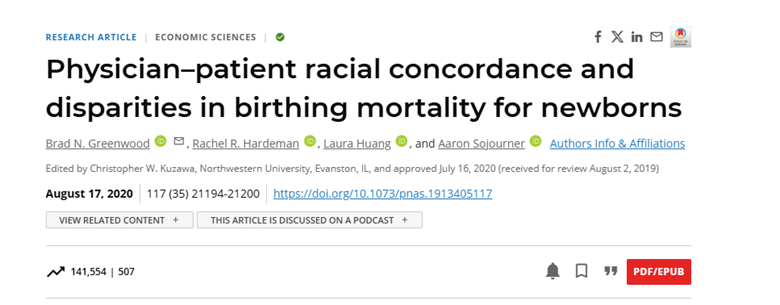
A 2020 study published in the Proceedings of the National Academy of Sciences (PNAS) infamously claimed that black newborns were more likely to survive if treated by black doctors. While the study initially received effusive praise, it has since been debunked and exposed as an attempt to push an ideological narrative rather than an honest, scientific endeavor.

The damage caused by this study can’t be fully undone, but PNAS could at least partially rectify the mistake in publishing the study by retracting it or making it abundantly clear to all readers that the results are not credible. Instead, a critique of the study which definitively proves that the results are biased by a failure to statistically account for the disproportionate assignment of very low birth weight black newborns to highly specialized white doctors is buried. A reader would have to click the “view related content” button on the home screen to access the critique.

Figure 1. A screenshot of PNAS’s interface featuring the study in question.

As a matter of habit, most people who read the study probably don’t bother to click on “related content.” Because the critique is hidden, the study and its original findings continue to be cited in academic literature. According to Google Scholar, that includes 47 citations in 2025 alone (of a total of 766), meaning that even after the study was formally debunked in September 2024, it continues to accrue about one additional citation every other day.

A review of the 10 citations most recently published in English-language, peer-reviewed journals indicates that these citations are not warnings about the politicization of medical research or the ideological capture of medical journals, but credulous citations in favor of racially concordant (i.e. segregated) medical care. Specifically, the following claims feature a citation of the debunked PNAS study:

  • BMC Health Services Research: “Extensive research has been published documenting the desire for and the benefit of having racially concordant obstetricians, midwives, and doulas.”
  • Discover Social Science and Health: “Studies also show patients respond well to being cared for by a diverse workforce, and that racial concordance between providers and their patients can improve patient health outcomes.”
  • Journal of the National Medical Association: “There is ample evidence demonstrating that increasing diversity of the healthcare team can decrease the many disparities that exist in healthcare outcomes.”
  • American Journal of Obstetrics and Gynecology: “Our findings that trust can be enhanced by racially-concordant care – and facilitates biopsy acceptability – supports past findings of a preference for and clinical benefit associated with racially-concordant obstetric care among Black women, and suggest this preference and benefit extend to gynecologic care.”
  • Health Services Research: “While patient–provider race concordance has been shown to be positively associated with aspects of care such as joint decision-making, interpersonal respect, satisfaction, and uptake of preventive care…”
  • Frontiers in Medicine: “A diverse healthcare workforce is critical to improving the quality of care offered to diverse populations. This is supported by a growing body of evidence that highlights the connection between increased diversity among healthcare professionals and the enhanced delivery of culturally appropriate care to diverse patient populations.”
  • Advances in Medical Education and Practice: “Diversity of the physician workforce, particularly with respect to racial, ethnic and linguistic diversity, fosters trust in the health care system, enhances patient satisfaction and the quality of the patient experience, enables the inclusion of minoritized and marginalized voices in institutional policy making, and may improve the patient outcomes for minoritized populations…”
  • BMJ Open: “In another study conducted among newborns in Florida, infant–physician racial concordance was associated with improvement in neonatal mortality rates.”
  • JAMA Network Open: “Concordance between children and practitioner race, which may mitigate some of these biases, has been demonstrated to reduce disparities in neonatal mortality.”
  • JAMA Network Open: “The increased mortality of Black infants overall has been well documented in our neonatal intensive care units. Physician concordance has been suggested to play one such difference in the outcomes, with only 5% of physicians in the US identifying as African American.”

PNAS did the medical community a disservice by publishing a study with obvious flaws. It continues that disservice by not retracting the study or issuing a clearer disclaimer about the results. Unless or until that day comes, readers should keep PNAS’s “editorial standards” in mind when reading it.

https://donoharmmedicine.org/wp-content/uploads/2023/04/doctor-nurse-student-medical-books-scaled.jpg 1280 2560 Ailan Evans https://donoharmmedicine.org/wp-content/uploads/dono-logo.png Ailan Evans2025-04-01 22:48:292025-04-01 22:48:29Debunked Racial Concordance Study Continues to be Cited Credulously

Virginia Could Move Closer to Protecting Children From Harmful Gender Interventions

Uncategorized Virginia DEI, Gender Ideology State government Commentary Do No Harm Staff

Last week, Virginia Governor Glenn Youngkin took a step toward protecting children from the harms of sex change interventions.

Youngkin added an amendment to legislation requiring school administrators to notify parents about safe gun storage policies. 

The amendment would further require school administrators to let parents know if their child requested a school employee to “participate” in either their “social transition” or their actual transition to a “stated gender” different from their biological sex. 

In other words, the amendment would let parents know if their child is experiencing gender dysphoria and school employees are “affirming” their child’s gender incongruence. 

It’s important to protect children experiencing gender dysphoria, as once children are on the transgender medicalization pathway, they are often shepherded by medical providers toward increasingly harmful interventions such as cross-sex hormones and surgical procedures.

Ultimately, as the most authoritative reviews of the evidence on this issue has shown, there is no strong evidence to support the effectiveness of child sex change interventions, and they carry known harms as well as further unknown risks. 

The “affirmation” approach to pediatric gender medicine – which is enabled by school administrators dutifully “affirming” the gender incongruence of distressed children – is demonstrably ineffective and unsupported by the weight of the evidence. What’s more, children lack the capacity to meaningfully consent to such interventions. 

In fact, Do No Harm Parent Advocate January Littlejohn has seen the harms of this process first-hand. School administrators aided the “transition” of January’s own daughter and encouraged her to use a new name and pronouns. Now, January is a fierce advocate for the rights of parents to protect their children against the harms of gender ideology.

Protecting children from this “affirmation” approach is an important first step to prevent further harmful medicalization.

Additionally, Youngkin proposed amendments to legislation that would force medical professionals to sit through so-called “unconscious bias” trainings.

The legislation would “require unconscious bias and cultural competency training as part of the continuing education requirements” for the renewal of licensure.”

Youngkin proposed a tweak to the bills, changing the requirements so that medical professionals would instead have to “complete two hours of continuing learning activities that address maternal health care for populations of women that data indicate experience significantly greater than average maternal mortality.”

Unconscious or “implicit” bias is a dubious concept; the tests used to evaluate or identify implicit bias fail to meet widely-accepted standards of reliability and validity and have been found to be “poor predictors” of real-world bias and discrimination.

Do No Harm believes that Virginia’s medical professionals don’t deserve to be subjected to mandatory training that accuses them of racism and pushes unsupported concepts.

https://donoharmmedicine.org/wp-content/uploads/2023/04/Virginia-state-flag-scaled.jpg 1350 2560 Ailan Evans https://donoharmmedicine.org/wp-content/uploads/dono-logo.png Ailan Evans2025-04-01 13:11:592025-04-01 13:11:59Virginia Could Move Closer to Protecting Children From Harmful Gender Interventions

A Revolt Against DEI in Social Work?

Uncategorized United States DEI Medical Journal Commentary Do No Harm Staff

Earlier this month, the Journal of Teaching in Social Work unveiled a new issue focused on criticisms of the DEI ideology that has been so dominant in social work, healthcare and medicine. 

The issue, titled “Beyond Ideological Mandates: Critical Reflections on Anti-Racist and Anti-Oppressive Social Work Education,” features over a dozen individual criticisms of DEI and the role of social work associations in imposing this ideology onto the profession. 

As a field related to and frequently overlapping with medicine and healthcare, it’s essential for the health of Americans that social work is free from discriminatory and regressive practices and beliefs; Do No Harm previously reported on the National Association of Social Workers’ myriad commitments to antiracism and social activism, and codification of DEI into its ethics statements. 

One article, titled, “Out of Balance: Moving Beyond Anti-Racist & Anti-Oppressive Education,” specifically takes issue with the Council on Social Work Education, the accrediting body for social work programs.

It’s worth noting that the article was published under a pseudonym.

“Debates over the nature of social work education are not new,” the abstract reads. “What is new, however, comes from the Council on Social Work Education’s (CSWE) injection of critical pedagogy into social work education through ‘anti-racist’ and ‘anti-oppressive’ competencies laid out in the 2022 Educational Policy and Accreditation Standards (EPAS).”

The article argues that the actual practice of social work has been diminished and instead prospective entrants into the field are inundated with ideological programming.

“As a result, social work classrooms have become dedicated to fostering moral directives at the cost of practical skills,” the article continues. “Students’ hard-earned money is now thrown away as they sit through lessons of stereotyped, pessimistic ‘moral education’ rooted in ‘luxury beliefs,’ leaving them unprepared for the complexities of practice and failing thousands of clients across the United States in the process.”

Another article, titled “A Critique of Antiracist Ideology,” delivers a dressing-down of the DEI ideology, arguing that it will lead to deleterious outcomes for mental health.

“In this article, I argue that antiracist political activism modeled after the teachings of critical race theory (CRT) and critical social justice theory (CSJ) more generally, is an unethical form of pedagogy and clinical praxis that will likely damage members of society by producing incompetent mental health professionals,” the abstract states.

“Antiracist propaganda in education fails to address (1) the axiological humanistic priorities that center on the distinct phenomenology of individual lives, and (2) inappropriately focuses on race essentialism and colonial blame rather than on (3) universal egalitarian principles mental health disciplines should prioritize in education, training, and public service,” the article continues.

This issue is a tremendous development, representing a departure from the traditional DEI orthodoxy and an embrace of open criticism of the so-called “woke” ideology. The editorial board of the journal described their impetus for the issue being the response to the October 7th attacks on Israel by Hamas, and how DEI ideology was used to justify hateful ideas.

“The galvanizing spark for the call was the response to events following the October 7 massacre by Hamas,” the editors wrote. “This included a not-incidental number of social work students and faculty signing petitions and joining protests that devalued Jewish lives and valorized violence in the name of antiracist practice that deemed Jewish people as being on the wrong side of the ‘settler-colonialism’ or antiracist line.”

“We saw in this response a coalescing of what we have been observing for some time, that perhaps from impatience and frustration with the stickiness of entrenched social problems, our profession has gradually been letting go of the necessary burdens of the humbling search for professional and scientific knowledge,” they continued. 

“Instead, we too often are settling for the comfort of moralistic and rigid truth-claims that, by their own logic, preempt the discomfort of critique,” they added. “In this way, the response to October 7 has been one moment in a larger trajectory of professional change—but a moment we found especially compelling, in the explicit anti-Semitism it perpetrated on too many of our communities and, in so doing, making overt the broader dangers of mandating a single, particular ideology, including the ways in which this compromises academic freedom and the development of critical thinking in our students and our own practice as scholars and teachers.”

It’s heartening to see such strong criticism of the DEI agenda published in such a prominent platform.

Just a few years ago, DEI across all disciplines went essentially unchallenged.

This is good news, and a positive sign that DEI will become just a passing, harmful memory.

https://donoharmmedicine.org/wp-content/uploads/2022/05/shutterstock_1686925927-scaled.jpg 1707 2560 Ailan Evans https://donoharmmedicine.org/wp-content/uploads/dono-logo.png Ailan Evans2025-03-31 12:17:412025-03-31 12:17:41A Revolt Against DEI in Social Work?

East Tennessee State University Tries to Rebrand Divisive DEI

Uncategorized Tennessee DEI East Tennessee State University Medical School Commentary Do No Harm Staff

East Tennessee State University (ETSU), home of the Quillen College of Medicine (QCOM), appears to be attempting to rebrand its DEI activities in the wake of President Trump’s executive order and corresponding guidance from the Department of Education.

Earlier this month, ETSU sent out an email addressed from President Brian Noland recounting recent decisions the university had made regarding its DEI resources. The email comes on the heels of the Department of Education demanding institutions of higher education cease all racially discriminatory policies, programs, and practices; the Department correctly noted that many of these offensive policies are justified on the grounds of DEI.

“Recently, the U.S. Department of Education directed institutions across the country to review their programs and services to ensure equal access for all individuals, regardless of race or personal identity,” Noland said in the email. “ETSU is not an exclusionary institution. Nearly all of our programming and resources are open to anyone wishing to participate. However, we recognize that some terminology may have been construed as exclusive by members of our campus community.”

Despite the statement “ETSU is not an exclusionary institution,” the statement “nearly all of our programming and resources are open to anyone” implies that ETSU realizes its practices and policies have been somewhat less than unifying and welcoming.

ETSU has a long and storied history of promoting radical, divisive, and exclusionary ideologies and practices. Do No Harm has previously exposed ETSU and QCOM for their DEI activities in our 2023 report, “The DEI Bureaucracy in Tennessee’s Medical Schools.”

QCOM maintained a “Diversity Council” whose duties included collecting data and monitoring metrics to ensure that QCOM reached diversity goals, and the school practiced holistic admissions with the aim to increase diversity among the student body.

Additionally, the Quillen College of Medicine recommitted itself to pursuing diversity goals in a policy statement this January.

And most recently, as the Washington Examiner reported, ETSU hosted a lecture called “Health Care Reparations: Reversing the Impact of Race Corrections on Health Equity.”

Other racially themed events held at the September conference included a session on “Black Male Empowerment,” three talks on diversity, equity, and inclusion, a discussion on “racial equity in organizational leadership,” and a training on “facilitating cultural humility.” One event referred to mothers by using the gender-neutral term “lactating parents.”

Noland’s email then went on to list the actions ETSU was taking to achieve “full compliance” with federal directives.

“To ensure full compliance with recent federal directives, the Office of University Counsel is reviewing university communications, including web pages,” the email reads. “In the meantime, new landing pages have been created for the Multicultural Center, the Pride Center, and the Women and Gender Resource Center, with details of events offered by these centers available on the university calendar.”

Of these pages, the previous iteration of the Multicultural Center is easily the page most within the purview of the executive order.

That page includes numerous references to DEI and related resources and concepts; the new page for the Multicultural Center omits reference to DEI entirely.

According to an archived version of the previous Multicultural Center page, ETSU had advertised a “Diversity Scholarship,” had maintained a “Black Faculty and Staff Association,” and had multiple invocations of the benefits of diversity as well as commitments to infuse DEI into the school’s functions.

The email ended with a reaffirmation of the university’s values.

“While processes and language may evolve, our values remain unchanged,” the email reads. “We will continue to cultivate a campus where all individuals feel valued, supported, and empowered to succeed. We will uphold free expression, thoughtful discourse, and our unwavering commitment to respect and civility.”

Do No Harm hopes these actions are genuine good-faith efforts to end divisive and exclusionary practices, rather than attempts to remove troublesome language.

Discrimination exists regardless of what one elects to call it; the practice itself must end.

https://donoharmmedicine.org/wp-content/uploads/2024/10/shutterstock_1912865638-scaled.jpg 1696 2560 Ailan Evans https://donoharmmedicine.org/wp-content/uploads/dono-logo.png Ailan Evans2025-03-28 18:20:292025-03-28 18:20:29East Tennessee State University Tries to Rebrand Divisive DEI

Do No Harm and FAIR File Lawsuit Over Arkansas Racial Quotas

Uncategorized Arkansas DEI State government Press Release Do No Harm Staff

RICHMOND, VA; March 26, 2025 – This week, Do No Harm and the Foundation Against Intolerance & Racism (FAIR) filed a federal lawsuit challenging an Arkansas law imposing racial quotas on gubernatorial appointments to state licensing boards.

For example, Arkansas’s law requires at least one member of the five-person Occupational Therapy Examining Committee to be a racial minority. None of the current members meet this requirement, and three seats are open.

Do No Harm and FAIR are filing the lawsuit on behalf of two Arkansas natives who meet the committee’s requirements but are excluded because they are not racial minorities. Pacific Legal Foundation represents Do No Harm and FAIR.

“By imposing racial quotas on gubernatorial appointments, Arkansas is illegally discriminating against qualified applicants to its licensing boards,” said Stanley Goldfarb, MD, Chairman of Do No Harm. “Medical boards like the Occupational Therapy Examining Committee should be made up of the most qualified candidates to ensure that expertise is prioritized at every level of the healthcare community. Arkansas should prioritize merit over radical identity politics.”

“Arkansas cannot disqualify individuals from public service because of their race,” said Jeff Jennings, an attorney at Pacific Legal Foundation. “Courts have repeatedly struck down race-based appointment mandates as unconstitutional, and Arkansas should be no different. Public service should be based on qualifications, not immutable characteristics.”

To see Pacific Legal Foundation’s case page for Do No Harm, Foundation Against Intolerance and Racism v. Governor Sanders, click here.


Do No Harm, established in April 2022, has rapidly gained recognition and made significant strides in its mission to safeguard healthcare from ideological threats. With 16,000 members, including doctors, nurses, physicians, and concerned citizens across all 50 states and 14 countries, DNH has achieved over 10,000 media hits in top-tier publications and garnered widespread attention through numerous broadcast news appearances.


https://donoharmmedicine.org/wp-content/uploads/2022/11/DNH_ContentCards_PressRelease.png 675 1200 Ailan Evans https://donoharmmedicine.org/wp-content/uploads/dono-logo.png Ailan Evans2025-03-26 14:55:332025-03-26 14:55:33Do No Harm and FAIR File Lawsuit Over Arkansas Racial Quotas

University of Pittsburgh Medical Center Hosts Political Activists, Advocates of Critical Race Theory

Uncategorized Pennsylvania, United States DEI University of Pittsburgh Medical School Commentary Do No Harm Staff

During its 47th Annual Refresher Course in Family Medicine, the University of Pittsburgh Medical Center hosted a March 6 session, titled “Racial Health Disparities” and presented by Stephanie Miller, MD and Kristina Johnson, MD.

The session was replete with political advocacy and references to DEI, critical race theory, and implicit bias.

For instance, Johnson spent a significant portion of the discussion going on a diatribe against the public health policies of the Trump administration.

“There is an ongoing attempt at erasure of trans people. There are outright attacks on gender affirming care,” Johnson said. “Immigration and Customs Enforcement has ended its policy of staying out of healthcare facilities, and the Department of Education may be cutting financial support for students with disabilities. As physicians, we must speak up. Use your voice.”

Without delving too deeply into the political nature of these attacks, it’s worth noting that the Trump administration’s actions regarding so-called “gender-affirming care” have only been to restrict federal funding of such interventions for children. 

Moreover, in addition to citing founder of critical race theory Richard Delgado, Miller called for healthcare professionals to engage in active anti-racism, using an example of a moving walkway at an airport. 

“Actively racist behavior is equivalent to walking fast on the conveyor belt. Passive racist behavior is equivalent to standing still on the walkway. No overt effort is being made, but the conveyor belt moves the bystanders along to the same destination as those who are actively walking. Some of the bystanders may feel the motion of the conveyor belt, see the active racists ahead of them, and choose to turn around; but unless they are walking actively in the opposite direction at a speed faster than the conveyor belt, unless they are actively anti-racist, they will find themselves carried along with others.” 

Anti-racism in practice often holds that racial discrimination is praiseworthy and necessary. It seeks to overcome different outcomes among racial and gender groups by actively discriminating in favor of some people and against others. Its most famous advocate, Ibram X. Kendi, made his embrace of racial discrimination explicit: “The only remedy to past discrimination is present discrimination. The only remedy to present discrimination is future discrimination.”

At another point in the discussion, Miller talked about how to practice this ideological form of medicine in practice.

“You can provide gender-affirming care by confirming that you’re using your patients’ or your colleagues’ correct names and pronouns,” Miller said. “You can use ancestry rather than race to describe the risk of disease.”

Additionally, at various points in the discussion, both Miller and Johnson dismissed the idea that health disparities between racial groups could be explained by physical/genetic differences. 

Johnson summarizes her point succinctly here:

“We have talked about how the social construct of race was used by white people to gain and hold onto power, and how that resulted in health disparities between races; and the false conclusion that those disparities are based in genetics rather than racism. We’ve also explained that racism is anything that increases the disparity between racial groups, whether that’s intentional or not; and we use this narrow focus because the historical path and present-day disparities are so glaringly obvious.”

This is misleading. For instance, as our own Director of Research Ian Kingsbury has shown using the example of preeclampsia, in which about 55 percent of risk is estimated to be genetic, “West African ancestry is linked to risk variants in a gene called alipoprotein L1 (APOL1) that dramatically increase the likelihood of developing preeclampsia or kidney disease.” Genetic differences obviously play a role in numerous other conditions.

In other words, genetic differences between different groups of people obviously lead to differences in particular health outcomes, and it is dangerous to dismiss this fact.

https://donoharmmedicine.org/wp-content/uploads/2024/08/shutterstock_2273908799-scaled.jpg 1440 2560 Ailan Evans https://donoharmmedicine.org/wp-content/uploads/dono-logo.png Ailan Evans2025-03-26 13:13:352025-03-26 13:13:35University of Pittsburgh Medical Center Hosts Political Activists, Advocates of Critical Race Theory
Page 13 of 56«‹1112131415›»
COPYRIGHT © DO NO HARM 2025. ALL RIGHTS RESERVED.
  • Contact
  • Privacy
  • Disclaimer
  • Link to X
  • Link to Facebook
  • Link to Instagram
  • Link to LinkedIn
  • Link to Youtube
Scroll to top Scroll to top Scroll to top