
• HAVE YOU SEEN OR EXPERIENCED THE IMPACT OF DEI OR RADICAL GENDER IDEOLOGY AT YOUR INSTITUTION? CLICK HERE TO SHARE YOUR STORY.
Do No Harm
  • About Us
    • ABOUT
    • TEAM
    • FAQS
    • WHAT OTHERS SAY
    • VOICES OF DO NO HARM
  • OUR WORK
    • NEWSROOM
    • ISSUE AWARENESS
      • IDENTITY POLITICS (DEI)
      • GENDER IDEOLOGY
    • POLICY WORK
    • LEGAL ACTION
    • RESEARCH
    • RESOURCES
    • CENTERS
  • GET INVOLVED
    • SUBMIT A TIP
    • BECOME A MEMBER
    • CAREERS
  • MEDIA INQUIRIES
  • Search
  • DONATE
  • Menu Menu

NYU Langone Health Promotes Race-Based Engagement Groups

Uncategorized New York DEI Medical School Commentary Do No Harm Staff

In a bid to promote “equity” and “inclusion”, many medical schools have instead returned to segregation. 

Schools across the country promote race-based “affinity” and engagement groups that are targeted toward students and faculty of certain races. These groups are explicitly intended to promote the interests of favored racial groups.

For example, a flyer obtained by Do No Harm advertises “BIPOC Engagement Groups” hosted by the Department of Child and Adolescent Psychiatry (DCAP) at NYU Langone Health. BIPOC refers to individuals who are “black, indigenous, and/or people of color.” 

The flyer notes that the purpose of the group is to advocate for “equity, inclusion, and systemic change” and to facilitate “personal and professional growth.”

Additionally, the flyer includes a survey in which prospective group members indicate their “racial identity.” Curiously, “white” is not an option they can select.

Figure 1. A survey asking respondents their racial identity.

The flyer was included in an email sent out by the department advertising a “DCAP BIPOC Faculty, Trainee, and Staff Mixer.”

The email noted that the mixer was open to “all,” while at the same time promoting the “BIPOC Engagement Groups.”

Figure 2. An email advertising the BIPOC mixer.

“Also, we want to ensure that all BIPOC faculty, trainees, and staff are aware of the BIPOC Engagement Groups that meet monthly, an additional way to develop community.” the email read. “We are doing a survey to understand ways in which we can tailor the groups to make them more accessible and engaging.”

Figure 3. A flyer advertising the BIPOC mixer.

Oftentimes, the existence of these groups reflects a larger institutional commitment to DEI.

For instance, the NYU Grossman School of Medicine, which is part of NYU Langone Health, maintains its Office of Diversity Affairs Visiting Elective Fund award which targets “underrepresented students.”

Although the opportunity is open to students of “all backgrounds,” the description of the fund noted that “students from underrepresented backgrounds, including but not limited to those who identify as Black or African American, Latinx, Native American, Native Pacific Islander, or Native Alaskan, are encouraged to apply.”

The medical school also promotes unconscious bias training, which purports to address unconscious racial prejudice, and the Implicit Association Test, which is not considered reliable.

“We conduct unconscious bias training for faculty and hospital departments to assist in the faculty hiring and resident selection processes,” the medical school’s website reads. “Our team provides guidance and supports efforts to recruit diverse talent for faculty positions.”

Rather than view its faculty through this racialized lens, NYU Langone Health should promote opportunities that are friendly to all, no matter their race, sex, or creed.

It should not promote pathways to professional development that are definitionally divisive.

https://donoharmmedicine.org/wp-content/uploads/2024/02/shutterstock_417195604-scaled.jpg 1709 2560 Ailan Evans https://donoharmmedicine.org/wp-content/uploads/dono-logo.png Ailan Evans2025-01-22 19:23:282025-01-22 19:23:28NYU Langone Health Promotes Race-Based Engagement Groups

Do No Harm Applauds President Trump for Targeting DEI in Medical Organizations

Uncategorized United States DEI Federal government Press Release Do No Harm Staff

RICHMOND, VA; January 22, 2025 – President Trump has issued an executive order targeting DEI’s clutch on federal agencies and publicly funded institutions, including medical schools and associations.

The order requires “all executive departments and agencies to terminate all discriminatory and illegal preferences, mandates, policies, programs, activities, guidance, regulations, enforcement actions, consent orders, and requirements.” It also mandates that all agencies must enforce civil rights laws and “combat illegal private-sector DEI preferences, mandates, policies, programs, and activities.”

The executive order has enormous ramifications for medical schools, medical associations, and other healthcare institutions. Many of its broader provisions will directly impact the medical field, while the order makes explicit reference to DEI activities at healthcare institutions as well.

“This order sends a strong message to the American people that our medical professionals will be guided by merit and excellence, not identity politics,” said Kristina Rasmussen, Executive Director at Do No Harm. “For too long medical schools and associations have embedded DEI in admissions, hiring, curriculum, and scholarships, compromising the integrity of the medical profession and the quality of patient care. We commend President Trump for taking this action to restore trust in our institutions and hope in the American Dream.”

The order revokes six previous executive orders that encouraged “illegal discrimination in the federal government.” Additionally, President Trump ordered federal agencies to produce a “strategic enforcement plan” that identifies “potential civil compliance investigations,” specifically mentioning “medical associations, and institutions of higher education with endowments over 1 billion dollars.”

President Trump also ordered the Attorney General and the Secretary of Education to issue guidelines ensuring federally funded institutions of higher education comply with the Supreme Court’s 2023 Students for Fair Admissions v. Harvard ruling that struck down affirmative action in school admissions. This week, Do No Harm published a report identifying medical schools that likely continue to practice discriminatory admissions.

The executive order explicitly calls out “the medical industry” for using “dangerous, demeaning, and immoral race- and sex-based preferences under the guise of so-called ‘diversity, equity, and inclusion’ (DEI) or ‘diversity, equity, inclusion, and accessibility’ (DEIA) that can violate the civil-rights laws of this Nation.” It continues to say that the medical community’s DEI policies “threaten the safety of American men, women, and children across the Nation by diminishing the importance of individual merit, aptitude, hard work.”


Do No Harm, established in April 2022, has rapidly gained recognition and made significant strides in its mission to safeguard healthcare from ideological threats. With over 15,000 members, including doctors, nurses, physicians, and concerned citizens across all 50 states and 14 countries, DNH has achieved over 10,000 media hits in top-tier publications and garnered widespread attention through numerous broadcast news appearances.



https://donoharmmedicine.org/wp-content/uploads/2022/11/DNH_ContentCards_PressRelease.png 675 1200 Ailan Evans https://donoharmmedicine.org/wp-content/uploads/dono-logo.png Ailan Evans2025-01-22 15:31:342025-01-22 15:31:34Do No Harm Applauds President Trump for Targeting DEI in Medical Organizations

Three Things You Need to Know About President Trump’s DEI Executive Order and Healthcare

Uncategorized United States DEI Federal government Commentary Executive Do No Harm Staff

On Tuesday, President Trump signed an executive order aimed at tackling DEI in the private sector and enforcing compliance with the Supreme Court’s ruling that race-based university admissions are illegal.

The executive order has enormous ramifications for medical schools, medical associations, and other healthcare institutions. Many of its broader provisions will directly impact the medical field, while the order makes explicit reference to DEI activities at healthcare institutions as well.

The order has three main areas of focus: race-based admissions at institutions of higher education like medical schools, DEI practices in private sector organizations such as medical associations, and DEI in the federal contracting and grantmaking process.

“This order sends a strong message to the American people that our medical professionals will be guided by merit and excellence, not identity politics,” said Kristina Rasmussen, Executive Director of Do No Harm. “For too long medical schools and associations have embedded DEI in admissions, hiring, curriculum, and scholarships, compromising the integrity of the medical profession and the quality of patient care. We commend President Trump for taking this action to restore trust in our institutions and hope in the American Dream.”

Medical School Admissions

The executive order directed the Attorney General and Secretary of Education to issue guidance ensuring universities’ compliance with Students for Fair Admissions v. Harvard (SFFA), the landmark Supreme Court case that ruled race-based “affirmative action” admissions were illegal for most institutions of higher education.

“Within 120 days of this order, the Attorney General and the Secretary of Education shall jointly issue guidance to all State and local educational agencies that receive Federal funds, as well as all institutions of higher education that receive Federal grants or participate in the Federal student loan assistance program under Title IV of the Higher Education Act, 20 U.S.C. 1070 et seq., regarding the measures and practices required to comply with Students for Fair Admissions, Inc. v. President and Fellows of Harvard College, 600 U.S. 181 (2023).”

Shoring up compliance with SFFA is essential to tackle discriminatory practices at medical schools. Do No Harm has published two reports in the “Skirting SCOTUS” series laying out how medical schools are likely circumventing the Supreme Court’s ruling in SFFA.

More rigorous enforcement of existing civil rights laws will ensure that capable students will not have life-changing opportunities denied to them on the basis of race.

Private Sector DEI

President Trump asked the heads of federal agencies and departments to produce a strategic enforcement plan for federal civil rights laws identifying the “most egregious and discriminatory DEI practitioners” in their respective areas of concern.

This plan will include specific steps to deter illegal DEI programs and practices, with each agency tasked with identifying “nine potential civil compliance investigations” of private-sector organizations.

Moreover, the executive order explicitly mentions “medical associations” and “institutions of higher education” with endowments over $1 billion, thereby covering many of the most prolific advocates of DEI and racial discrimination in the medical field.

Tackling the discriminatory practices of medical associations is crucial to restoring merit and fairness in the medical field. Do No Harm has cataloged dozens of discriminatory scholarships and opportunities doled out by medical associations on the basis of race.

Do No Harm’s bombshell report on the Association of American Medical Colleges (AAMC) further exposed how the AAMC has injected DEI into nearly every facet of medical education.

Contracting and Grantmaking

The executive order further directed federal agencies to eliminate DEI language and discriminatory practices in the federal contracting and grantmaking process.

“(ii)  Excise references to DEI and DEIA principles, under whatever name they may appear, from Federal acquisition, contracting, grants, and financial assistance procedures to streamline those procedures, improve speed and efficiency, lower costs, and comply with civil-rights laws; and

(iii)  Terminate all ‘diversity,’ ‘equity,’ ‘equitable decision-making,’ ‘equitable deployment of financial and technical assistance,’ ‘advancing equity,’ and like mandates, requirements, programs, or activities, as appropriate.”

The abuse of the federal grantmaking process as a mechanism to advance DEI has been well-documented.

Grant programs backed by the National Institutes of Health (NIH), for instance, explicitly discriminate against applicants on the basis of race.

Moreover, NIH research grant listings have included language directing applicants to prioritize certain races when constructing their research team.

Eliminating these discriminatory abuses is necessary to promote excellence and merit in the scientific and medical fields.

Altogether, these steps will go a long way toward restoring Americans’ trust in the medical profession.

https://donoharmmedicine.org/wp-content/uploads/2023/04/shutterstock_1159933525-scaled.jpg 1920 2560 Ailan Evans https://donoharmmedicine.org/wp-content/uploads/dono-logo.png Ailan Evans2025-01-22 14:14:232025-01-22 14:14:23Three Things You Need to Know About President Trump’s DEI Executive Order and Healthcare

Do No Harm Releases Second Report Documenting Medical Schools Skirting SCOTUS Ban on Race-Based Admissions

Uncategorized United States DEI Medical School Press Release Do No Harm Staff

RICHMOND, VA; January 21, 2025 – Today, Do No Harm published a report titled “Skirting SCOTUS: How Medical Schools Will Continue to Practice Racially Conscious Admissions.”

The report, a follow-up to Do No Harm’s first “Skirting SCOTUS” report, reveals evidence that medical schools have continued to use race-based admissions after the Supreme Court ruled in Students for Fair Admissions v. Harvard (SFFA) that such practices violate the law.

Before SFFA, Asian and white students were subjected to harsher admissions standards than Hispanic and black students. After SFFA, admission standards should have been applied equally across all races. However, in 2024, matriculating Asian students averaged an 89th percentile score on the MCAT, compared to the 84th percentile for white students, 67th percentile for Hispanic students, and 68th percentile for black students. These statistics suggest that medical schools are still unfairly requiring higher standards for Asian and white applicants than for Hispanic and black applicants.

Because affirmative action created dramatically harsher admissions standards for white and Asian applicants compared to black and Hispanic applicants, proper implementation of race blind admissions should have culminated in a pronounced shift in medical school demographics. That transformation has been observed at some medical schools. However, others have seemingly ignored the Supreme Court’s ruling. At Texas Christian University (TCU), University of Cincinnati, University of Washington, and Kaiser Permanente School of Medicine, the class of 2028 had a higher percentage of black or Hispanic students than the class of 2027. Similarly, Quinnipiac University, University of Maryland, University of Chicago, and Duke University medical schools had an increased percentage of “underrepresented” students in the class of 2028 as compared to 2027.

Many of these schools still boast about using race-based considerations in admissions. For example:

  • The University of Cincinnati College of Medicine’s website says that it is “committed to recruiting and supporting a diverse student body, faculty, leadership, and administrative staff.”
  • The Kaiser Permanente Bernard J. Tyson School of Medicine says that “equity, inclusion, and diversity are woven into every aspect of Kaiser Permanente Bernard J. Tyson School of Medicine, including pipeline efforts, admissions, staffing, curriculum, student support, and community.”
  • The University of Chicago Pritzker School of Medicine says it is “committed to the recruitment and retention of a diverse class of students.”

Given the unexpected post-SFFA matriculant statistics, and several schools’ renewed commitment to DEI-centered admissions, the report concludes that medical schools are circumventing the Supreme Court’s decision.

“Clearly, medical schools are finding workarounds to factor in race and ethnicity when they should be focused on aptitude and merit,” said Ian Kingsbury, Director of Research at Do No Harm. It is not only qualified students who pay the price for these discriminatory practices, but also patients. Failing to prioritize medical expertise will further erode trust in the doctor-patient relationship and undermine the integrity of the entire healthcare system.”

Click here to read the report.


Do No Harm, established in April 2022, has rapidly gained recognition and made significant strides in its mission to safeguard healthcare from ideological threats. With over 15,000 members, including doctors, nurses, physicians, and concerned citizens across all 50 states and 14 countries, DNH has achieved over 10,000 media hits in top-tier publications and garnered widespread attention through numerous broadcast news appearances.


https://donoharmmedicine.org/wp-content/uploads/2022/11/DNH_ContentCards_PressRelease.png 675 1200 Ailan Evans https://donoharmmedicine.org/wp-content/uploads/dono-logo.png Ailan Evans2025-01-21 19:57:592025-01-21 19:57:59Do No Harm Releases Second Report Documenting Medical Schools Skirting SCOTUS Ban on Race-Based Admissions

The Latest Attack on the Cass Review Comes Up Short

Uncategorized United Kingdom, United States Gender Ideology Medical Journal Commentary Do No Harm Staff

Since the publication of the Cass Review, an exhaustive review of gender medical services in the United Kingdom that found “remarkably weak evidence” to support the use of puberty blockers and hormone treatments for gender-distressed children, many who are committed to so-called “gender-affirming care” have attempted to downplay its findings.

The latest salvo comes from an article that argues the Cass Review “transgresses medical law, policy, and practice, which puts it at odds with mainstream U.S. expert guidelines.”

The article, published in The New England Journal of Medicine (NEJM), is titled “The Future of Gender-Affirming Care — A Law and Policy Perspective on the Cass Review,” and is authored by Daniel G. Aaron, M.D., J.D., and Craig Konnoth, J.D.

The scope of the article is limited to procedural critiques. The authors specifically criticize the Cass Review on the grounds that it “lacked peer review, transparency of authorship, and equitable selection of nonauthor contributors.”

Yet these criticisms are misguided, and many of the supporting arguments lack coherence.

One of the article’s central critiques of the Cass Review is that it fails to adequately prevent “antitransgender bias” in “invitations to oversee and participate in the report.”

There is evidence of antitransgender bias in invitations to oversee and participate in the report. At the outset, the Cass Review’s terms of reference for its assurance group (advisory body) stated that it “deliberately does not contain subject matter experts or people with lived experience of gender services.” In other words, GAC experts and GAC patients were generally excluded from roles in overseeing the report. The clinicians interviewed for the report, for their part, are described as “self-selecting,” indicating that Cass and her colleagues did not attempt to filter out people with antitransgender bias. Indeed, according to the Review, a third of health professionals whom the authors chose to interview agreed that “there is no such thing as a trans child.”

This argument is flawed for several reasons.

First, as the cited source in the NEJM article notes, the updated terms of reference for the Cass Review’s assurance group clarify that “members are independent of NHS England and NHS Improvement and of providers of gender dysphoria services, and of any organisation or association that could reasonably be regarded as having a significant interest in the outcome of the Review.” In other words, the purpose of these terms is to prevent people who already perform child sex change procedures from influencing the review’s conclusions.

This makes sense. To include them would be to simply allow in a party with a significant bias  – though not the kind of bias with which the authors are so concerned. 

The authors’ position seems to be that the Cass Review is remiss for not allowing individuals with obvious conflicts of interest to steer its conclusions. That is hardly a convincing argument.

Second, the authors equate “antitransgender bias” with the position that a child cannot be transgender. This statement is simply not true. A position on whether a child can adequately understand their gender identity in no way implies prejudice against transgender individuals. 

And third, if eliminating antitransgender bias meant only permitting healthcare professionals who believe that children can be transgender to provide input for the review, then the review would include only people already predisposed to endorsing so-called “gender-affirming care” for minors. The existence of transgender children presupposes, at the very least, the legitimacy of theoretical procedures to “affirm” that child’s transgender identity.

The authors also criticize the evidentiary standards of the Cass Review as too high, arguing that randomized controlled trials (RCTs) are not the standard by which research supporting so-called “gender-affirming care” should be conducted.

Nowhere in the authors’ critique of the Cass Review’s evidentiary standards is there an argument that the evidence for puberty blockers and cross-sex hormones to treat gender-distressed children is robust. 

Rather, the authors point to the fact that many drugs used in pediatric medicine have been “prescribed off-label on the basis of limited evidence.” 

This is comparing apples to oranges. Off-label use of, say, acetaminophen and off-label use of Lupron have vastly different potential harms. The off-label use of certain drugs without robust evidence does not necessarily imply that all off-label uses of all drugs without robust evidence should be permitted – or why have pharmaceutical regulatory bodies at all? Puberty blockers, for instance, have potential side effects including diminished bone density, cognitive impairment, and increased risk of infertility.

The off-label use of a drug to treat a serious illness that endangers a child is not comparable to the off-label use of a drug that lacks evidence of its effectiveness and, in fact, is demonstrably dangerous itself. There is no proof that gender transition drugs are the correct treatment for gender dysphoria – the evidence in fact shows the opposite – and referencing the off-label use of other drugs does not change this fact. 

Moreover, the central criticism of the use of puberty blockers and cross-sex hormones to treat gender dysphoria isn’t procedural – in the sense that these drugs haven’t checked the right FDA boxes – but substantive: the evidence supporting their efficacy is weak, and they have known harms and unknown long-term risks. Nothing in the NEJM article contests that criticism.

The authors launch another critique at the Cass Review for lack of transparency in authorship, and for not submitting the report’s conclusions to peer review. Indeed, the authors assert that the Cass Review would have violated U.S. federal law requiring peer review for government-funded scientific information that will impact policy decisions.

First, peer review does not guarantee accuracy, nor does its absence imply inaccuracy: as Do No Harm has previously revealed, many of the peer-reviewed studies used to support child sex change interventions on minors are themselves rife with methodological flaws. And, as we’ve seen with the NEJM itself, too often, peer review can be an instrument of ideological enforcement.

Second, the authors’ apparent implication that a review published in the U.K. might possibly fail to comply with U.S. regulatory standards somehow calls its conclusions into question is absurd. 

And finally, the authors assert that the Cass Review serves to help enforce the “gender binary,” and that “similar calls for higher standards are not applied to cisgender young people receiving gender-affirming care.”

This is a simple category error; it’s misleading to equate treatments aimed at ensuring proper hormonal development with “gender-affirming care.” 

Boys who have decreased testosterone, for example, may need hormone treatments for proper bone and muscle development. It would be incorrect to dismiss the purpose of this treatment as an effort to affirm their maleness. 

Addressing the harms associated with improper development is conceptually different from a child who wishes to change their appearance to match the opposite sex or appear more androgynous. 

All in all, the authors rely on these faulty premises to lodge their procedural complaints while hurling accusations of antitransgender bias.

And that’s not very convincing.

https://donoharmmedicine.org/wp-content/uploads/2022/05/shutterstock_1686925927-scaled.jpg 1707 2560 Ailan Evans https://donoharmmedicine.org/wp-content/uploads/dono-logo.png Ailan Evans2025-01-21 15:21:312025-01-21 15:21:31The Latest Attack on the Cass Review Comes Up Short

Trump Administration Takes Crucial First Steps Toward Tackling DEI in Medicine

Uncategorized United States DEI Federal government Commentary Executive Do No Harm Staff

On Monday, President Trump signed several executive orders targeting diversity, equity, and inclusion (DEI) initiatives in the federal government. 

The most comprehensive executive order, Ending Radical And Wasteful Government DEI Programs And Preferencing, directed the Office of Management and Budget and the Office of Personnel Management to terminate “all discriminatory programs,” including DEI mandates and activities, in the federal government.

The order also directed federal agency heads to terminate all DEI offices, positions, and policies within their respective agency.

Additionally, President Trump signed an executive order to ensure merit-based hiring in the federal workforce. The order ensures that federal agencies “prevent the hiring of individuals based on their race, sex, or religion” going forward.

And finally, President Trump signed executive orders rescinding Biden-era directives that embedded DEI practices in federal agencies.

These included Executive Order 13985, which directed federal agency heads to promote “racial equity” in their respective departments, Executive Order 13988, which aimed to prevent discrimination on the basis of gender identity or sexual orientation, and Executive Order 14127, which more aggressively promoted DEI through developing a government-wide “Diversity, Equity, Inclusion, and Accessibility Strategic Plan” and directing each agency to implement this plan.

“Do No Harm commends President Trump’s actions to roll back DEI practices in the federal government and restore merit-based hiring,” said Dr. Stanley Goldfarb, Chairman of Do No Harm. “Do No Harm will work with the incoming administration in its efforts to remove politics from medicine.”

Do No Harm has worked diligently to expose federal health agencies’ roles in advancing DEI and racially discriminatory practices in the medical field. From lawsuits challenging discriminatory policies to research and comments on the negative effects of the Biden administration’s “health equity” agenda, we have worked to rid healthcare of these harmful practices.

We are optimistic that these policies and ideologies will be sent to the dustbin of history.

https://donoharmmedicine.org/wp-content/uploads/2025/01/shutterstock_2502569527-scaled.jpg 1536 2560 Ailan Evans https://donoharmmedicine.org/wp-content/uploads/dono-logo.png Ailan Evans2025-01-21 14:29:522025-01-21 14:29:52Trump Administration Takes Crucial First Steps Toward Tackling DEI in Medicine

The FIRST Program: The NIH’s DEI Money Machine

Uncategorized United States DEI Federal government Commentary Executive Do No Harm Staff

Over the last decade or so, many of the chief culprits responsible for advancing DEI initiatives in the medical field have been federal health agencies.

The National Institutes of Health (NIH) is no exception, pushing guidelines requiring diversity commitments in grant applications to outright funding DEI initiatives. By manning the faucet of federal funding that many universities use to bankroll their research initiatives, the NIH can exert a significant influence over these grantee institutions.

Enter the NIH’s Faculty Institutional Recruitment for Sustainable Transformation (FIRST) Program. 

First announced in December 2020, the FIRST Program is designed to “transform culture at NIH-funded extramural institutions” by “building a self-reinforcing community of scientists committed to diversity and inclusive excellence (IE).”

In other words, the goal of the program is to advance DEI at institutions of higher education through financial incentives, specifically focused on hiring and personnel.

The NIH’s FIRST Program has distributed grants to 16 universities and medical schools, including prestigious and influential institutions such as Cornell University, Northwestern University, the University of Michigan, and the Icahn School of Medicine at Mount Sinai. These schools established school-centered FIRST programs that in turn pursue DEI through hiring initiatives.

Officially, the FIRST Program prohibits racial discrimination in the hiring process.

But in practice, the incentives of the FIRST Program to hire candidates from underrepresented groups predictably resulted in overt racial discrimination. 

John Sailer, senior fellow at the National Association of Scholars, documented instances of explicit racism at grantee institutions in The Wall Street Journal.

For instance, faculty members discussed the race and sexual orientation of applicants to determine their fit; one professor at the University of New Mexico even explicitly said they “don’t want to hire white men for sure.”

A grant proposal from Vanderbilt University, which received funding from the FIRST Program, explicitly stated the intent to “focus on the cluster hiring of faculty from minoritized racial and ethnic groups, specifically Black, Latinx, American Indian, and Pacific Islander scientists.”

“Successful candidates will be early stage investigators who are Black, Latinx, or from a disadvantaged background (as defined by NIH),” a description of an Icahn School of Medicine at Mount Sinai job read, according to The Wall Street Journal.

In addition to these examples of explicit racial restrictions, many of the grantee institutions say they prioritize “underrepresented” candidates for FIRST Program hiring initiatives.

Cornell’s $5 million award, for instance, “will support the hiring and retention of 10 new assistant professors from groups underrepresented in their fields, while transforming institutional climate into a culture of inclusive excellence.”

The Icahn School of Medicine at Mount Sinai’s $16 million award supports, among other things, a “cohort cluster hiring” initiative to bring on 12 early-stage investigators, targeting those “underrepresented in science and medicine.”

The NIH defines “underrepresented” groups in biomedical research as “Blacks or African Americans, Hispanics or Latinos, American Indians or Alaska Natives, Native Hawaiians and other Pacific Islanders.”

Northwestern University even explicitly says it is using this definition for its FIRST-funded program, stating that, while it will grant equal consideration to applicants regardless of race, “[w]e especially encourage applications by members of groups underrepresented in the biomedical, clinical, behavioral, engineering, physical, and social sciences as defined by the Notice of NIH’s Interest in Diversity.”

It’s hard to see how racial discrimination was not the inevitable result of the FIRST Program’s aim to incentivize hiring of “underrepresented” candidates, especially considering the NIH’s own definition of “underrepresented.”

And the FIRST Program is hardly the only instance of the NIH’s diversity initiatives leading to discriminatory programming. The agency has routinely 

The Enhancing Science, Technology, Engineering, and Math Educational Diversity (ESTEEMED) grant program, for example, is designed to help undergraduates from “diverse” backgrounds pursue careers in biomedicine. The program, which began in 2017, specified that the grantors should target “individuals from groups identified as underrepresented in the biomedical, clinical, behavioral and social sciences” such as racial minorities and disabled individuals.

The NIH currently lists 16 active ESTEEMED grant programs on its website; each program’s eligibility criteria contains varying degrees of racial preference.

For instance, Clemson University’s “Call Me Doctor ESTEEMED Scholars Program” stipulates that applicants are eligible if they are from the following ethnic backgrounds: “Hispanic or Latino, Black or African American, Native Hawaiian or Other Pacific Islander, American Indian or Alaska Native.”

The University of Georgia, meanwhile, requires students to be “from a diverse background, including from one or more groups underrepresented in the sciences” to be eligible for its ESTEEMED program.

The University of Texas San Antonio’s program requires applicants to be “ethnically underrepresented in the sciences (Hispanic, African American, American Pacific Islander, Alaskan),” disabled, or financially disadvantaged.

And as mentioned previously, the NIH’s grant requirements also encourage racial discrimination.

Do No Harm Senior Fellow Dr. Kevin Jon Williams, a professor of cardiovascular sciences at Temple University’s Lewis Katz School of Medicine, highlighted an NIH grant listing’s discriminatory guidelines in an op-ed for The Wall Street Journal.

The grant listing stated that the funding agency “expects applicants to recruit individuals from diverse backgrounds, including individuals from underrepresented groups for participation in the study team.” The updated listing for the grant later dropped the discriminatory language.

If the NIH truly wishes to advance human knowledge and innovation in the biomedical field, these policies and grant programs simply cannot be tolerated.

They are unethical, cruel, and incompatible with the pursuit of excellence. There is no evidence that diversity among scientific personnel produces better outcomes. These initiatives will only lead to the devaluation of merit.

The incoming administration should make it a priority to turn off the DEI funding faucet.

https://donoharmmedicine.org/wp-content/uploads/2024/07/shutterstock_773282173-scaled.jpg 1841 2560 Ailan Evans https://donoharmmedicine.org/wp-content/uploads/dono-logo.png Ailan Evans2025-01-20 01:11:462025-01-20 01:11:46The FIRST Program: The NIH’s DEI Money Machine

Do No Harm Files Federal Complaint Against Johns Hopkins for Discriminating Against Medical Students

Uncategorized Maryland DEI Johns Hopkins University School of Medicine Medical School Press Release Do No Harm Staff

RICHMOND, VA; January 16, 2025 – Do No Harm and the Wisconsin Institute for Law & Liberty (WILL) filed a federal complaint with the Department of Health and Human Services Office for Civil Rights against Johns Hopkins University for discriminating against medical students on the basis of race and sex.

Johns Hopkins University’s School of Medicine, a top-ranking medical school that relies on taxpayer funding, offers certain education programs for third and fourth-year medical students, where they gain valuable hands-on experience across a variety of medical disciplines.

However, the university restricts access to these programs to medical students from racial groups deemed to be “underrepresented” in medicine.

These discriminatory programs are aligned with Johns Hopkins’ mission to prioritize race and “increase diverse representation.” For these reasons, Do No Harm and WILL have asked the HHS to investigate the university for violating the Affordable Care Act and Title VI of the Civil Rights Act of 1964.

“Johns Hopkins, an institution that promulgated an absurdly offensive and racist definition of privilege, is also responsible for racially discriminatory programs,” said Dr. Stanley Goldfarb, Chairman of Do No Harm. “We are filing these Office for Civil Rights complaints to bring Johns Hopkins’ discrimination to light. Johns Hopkins should drop all unlawful racial requirements for programs and focus on providing the best education possible to future medical professionals.”

“America’s hospitals and medical training institutions face a reckoning,” said Cara Tolliver, Associate Counsel at WILL. “The healthcare system cannot function effectively when healthcare education opportunities and experiences are reserved for certain individuals based on race and factors other than merit. Healthcare organizations that continue to ignore long-established anti-discrimination laws may soon find the new Trump-Vance Administration taking a firm stance.”

In 2022, the U.S. Department of Education’s Office for Civil Rights opened an investigation into Johns Hopkins School of Medicine over a discriminatory elective program in response to a complaint filed by a Do No Harm senior fellow. Additionally, Do No Harm has called for the university to close its DEI department after the chief diversity officer claimed that all whites, heterosexuals, and Christians are privileged – that officer has since resigned.


Do No Harm, established in April 2022, has rapidly gained recognition and made significant strides in its mission to safeguard healthcare from ideological threats. With over 15,000 members, including doctors, nurses, physicians, and concerned citizens across all 50 states and 14 countries, DNH has achieved over 10,000 media hits in top-tier publications and garnered widespread attention through numerous broadcast news appearances.


https://donoharmmedicine.org/wp-content/uploads/2022/11/DNH_ContentCards_PressRelease.png 675 1200 Ailan Evans https://donoharmmedicine.org/wp-content/uploads/dono-logo.png Ailan Evans2025-01-16 20:56:022025-01-16 20:56:02Do No Harm Files Federal Complaint Against Johns Hopkins for Discriminating Against Medical Students

A Professional Development Award – But Only for Black Scientists?

Uncategorized United States DEI Medical Journal Commentary Do No Harm Staff

Should life-changing opportunities be curated on the basis of applicants’ race?

Take the Rising Black Scientists Award by Cell Press, which publishes several medical science journals as well as scientific journals in other fields including chemistry and plant science.

As part of its diversity initiatives, Cell Press has for the past five years awarded funds to support the careers of rising scientists – who must be black to be eligible for the award.

Winners receive a $10,000 award and $500 in travel funds, as well as publication of their essays in issues of Cell Press journals Cell and iScience. Honorable mentions receive $500 as well as publication in iScience.  

These types of discriminatory awards are commonplace in the medical and scientific fields: Do No Harm recently filed a federal civil rights complaint against the Alliance for Regenerative Medicine (ARM) over an early-career internship program that was only open to black students. ARM removed the racial requirement following Do No Harm’s complaint.

Oftentimes, these awards and opportunities are justified on the basis of providing career pathways to groups deemed underrepresented or underprivileged.

“The award is meant to break down barriers and create opportunities by providing funds to support professional development,” Cell Press’ description of the award reads, stipulating that applicants must “identify as Black/African-American” to be eligible.

The award matches Cell Press’s larger infatuation with DEI initiatives and racial politics over the past few years.

In the midst of the 2020 Black Lives Matter protests and riots, Cell Press flagellated itself for its perceived lack of diversity and pledged to recruit more black employees, as well as initiate efforts to promote more black professionals.

“Cell Press is part of the problem,” the pledge began. “We are not a diverse enough organization. We do not count enough underrepresented minorities among our staff. We do not have enough Black researchers on our advisory boards or reviewer pools. We have not invited nearly enough content from Black authors, nor have we sufficiently used our platform to raise up Black voices.”

“Going forward, we will create more opportunities for Black professionals to succeed in STEM publishing, support Black researchers in developing their careers, and use our journals to showcase more Black researchers and their work,” it continued.

Science should, of course, be open to people of all racial backgrounds.

But prioritizing race over merit is not the answer, and is antithetical to a genuine commitment to scientific excellence. The proper course of action is to value merit, achievement, and brilliance over scientists’ specific racial background.

Racial discrimination in any form is immoral, no matter what justification its proponents use.

https://donoharmmedicine.org/wp-content/uploads/2023/09/shutterstock_165320348-scaled.jpg 1696 2560 Ailan Evans https://donoharmmedicine.org/wp-content/uploads/dono-logo.png Ailan Evans2025-01-14 14:48:422025-01-14 14:48:42A Professional Development Award – But Only for Black Scientists?

American Physical Therapy Association Operates Discriminatory Scholarship Programs

Uncategorized United States DEI Medical association Commentary Do No Harm Staff

The American Physical Therapy Association (APTA) is actively discriminating against its own members.

As part of the APTA’s commitment to diversity, the organization hands out monetary awards that are only available to minority APTA members.

The APTA’s Faculty Development Scholarship Award, for example, provides a monetary award to “minority faculty pursuing a postprofessional doctoral degree.”

To qualify for the award, applicants must be “members of one of the following racial/ethnic minority groups: African American or Black, Asian, Native Hawaiian or other Pacific Islander, American Indian/Alaska Native and Hispanic/Latino.”

The APTA operates similar programs for minority students, the PT Student and PTA Student Awards. These awards also require applicants to be members of the aforementioned racial groups to receive the award.

These discriminatory programs are funded by the APTA’s Minority Scholarship Fund and are symptomatic of a larger institutional commitment to DEI. 

For instance, the APTA’s continuing education content is replete with lessons in DEI principles and strategies for physical therapists to advance DEI in their workplaces.

The APTA’s “DEI Certificate” includes six courses that together instruct APTA members “about bias, microaggressions, population health, the Americans with Disabilities Act, treating a gender diverse population, and improving diversity in the physical therapy profession.”

Organization-wide, the APTA has in the past few years taken several actions toward strengthening its adherence to DEI.

In an infographic included in the APTA’s magazine in October 2022, the organization boasted of the steps it has taken to improve diversity in its ranks while advancing DEI in the “association, profession, and society” more broadly. These steps included 21 APTA sections and chapters establishing their own DEI committees, doubling the number of DEI continuing education courses available, and expanding the APTA’s PT Moves Me Ambassador Program.

That program is a recruiting initiative by the APTA designed to “[i]ncrease diversity” within the physical therapy profession.

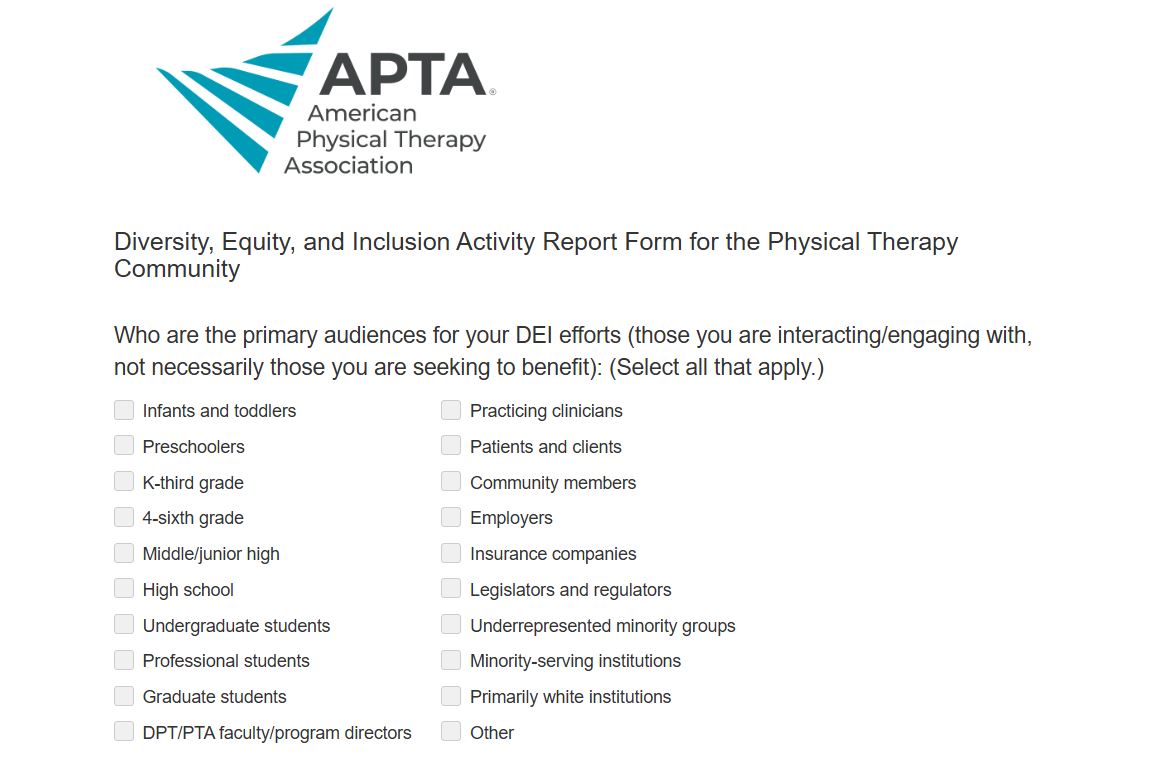
The APTA also surveys the extent to which its members and the profession at large are advancing DEI through its “Diversity, Equity, and Inclusion Activity Report Form for the Physical Therapy Community.” 

The form asks respondents to detail their involvement with DEI initiatives and their own personal work advancing DEI; one question even asks the respondents to list their primary audiences for DEI efforts, with options including “Infants and toddlers” and “Preschoolers.”

Figure 1. A screenshot of the APTA’s Diversity, Equity, and Inclusion Activity Report Form.

The APTA also encourages its members to involve themselves with outside groups who are actively promoting DEI in other fields or who are outright political actors. The organization’s DEI Toolkit includes a list of DEI and “anti-racism” resources, groups, and initiatives with whom their members should engage.

This includes White Coats for Black Lives, a medical student organization that, as Do No Harm previously reported, defended individuals who praised the October 7th terrorist attacks on Israel.

It’s clear the APTA envisions itself as a political actor, and uses its position with the physical therapy profession to advance a radical racial ideology through its initiatives, courses, and scholarships.

No healthcare organization should engage in racial discrimination. This is a horrific example to set for the physical therapy profession, and the APTA should reconsider its ideological commitments at once.

https://donoharmmedicine.org/wp-content/uploads/2025/01/shutterstock_2478331313-scaled.jpg 1724 2560 Ailan Evans https://donoharmmedicine.org/wp-content/uploads/dono-logo.png Ailan Evans2025-01-13 20:43:082025-01-13 20:43:08American Physical Therapy Association Operates Discriminatory Scholarship Programs

Do No Harm Lawsuit Against Pfizer to Move Forward After Second Circuit Reversal  

Uncategorized United States DEI Press Release Do No Harm Staff

RICHMOND, VA; January 10, 2024 – Today, the Second Circuit Court of Appeals reversed a previous decision and affirmed Do No Harm’s standing in its lawsuit against Pfizer over a racially discriminatory fellowship program.  

“We are pleased the Second Circuit has reversed course and correctly recognized our right to protect our members in the district court. Protecting the anonymity of association members is crucial to prevent intimidation when brave individuals speak out against powerful organizations for their unconstitutional practices,” said Do No Harm Chairman Dr. Stanley Goldfarb. “While Pfizer tried to hide behind process and procedure, they now will have to answer for their discriminatory and illegal fellowship program. We look forward to continuing our fight to oust corrosive identity politics wherever it exists in medicine.” 

Background 

  • On September 15, 2022, Do No Harm first sued Pfizer on behalf of two of its members over Pfizer’s Breakthrough Fellowship Program, which excluded Asian American and white applicants.
  • According to the lawsuit, the Breakthrough Fellowship Program’s exclusion of Asian American and white applicants violates the Civil Rights Act, the Affordable Care Act, the New York State Human Rights Law, and the New York City Human Rights Law. 
  • In December 2022, the district court dismissed Do No Harm’s case, citing lack of standing. Do No Harm appealed that decision and in October 2023, argued before the U.S. Court of Appeals for the Second Circuit in New York.  
  • In March 2024, the Second Circuit ruled that Do No Harm must identify, by name, the members on behalf of which it is suing to have standing.  
  • Now, following review, the Second Circuit has reversed that previous decision. Do No Harm will continue to challenge Pfizer’s racial exclusion in the district court.  

More information on the lawsuit can be found here: Do No Harm v Pfizer 


Do No Harm, established in April 2022, has rapidly gained recognition and made significant strides in its mission to safeguard healthcare from ideological threats. With 15,000 members, including doctors, nurses, physicians, and concerned citizens across all 50 states and 14 countries, DNH has achieved over 10,000 media hits in top-tier publications and garnered widespread attention through numerous broadcast news appearances. 

https://donoharmmedicine.org/wp-content/uploads/2022/11/DNH_ContentCards_PressRelease.png 675 1200 Ailan Evans https://donoharmmedicine.org/wp-content/uploads/dono-logo.png Ailan Evans2025-01-10 21:08:132025-01-10 21:08:13Do No Harm Lawsuit Against Pfizer to Move Forward After Second Circuit Reversal  

UT Southwestern Residents Promote ‘DEI Committee’ Despite Texas Ban

Uncategorized Texas DEI University of Texas Southwestern Medical School Medical School Commentary Do No Harm Staff

On January 1, 2024, the Texas law preventing public universities from maintaining DEI offices and employing DEI officials went into effect. 

Among other things, the law ensures public institutions of higher education do not “hire or assign an employee of the institution or contract with a third party to perform the duties of a diversity, equity, and inclusion office,” and do not operate “a training, program, or activity designed or implemented in reference to race, color, ethnicity, gender identity, or sexual orientation.” Universities also cannot have policies or programs “promoting differential treatment of or providing special benefits to individuals on the basis of race, color, or ethnicity.”

Yet the University of Texas Southwestern Medical Center (UT Southwestern), the largest medical school in the state of Texas, is rife with DEI activity.

According to an email obtained through a public records request, the hospital’s residents voted on leadership positions in February 2024 – after the Texas law restricting DEI had gone into effect – including for a DEI position.

The email, from fifth-year surgical resident Dr. Maisa Nimer, discusses the “DEI committee” leadership position and notes that eligible candidates must be research residents in their second to fifth years.

Here’s the kicker: the description of the DEI committee position states that the candidate will “work with faculty DEI team on new employee training, hiring/interview processes, assist with DEI outreach and recruitment efforts; heavy involvement in structural disadvantage curriculum and DEI lectures.”

This would, of course, indicate that the UT Southwestern faculty has a DEI team that is involved in hiring decisions, lectures, and curriculum content. In other words, DEI is very much a presence at UT Southwestern.

Moreover, per the email, the voting process will be overseen by Dr. John Mansour, a Professor of Surgery and Vice Chair of Quality in the Department of Surgery at UT Southwestern.

And that’s not all; UT Southwestern is also maintaining its “UTSW-Parkland Health Equity Scholars Program,” a 2-year initiative aimed at improving faculty members’ engagement with “minority communities.” The university accepted applications for the 2024 cohort.

The webpage advertising the program further notes that scholars will have access to “training in implicit bias mitigation.” Program description documents from 2021 obtained by Do No Harm further note that scholars “will become workshop moderators and leaders in Implicit Bias mitigation in their department/division/section.”

The premise of the program is itself problematic: the common conception of health equity is based on the belief that systemic racism is at least largely at fault for disparities in health outcomes between racial groups. And achieving “health equity” invariably involves preferential treatment of certain racial groups in order to close racial disparities in health outcomes or treatments. 

This is definitionally “differential treatment” on the basis of race, color, or ethnicity.

In addition to these policies and programs, the school curriculum is replete with DEI ideology.

UT Southwestern’s Department of Surgery maintains a “structural disadvantage curriculum” (SDC) that was funded in 2022 by a grant from the American College of Surgeons to bankroll “innovative and impactful research projects and programs addressing diversity, equity, and inclusion (DEI), and anti-racism issues.”

Do No Harm obtained a series of lectures from the SDC that were dated as taking place in 2024, following the enactment of Texas’ DEI law. 

These lectures touch on topics ranging from systematic racism in policing to prison reform to the treatment of Native Americans, and are at best tangentially related to issues of medicine and clinical practice.

One July 2024 lecture from the SDC, titled “Structural Violence and Mass Incarceration,” included explicit calls for audience members to participate in left-wing politics and support policies like cash bail. 

“You can support some policies. The George Floyd Act is a measure that seeks to ban racial and religious profiling by law enforcement at the federal, state, and local level,” the lecturer said.

The lecture also went on to criticize the concept of qualified immunity, which protects government officials (like police officers) from liability for actions that violate constitutional rights.

Keep in mind this is a medical school promoting this content. What these issues have to do with medicine is anyone’s guess. 

In fact, during the question and answer section of one March 2024 lecture on “Structural Disadvantages of Native Americans,” an audience member asked the speaker if there were any resources available that would allow them to put their surgical skills to use. The speaker did not have a resource at hand.

All in all, it’s clear that DEI is alive and well at UT Southwestern.

Texas’ medical schools would be best served fully jettisoning these regressive ideals and committing to providing a medical education that equips residents and future physicians with the skills necessary to save lives and prevent harm.

https://donoharmmedicine.org/wp-content/uploads/2023/05/shutterstock_2241273961-scaled.jpg 1707 2560 Ailan Evans https://donoharmmedicine.org/wp-content/uploads/dono-logo.png Ailan Evans2025-01-10 19:24:052025-01-10 19:24:05UT Southwestern Residents Promote ‘DEI Committee’ Despite Texas Ban

University of Washington School of Medicine Removes Race-Based Restrictions After Do No Harm Lawsuit

Uncategorized Washington DEI Medical School Press Release Do No Harm Staff

RICHMOND, VA; January 10, 2024 – The University of Washington School of Medicine (UWSOM) has removed race-based restrictions from a physician networking directory after Do No Harm sued the program for racial discrimination.

Originally, only “black, indigenous and people of color” (BIPOC) students and physicians were eligible to participate in UWSOM’s Physicians Directory, a database of physicians that students could use for career advice. But on October 15, Do No Harm filed a lawsuit against UWSOM, claiming its directory violated the Equal Protection Clause of the Fourteenth Amendment, Title VI of the 1964 Civil Rights Act, and Section 1557 of the Affordable Care Act.

In response to Do No Harm’s lawsuit, UWSOM renamed the program “MD Connections,” and opened it to students of all races. Additionally, the school removed all mentions of race from the directory and revised its website to clarify that all students can participate in the program regardless of race or ethnicity. In light of these changes, Do No Harm has agreed to settle with UWSOM, and the case will be dismissed.

“This is a win for University of Washington’s medical students, the medical community, and the crucial principle of equality,” said Dr. Stanley Goldfarb, Chairman of Do No Harm. “We are pleased that UWSOM responded to our lawsuit by removing its discriminatory policies that barred certain students from career opportunities on the basis of race. We will continue to speak out and take legal action against any discriminatory programs that undermine the integrity of our medical system.”

Click here to read the joint stipulation of dismissal.

Click here to read the original lawsuit.


Do No Harm, established in April 2022, has rapidly gained recognition and made significant strides in its mission to safeguard healthcare from ideological threats. With 15,000 members, including doctors, nurses, physicians, and concerned citizens across all 50 states and 14 countries, DNH has achieved over 10,000 media hits in top-tier publications and garnered widespread attention through numerous broadcast news appearances.


https://donoharmmedicine.org/wp-content/uploads/2022/11/DNH_ContentCards_PressRelease.png 675 1200 Ailan Evans https://donoharmmedicine.org/wp-content/uploads/dono-logo.png Ailan Evans2025-01-10 13:41:282025-01-10 13:41:28University of Washington School of Medicine Removes Race-Based Restrictions After Do No Harm Lawsuit

How the Biden CMS Corrupted Healthcare With Radical Identity Politics

Uncategorized DEI Federal government Commentary Executive Do No Harm Staff

As the federal agency responsible for administering core national health insurance programs, the Centers for Medicare & Medicaid Services (CMS) should aim to promote a healthcare system free from divisive politics or discriminatory practices.

Yet during the Biden administration, CMS adopted a number of policies actively working against this ideal. These policies were often in pursuit of the administration’s “health equity” agenda, and encouraged medical providers to advance radical identity politics or even outright discriminate on the basis of race. 

Since our founding in 2022, Do No Harm has worked to expose and combat these harmful policies. We’ve repeatedly submitted comments opposing CMS’ divisive agenda and supported litigation against the agency’s discriminatory rules.

It is absolutely imperative that CMS ditch these regressive practices. 

A CMS that promotes a robust healthcare system cannot at the same time promote racial discrimination: the two concepts are mutually exclusive.

‘Health Equity’

The core organizing premise of CMS’ discriminatory policies is “health equity,” which holds that the racial disparities in health outcomes and healthcare are due to systemic racism.

Most recently, CMS proposed a rule to implement a new payment model, the Increasing Organ Transplant Access (IOTA) Model, to reduce perceived disparities in treatment for kidney issues. The model, justified on the basis of “health equity,” would encourage hospitals to racially discriminate in the kidney transplantation selection process in order to receive incentive payments.

Do No Harm called on CMS to withdraw the rule in June 2024, arguing it exceeded the agency’s statutory authority as well as promoted illegal discrimination.

“In short, the proposed rule would encourage providers to adopt plans that favor some racial

groups in the kidney-transplant process over others,” Do No Harm’s comment stated. “As a matter of policy, law, and morality, this cannot stand.”

Multiple media outlets, including the Washington Free Beacon, covered the proposed rule and Do No Harm’s reaction.

In November 2024, CMS announced the finalized rule which dropped the proposed requirement for hospitals to submit ‘health equity plans’ to receive incentive payments.

This is a major victory, but this particular policy is just the tip of the iceberg when it comes to CMS’ racially divisive agenda. Since the beginning of the Biden administration, CMS has worked to inject radical concepts like DEI into the healthcare and medical fields.

On his first day of office on January 20, 2021, President Joe Biden issued Executive Order 13985, directing federal agencies to address perceived “systematic racism” and promote “equity.” 

CMS, relying on this executive order, published a rule in July 2021 proposing to create an “anti-racism plan” that encourages CMS to address “health equity” and reduce racial disparities, as well as potentially administering anti-racism and implicit bias trainings. In particular, the rule would financially reward doctors for adopting “anti-racist” policies in their practices.

“As physicians try to abide by this policy, they will find it harder and harder to provide equal access to care,” wrote Do No Harm Senior Fellow Benita Cotton-Orr in the New York Post.

Do No Harm supported a lawsuit against CMS over the rule that argued the regulation was not supported by statutory authority and encouraged doctors to engage in racial discrimination. The lawsuit is ongoing, with a federal judge denying the federal government’s motion to dismiss the complaint in 2023. Do No Harm also praised Congressman Gary Palmer (R-AL) for introducing the Prevent Racism in Medicare Act, which would revoke the anti-racist incentive policy.

Then in April 2022, CMS issued a proposed rule for inpatient and long-term hospitals, forcing them to report information on patient race, ethnicity, income, geographic location, sexual orientation, and gender identity. This information could then be used to financially reward or punish healthcare providers based on their adherence to identity politics. Do No Harm urged the public to comment on the rule in July 2022, and submitted comments later that month raising the alarm about the rule’s potential for abuse.

In 2023, CMS proposed two rules that would modify quality reporting programs for skilled nursing facilities and cancer hospitals, respectively. These reporting programs use payment incentives and payment reductions to ensure facilities are providing adequate care.

However, the modifications instead promote the concept of “health equity” once again by including a health equity scoring system in the quality reporting guidelines. This encourages providers to promote health equity, which in practice is essentially racial discrimination. The finalized version of the rules went into effect later in 2023. 

Moreover, in September 2023, Do No Harm submitted comments on a CMS rule that would alter physicians’ fee schedule within Medicare and Medicaid to promote health equity, expressing concern that the rule would financially encourage providers to discriminate against their patients.

“Stated plainly, the proposed rule change would directly incentivize healthcare providers to deliver more services to patients of certain races/ethnicities, sexualities, and religions,” the comment stated. “Such a system would constitute a clear violation of the Civil Rights Act of 1964, and pushing individual patients to the front of the line based on any factor other than their health status is morally wrong.”

That rule also went into effect later in 2023.

Unwinding Racial Discrimination

These policies represent the most visible manifestations of how CMS has injected racially discriminatory ideals into the healthcare system.

Financially incentivizing doctors to discriminate against their patients and promote radical ideology goes against the very foundation of medical ethics: to do no harm. These CMS policies instead subjugate public health to an insidious agenda that views Americans by their race, and not by their health needs. 

The next administration should take action immediately to unwind these harmful regulations and promote a healthcare system that is free and equal – and not one that punishes Americans based on their race.

https://donoharmmedicine.org/wp-content/uploads/2025/01/shutterstock_2248274327-scaled.jpg 1707 2560 Ailan Evans https://donoharmmedicine.org/wp-content/uploads/dono-logo.png Ailan Evans2025-01-09 00:59:302025-01-09 00:59:30How the Biden CMS Corrupted Healthcare With Radical Identity Politics

Virginia Resurrects Bill Forcing Healthcare Professionals to Submit to Divisive Trainings 

Uncategorized Virginia DEI State legislature Commentary Do No Harm Staff

Thanks to a new bill, Virginia could soon force medical professionals to sit through so-called “unconscious bias” trainings.

The bill, introduced by Democratic Delegate Cliff Hayes on January 3, would direct the state board of medicine to “require unconscious bias and cultural competency training as part of the continuing education requirements for renewal of licensure.”

This means that if medical professionals wish to be licensed in Virginia, they must undergo what often amounts to ideological programming that has no basis in established science.

The Virginia Legislature had already advanced a previous iteration of the bill in early 2024, but Governor Glenn Youngkin vetoed the legislation. He instead proposed an alternative requirement that medical professionals “complete two hours of continuing learning activities that address maternal health care for populations of women that data indicate experience significantly greater than average maternal mortality.”

Yet lawmakers are plowing ahead with this legislation once again.

Specifically, the bill requires the first unconscious bias training to cover “unconscious racial bias affects care during pregnancy and the postpartum period.”

There is no solid evidence finding a causal link between unconscious bias/implicit bias (which is itself a dubious concept at best) and racial disparities in health outcomes. Additionally, the study of racism’s effects in public health is an area plagued by poor scholarship. 

For instance, a hugely influential 2020 study purported to show that the elevated infant mortality rate among black babies was partially reduced when black babies had black doctors rather than white doctors. Yet a commentary published in September 2024 debunked the results of the 2020 study by examining the same data and finding that, when controlling for low birth weights, the effect of black doctors treating black babies becomes statistically insignificant.

What’s more, the tests used to evaluate or identify implicit bias fail to meet widely-accepted standards of reliability and validity and have been found to be “poor predictors” of real-world bias and discrimination. Ohio State University psychology professor emeritus Hal Arkes described the test as “an extremely feeble predictor of behavior.”

And furthermore, there is no evidence that being treated by a physician of the same race improves one’s health outcomes. 

With these facts in mind, the notion that a state-mandated unconscious bias training would materially affect racial disparities in health outcomes strains credulity. 

But it’s not just that unconscious bias training is based on shoddy premises: it’s actively divisive. 

Asserting without evidence that individuals are implicitly prejudiced against other races breeds paranoia and creates unwarranted inhibitions among medical professionals just trying to do their job. 

Moreover, a study released by the Network Contagion Research Institute (NCRI) and the Rutgers University Social Perception Lab in November 2024 found that exposure to DEI trainings increased agreement with rhetoric from Adolf Hitler, and encouraged “punitive responses” to “imagined prejudice.”

And Virginia’s legislation would mandate the trainings leading to these negative consequences.

These requirements are not new: Do No Harm launched its own alternative implicit bias course to meet Michigan’s requirement that doctors and nurses submit to implicit bias training as a condition of their licensure.

But Virginia’s medical professionals deserve better. They should not be subjected to mandatory training that accuses them of racism and pushes unsupported concepts.

https://donoharmmedicine.org/wp-content/uploads/2023/04/doctor-nurse-student-medical-books-scaled.jpg 1280 2560 Ailan Evans https://donoharmmedicine.org/wp-content/uploads/dono-logo.png Ailan Evans2025-01-07 18:57:132025-01-07 18:57:13Virginia Resurrects Bill Forcing Healthcare Professionals to Submit to Divisive Trainings 

Memorial Health’s Discriminatory DEI Pledge

Uncategorized Illinois DEI Health system Commentary Do No Harm Staff

Memorial Health, an Illinois-based health system, is advertising its pledge to hire “diverse” candidates while promoting its commitment to DEI ideology.

According to its “Equity, Diversity, and Inclusion” (EDI) pledge, the health system will “actively recruit, hire and promote diverse candidates so that our colleagues more accurately reflect the communities we serve.”

“We know diverse perspectives strengthen our teams and our care, and we are committed to building an inclusive culture where everyone can fully engage,” the hospital states on its EDI page. 

Furthermore, Memorial Health participates in the Illinois Health and Hospital Association Racial Equity in Healthcare Progress Report, which requires the hospital to report the racial breakdown of its employees. 

The progress report is a voluntary program that tracks Illinois hospitals’ progress toward “health equity” by assessing various metrics of racial diversity and adherence to DEI ideology.

“What is the self-reported racial/ethnic demographic breakdown of the staffing categories below at your organization,” the first question of the progress report asks, with the categories referring to different racial groups. 

Additionally, the survey asks the “racial/ethnic demographic breakdown” of each hospital’s patient population.

The progress report further asks hospitals and health systems whether their governing board and senior leadership “reflect the organizational commitment to promote racial equity” by having “strategies in place” to support diversity among the hospitals’ board, and what percentage of their organizational staff have completed activities like DEI and anti-racism trainings.

It’s difficult to see the purpose of these questions as they relate to hospitals’ medical goals; there is no evidence that patients receive better care when treated by physicians of the same race, or that having a more racially diverse patient and physician population will lead to better health outcomes.

But looking through Memorial Health’s other statements on DEI reveals the health system’s deep-seated ideological commitment.

For instance, Memorial Health’s EDI page also goes on to note that “every colleague” receives health equity training, and that all providers must take unconscious bias training to renew their Illinois state licenses. 

The role of a healthcare provider is to heal patients, not pursue an ideological agenda. 

And providers should not be racially discriminating against would-be employees in service of misguided racial equity goals.

https://donoharmmedicine.org/wp-content/uploads/2024/10/shutterstock_1701937552-2-scaled.jpg 1707 2560 Ailan Evans https://donoharmmedicine.org/wp-content/uploads/dono-logo.png Ailan Evans2025-01-07 17:20:492025-01-07 17:20:49Memorial Health’s Discriminatory DEI Pledge

Georgetown’s ‘Anti-Racist Physician’ Course Pushes Dubious Science on Med Students

Uncategorized United States, Washington DC DEI Georgetown University Medical School Commentary Do No Harm Staff

The Georgetown University School of Medicine, alongside the National Anti-racism in Medicine Curriculum Coalition (NAMCC), developed a medical school elective course aimed at promoting “anti-racism” and tackling “anti-Blackness” in the medical field. 

The course, Core Competencies of an Anti-racist Physician, is promoted through the Association of American Medical Colleges’ (AAMC) educational resource journal, MedEdPortal.

“The course sought to advance students’ skills in recognizing how anti-Blackness may influence a clinical encounter and being able to explicitly name the entrenched nature of anti-Blackness in the culture and history of medicine writ large,” the course description in MedEdPortal states.

What does this look like in practice? Well, the course sends students through several activities that amount to either lessons on African American culture or DEI trainings, each with seemingly little pedagogical value pertaining to the practice of medicine.

“During this course, students viewed the documentary 13th and reflected on their results on the Implicit Association Test, as well as engaging in a required visit to the National Museum of African American History and Culture in Washington, DC,” the course description states.

It’s hard to see what a documentary about the incarceration of black Americans has to do with the competencies required to be a physician, or how a field trip to a museum is preparing students to better treat their future patients. These activities aren’t relevant to medical education except in the most attenuated sense, and surely Georgetown can find more useful courses to fill their students’ schedules.

But the more troubling aspect is the promotion of the Implicit Association Test (IAT) as a useful tool.

A 2013 meta-analysis published in the Journal of Personality and Social Psychology found that IATs were “poor predictors” of real-world bias and discrimination, while the test has not been shown to correlate with other indicators of real-word discrimination.

In short, the course asks students to examine outcomes on a test of their racial biases that have very little real world application. This is, at best, a waste of time and resources, but more accurately a great way to engender paranoia and self-loathing among medical students.

Moreover, the assessment that accompanies the course, aimed at gauging students’ learning outcomes, is effectively a test of their adherence to DEI ideology. 

For instance, the assessment asked students to set a racial equity goal for themselves. These could include possible affirmations such as “I am planning to read more books by Black authors,” “I will interrupt or redirect racist hate speech in my personal or professional life,” and “I will take the [Implicit Association Test] to better understand my bias.”

But it doesn’t stop there; the assessment also asks students to rate how much they agree with the following statements: “Anti-Black racism is a problem in US healthcare systems,” “Racial minority patients are routinely treated differently in the hospital, especially black patients,” and “I understand the ways that race is falsely biologized in a clinical context,” along with many others.

A score of 5 is given when a student “strongly agrees” with the statement. The “correct” answers for all the previous questions are all 5s.

It’s concerning that a course like this is clogging up medical school curricula when there is already so much a prospective physician must learn. And it’s even more concerning that, should the course succeed in achieving its learning outcomes, students will come away worse off. 

Medical schools and educators should focus instead on preparing students for the actual practice of medicine, not inundating students with harmful and radical ideas in the misguided pursuit of “anti-racism.”

https://donoharmmedicine.org/wp-content/uploads/2024/11/shutterstock_2449562991-scaled.jpg 1708 2560 Ailan Evans https://donoharmmedicine.org/wp-content/uploads/dono-logo.png Ailan Evans2025-01-02 16:59:072025-01-02 16:59:07Georgetown’s ‘Anti-Racist Physician’ Course Pushes Dubious Science on Med Students

How the Icahn School of Medicine at Mount Sinai Came to Embrace DEI

Uncategorized New York DEI Icahn School of Medicine at Mt. Sinai Health system, Medical School Commentary Do No Harm Staff

The Icahn School of Medicine at Mount Sinai has long been one of the foremost drivers of DEI in medical education. Its curriculum and administrative policies are saturated with references to DEI and “antiracism,” and it has openly embraced racially discriminatory practices.

Like many medical institutions, the Mount Sinai Health System began seriously committing to an aggressive, DEI-centered restructuring of its core priorities in the wake of George Floyd’s death.

Per a web page recounting the system’s progress toward its DEI goals, these efforts extend beyond recruiting and hiring at the health system to pedagogy at the Icahn School of Medicine. 

The school’s DEI web page notes that its “structures, policies, and practices are aimed at advancing diversity, equity and inclusion in the areas of training and education as well as recruitment, retention, and career development of students, trainees, faculty and staff.”

Moreover, prospective students are met with a litany of “racial justice” resources and links advertising the school’s infatuation with DEI.

For instance, the school operates a program called “Anti-Racist Transformation in Medical Education” that aims to “develop the capacity of medical schools to dismantle systemic racism and bias in their work and learning environments,” and “promote shared learning on how to dismantle racism within and across medical schools.”

These efforts extend not only to the Icahn School of Medicine, but to partner medical schools as well.

Another link goes to the Racism and Bias Initiative, which aims, among other things, to “integrate teaching of anti-racist practice longitudinally across the redesigned curriculum.”

It’s concerning that a medical institution would so completely reorient its mission in service of radical ideology. But how these ideas manifest in practice is all the more disturbing. 

Racial Discrimination

Do No Harm has repeatedly exposed how the Icahn School of Medicine’s commitment to racial justice is often a proxy for its own form of racial discrimination, excused in the name of DEI.

In June 2023, Do No Harm Senior Fellow Mark J. Perry filed a complaint with the New York City Commission on Human Rights (CCHR) regarding the Growth in Operations, Administrations, and Leadership Society (GOALS) program at the Icahn School of Medicine. The program was characterized as “an elite Black male Initiative at Mount Sinai Health System that advocates for career advancement opportunities and equitable resources for its members.” Perry later filed complaints over the program with the Department of Education and Department of Health and Human Services’ Offices for Civil Rights (OCR); these cases all remain under review. 

Moreover, the Washington Examiner reported on documents, obtained by Do No Harm, showing how the Icahn School of Medicine is evaluating instructors based on their contributions to DEI and is requiring job applicants to demonstrate their adherence to DEI ideology.

Additionally, as John Sailer of the National Association of Scholars reported, the Icahn School of Medicine advertised a job that limited applicants to “early stage investigators who are Black, Latinx, or from a disadvantaged background […].”

In March 2023, Do No Harm filed a complaint with the Department of Health and Human Services OCR against the Mount Sinai Health System for sponsoring Icahn’s Visiting Electives Program for Students Underserved in Medicine (VEPSUM). The program’s eligibility criteria stipulated that applicants must be “underrepresented in medicine, specifically Black/African American, Hispanic/Latino, Native American/Alaska Native, and Pacific Islander/Native Hawaiian.” The Icahn School of Medicine ended up removing the discriminatory eligibility criteria following our complaint. 

And in September 2023, Perry filed another complaint with the CCHR against the Mount Sinai Health System over a paid fellowship that discriminated on the basis of race. 

“Anti-Racist Pedagogy”

The Icahn School of Medicine also contributed to the Association of American Medical Colleges’ (AAMC) DEI efforts. 

While investigating the AAMC, Do No Harm discovered that the Icahn School of Medicine’s Center for Antiracism in Practice developed a program aimed at embedding “antiracism” within “all courses and clerkships” at the school.

In 2021, the school established the Center for Antiracism in Practice “to integrate anti-racism efforts” across the school’s departments; the center was later subsumed under the Institute for Equity and Justice in Health Sciences Education in 2023.

“Participants work one-on-one with CAP facilitators to implement and assess the effectiveness of anti-racist pedagogy, policies, and practices within their courses,” the program description reads. 

What does this antiracism look like in practice? Well, the school’s Office for Diversity and Inclusion advertised a book by anti-racism “scholar” Ibram X. Kendi, who openly calls for racial discrimination to achieve racial equity and remediate past injustices.

And given the school’s open embrace of racially discriminatory policies, it’s clear that to the Icahn School of Medicine, DEI and “antiracism” involves overt discriminatory practices.


Do No Harm is committed to eliminating DEI and its divisive concepts from medical education. 

As evidenced by the Icahn School of Medicine at Mount Sinai, these ideas not only degrade the quality of medical education but lead to overt racial discrimination that unjustly disadvantages individuals based on their race.

Do No Harm will remain vigilant and continue exposing racial discrimination in the medical field.


https://donoharmmedicine.org/wp-content/uploads/2024/07/shutterstock_1279492897-scaled.jpg 1453 2560 Ailan Evans https://donoharmmedicine.org/wp-content/uploads/dono-logo.png Ailan Evans2024-12-23 18:48:372024-12-23 18:48:37How the Icahn School of Medicine at Mount Sinai Came to Embrace DEI
Page 17 of 56«‹1516171819›»
COPYRIGHT © DO NO HARM 2025. ALL RIGHTS RESERVED.
  • Contact
  • Privacy
  • Disclaimer
  • Link to X
  • Link to Facebook
  • Link to Instagram
  • Link to LinkedIn
  • Link to Youtube
Scroll to top Scroll to top Scroll to top