• HAVE YOU SEEN OR EXPERIENCED THE IMPACT OF DEI OR RADICAL GENDER IDEOLOGY AT YOUR INSTITUTION? CLICK HERE TO SHARE YOUR STORY.
Do No Harm
  • About Us
    • ABOUT
    • TEAM
    • FAQS
    • WHAT OTHERS SAY
    • VOICES OF DO NO HARM
  • OUR WORK
    • NEWSROOM
    • ISSUE AWARENESS
      • IDENTITY POLITICS (DEI)
      • GENDER IDEOLOGY
    • POLICY WORK
    • LEGAL ACTION
    • RESEARCH
    • RESOURCES
    • CENTERS
  • GET INVOLVED
    • SUBMIT A TIP
    • BECOME A MEMBER
    • CAREERS
  • MEDIA INQUIRIES
  • Search
  • DONATE
  • Menu Menu

Do No Harm Chairman Releases New Book Documenting Fight Against Identity Politics in Medicine

Uncategorized United States DEI, Gender Ideology Press Release Do No Harm Staff

RICHMOND, VA; September 30, 2025 – Today, Do No Harm is proud to announce the release of Doing Great Harm?: How DEI and Identity Politics Are Infecting American Healthcare―and How We Are Fighting Back, a new book written by board chairman Stanley Goldfarb, MD.

Doing Great Harm? is an insider’s account of the takeover of the medical establishment and medical schools by identity politics. Dr. Goldfarb documents the behind-the-scenes story of the successes and accomplishments of the anti-woke medicine movement since the launch of Do No Harm in 2022. He also explores how DEI and gender ideology have hurt medical care, medical education, and the healthcare system, and what work still needs to be done.

“I experienced firsthand the hold that identity politics had on the medical establishment when I was cancelled for simply questioning the supposed necessity of DEI in healthcare,” said Stanley Goldfarb, MD, Chairman at Do No Harm. “In response, we founded Do No Harm to combat the infectious spread of this divisive ideology. Since our inception, we have achieved numerous wins in the fight to restore integrity to medicine. From securing legal victories and filing civil rights complaints against discriminatory programs to publishing resources that help protect children from gender ideology, we have worked tirelessly to hold medical institutions accountable to the Hippocratic Oath. My book is a primer for anyone who wants the full story of how identity politics infiltrated healthcare, how we have countered its spread, and what remains to be done.”

Dr. Goldfarb’s book covers topics including:

  • Discriminatory DEI programs operated by medical schools;
  • Declining admissions and academic standards as medical schools prioritize molding physicians for social activism at the expense of medical science;
  • Medical journals publishing dishonest scholarship that serves an ideological agenda;
  • The U.S. healthcare system’s wholesale promotion of irreversible sex-change procedures for minors, despite Europe’s rejection of so-called “gender-affirming care”; and
  • Medical societies forcing “implicit bias” training and other racially charged theories on their members.

The book can be purchased here.

Do No Harm was founded after Dr. Goldfarb’s successful first book, Take Two Aspirins and Call Me by My Pronouns: Why Turning Doctors into Social Justice Warriors is Destroying American Medicine. Since its inception just three years ago, Do No Harm has submitted over 550 FOIA requests, filed more than 170 civil rights complaints, won numerous lawsuits, and published influential reports and resources including the Stop the Harm Database.


Do No Harm, established in April 2022, has rapidly gained recognition and made significant strides in its mission to safeguard healthcare from ideological threats. It has over 35,000 members, including doctors, nurses, physicians, and concerned citizens across all 50 states and 14 countries.


https://donoharmmedicine.org/wp-content/uploads/2022/11/DNH_ContentCards_PressRelease.png 675 1200 Ailan Evans https://donoharmmedicine.org/wp-content/uploads/dono-logo.png Ailan Evans2025-09-30 23:12:092025-09-30 23:12:09Do No Harm Chairman Releases New Book Documenting Fight Against Identity Politics in Medicine

SIU School of Medicine’s Long, Long History of DEI

Uncategorized Illinois DEI, Gender Ideology Southern Illinois University Medical School Commentary Do No Harm Staff

Over the past few months, Do No Harm has exposed numerous examples of Southern Illinois University (SIU) School of Medicine officials and administrators promoting regressive identity politics.

From unearthed videos exposing administrators’ efforts to resist the Trump administration’s anti-DEI efforts to evidence of discrimination, SIU has long been one of the most prolific proponents of DEI in medical education.

Now, the Daily Wire has reported that Dr. Jerry Kruse, dean and provost of SIU School of Medicine, is stepping down from his position next year. 

This latest development coincides with reporting that SIU is promoting scholarships that are restricted to members of certain racial groups.

Do No Harm is providing a brief overview of the various examples of identity politics at SIU that we’ve helped publicize leading up to Dean Kruse’s announcement:

Discriminatory Recruitment Plans: In April, Do No Harm first reported on several SIU recruitment plans aimed at recruiting students, staff, and faculty deemed to be “underrepresented” in medicine. These plans date back over a decade, indicating SIU’s lengthy commitment to discriminatory recruiting practices.

For instance, the school’s Minority Faculty Recruitment Plan states that: “The School will recruit, retain, and advance a student body, faculty, and staff reflective of the diversity of the region served by the medical school. A diverse faculty includes individuals from traditionally underrepresented in medicine groups (African-Americans, Latinos, Native- American Indians, Alaskans Natives, Native Hawaiians and other Pacific Islanders) as well as women.”

“Resist” Trump Administration Policies: In May, Do No Harm obtained footage of Dean Kruse promising to oppose Trump’s executive orders on DEI and gender during a meeting with school staff.

“We will resist obeying in advance. We won’t do any anticipatory obedience,” Kruse said. “The existing laws have not changed, no court directives will require any change in compliance at this time.”

“More importantly, these orders and actions constitute a direct attack on the people we serve, the people to whom we are accountable,” Kruse added.

Admissions Disparities: Also in May, the Daily Wire, citing figures and analysis from Do No Harm, reported that blacks and Hispanics admitted to SIU have on average much lower GPAs and MCAT scores than admitted whites and Asians.

“In 2024, the average MCAT score of accepted Asians and whites (combined) was more than 4 points higher than that of accepted blacks and Hispanics (combined) — equivalent to a gap of about 14 percentile points. On GPA, accepted Asians and whites on average had 0.36 higher scores than accepted Blacks and Hispanics.”

Misleading Claims Supporting Gender Ideology: In July, the Daily Wire reported on the Gender Equity and Transgender Clinic, owned and operated by SIU, which offers sex change interventions to minors.

On its website, the Clinic made the following claim: “Puberty blockers are not permanent. When they are stopped, puberty continues normally.”

As Do No Harm pointed out in a recent comment to the Federal Trade Commission, this claim is misleading at best as “the effect of pubertal suppression on neurodevelopment is wholly unknown.”

“Puberty doesn’t just continue normally,” Do No Harm Senior Fellow Dr. Jared Ross told the Daily Wire. “There are only so many years of pubertal development. And if you interfere with puberty during that time, you don’t get to make it up later. 
Those are lost years of growth and development.”

Discriminatory Scholarships: SIU is still advertising several scholarships for its medical students that are facially discriminatory.

One scholarship, the “Underrepresented Students in Medicine” scholarship operated by the American Medical Women’s Association, provides two $1,000 scholarships for applicants that, according to SIU, are exclusively reserved for applicants who are “African American, Hispanic/Latino, Native American, Pacific Islander and mainland Puerto Rican.”

The scholarship purports to “actively promote a diverse culture” in medicine in order to align with the claim that “patients that we serve are from increasingly diverse ethnic backgrounds and communities.” The program’s description makes clear that it is intended for applicants of certain racial groups, citing the Association of American Medical College’s now-removed definition of “underrepresented in medicine.”

However, in an encouraging sign, the scholarship’s description states that it “will not be open for 2025-2026 cycle.” With any luck, the American Medical Women’s Association will ditch racial discrimination for good.  


In short, these examples reveal a long, sustained pattern of commitment to radical identity politics over excellence and merit.

SIU should think very carefully about its administrative decisions going forward; it’s never too late to ditch this ideological agenda and return its focus to educating the best possible physicians.

https://donoharmmedicine.org/wp-content/uploads/2024/07/shutterstock_2223576453-scaled.jpg 1707 2560 Ailan Evans https://donoharmmedicine.org/wp-content/uploads/dono-logo.png Ailan Evans2025-09-30 17:33:432025-09-30 17:33:43SIU School of Medicine’s Long, Long History of DEI

University of Washington Med School Ditches DEI-Inspired Admissions Question

Uncategorized Washington DEI University of Washington School of Medicine Medical School Commentary Do No Harm Staff

The University of Washington School of Medicine (UWSOM) will no longer ask prospective students how they contribute to a “diverse” student body, according to an email obtained by Do No Harm.

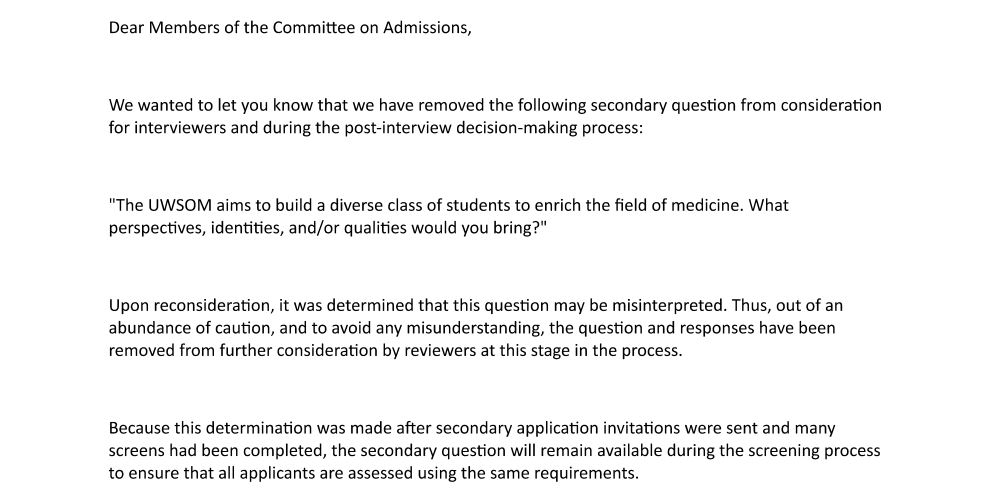
The email, sent by Associate Dean of Admissions LeeAnna Muzquiz, MD, to UWSOM admissions committee members, states that the members reviewing students for admission should no longer consider the following question:

“The UWSOM aims to build a diverse class of students to enrich the field of medicine. What perspectives, identities, and/or qualities would you bring?”

This is obviously a positive development, and a win for all prospective medical students considering applying to UWSOM. And for that, UWSOM deserves credit. 

Yet the justification for this decision raises even more questions.

“Upon reconsideration, it was determined that this question may be misinterpreted,” the email reads. “Thus, out of an abundance of caution, and to avoid any misunderstanding, the question and responses have been removed from further consideration by reviewers at this stage in the process.”

By “misinterpreted,” Muzquiz may mean “interpreted as a pretext for ideologically motivated or even racially discriminatory hiring decisions.” 

That’s simply the reasonable interpretation. What the intended interpretation of that question was, we can only wonder.

It wouldn’t be the first time UWSOM has engaged in racial discrimination: Do No Harm successfully sued the school after it restricted access to a physicians’ directory to “black, indigenous and people of color” (BIPOC) students and physicians.

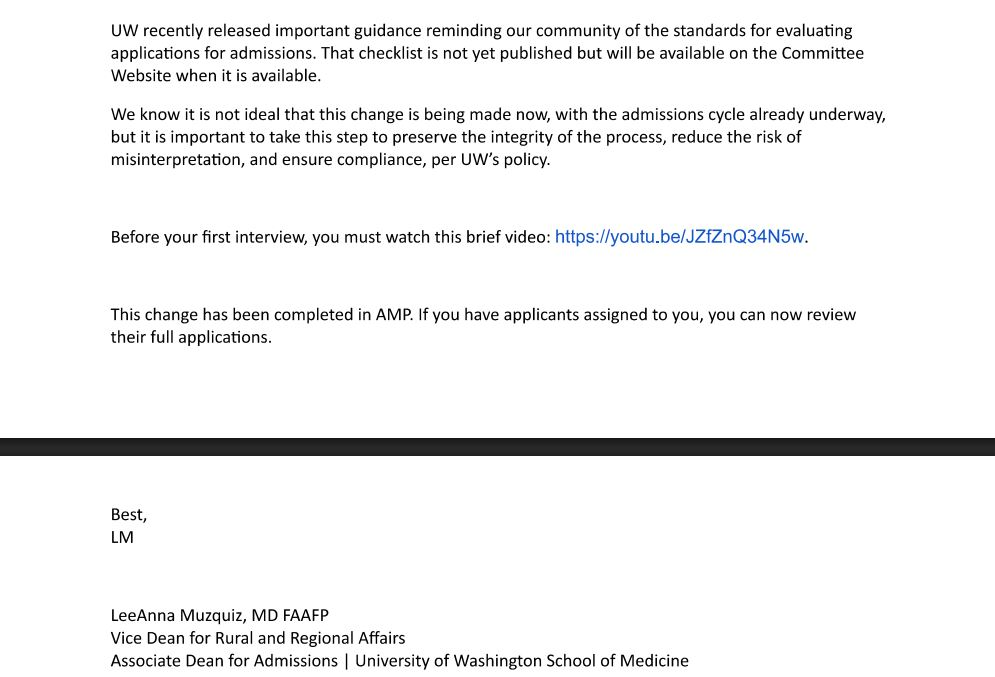
Moreover, the email contained a link to a video in which Muzquiz reminded committee members that the consideration of race and other protected characteristics in the admissions process was not “acceptable.”

In the same breath, Muzquiz also lauded the “holistic review” process, in which prospective students are evaluated less for their academic achievements such as grades and MCAT scores, and more for less tangible factors.

As Do No Harm has frequently noted, holistic review can be an end-around for race-based admissions.

Muzquiz made sure to disclaim this intention, stating clearly that holistic review “cannot be used as a proxy” for racial discrimination.

In sum, this is certainly a positive development. Do No Harm encourages UWSOM (and all schools, for that matter) to ensure that ideology plays no role whatsoever in its admissions, and that it selects students based on merit.

https://donoharmmedicine.org/wp-content/uploads/2023/01/shutterstock_1204078630-scaled.jpg 1708 2560 Ailan Evans https://donoharmmedicine.org/wp-content/uploads/dono-logo.png Ailan Evans2025-09-29 20:48:092025-09-29 20:48:09University of Washington Med School Ditches DEI-Inspired Admissions Question

Do No Harm Submits FTC Comment Debunking Myths of Child Transgender Industry

Uncategorized United States Gender Ideology Federal government Commentary Executive Do No Harm Staff

This month, Do No Harm submitted a comment to the Federal Trade Commission (FTC) debunking several myths promoted by the child transgender industry.

The FTC had requested comments on how the child transgender industry’s practices harmed Americans, such as through a medical professional making false claims or failing to disclose the risks of sex change interventions. 

The request followed a workshop hosted by the FTC in which multiple experts, including Do No Harm fellows, highlighted the misleading and deceptive practices employed by the child transgender industry.

Do No Harm’s comment takes on several of the most pervasive and pernicious myths employed by gender ideologues.

First, the comment explains how the myth that sex change interventions reduce the risk of suicide is completely unsupported by evidence.

“This emotional blackmail is completely unsupported by the evidence,” the comment states. “As admitted by a researcher for WPATH (one of the organizations that signed on to the previously cited amicus brief): ‘There is insufficient evidence to draw a conclusion about the effect of hormone therapy on death by suicide among transgender people.’”

Next, the comment debunks the notion that child sex change interventions are safe and effective, pointing to ample evidence, such as the Cass Review and other comprehensive reports, finding the opposite.

“All systematic reviews performed on this topic have concluded that the evidence underlying medical interventions for gender dysphoria in minors is weak; zero have come out the other way,” the comment notes.

The comment then points out that claims of puberty blockers being “reversible” is likewise a myth as “the effect of pubertal suppression on neurodevelopment is wholly unknown.” Finally, the comment debunks the claim that the rate of “regret” for minors who have undergone pediatric medical transition is low, pointing both to the paucity of evidence on the topic as well as studies that have found the rate to be significant.

Read the full comment here.

https://donoharmmedicine.org/wp-content/uploads/shutterstock_1031248531-scaled-1.jpg 1707 2560 Ailan Evans https://donoharmmedicine.org/wp-content/uploads/dono-logo.png Ailan Evans2025-09-29 14:56:502025-09-29 14:56:50Do No Harm Submits FTC Comment Debunking Myths of Child Transgender Industry

DEI Skeptics Need Not Apply?

Uncategorized Colorado DEI Public university Commentary Do No Harm Staff

What does a commitment to “equity” have to do with one’s ability to take an X-Ray?

A sensible person would say “not a thing.”

But Pike’s Peak State College in Colorado clearly values this quality enough to list it in one of the school’s job postings.

The school’s job listing for its Director of Medical Imaging position is replete with references to diversity and DEI more broadly. The Director “ensures program compliance with the national certification bodies, curriculum standards, institutional policies, and workforce needs,” which includes overseeing faculty members.

One of the position’s minimum qualifications is: “Demonstrated skills working in a diverse population.”

Moreover, one of the preferred qualifications is: “Demonstrated success increasing diversity of students/employees and implementing diversity initiatives.”

The job description even includes “Commitment to equity and inclusive practices in health education” under “General Duties, Skills, Knowledge, and Abilities.”

It should be obvious that these traits have nothing to do with one’s ability to run a medical imaging program, or perform any healthcare education function for that matter. Imposing ideological requirements on these positions will at best narrow the pool of candidates and at worst select for candidates who are more concerned with the DEI agenda than with healthcare itself.

Nevertheless, this ideology appears to have made its way into the school’s academics and administration.

The school’s DEI webpage makes clear the school’s goal of “[a]ttracting, hiring, and retaining a dedicated workforce that mirrors and supports the diversity of our student body.”

As another example, one of the courses in the school’s Behavioral Health program, called “Treating Diverse Populations,” teaches “principles related to microaggressions, systemic racial injustice, social justice, and multicultural and social justice counseling.”

Pike’s Peak State College should stick to ensuring it provides the best possible healthcare education, and leave the politics at the classroom door. 

https://donoharmmedicine.org/wp-content/uploads/2024/02/shutterstock_1789461236-scaled.jpg 1709 2560 Ailan Evans https://donoharmmedicine.org/wp-content/uploads/dono-logo.png Ailan Evans2025-09-26 17:44:442025-09-26 17:44:44DEI Skeptics Need Not Apply?

Penn Nursing Promotes Debunked ‘Racial Concordance’ Theory to Justify ‘Diversity’ Hiring

Uncategorized Pennsylvania DEI Medical School Commentary Do No Harm Staff

Last month, University of Pennsylvania School of Nursing (Penn Nursing) posted an announcement to its site advertising the findings of a new study set to be published in Nursing Research.

The study, “Racial Concordance of Black Nurses and Patients Across Hospitals,” was conducted by the Penn Nursing Center for Health Outcomes and Policy Research (CHOPR) and led by Penn Nursing professor and CHOPR Associate Director Eileen T. Lake.

As its name suggests, the study examines the dynamic of racial concordance – in which patients are treated by providers of the race – in the nursing context, and lays out a case for increasing “diversity,” with the implication of doing so by hiring more black nurses.

The study finds that the proportion of black nurses “was notably lower” than the proportion of black patients, characterizing this disparity as a potential danger to patient health.

“Our findings highlight a critical gap in structural competency within healthcare institutions,” said Lake in Penn Nursing’s announcement. “Despite Black patients often receiving care in hospitals with more Black nurses, the existing nursing workforce lacks sufficient diversity, especially in settings where racial concordance could be most beneficial.”

“The study emphasizes the urgent need for healthcare institutions and policymakers to prioritize diversifying the nursing workforce to better reflect patient demographics, which is crucial for addressing health inequities,” the announcement reads.

Yet the study’s premise is hopelessly flawed.

The notion that racial concordance improves health outcomes is utterly without merit.

Although the study cites several articles supporting the premise that it’s beneficial for patients to be treated by providers of the same race, the weight of the evidence suggests that racial concordance has virtually no effect on patient health outcomes.

Do No Harm’s December 2023 report on this issue examined the literature on racial concordance and highlighted the fact that four out of five systematic reviews found no evidence to support the claim that racial concordance produces positive health outcomes.

Another recent review published in the Substance Use & Addiction Journal found inadequate evidence to support the notion that racial concordance improves health outcomes for black patients in addiction treatment.

The review examined 11 articles published between 1971 and 2016 that explored the effects of racial concordance on black patients in addiction treatment.

The Penn Nursing study, meanwhile, relies on older individual studies rather than engaging meaningfully with the weight of this evidence.

Moreover, the study relies on the concept of “structural competency” to backdoor in its endorsement of this racially concordant approach, arguing that racially concordant care is part of healthcare institutions’ “structural competency.”

“Structural competency—defined as the trained ability to recognize and address the effects

of social, political, and economic structures on health—is crucial for health care institutions,” the study states.

“One effective way to demonstrate this competency is by cultivating a structurally fluent workforce that understands how external factors and social determinants contribute to health inequities,” the study continues.

Here, the study again employs a false premise: that of the validity of so-called “social determinants of health,” or social and environmental factors that can be construed as “determining” health outcomes.

Commonly-cited examples of social determinants of health, or SDOH, include income, employment, educational quality, housing quality, transportation, and so on.

However, the theory that SDOH “cause” significant variance in health outcomes lacks evidentiary support.

As Manhattan Institute Senior Fellow Chris Pope lays out, “SDOH literature is dominated by sloppily designed observational studies that do not seriously attempt to disentangle causation from correlation or to control for obvious sources of bias.”

In other words, the evidence doesn’t support that social determinants of health “determine” outcomes at all.

Moreover, implicit in the study’s premise is the claim that white nurses can’t provide the same level of care to black patients as black nurses. Not only is this claim utterly without evidence, as demonstrated above, but it is a shameful smear of hardworking healthcare professionals who have dedicated themselves to caring for all patients, no matter their race. These claims are divisive and degrade trust in the healthcare workforce.

In sum, the Penn Nursing study employs these concepts to argue for the diversification of the nursing workforce.

It’s hard to imagine how this could be achieved absent policies that distract from the mission of healthcare and favor “diversity” at the very best, and are discriminatory at worst.

It goes without saying that Penn Nursing should not promote debunked and unsupported theories. And it certainly shouldn’t do so to lobby for unethical hiring practices.

https://donoharmmedicine.org/wp-content/uploads/2023/12/shutterstock_2213352297-scaled.jpg 1708 2560 Ailan Evans https://donoharmmedicine.org/wp-content/uploads/dono-logo.png Ailan Evans2025-09-24 17:59:262025-09-24 17:59:26Penn Nursing Promotes Debunked ‘Racial Concordance’ Theory to Justify ‘Diversity’ Hiring

Here Are the Top-Ranked – and Worst-Offending – Medical Schools

Uncategorized United States DEI Medical School Commentary Do No Harm Staff

Unlike traditional medical school rankings, the Medical School Excellence Index is not concerned with institutional prestige. Rather, it ranks medical schools according to their institutional values and educational priorities. 

Does the school recruit the best and brightest applicants according to standardized metrics of aptitude? Does the school have a clear, deeply-rooted commitment to excellence and transparency in academics? Does the school prioritize merit over identity politics and discriminatory ideology?

The top-ranked schools most closely reflect these principles. As a result, many prestigious medical schools who obviously have produced and will continue to produce qualified physicians will not top the list.

Conversely, the lowest-ranked schools favor ideology over merit. 

They do not prioritize academic excellence in admissions, dedicate administrative resources to divisive, harmful, and regressive DEI practices, and broadcast an institutional commitment to identity politics that is antithetical to a commitment to excellence in clinical practice.

Here are the top-ranked schools:

The University of South Florida Morsani College of Medicine

USF Morsani College of Medicine earns the top spot among all medical schools, scoring a perfect 100 points. 

First, the average MCAT scores and GPAs of matriculated students are each in the top quintile of all allopathic medical schools in the United States, meaning that USF accepts the most academically qualified students. Second, the school maintains a tiered grading system throughout each phase of medical school, rather than adopting a pass/fail grading system. The school maintains an Alpha Omega Alpha honor society chapter and does not have a dedicated DEI office. Furthermore, its mission statement does not contain any support for DEI.

NYU Grossman School of Medicine

Coming in at second place is NYU Grossman School of Medicine, which notched 92 points out of 100. 

The average MCAT scores and GPAs of matriculated students at NYU are each in the top quintile of all allopathic medical schools in the United States; in fact, the average MCAT scores are the highest in the country. NYU also has a tiered grading system throughout the clinical phase of medical school. Like USF, NYU maintains an Alpha Omega Alpha honor society chapter and does not have a dedicated DEI office. However, the school’s mission statement is not fully without references to DEI ideology and practices, thus resulting in a small point penalty.

The Perelman School of Medicine at the University of Pennsylvania

Also tied for second place is the Perelman School of Medicine at the University of Pennsylvania at 92 points out of 100. 

At Perelman, the average MCAT scores and GPAs of matriculated students are each in the top quintile of the country’s allopathic medical schools. Like NYU, Perelman has a tiered grading system throughout the clinical phase of medical school. Perelman also maintains an Alpha Omega Alpha honor society chapter and does not have a dedicated DEI office. Yet like NYU, the school’s mission statement is not fully without references to DEI ideology and practices, thus costing Perelman several points.

University of Michigan Medical School

The final institution tied for second is the University of Michigan Medical School, which likewise notched 92 points out of 100. 

Matriculated students at Michigan have average MCAT scores and GPAs that each are in the top quintile of all allopathic medical schools in the country. Moreover, Michigan has a tiered grading system throughout the clinical phase of medical school. The school maintains an Alpha Omega Alpha honor society chapter and does not have a dedicated DEI office, but its mission statement does contain references to DEI ideology and practices.

Here are the lowest-ranked schools:

The University of California, Davis School of Medicine

UC Davis, along with all the other lowest-ranked schools, notched a dismal 18 points out of 100, reflecting a departure from the pursuit of excellence and an embrace of identity politics.

For one, the average MCAT score of matriculated students was in the second-lowest quintile among all allopathic medical schools in the country, whereas the average GPA was in the lowest quintile. The school also lost points for implementing a pass/fail grading system in the preclinical phase of medical education.

But where UC Davis (along with the other schools ranked lowest) failed to notch any points at all was its rejection (or lack thereof) of DEI. The school earned 0 points for its mission statement, meaning the statement reflected the strongest commitment possible to DEI. Likewise, the fact that it still maintains a dedicated DEI office means it failed to earn any points at all.

Of note: UC Davis previously received top marks from the Association of American Medical Colleges (AAMC) for its commitment to diversity in admissions and hiring. School administrators also discussed how the institution has implemented “socially accountable admissions” to transform the demographics of its student body.

Oregon Health & Science University School of Medicine

Like UC Davis, OHSU also only managed to score 18 points.

The average MCAT score of matriculated students at OHSU was in the second-lowest quintile among all allopathic medical schools in the country, and the average GPA was in the lowest quintile. OHSU also implements a pass/fail grading system in the preclinical phase of medical education. 

Furthermore, OHSU’s mission statement evinces the strongest commitment possible to DEI, and OHSU maintains a dedicated DEI office.

Of note: OHSU previously operated racially-segregated “camaraderie groups” for its employees.

The University of New Mexico School of Medicine

Also coming in at 18 points is the University of New Mexico School of Medicine.

Although the average GPA of matriculated students at New Mexico was in the second-lowest quintile among all allopathic medical schools in the country, the average MCAT score was in the lowest quintile. Like the other lowest-ranked universities, New Mexico implements a pass/fail grading system in the preclinical phase of medical education. 

New Mexico also maintains a dedicated DEI office, and its mission statement is replete with references to DEI ideology and practices.

Of note: New Mexico previously considered racial characteristics when evaluating applicants for clerkship positions.

The Central Michigan University College of Medicine

Rounding out the bottom four medical schools is the Central Michigan University College of Medicine, which also scored 18 points.

At Central Michigan, the average GPA of matriculated students at New Mexico was in the second-lowest quintile among all allopathic medical schools in the country, and the average MCAT score was in the lowest quintile. Central Michigan also implements a pass/fail grading system in the preclinical phase of medical education.

Moreover, Central Michigan’s mission statement contains the strongest possible commitment to DEI, and the school maintains a dedicated DEI office.

Of note: Central Michigan received strong marks from the AAMC for its commitment to diversity, as evidenced by its administrators actively working to promote DEI in public forums outside the university.


https://donoharmmedicine.org/wp-content/uploads/iStock-2118540734.jpg 1414 2121 Ailan Evans https://donoharmmedicine.org/wp-content/uploads/dono-logo.png Ailan Evans2025-09-24 14:04:002025-09-24 14:04:00Here Are the Top-Ranked – and Worst-Offending – Medical Schools

Do No Harm Launches Center for Accountability in Medicine and Anti-Woke Medical School Rankings

Uncategorized United States DEI Medical School Press Release Do No Harm Staff

RICHMOND, VA; September 24, 2025 – Today, Do No Harm proudly launched the Center for Accountability in Medicine. Through a data-driven and research-focused approach, the Center will expose and hold accountable medical institutions that push divisive identity politics. The Center will provide valuable resources to the public on which schools, medical associations, and academic journals are adhering to core principles of excellence and merit instead of political ideology.

The Center’s inaugural publication is the Medical School Excellence Index. This is the first definitive ranking of U.S. medical schools based on their commitment to academic excellence, transparency, and opposition to divisive identity politics. The Index serves as a counter to traditional rankings, which often favor DEI programs or ignore their detrimental effects.

“The Center for Accountability in Medicine and the Medical School Excellence Index are urgently needed to combat the tide of wokeness in healthcare,” said Ian Kingsbury, PhD, Director of the Center for Accountability in Medicine. “To eliminate DEI’s divisive influence in medicine, we must recognize medical schools that focus on excellence and expose those that promote political activism. The Center advances Do No Harm’s mission of ensuring patients, not politics, remain the top priority of the institutions training our future medical professionals. I am excited for our next chapter in leading the fight to restore integrity to medicine.”

“The launch of the Center for Accountability in Medicine marks a major step forward in Do No Harm’s mission of restoring integrity to medicine,” said Stanley Goldfarb, MD, Chairman at Do No Harm. “From exposing medical schools’ racially based admissions practices and accreditors’ DEI mandates to suing major institutions and companies over discriminatory programs, we have achieved unprecedented success in rooting out divisive identity politics from healthcare. The new Center, under Ian Kingsbury’s leadership, will continue and expand this work to ensure our nation’s medical institutions are held accountable and prioritize merit and expertise, not an ideological agenda.”

The Medical School Excellence Index identifies the best medical schools in the country as well as the worst by ranking each institution on three constructs: Academic excellence, transparency, and rejection of DEI.

The top-ranked schools are:

  • USF Health Morsani College of Medicine
  • NYU Grossman School of Medicine
  • University of Michigan Medical School
  • Perelman School of Medicine at the University of Pennsylvania

The worst-ranked schools are:

  • University of California, Davis School of Medicine
  • University of New Mexico School of Medicine
  • Central Michigan University College of Medicine
  • Oregon Health & Science University College of Medicine

The full rankings can be found here.

The Center will be led by Ian Kingsbury, PhD, Director of Research at Do No Harm.


Do No Harm, established in April 2022, has rapidly gained recognition and made significant strides in its mission to safeguard healthcare from ideological threats. It has 35,000 members, including doctors, nurses, physicians, and concerned citizens across all 50 states and 14 countries.


https://donoharmmedicine.org/wp-content/uploads/2022/11/DNH_ContentCards_PressRelease.png 675 1200 Ailan Evans https://donoharmmedicine.org/wp-content/uploads/dono-logo.png Ailan Evans2025-09-24 13:53:072025-09-24 13:53:07Do No Harm Launches Center for Accountability in Medicine and Anti-Woke Medical School Rankings

The NEJM Dips Its Toes Into ‘Antiracist’ Activism

Uncategorized United States DEI Commentary Do No Harm Staff

NEJM Catalyst, an academic journal focused on “health care delivery” and a subprint of The New England Journal of Medicine, has dedicated a “special issue” specifically to topics surrounding “structural racism.”

According to the editor’s note accompanying the issue, the goal of the issue is to chart pathways, such as policy reforms, to advance “health equity” and address structural racism.

“Structural racism cannot be resolved by the actions of one individual; power imbalances between health care institutions and the communities they serve must be reset,” the note reads. “The best way to do this is to centrally involve those most harmed by racism in monitoring it and implementing viable solutions.”

These “solutions” often involve policy changes that stray outside the realm of healthcare and into politics. Additionally, the bulk of the articles reflect the view common among proponents of DEI policies and similar initiatives that the American healthcare system is fundamentally racist, and that to ameliorate racial health disparities it should be reformed. 

These reforms appear to be heavy-handed attempts to inject DEI into healthcare and healthcare education.

For instance, one of the articles, titled “Lift Every Voice: Driving Antiracist Structure, Policy, and Culture Change in the Health Care Workplace,” catalogued the efforts of the “Lift Every Voice” initiative, which intended to collect data about racism in healthcare workplaces and address it by “creating responsive antiracism policy and culture change.”

The editor’s note describes another article as highlighting efforts “to develop a culturally grounded antiracism educational program that teaches care providers how to address social injustices while caring for members of [the formerly incarcerated] population.”

In other words: training to achieve certain social and ideological goals.

Yet another article, titled “Clinic-Based Community Organizing,” is even more explicit in its calls for political change, and seeks to use the health clinic as a vehicle for such change.

“Through applying a four-step relational organizing model that emphasizes listening to lived experience, convening core teams rooted in trust and love, developing community-organizing skills, and taking collective action, the program has created change in local clinical practice and quality improvement efforts that improve conditions for systemically harmed communities,” the article description reads. “The program’s community core teams — composed of patients and community members with lived experiences of oppression — have also led local and state policy efforts on issues that reflect their health priorities, including housing and language access.”

Regardless of the merits of these proposals, it’s important to draw a distinction; it is not the purview nor the place of physicians to use clinical practice as a vehicle for political advocacy. Rather, the physician has a duty to provide the best possible healthcare for their patients.

This point is all the more true when such political advocacy is thinly-veiled DEI activism, as the editor’s note makes clear.

“While some may feel discouraged by emerging threats to health equity efforts, this special issue affirms work toward addressing structural racism,” the editor’s note accompanying the special issue reads. “The contents offer clarity that may help future efforts to dismantle unjust structures. The investments may benefit impacted communities, health care institutions, and the United States and other nations.”

Taken together, NEJM Catalyst’s “special issue” blurs the line between medicine and politics. By presenting “antiracist” activism as a necessary component of healthcare delivery, the publication elevates ideology over clinical objectivity and shifts the physician’s role from healer to social reformer. 

Calls for structural change, community organizing, and DEI-infused education programs go well beyond the responsibility of providing evidence-based care and instead transform medicine into a platform for political advocacy.

https://donoharmmedicine.org/wp-content/uploads/2022/05/shutterstock_1686925927-scaled.jpg 1707 2560 Ailan Evans https://donoharmmedicine.org/wp-content/uploads/dono-logo.png Ailan Evans2025-09-23 20:52:272025-09-23 20:52:27The NEJM Dips Its Toes Into ‘Antiracist’ Activism

Planned Parenthood Is Teaching Teens How to Get Around Gender-Transition Safeguards

Uncategorized United States Gender Ideology Medical association Media Mention Do No Harm Staff

“To say that puberty blockers ‘pause’ puberty implies a simple, harmless process; it’s not,” Dr. Kurt Miceli, medical director at the organization Do No Harm, told National Review.

Prolonged use of puberty blockers can lead to significant changes in bone density, and even fertility, particularly if cross-sex hormones are started thereafter. Additionally, when a child’s puberty is delayed because of puberty blockers, it can unintentionally increase the gap in development as one’s peers progress through natural puberty with the impacted child remaining in a ‘paused’ state. This may inadvertently add strain to a child’s social and emotional well-being.

Miceli further mentioned that puberty blockers may also negatively affect bone health, growth, and neurocognitive development.

Read the full story at National Review.

https://donoharmmedicine.org/wp-content/uploads/2022/04/DNH_MediaHitGold_NationalReview.jpg 630 1100 Ailan Evans https://donoharmmedicine.org/wp-content/uploads/dono-logo.png Ailan Evans2025-09-16 13:56:002025-09-16 13:56:00Planned Parenthood Is Teaching Teens How to Get Around Gender-Transition Safeguards

Therapists are banned from talking to kids about accepting their biological sex

Uncategorized Minnesota, United States Gender Ideology Medical School Op-Ed Kurt Miceli, MD

After the tragic shooting at Minnesota’s Annunciation Catholic School, families across the country began asking if the shooter could have been stopped.

But Americans should also ask a related question: Why do states ban kids who think they’re transgender from even talking to therapists about accepting their biological sex?

The school shooter in Minnesota identified as transgender. Yet in half the states, including Minnesota, it’s illegal for therapists to help confused kids come to grips with who they really are.

Read the full op-ed at the New York Post.

https://donoharmmedicine.org/wp-content/uploads/2022/06/DNH_MediaHit_NewYorkPost.png 631 1101 Ailan Evans https://donoharmmedicine.org/wp-content/uploads/dono-logo.png Ailan Evans2025-09-15 20:06:582026-01-20 14:41:14Therapists are banned from talking to kids about accepting their biological sex

CDC urged to update medical codes to include detransitioners

Uncategorized United States Gender Ideology Federal government Media Mention Do No Harm Staff

Doctors called on the Centers for Disease Control and Prevention to update medical codes to include side effects suffered by detransitioners.

Dr. Kurt Miceli, medical director for the advocacy group Do No Harm, presented at the CDC’s twice-yearly conference to update U.S. medical codes to include side effects for detransitioners, or those who no longer identify as transgender.

Miceli and his team at Do No Harm, which stands against gender transition medicine for minors, put together a presentation for the panel that oversees the ICD-10-CM, the official diagnostic coding system that standardizes medical treatment and insurance information in the United States. 

Read the full article at The Washington Examiner.

https://donoharmmedicine.org/wp-content/uploads/2022/07/DNH_MediaHit_WashingtonExaminer.png 631 1101 Ailan Evans https://donoharmmedicine.org/wp-content/uploads/dono-logo.png Ailan Evans2025-09-12 20:04:392025-09-12 20:04:39CDC urged to update medical codes to include detransitioners

House Appropriations Committee Approves Defunding Discriminatory Nursing Program

Uncategorized United States DEI Federal government Commentary Do No Harm Staff

Earlier this week, the House Appropriations Committee approved the Fiscal Year 2026 Labor, Health and Human Services, Education, and Related Agencies Appropriations Act, a spending bill which included appropriations for various health and medicine-related programs.

One program that will not receive funding under the bill, however, is the Nursing Workforce Diversity (NWD) program.

A project of the Department of Health and Human Services (HHS), the NWD program awards funding to nursing education programs that engage in racially discriminatory practices.

In fact, the program was the subject of an extensive report by Do No Harm examining how various nursing programs funded under NWD use the federal dollars to support explicitly discriminatory initiatives.

As outlined in Do No Harm’s report, the program asks recipients to establish methods to increase the enrollment of “racial and ethnic minorities” and other “underrepresented” groups.

Recipient nursing education programs have obliged, prioritizing certain racial groups for educational opportunities or employing admissions strategies designed to increase racial diversity.

The defunding of the NWD program is tremendous news for would-be nurses who happen to be members of racial groups disfavored by the program’s objectives, as well as for patients everywhere.

That’s not all the appropriations bill defunded, however. 

The bill also prevents funding from going toward “drugs or surgery that alter bodily sex traits as interventions for gender dysphoria,” per the committee report.

The bill further directs the Centers for Disease Control and Prevention (CDC) to conduct a long-term study on the effects of interventions, such as drugs and surgery, used for the purposes of child sex changes.

https://donoharmmedicine.org/wp-content/uploads/2023/12/shutterstock_2213352297-scaled.jpg 1708 2560 Ailan Evans https://donoharmmedicine.org/wp-content/uploads/dono-logo.png Ailan Evans2025-09-12 18:41:442025-09-12 18:41:44House Appropriations Committee Approves Defunding Discriminatory Nursing Program

Reclaiming Merit in Medical Education

Uncategorized United States DEI Medical Journal, Medical School Letter Kurt Miceli, MD

[Note: The full version of this article originally appeared as a comment to “Medical School Admissions After the Supreme Court’s 2023 Affirmative Action Ruling” by Nguyen, et al and published in JAMA Network Open. You can read Dr. Miceli’s article in its entirety here.]

The study by Nguyen, et al. ignores a fundamental question: What is the true purpose of medical education? Rather than engaging in social engineering, medical schools need to focus on identifying and training the most qualified individuals to become physicians. Patients rightfully expect—and deserve—the highest standard of care. Yet, the study neglects to consider merit-based factors and thus the quality of applicants.

Data from the AAMC reveals persistent differences in academic performance among matriculants even post-Students for Fair Admission (SFFA). In the ‘24-25 academic year, Asian matriculants scored 513.9 on the MCAT, compared to 512.2 for White matriculants, 506.4 for Black matriculants, and 505.9 for Hispanic matriculants—figures nearly unchanged from the year prior and where a single point difference on the MCAT equals ~3 points in percentile rank. [1 2 3] If race-neutral admissions policies had been meaningfully implemented following SFFA, one would expect these gaps to have narrowed. They haven’t.

The organization for which I work, Do No Harm, analyzed admissions data from 23 public allopathic medical schools. In all but one, accepted Asian and white applicants had, on average, higher MCAT scores than accepted black applicants. At 13 schools, the average MCAT score of rejected Asian or white applicants was higher than the average MCAT score of accepted black applicants. And, at Eastern Virginia Medical School, for example, black applicants had up to an 11-fold higher chance of acceptance compared to GPA- and MCAT-matched Asian or white peers. These patterns suggest that, even after SFFA, many medical schools may still be prioritizing racial considerations over academic merit in their admissions decisions.[4]

Read Dr. Miceli’s full comment at JAMA Network Open here.


  1. https://www.aamc.org/data-reports/students-residents/data/facts-applicants-and-matriculants ↩︎
  2. https://www.aamc.org/media/6066/download?attachment ↩︎
  3. https://students-residents.aamc.org/media/15781/download ↩︎
  4. https://donoharmmedicine.org/wp-content/uploads/2025/07/Skirting-SCOTUS-III-Racially-Conscious-Admissions-1.pdf ↩︎
https://donoharmmedicine.org/wp-content/uploads/2022/05/shutterstock_1686925927-scaled.jpg 1707 2560 Ailan Evans https://donoharmmedicine.org/wp-content/uploads/dono-logo.png Ailan Evans2025-09-12 15:24:572026-01-20 14:41:14Reclaiming Merit in Medical Education

Do No Harm Submits Comment Backing Repeal of ‘Anti-Racism’ Rule

Uncategorized United States DEI Federal government Commentary Do No Harm Staff

This week, Do No Harm submitted a comment in support of a proposal by the Centers for Medicare and Medicaid Services (CMS) to repeal a rule pressuring doctors to implement “anti-racism” plans.

The rule, passed by the Biden administration in 2021, required clinicians participating in CMS’s Merit-Based Payment System (MIPS) – a program that rewards clinicians for improving the quality of patient care and outcomes – to ensure their policies and clinical guidelines are “aligned with a commitment to anti-racism.”

Moreover, the rule instructed clinicians to apply CMS’s 2021 Disparities Impact Statement, which told clinicians to “[s]tratif[y] measures and health outcomes by race and ethnicity” and to identify the “population(s)” they will “prioritize.”

As Do No Harm’s comment argues, this effectively encourages racial discrimination while endorsing the noxious, harmful ideology of anti-racism, which definitionally supports “present discrimination” to remedy discrimination in the past.

“The Anti-Racism Rule was itself—and further promoted—unlawful racial discrimination,” the comment states. “Race-based classifications are unconstitutional, even if they aim to reduce disparities.”

The proposed repeal is welcome news and a long time coming.

In fact, just a few months after our founding, Do No Harm supported a lawsuit against the Biden administration over the rule.

With Do No Harm’s help, Dr. Amber Colville, a visiting fellow at Do No Harm, sued the Biden administration, arguing the “anti-racism” rule was illegal. This was the first lawsuit Do No Harm supported.

Do No Harm commends the Trump administration for taking action to repeal this harmful rule.

The federal government has no business promoting anti-racist ideology and divisive practices which are incompatible with the promise of racial equality embedded in our Constitution.

https://donoharmmedicine.org/wp-content/uploads/2025/04/shutterstock_663739642-scaled-e1745267226110.jpg 1067 1860 Ailan Evans https://donoharmmedicine.org/wp-content/uploads/dono-logo.png Ailan Evans2025-09-11 19:54:452025-09-11 19:54:45Do No Harm Submits Comment Backing Repeal of ‘Anti-Racism’ Rule

The CDC Can Help Those Disfigured by ‘Gender-Affirming Care’

Uncategorized United States Gender Ideology Federal government, Medical association Op-Ed Kurt Miceli, MD

Chloe Cole had a difficult adolescence. As a result, she became a victim of unethical medical experiments, which left her with injuries that can’t be healed.

As Ms. Cole, 21, tells it, she was a tomboy as a child. She didn’t like “girly” things, and when she started puberty early—8 or 9, she has testified—she got unwanted attention from boys. Like many kids in the early to mid-2010s, she spent a lot of time on social media and videogames, which led her to online communities that told her she was really a boy.

She came to believe that she was born in the wrong body. When she was 12, “I came out as transgender in a letter I sat on the dining room table. My parents were immediately concerned. They felt like they needed to get outside help from medical professionals, but this proved to be a mistake.” The doctors pushed Chloe and her parents to accept the lie that she could become a boy.

Read the full op-ed at The Wall Street Journal.

https://donoharmmedicine.org/wp-content/uploads/2024/03/DNH_MediaHitGold_WSJ-1024x576-1.jpg 576 1024 Ailan Evans https://donoharmmedicine.org/wp-content/uploads/dono-logo.png Ailan Evans2025-09-09 20:46:122026-01-20 14:41:14The CDC Can Help Those Disfigured by ‘Gender-Affirming Care’

Major Medical Education Accreditor Quietly Ditches DEI Requirements After Trump Executive Order

Uncategorized United States DEI The Accreditation Council for Graduate Medical Education Medical association Media Mention Do No Harm Staff

A leading medical education accreditor is eliminating its diversity, equity, and inclusion requirements after suspending them earlier this year to comply with an executive order from President Trump.

The Accreditation Council for Graduate Medical Education (ACGME) is closing its DEI department and removing DEI requirements from its accreditation standards, according to an internal email provided to NR by the watchdog group Do No Harm, which works to root out the use of race and gender-based criteria in the medical field.

“Recent federal directives, including executive orders and a proposed rule from the Centers for Medicare & Medicaid Services have prohibited accrediting bodies from requiring or otherwise encouraging a focus on diversity, equity, and inclusion (DEI). Similar directives apply to programs and hospitals receiving Medicare payments for GME,” reads the email from the ACGME communications department.

Read the full story at National Review.

https://donoharmmedicine.org/wp-content/uploads/2022/04/DNH_MediaHitGold_NationalReview.jpg 630 1100 Ailan Evans https://donoharmmedicine.org/wp-content/uploads/dono-logo.png Ailan Evans2025-09-08 18:53:522026-01-12 05:17:13Major Medical Education Accreditor Quietly Ditches DEI Requirements After Trump Executive Order

The AMA Doesn’t Represent Doctors Like Me

Uncategorized United States DEI Medical association Letter Kurt Miceli, MD

The American Medical Association says it puts science above politics, but the record, as Allysia Finley has laid out, speaks for itself (Letters, Aug. 27). One of the biggest explanations for the association’s mission creep is that it represents a narrow and radicalized slice of the medical profession, falsely giving the impression that it speaks for all doctors.

Doctors have been leaving the AMA in droves for decades. Today it represents less than 20% of U.S. physicians. As of 2023, about half of its members were medical students or residents, who have gone to medical schools that are captured by such political fads as DEI.

Read the full letter at The Wall Street Journal.

https://donoharmmedicine.org/wp-content/uploads/2024/03/DNH_MediaHitGold_WSJ-1024x576-1.jpg 576 1024 Ailan Evans https://donoharmmedicine.org/wp-content/uploads/dono-logo.png Ailan Evans2025-08-29 22:40:222026-01-20 14:41:14The AMA Doesn’t Represent Doctors Like Me
Page 6 of 56«‹45678›»
COPYRIGHT © DO NO HARM 2025. ALL RIGHTS RESERVED.
  • Contact
  • Privacy
  • Disclaimer
  • Link to X
  • Link to Facebook
  • Link to Instagram
  • Link to LinkedIn
  • Link to Youtube
Scroll to top Scroll to top Scroll to top