The University of Colorado School of Medicine (CUSOM) promoted three discriminatory scholarships for “historically underrepresented” groups on its website – that is, until they were notified by the Office for Civil Rights (OCR) that those programs were being challenged.
On June 4, 2023, Do No Harm senior fellow Mark Perry filed a federal civil rights complaint with the Department of Education’s OCR for three “diversity scholarships” that discriminated on the basis of race/ethnicity or sex/gender identity/sexual orientation. Shortly after the Denver OCR received the complaint and contacted the university, CUSOM made substantial changes to the eligibility criteria for each of the three scholarships:
1. Medical Student Externship Diversity Scholarship
The original eligibility criteria stated, “The Program is open to applicants who belong to groups that are recognized as historically underrepresented in the health profession including African American, American Indian, Alaskan Native, Hispanic/Latino, Pacific Islander and/or LGBTQIA+.”
Figure 1. CUSOM Medical Student Externship Diversity Scholarship webpage as it appeared in June 2023 (archived page).
The eligibility was later updated to remove the illegal race/sexual orientation/gender identity restrictions:
Figure 2. Updated eligibility criteria for the Medical Student Externship Diversity Scholarship (current page).
2. The Chair’s Diversity Scholarship
Eligibility for this scholarship was originally restricted to “a member of a traditionally underrepresented minority in health science graduate programs (African-American, Hispanic/Latino, Pacific Islander, Native American/Alaska Native, Vietnamese, or rural students).”
Figure 3. CUSOM Chair’s Diversity Scholarship webpage as it originally appeared (archived page).
The revised criteria now say that “any student in good academic standing” is eligible to apply:
Figure 4. Revised eligibility criteria for the Chair’s Diversity Scholarship (current page).
3.Visiting Student Diversity Scholarship
This scholarship was being promoted as an opportunity for 4th-year medical students with an interest in surgery; however, the discriminatory program was only open to “applicants who belong to groups that are recognized as historically underrepresented in the health profession including African American, American Indian, Alaska Native, Hispanic/Latino, Pacific Islander and/or LGBTQ.”
Figure 5. CUSOM Visiting Student Diversity Scholarship webpage in June 2023 (archived page).
After being notified by OCR of the federal civil rights complaint, the CUSOM revised the eligibility criteria to say that anyone can apply:
“In each case, CUSOM scrubbed the discriminatory and illegal eligibility restrictions based on race, sexual orientation, and/or gender identity after the filing of my complaint,” Perry said. “The remedy that Do No Harm and I sought,” he continued, “was to enjoin the University from continuing to engage in illegal discrimination.”
As soon as the OCR finalizes its investigation it has indicated that it will issue a closure letter to reflect the changes CUSOM has made to correct its non-compliance with Title VI and Title IX, according to an email Perry received from the Denver OCR.
Do No Harm applauds the steps that CUSOM has taken to stop its illegal discrimination and enforce federal civil rights laws including Title VI and Title IX – as is legally required by recipients of federal financial assistance. We encourage other medical education programs to follow suit.
This case at the University of Colorado School of Medicine demonstrates the effectiveness of challenging colleges and universities that are violating the law by offering discriminatory scholarships and academic programs. Do No Harm will continue to take the necessary action to correct these violations and restore fairness and the equal treatment of all individuals in medical education.
https://donoharmmedicine.org/wp-content/uploads/2023/09/shutterstock_1176796777-scaled.jpg17072560supporthttps://donoharmmedicine.org/wp-content/uploads/DNH_Logo_Stethescope-1.pngsupport2023-09-09 03:57:162026-02-11 15:33:36The University of Colorado School of Medicine Suddenly Scrubs Its Website After Being Hit with Federal Civil Rights Complaint
Do No Harm chairman Dr. Stanley Goldfarb submitted comments to the Centers for Medicare and Medicaid Services (CMS) regarding the proposed rule CMS–1784–P, which seeks to make changes to the way healthcare providers are paid for their services.
“The proposed rule gives our group of experienced medical professionals great concern in several areas,” Dr. Goldfarb wrote in a September 8 letter to CMS. “What should be straightforward updating of various payment policies,” he continued, “has instead become just the latest effort by the Biden administration to use critical government services as a carrier for its alleged ‘health equity’ goals.”
Stated plainly, the proposed rule change would directly incentivize healthcare providers to deliver more services to patients of certain races/ethnicities, sexualities, and religions. Such a system would constitute a clear violation of the Civil Rights Act of 1964, and pushing individual patients to the front of the line based on any factor other than their health status is morally wrong.
https://donoharmmedicine.org/wp-content/uploads/2023/09/shutterstock_165320348-scaled.jpg16962560Laura Morganhttps://donoharmmedicine.org/wp-content/uploads/DNH_Logo_Stethescope-1.pngLaura Morgan2023-09-08 20:11:382026-02-11 15:33:36Do No Harm Submits Comment to CMS: Payment Policies Must Not Be Based On “Health Equity Goals” of the Biden Administration
The Department of Education’s Office for Civil Rights (OCR) has opened a federal civil rights investigation against the University of Delaware (UD) for a program that discriminates on the basis of sex.
Mark Perry, senior fellow at Do No Harm, filed a Title IX complaint with the OCR for the school’s partnership with The Perry Initiative, a pipeline program exclusively for women entering the fields of medicine or engineering. One component of the project is the Perry Outreach Program (POP), which is for female high school students who are interested in orthopedic surgery. POP restricts applicant eligibility to those who “gender-identify as female or non-binary.” By using its resources, facilities, staff, and websites to promote The Perry Initiative, UD violates Title IX of the Education Amendments of 1972, which prohibits discrimination based on sex and gender identity.
Figure 1. The Perry Outreach Program in orthopedic surgery at the University of Delaware.
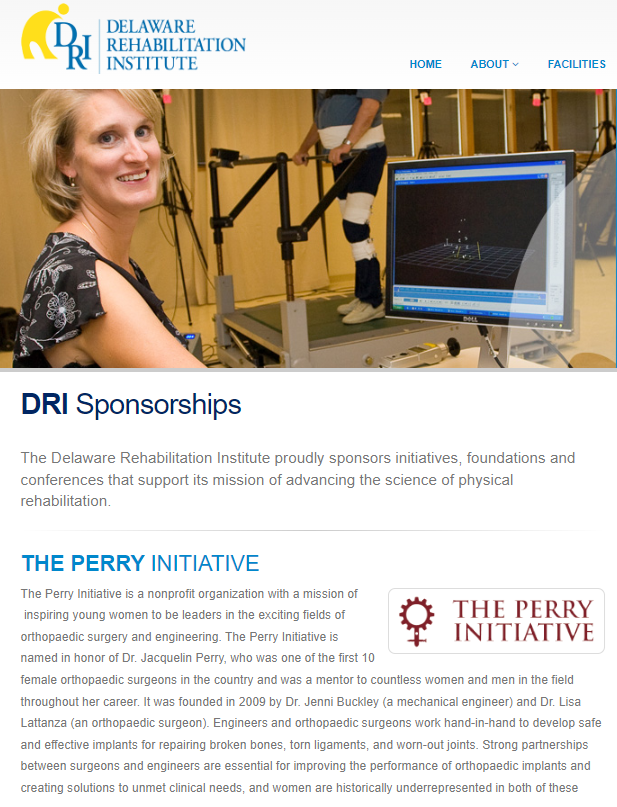
The UD Delaware Rehabilitation Institute (DRI) also “proudly sponsors” The Perry Initiative in support of its “mission of advancing the science of physical rehabilitation.”
Figure 2. The UD Delaware Rehabilitation Institute, sponsor of The Perry Initiative.
One of the co-founders and board members of The Perry Initiative is Dr. Jenni Buckley, a mechanical engineer and UD faculty member.
Do No Harm is monitoring the progress of this investigation and anticipates a positive outcome from the Office for Civil Rights. In addition to the Title IX complaint against UD, Do No Harm is also challenging the discriminatory female-only Perry Initiative programs at 14 other colleges and universities.
Are you seeing programs or scholarships at your school that discriminate on the basis of race or sex? Please let us know; you may remain anonymous if you wish.
https://donoharmmedicine.org/wp-content/uploads/2023/08/shutterstock_549472993-scaled.jpg14402560Laura Morganhttps://donoharmmedicine.org/wp-content/uploads/DNH_Logo_Stethescope-1.pngLaura Morgan2023-09-06 11:53:202026-02-11 15:33:36A Federal Civil Rights Investigation is Underway at the University of Delaware
The Indiana University School of Medicine (IUSM) is at it again pushing more identity politics on faculty and staff, this time with an online learning course called Mitigating Unconscious Bias in Decision-Making.
Do No Harm has previously covered IU’s other woke offerings, such as a training module from the IU Office of Academic Affairs that instructed job search committee members to consider their “implicit bias” and “whiteness” in the course of evaluating applicants, rather than focusing solely on their experience and suitability for the position.
The new course on “unconscious bias in decision-making” is an additional offering on the same topic, but for a wider audience. IUSM employees and students were notified of its existence via email, which Do No Harm was made aware of by an anonymous source. Even individuals who are not affiliated with the university can enroll: “While this training is designed with academic medicine in mind,” the email noted, “the content can be applied to any setting.”
Promoted by the woke dean of IUSM
The training module opens with a message from Dean Jay Hess, who notes that understanding one’s own perceptions is a fundamental step in making everyone at IUSM feel supported and encouraged. “On multiple occasions when I was faced with a decision,” he claims, “my decision-making was in fact influenced by unconscious bias.” He even acknowledges that the training itself is questionable. “There is some research and there are many people out there who question the value of unconscious bias training,” he says. But he encourages it as “important” for IUSM from the perspective of recruitment, evaluation, and promotion of people, and even to the care of patients.
Figure 1. Course offered by the Indiana University School of Medicine.
Training places equity and justice at the center of patient care
The first unit of the module says that IUSM “commits to identifying and dismantling hate, oppression, systemic racism, and discrimination in academic medicine,” and instructs learners to do the same by taking steps to address diversity, equity, inclusion, and justice.
“As we become more aware of our biases, we can make better data-informed decisions,” said Dr. Alvaro Tori, associate dean for Diversity Affairs at IUSM. He also advised learners regarding “taking inventory of the identities that you ascribe to and the power, privilege, and oppression that we each navigate.” Dr. Tori said that these measures place equity and justice in the center of the work of patient care, education, and research.
Subsequent sections in the training provide a roadmap for taking such an identity-based inventory and buying into the concept of “equity.” Units 2 and 3 in the module used YouTube videos, created by the University of California Los Angeles (UCLA) in 2019, with the ubiquitous explanation of biases being our brains’ way of taking shortcuts to deal with information overload and numerous examples of types of bias.
https://youtu.be/BwYFhJO9t50
Video from “Mitigating Unconscious Bias in Decision-Making” at IUSM.
In Unit 3, the Implicit Association Test (IAT) is introduced, and despite its weak science, the module content states “the IAT is considered more reliable and valid than survey evaluations.”
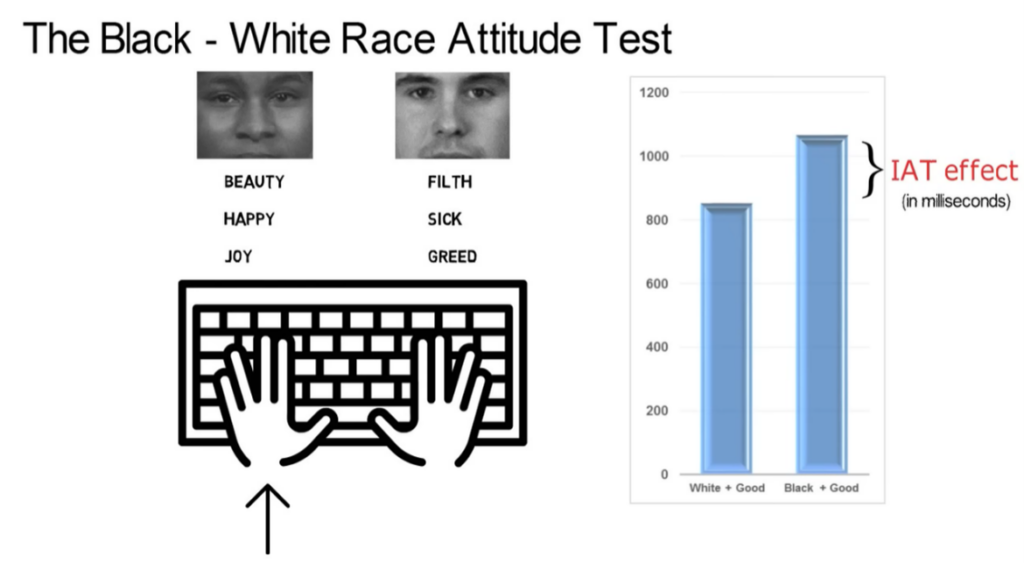
But it goes to the extreme in an effort to make its misguided point. The UCLA video on this topic refers to “The Black-White Attitude Test,” and describes how the tester will see pictures of a young black male’s face and a picture of a young white male’s face. The tester is instructed to sort the faces by hitting a key on the left side of the keyboard for white, and key on the right side for black. The next step is to sort words in two “attitudinal categories” using the words “beauty,” “happy,” and “joy” or “filth,” “sick,” and “greed.” The tester then identifies the “good” words by striking a key on the left, and the “bad” words using the right side of the keyboard. The final step is to sort the words and the faces together. However, the exercise further conditions the tester to associate positive words with white faces and negative words with black faces by actually instructing him or her to do so. The narrator states that when good words are associated with white faces and bad words are associated with black faces, “you will find your groove and fly through this test. Most of us do.”
Figure 2. From “Lesson 5: The IAT” from the UCLA Office of Equity, Diversity, and Inclusion (a component of the IUSM Mitigating Unconscious Bias course).
However, when the procedure is reversed, the claim is that the process takes longer and testers will make more mistakes. The video attributes this to the so-called “IAT Effect,” which “reflects the strength of an attitude” and indicates “an implicit preference for whites.”
https://youtu.be/hr9xAcWv790?t=135
Video from “Mitigating Unconscious Bias in Decision-Making” at IUSM.
There is no proof that unconscious bias plays a role in clinical decision-making that leads to disparate outcomes. Beyond the fact that the IAT fails in its goals, there simply is no evidence that using it is beneficial in any way.
IUSM’s training offers conflicting advice
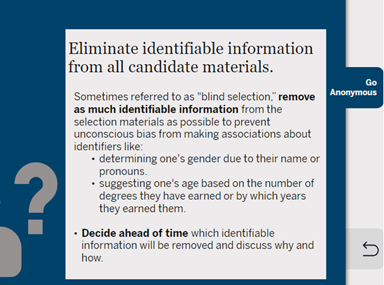
Unit 3 offers a discussion of the ways to address individual bias. The material moves into the “group mitigation strategies” and a section that describes “What We Will Do.” One of the strategies is to “go anonymous,” meaning that any information that could be used to identify an individual is to be eliminated from application documents, thus creating a “blind selection” process.
Figure 3. From “Mitigating Unconscious Bias in Decision-Making” at Indiana University School of Medicine.
But that doesn’t align with the IUSM Office of Academic Affairs training module, which makes it clear to search committee members that they are to use “equity benchmarks” at every point of faculty candidate review and selection (emphasis added):
Here are some strategies that serve to buffer outcomes from the impact of bias. First, search committees should adopt an inclusive mindset. Rather than trying to narrow the pool down, they should try to make it as inclusive as possible. Furthermore, at each point of the process that the pool gets narrowed, the committee should ensure that the percentage of minoritized applicants continues to reflect the percentage in the original pool. If it does not, then the committee might revisit their criteria for evaluating applicants. Second, establish and use well-defined criteria to guard against bias. As we discussed, criteria that seem valid on the surface may systematically disadvantage applicants of color. Wherever possible, eliminate biased metrics or find ways to adjust for them in the ratings. Finally, ensure accountability by agreeing that decision-making processes must be clear to all committee members and by slowing down the evaluation process so as not to rely on biases and heuristics when assessing candidates.
So what are IUSM community members supposed to do? Anonymize data, or insert percentage controls of minoritized applicants? It is no wonder that Do No Harm has heard from so many concerned stakeholders who feel that they’re being fed contradictory guidance that constantly pushes identity politics.
It’s time the Indiana University School of Medicine stops wasting time and resources on training that only serves to create division. State policymakers are starting to pay attention to constituent requests for help to force some sanity back into the school.
Is your school or healthcare organization requiring implicit bias training? Please let us know via Do No Harm’s secure online portal.
https://donoharmmedicine.org/wp-content/uploads/2023/09/shutterstock_1244076769-scaled.jpg17092560Laura Morganhttps://donoharmmedicine.org/wp-content/uploads/DNH_Logo_Stethescope-1.pngLaura Morgan2023-09-05 21:44:302026-02-11 15:33:35The Indiana University School of Medicine Just Can’t Get Enough of Woke Ideologies
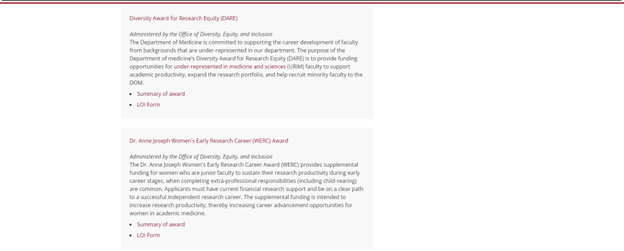
The Department of Education’s Office for Civil Rights (OCR) has completed its investigation of the Department of Medicine’s discriminatory single-sex, female-only early career research award at the University of Minnesota Medical School (UMMS), prompting the school to scrub its website.
In April 2023, we reported that the OCR was investigating the UMMS Department of Medicine’s Dr. Anne Joseph Women’s Early Research Career (WERC) Award, which limited eligibility to women, for violating Title IX of the Educational Amendments of 1972. On September 1, Do No Harm Senior Fellow Mark Perry was notified by the OCR that the investigation into the WERC Award was complete. “The University provided documentation to OCR that the Award was open to all applicants who met the eligibility criteria,” the disposition letter stated, “and was not limited based on sex.” The university also confirmed that it will remove the word “Women’s” from the name of the award.
A search of the University of Minnesota (UMN) website for the term “WERC” produced a result:
Figure 1. Search of the UMN website for the term “WERC” on September 2, 2023.
However, that link has been taken down:
Figure 2. Broken link on UMN website (September 2, 2023).
An archived page displaying the award can be seen here:
Figure 3 & 4. Archived page on UMMS Department of Medicine website as of June 4, 2023.
As a result of Perry’s work in recent years, the University of Minnesota-Twin Cities has been the target for two dozen civil rights complaints citing more than fifty violations of Title VI and Title IX. Do No Harm acknowledges resolution of the discriminatory limitations of the WERC research award, and encourages the University of Minnesota to revise the other programs it continues to sponsor that violate federal civil rights law.
https://donoharmmedicine.org/wp-content/uploads/2023/09/shutterstock_713202295-scaled.jpg21152560Laura Morganhttps://donoharmmedicine.org/wp-content/uploads/DNH_Logo_Stethescope-1.pngLaura Morgan2023-09-05 17:22:042026-02-11 15:33:36The University of Minnesota Department of Medicine Scrubs Its Website of a Discriminatory Program in the Wake of a Federal Civil Rights Investigation
Do No Harm recently spoke with Dr. Cindy Basinski, a practicing physician and medical educator in Indiana. She’s deeply worried about Indiana University School of Medicine, her alma mater. IUSM is one of the most radicalized medical schools in the nation. Dr. Basinski told us what’s at stake:
Every day, I talk with medical students and faculty at the IU School of Medicine. Their backgrounds and beliefs differ, but they all share the same concern. They see firsthand that IUSM is undermining medical education with divisive ideology. It’s creating a culture of fear and self-censorship that harms them and, ultimately, patients across Indiana and beyond.
IUSM is going the same route as most medical schools nationwide, though it’s arguably much further along the road. It has rallied around the ideology of “diversity, equity, inclusion, and justice.” Every medical student, educator, and physician I know is sympathetic to the goal of building trust and understanding among different communities and groups of people. But DEIJ goes much further, demanding conformity of views on campus.
Start with medical students. Before even getting into medical school, they are asked how they have promoted – or plan to promote – DEIJ objectives. Students have also told me about the politicized lessons they get in the classroom. IUSM is downplaying medical science and ethics in favor of politicized narratives about race and gender.
Students don’t dare disagree because they know it would destroy their chances of getting into residency programs they desire. They are completely dependent on recommendations from IUSM faculty, so they silence themselves for their own protection.
Faculty are also suffering. They cannot question the tenets of the DEIJ agenda, lest they be punished by administrators. Even worse, IUSM faculty are now required to show how they’ve advanced DEIJ in order to secure tenure or promotion. Whereas students are being forced into silence, IUSM faculty are being forced to be complicit with the corruption of medical education.
This runs counter to the purpose of medical education, the principles of medical science, and the pursuit of medical progress. The most incredible advances in medical history happened because students and faculty pushed the bounds of knowledge and questioned received wisdom. If faculty and future physicians aren’t exposed to a wide variety of views, or even free to share their own perspectives, they won’t move medicine forward. Patients will suffer.
Going public was a hard choice, but I know that staying silent jeopardizes the future of medicine. I’m speaking out for the countless students and faculty who cannot speak for themselves. IUSM is engaged in coercion at its worst, because it affects not only students and staff but the healthcare system in Indiana.
We need our lawmakers to help restore balance in medical education. I urge our Governor and General Assembly to recognize what’s happening and reform IUSM and all of Indiana’s higher education. Now is the time to protect the free speech rights of students and faculty alike. Now is the time to refocus medical and higher education on actual education, not divisive ideology. Hoosiers’ health depends on it.
Cindy Basinski, MD, FACOG, FPMRS, Adjunct Faculty Member at IUSM
Do No Harm is grateful to Dr. Basinski. Here’s hoping divisive ideology is driven from the Indiana University School of Medicine as soon as possible.
https://donoharmmedicine.org/wp-content/uploads/2023/09/shutterstock_745707979-scaled.jpg17042560Laura Morganhttps://donoharmmedicine.org/wp-content/uploads/DNH_Logo_Stethescope-1.pngLaura Morgan2023-09-05 12:03:292026-02-11 15:33:35Indiana Doctor and Educator: IUSM Needs Immediate Reform
Two commentaries published in the Journal of the American Medical Association (JAMA) on the same day leave no doubt that the American Medical Association remains committed to skirting rather than honoring the Supreme Court’s ban on affirmative action.
In The Supreme Court Decision on Affirmative Action—Fewer Black Physicians and More Health Disparities for Minoritized Groups, “researchers” arguethat the Supreme Court’s ruling against race-based admissions “goes beyond college admissions for Black people and other minority groups to the very core of the health of the entire country…Multiple research studies have shown that patients have improved outcomes when they are treated by people of a similar background or race or ethnicity.”
The claim that black patients fare better with black doctors references a systematic review (i.e., an assessment of the evidence base on the topic) that offers some optimism when it comes to the effect of racial concordance on patient-provider communication. It conveniently neglects to reference the four othersystematicreviews on race concordance in medicine which conclude that the evidence base does not reveal a pattern that demonstrates benefit, including a more recent review that also specifically focuses on patient-provider communication.
The JAMA piece isn’t the first occasion in which the American Medical Association has endorsed or promoted fictional claims that black patients fare better with black doctors. That they continue to promote these falsehoods in the face of public fact checking of sloppy factual errors reveals the depths of their conviction to continue lowering standards and engaging in racial preference for medical school admission.
In the other piece of commentary – Affirmative Action Ruled Unconstitutional: Options for Building a Diverse Healthcare Workforce – “researchers” assert that “The Court’s opinion potentially leaves room to maneuver.” Citing Justice Sotomayor’s dissent that colleges can consider “socioeconomic diversity” in their admissions decisions, they mention the UC Davis “socioeconomic disadvantage scale” as a blueprint for the “maneuvering” that they advocate. The UC Davis Associate Dean of Admissions is explicitand unapologetic about the fact that their admissions policies are a technical workaround to the state’s prohibition on affirmative action and a solution to the imagined problem of the “overrepresentation” of Asian physicians.
The piece concludes with a warning: “Far from coming to an end for legal questions about race and ethnicity and university admissions, intense litigation will likely continue for many years.” So long as woke activists at the American Medical Association remain committed to skirting the Supreme Court’s decision, this prediction is all but sure to come to fruition.
https://donoharmmedicine.org/wp-content/uploads/2023/09/shutterstock_76036825-scaled.jpg17002560Laura Morganhttps://donoharmmedicine.org/wp-content/uploads/DNH_Logo_Stethescope-1.pngLaura Morgan2023-09-04 13:22:222026-02-11 15:33:36Activists Scheme to Skirt Affirmative Action Ban – And Provide False Pretense For Doing It
The Eastern Vascular Society (EVS) is one of many medical organizations that’s gone off the woke deep end. For recent proof, look no further than the Society’s DEI survey.
The survey, which the Society says is intended for “measuring our progress” and gleaning “a more complete understanding of our membership,” starts by asking some simple questions relating to practice, career status, and the like. But a scroll just a bit farther down the page uncovers questions on buzzword topics like members’ race, preferred pronouns, and gender identity.
Questions from the EVS’s DEI Survey.
The EVS’s DEI Commitment – which preambles the survey – confirms the Society’s leftist slant.
The formulation of this survey begs a number of questions, not the least of which are what does demographic information like this have to do with practicing vascular medicine, or what does the EVS plan to do with these responses? Initiatives like this could signal that future DEI-related programs and practices are coming down the pipeline.
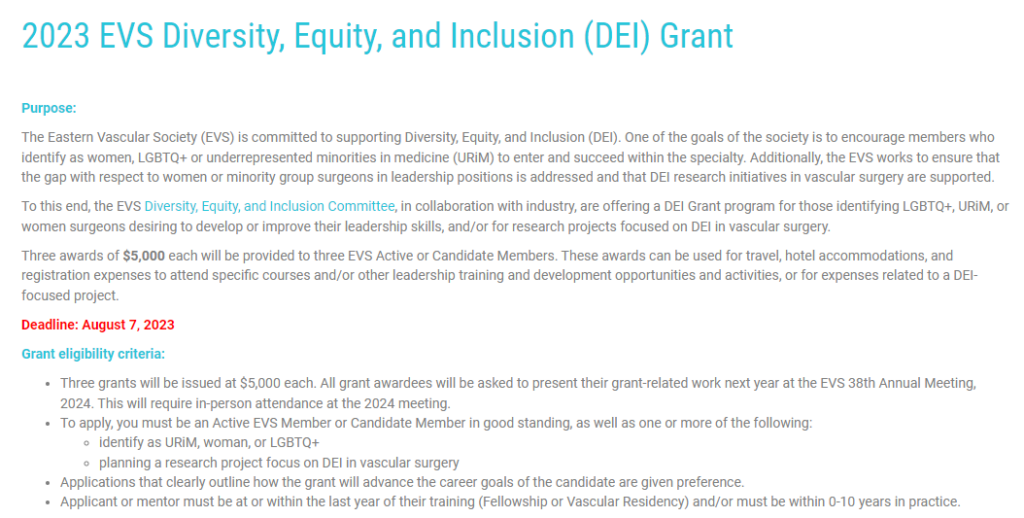
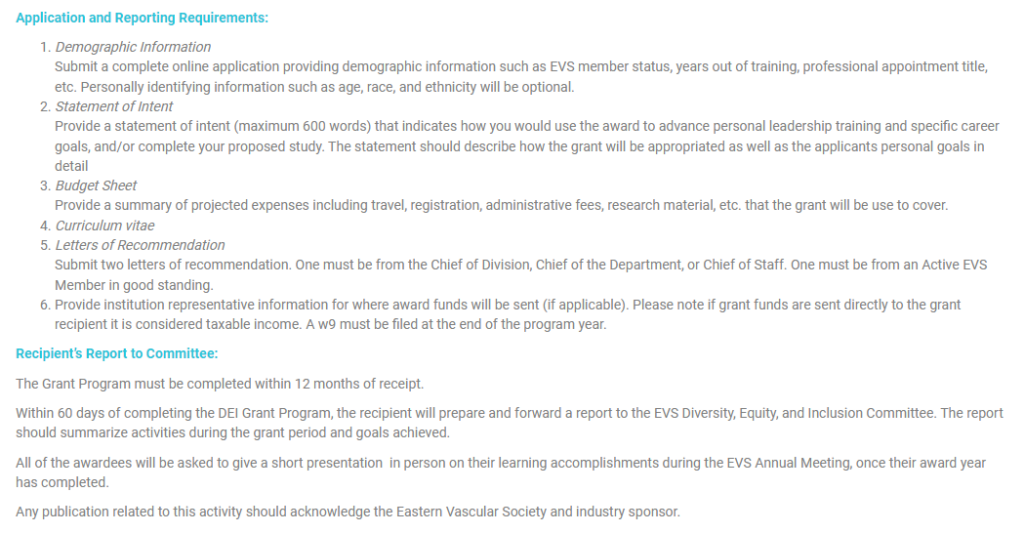
But the DEI survey is only one piece of the EVS’s latest woke puzzle: the Society recently finished receiving applications for its DEI Grant. The grant, which is being offered by the EVS’s DEI Committee, is designed specifically for members who identify as LGBTQ+, underrepresented in medicine (URiM), or women.
Information on the EVS’s DEI Grant.
Which is to say, the grant is designed to discriminate on the basis of race. Rather than taking a fair, colorblind, merit-based approach to its grantmaking process, EVS is instead showing its true, discriminatory colors.
More information on the EVS’s DEI Grant.
It’s important for all clinicians in every field to succeed in their professions. So, why doesn’t the EVS seek to serve all its members equally, rather than giving preference to some over others? Initiatives like the DEI survey and DEI Grant take the focus off patients and put it on politics.
But members of the EVS shouldn’t be surprised by either the survey or the grant, considering that the Society claims it was founded on woke ideas.
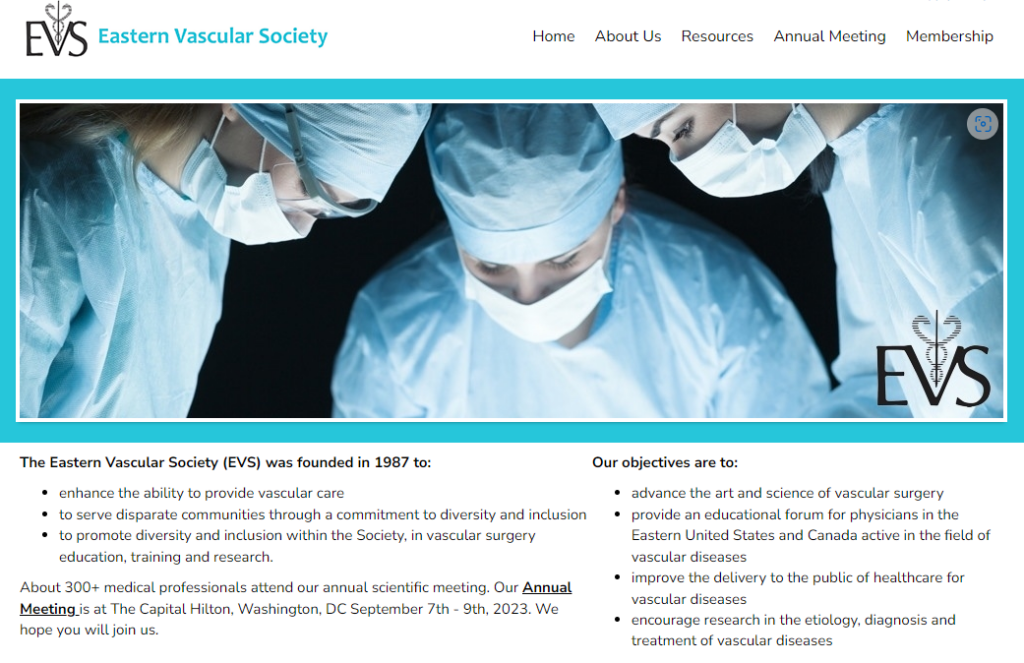
According to its homepage, the EVS was founded in 1987 in part to “to serve disparate communities through a commitment to diversity and inclusion” and “to promote diversity and inclusion within the Society, in vascular surgery education, training and research.”
The EVS’s homepage.
The EVS was woke before woke was a thing.
The Society joins the ranks alongside the AMA, ANA, the AAPM&R, and more in the battle against integrity in the medical field. And the number of medical associations who remain silent on or are free from destructive DEI-related ideologies – like those propagated by the EVS – is shrinking.
Do No Harm was founded to shed light on woke, divisive initiatives like these as part of our commitment to ensuring that all patients receive the best possible care. We’ll keep up the fight until merit is restored to medicine.
https://donoharmmedicine.org/wp-content/uploads/2023/09/shutterstock_1753066355-scaled.jpg17072560Laura Morganhttps://donoharmmedicine.org/wp-content/uploads/DNH_Logo_Stethescope-1.pngLaura Morgan2023-09-03 20:09:342026-02-11 15:33:36The Eastern Vascular Society puts its DEI Agenda Front and Center
The American College of Surgeons is at it again. First, Do No Harm visiting fellow Dr. Richard Bosshardt drew attention to the prestigious institution’s divisive turn and attempt to censor dissent. Now another source has let us know that the ACS is doubling down on discriminatory woke ideology.
The source sent us details the ACS’ upcoming Clinical Congress in Boston, Massachusetts. The Clinical Congress is the organization’s annual conference, attended by thousands of surgeons. They can expect indoctrination from start to finish.
The conference will feature an event called “DEI and Antiracism Fundamentals, Skills Building and Implementation Principles for Surgeons.” It’s as bad as it sounds. The event will brainwash surgeons with the “core tenets of DEI and Anti-racism along with the requisite skills necessary to strategically implement DEI efforts in one’s own surgical environments.” As we’ve seen, implementing DEI and anti-racism means fixating on patients’ race and even discriminating against patients, including by giving some patients preferential access to treatment.
Figure 1. From the ACS Clinical Congress 2023 program.
The conference also has plenty of other woke sessions. The list includes panel discussions on “how to achieve health equity” and “the social determinants of health,” as well as breakout sessions on recruiting more students from races that “under-represented in medicine” and “addressing implicit bias.” Without fail, these events will beat surgeons over the head with divisive and discriminatory ideas, from accusing surgeons of racism to training surgeons to be political activists as much as medical professionals.
None of this belongs in surgery, much less the rest of medicine. When Dr. Bosshardt called out the American College of Surgeons last year, he said it “must choose between surgery and ideology.” The ACS has made its choice, and it’s the wrong one. Surgeons and their patients deserve so much better.
https://donoharmmedicine.org/wp-content/uploads/2023/09/shutterstock_2013632891-scaled.jpg13082560Laura Morganhttps://donoharmmedicine.org/wp-content/uploads/DNH_Logo_Stethescope-1.pngLaura Morgan2023-09-02 19:19:432026-02-11 15:33:35More Extremism At The American College of Surgeons
The University of Arkansas (UA) at Fayetteville announced in mid-June it would be dissolving its DEI (Diversity, Equity, Inclusion) Division later in the year, but then also revealed the division’s staff and resources would be integrated into other departments of the university in order to meet goals associated with student or employee “recruitment” and “success.”
The timing of the announcement came two weeks in advance of the U.S. Supreme Court’s ruling in Students for Fair Admissions, Inc. v. President and Fellows of Harvard College, in which the Court largely struck down affirmative action in higher education. It also arrived amid growing concern about DEI initiatives in the administration of Arkansas Gov. Sarah Huckabee Sanders and the state legislature. This reported dissolution has led to questions about whether the university’s incorporation of DEI staff and resources into other offices is just a strategic workaround to enable woke practices to be maintained in a different form.
Inside Higher Edasked, is UA’s move “a capitulation to right-wing demands or a savvy defense tactic?”
And National Association of Scholars (NAS) Research Fellow Neetu Arnold tweeted:
It’s already happening.
The University of Arkansas is getting rid of its DEI division, but it is not getting rid of DEI personnel and their toxic ideology. Instead, it will become a part of higher ed operations permanently.
The article announcing the move contained email responses from UA Director of Media Relations John Thomas regarding the goals of reallocating the DEI office’s resources. According to Freedom of Information Act (FOIA) documents obtained by Do No Harm, not all of Thomas’s comments in response to the reporter’s questions made their way into the article. When asked if the move is “in response to the affirmative action bill filed in the Arkansas Legislature or the impending Supreme Court ruling on affirmative action,” Thomas said:
“While as a state institution, we are always respectful of the laws, regulations, and various viewpoints on how we carry out our mission, from an educational standpoint and as an employer, we believe that this is the best way to fulfill our land-grant mission of access and opportunity for all.”
A second document from the UA media relations office contains an additional response from the media relations office that contained the same statements to two different reporters.
The Arkansas Advocate also reported that, in his announcement about the reallocation of DEI personnel and resources, UA Chancellor Charles Robinson said the university’s strategic planning process “has affirmed that supporting equal opportunity, access and belonging are critical to our land-grant-mission and university values.”
Robinson continued:
“It is my belief based on my experience as having served as Vice Chancellor for Diversity, Vice Chancellor for Student Affairs, Provost — and now as Chancellor — that we can accomplish better outcomes by reallocating resources into these essential areas. We must strengthen our ability to achieve measurable results that enhance opportunity for all Arkansans.”
According to the Advocate, UA Faculty Senate Chair Stephen Caldwell said he, the provost, and Robinson have discussed their concerns that Arkansas could grow to be more like Florida in terms of blocking public colleges from funding DEI measures.
Caldwell said the goal is for both minority and non-minority students to be successful, “so let’s concentrate on student success and student excellence and try to achieve that in all mediums for all students of all backgrounds, races, creeds and colors.”
Asserting the DEI debate has created political polarization throughout the country, Caldwell observed Robinson’s strategy is to rebrand the debate as student success.
“And I think when you reframe it like that, it speaks to what it is that he’s trying to do, and the faculty are behind student success 100%,” he said.
A third document Do No Harm obtained shows how that “success” will be supported by distributing the former DEI assets throughout the campus. Dated July 11, 2023, this document contains a table that shows 46 items to address and take action on following their announcement and the Supreme Court ruling. Items to be reallocated included:
Division of Diversity, Equity, and Inclusion website, which has been taken down (archived page here)
DEI Fellows program to conclude on June 30
Two DEI positions will be transferred to Student Affairs and Student Success
Digital inventory will be transferred “as appropriate along with the person…where the need is greatest”
DEI banner to be carried at the June 23 PRIDE Parade
Discussion on the IDEALS (Inclusion, Diversity, Equity, Access, Leadership Development, Strategic Supports) Institute DEI training, which has been removed from the UA website (archived page here)
Future faculty recruitment strategy “to cultivate large pools of qualified candidates” and twopolicies
Steps to “reimagine the purpose, scope, and participants” of the DEI Advisory Board
Do No Harm will be monitoring the actions of the University of Arkansas for alignment and compliance with the Court’s race-neutral mandate, as well as its self-imposed decision to disperse its DEI division through the school.
Are you seeing ongoing efforts to consider race in university admissions to medical education programs, or DEI initiatives in states that have laws prohibiting them? Do No Harm wants to hear from you, and you may remain anonymous if you wish.
https://donoharmmedicine.org/wp-content/uploads/2023/08/shutterstock_312712007-scaled.jpg17092560Laura Morganhttps://donoharmmedicine.org/wp-content/uploads/DNH_Logo_Stethescope-1.pngLaura Morgan2023-09-02 17:30:462026-02-11 15:33:35University of Arkansas’ Move to Integrate DEI Staff into Other Offices Draws Questions
The Mount Sinai Health System (MSHS) in New York City continues to support race-based discrimination in its internal opportunities, despite municipal law that prohibits it. Under the City Human Rights Law, the City Commission on Human Rights (CCHR) has, in part, the “power to eliminate and prevent discrimination from playing and role in actions related to employment.”
Yet, the MSHS Office for Diversity and Inclusion (ODI) operates and funds the “Mount Sinai Administrative Fellowship Program,” prompting Do No Harm senior fellow Mark Perry to file a complaintwith the CCHR. The salaried fellowship is offered to applicants who “self-identify as a member of a racial/ethnic group that is historically underrepresented in healthcare leadership – specifically Black/African American, Hispanic/Latinx, Native American (American Indian or Alaskan Native), and/or Pacific Islander (one who has origins in any of the original peoples of Hawaii, Guam, Samoa, or other Pacific Islands).” This eligibility criterion, verified in the Administrative Fellowship Program application, illegally excludes Asian, white, and Middle Eastern/North African individuals on the basis of their race, color, or national origin.
Figure 1. August 23, 2022 email announcing the Mount Sinai Administrative Fellowship Program.
This is not the first time Perry has notified the CCHR of civil rights violations by Mt. Sinai. In June 2023, Perry filed a complaint regarding the Growth in Operations, Administrations, and Leadership Society (GOALS) program at the Icahn School of Medicine, “an elite Black male Initiative at Mount Sinai Health System that advocates for career advancement opportunities and equitable resources for its members.”
Figure 2. GOALS Program at Mt. Sinai Icahn School of Medicine.
These programs are reflective of other programs sponsored by the MSHS ODI. A concerned healthcare provider tipped us off to two ODI initiatives that place Black Lives Matter and anti-racism front and center. The United in Solidaritypage features a book by Ibram X. Kendi, critical race theory proponent and author of “How to Be an Antiracist.”
Figure 3. “United in Solidarity” page at Mt. Sinai Health System.
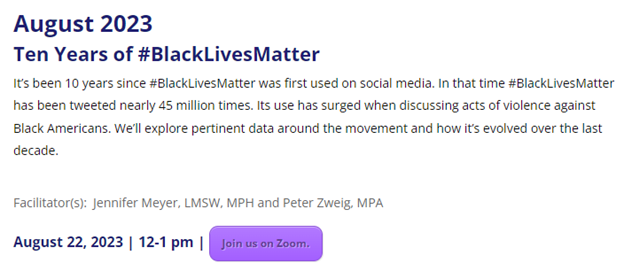
And, the MSHS Icahn School of Medicine recently hosted “Ten Years of #BlackLivesMatter” on its monthly Chats for ChangeZoom meetings schedule.
Figure 4. August 2023 “Chats for Change” at the Icahn School of Medicine.
Do No Harm urges the NYC Commission on Human Rights to investigate and resolve the discriminatory programs that the Mt. Sinai Health System is funding. We also encourage MSHS to shift its focus toward caring for all patients, students, and employees equally – regardless of skin color – and stop obsessively promoting racism and oppression in every facet of its operations.
https://donoharmmedicine.org/wp-content/uploads/2023/09/shutterstock_2123944583-scaled.jpg17072560Laura Morganhttps://donoharmmedicine.org/wp-content/uploads/DNH_Logo_Stethescope-1.pngLaura Morgan2023-09-01 14:29:172026-02-11 15:33:35Do No Harm Senior Fellow Mark Perry Names the Mt. Sinai Health System in Civil Rights Complaints Filed with the NYC Commission on Human Rights
On Monday, a unanimous panel of the United States Court of Appeals for the Eleventh Circuit issued a decision vacating a lower court’s preliminary injunction against Alabama’s law protecting minors from experimental gender medicine. This is a tremendous victory in the war against these radical and experimental interventions—which include puberty blockers, cross-sex hormones, and surgeries. This result means that Alabama’s law is now in effect and that children and adolescents in Alabama are protected from experimental gender medicine while the litigation over this law continues in the lower court.
The Eleventh Circuit’s unanimous opinion, authored by Judge Barbara Lagoa, explained that States are permitted to enact laws like Alabama’s in order to protect “children from drugs, particularly those for which there is uncertainty regarding benefits, recent surges in use, and irreversible effects.” The court also explained that the statute did not draw sex-based classifications—and thus was not subject to any form of heightened judicial scrutiny—because the law protected both boys and girls alike. Judge Brasher, who joined the majority opinion in full, also issued separate concurring opinion explaining that, even if Alabama’s law were subject to a heightened form of scrutiny, it would likely still pass the relevant constitutional test. Credit to Alabama Attorney General, Steve Marshall, and his entire team for having the courage to take on this issue in the service of protecting the children of Alabama.
Although this decision is a major victory, the battle continues elsewhere. Over the next month or so, the Sixth Circuit Court of Appeals will be reviewing preliminary injunctions issued against the laws of both Kentucky and Tennessee that protect minors from experimental gender medicine. And the Eighth Circuit will eventually be reviewing a permanent injunction issued against Arkansas’ law. It seems likely that this issue will eventually reach the Supreme Court, where we are confident these laws will prevail against constitutional challenge.
https://donoharmmedicine.org/wp-content/uploads/2023/08/shutterstock_2243979611-2.jpg6671000Laura Morganhttps://donoharmmedicine.org/wp-content/uploads/DNH_Logo_Stethescope-1.pngLaura Morgan2023-08-24 20:12:462026-02-11 15:33:35U.S. Court of Appeals for the Eleventh Circuit Issues a Ruling to Protect Youth from Gender Ideology in Alabama
On August 9, 2023, Do No Harm senior fellow Mark Perry sent the following letter via email to the entire Board of Trustees, the Chancellor, Provost, and General Counsel at the University of North Carolina (UNC). No response was received from any party.
Dear UNC Board of Trustees:
I was motivated to contact you after reading the 8/7/2023 article “Legal Compliance or ‘Interpretive Overreach’?” in Insider Higher Ed about your group’s recent discussions about whether UNC’s ban on the consideration of race for admissions should also extend to UNC’s hiring and contracting. In addition to considering a ban on considering race for employment and contracting, I would suggest that you should also address the issue of banning the consideration of race for UNC’s educational programs, events, scholarships, fellowships, internships, awards, etc. In fact, the consideration of race for those educational programs, etc. is already illegal according to Title VI’s prohibition of discrimination based on race, color, or national origin for recipients of federal funds like UNC. I can say that with some authority because I have more experience filing Title VI and Title IX complaints at colleges and universities than any other individual. To date, I have filed 855 federal civil rights complaints for more than 2,000 violations of Title VI and Title IX at more than 750 colleges and universities (many like UNC have multiple complaints). Based on those complaints, the Office for Civil Rights has opened nearly 400 federal civil rights complaints and more than 350 of those investigations have so far been resolved, mostly (90%) in my favor.
On December 19, 2022, I filed a Title VI complaint against UNC for its BIPOC*-only FERN: Fellowship for Exploring Research in Nutrition, and I shared a courtesy copy of that complaint with UNC General Counsel Charles Marshall and his staff (note that BIPOC = Black, Indigenous, People of Color). Within 24 hours of receiving a courtesy copy of my complaint, the FERN website was scrubbed of the BIPOC-only eligibility restriction and the fellowship is now open to all students regardless of race. UNC’s reaction was covered by the media including the article “UNC-Chapel Hill removes racial criterion for fellowship program limited to BIPOC amid civil rights complaint.” That quick 24-hour response reflects the fact that UNC’s General Counsel Office understands that all race-based discrimination for all of UNC’s educational programs is unlawful.
In addition to violating federal civil rights laws, race-based discrimination in UNC’s educational programs also violates UNC’s Statement on Non-Discrimination based on race, color, or national origin:
The University is committed to providing an inclusive and welcoming environment and to ensuring that educational and employment decisions are based on individuals’ abilities and qualifications. Consistent with these principles and applicable laws, it is, therefore, the University’s policy not to discriminate based on age, color, disability, gender, gender expression, gender identity, genetic information, national origin, race, religion, sex, sexual orientation or veteran status as consistent with the University’s Policy on Prohibited Discrimination, Harassment, and Related Misconduct. No person, on the basis of protected status [including race, color or national origin], shall be excluded from participation in, be denied the benefits of, or be subjected to unlawful discrimination, harassment, or retaliation under any University program or activity, including with respect to employment terms and conditions.
Note that discrimination based on “employment” is already prohibited by UNC’s Statement above.
Following my 12/19/2022 Title VI complaint against UNC I found six additional programs and scholarships at UNC that discriminate based on race in violation of Title VI (and one that also discriminates based on sex) and filed the Title VI complaint below (see bottom email) on 12/26/2022. That complaint has been docketed by the Office for Civil Rights as Case #11-23-2067 and was opened for a civil rights investigation by OCR on 6/23/2023. I shared a courtesy copy of my 12/26/2022 complaint with UNC General Counsel Charles Marshall and his staff.
As you continue to guide UNC’s policy prohibiting all illegal race-based discrimination for admissions, educational programs, financial aid, employment, contracting, etc., perhaps it would be helpful to conduct a complete internal audit of all UNC units (schools, colleges, departments, diversity offices, etc.) for discriminatory scholarships, fellowships, awards, programs, events, etc. to help uncover other violations of Title VI in addition to the six violations currently under federal investigation. I am confident that there are other discriminatory programs at UNC that I have not yet discovered by reviewing UNC websites in addition to new programs that might be introduced that violate Title VI and/or Title IX.
Ever vigilant,
Professor (em.) Mark J. Perry, Ph.D., University of Michigan
Senior Fellow, Do No Harm
https://donoharmmedicine.org/wp-content/uploads/2023/08/shutterstock_144792703-scaled.jpg17072560Laura Morganhttps://donoharmmedicine.org/wp-content/uploads/DNH_Logo_Stethescope-1.pngLaura Morgan2023-08-22 22:33:192026-02-11 15:33:35Senior Fellow Mark Perry Points Out UNC’s History of Civil Rights Violations to the Board of Trustees
Do No Harm was recently contacted by Clete Weigel, a nurse in Kent, Ohio. He told us his powerful yet painful story of standing up to his hospital after it went woke. We’re glad to share Clete’s story below. Hopefully it will inspire more medical professionals to speak out.
We are all the victims of a new view of “justice” that has infected our culture. This is my story, and it may soon be yours.
In February 2023 the Diversity Director at Summa Health published a blog announcing that our hospital would implement implicit bias training “to reduce health disparities.”
Her blog invited a response. So, I submitted comments citing statistical and observational data about the reality of health disparities, questioning the underlying reasoning in the director’s blog. I then asked questions which challenged the efficacy of implicit bias training.
My blog was never posted. It was not seen by the workforce, other than leadership, yet it resulted in my receiving a written discipline. I was summoned to a meeting where I was asked whether I understood the blog would be seen by the entire workforce. I replied that I was aware, and that I hoped to provide alternative points of view that others could read. But apparently that had never happened; no one had seen the blog or said anything about it.
Even so, my discipline would require two implicit bias trainings. Apparently, one training would not be enough to expunge my ostensibly radical ideas!
I resigned rather than participate in training that compels me to view myself as a member of an identity group. I am an autonomous individual. I submitted my resignation giving more than the required 4 weeks’ notice. Later that evening I received a call from my supervisor. She asked me whether the reason I had given for my resignation was “the way I wanted to frame it.”
I replied that I wasn’t trying to “frame” anything. My reason for leaving was simple: “Summa’s commitments no longer align with my deeply held personal convictions.” My employment and interactions were guided by my Christian faith. I had even received Summa’s prestigious “Caring Award” for my work with patients.
Yet my stated reason prompted my supervisor to say, “Well then, today was your last day of work.” I was given 4 weeks’ severance pay.
In the wake of this fiasco, I began wondering: What changed? After all, I hadn’t changed over 37 years. But Summa Health had changed.
During my disciplinary session, I reviewed a few of my arguments refuting the implicit bias training. The HR representative cut in, “Leadership has chosen to go in this direction.” These words elucidate the source of the problem. Hospital leaders have chosen to make operational decisions based upon ideology. Logic and arguments do not matter; the ideology does. Everything becomes secondary when ideology rules. That includes evidence-based medicine, valuing employees, science, discernment, the exchange of ideas, and yes, common-sense.
Clete Weigel, RN
Medicine will not be served by this ideology. Patients will be harmed by a world view that prefers narratives over science and identity groups over individuals. In the end, individual care will suffer as implicit bias training increases suspicion, discourse devolves, and patients are neglected.
Ironically, the ideology that purports to bring equity enslaves everyone to its impoverished view of humanity. Because of this, it cannot last. As more of us speak out, the truth will be known. Please share your story, like me, and help Do No Harm restore sanity to health care.
Do No Harm is grateful to Clete for his courage. If you know of a nurse or doctor who has been similarly punished for daring to question woke ideology, please let us know – securely and anonymously.
https://donoharmmedicine.org/wp-content/uploads/2023/08/shutterstock_1182184342-scaled.jpg14672560Laura Morganhttps://donoharmmedicine.org/wp-content/uploads/DNH_Logo_Stethescope-1.pngLaura Morgan2023-08-21 11:25:022026-02-11 15:33:35An Ohio Nurse Tells His Story
Do busy medical residents have time for cartoons and indoctrination into gender ideology? That seems to be the way Great Baltimore Medical Center (GBMC) sees it – and they are employing non-medical personnel to deliver that material.
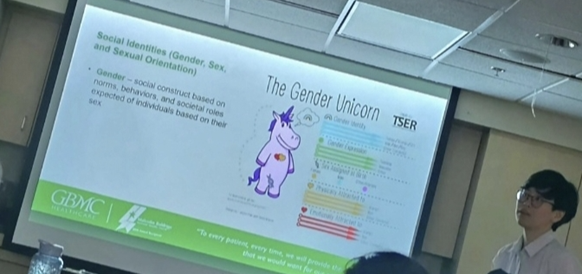
Last year, we told you about Oklahoma State University’s use of “The Gender Unicorn” in training students on “allyship” and “safe zones.” This time, the same material has made an appearance in a class for medical residents. On August 9, the GBMC Office of Diversity, Equity, & Inclusion (ODEI) dispatched Angela Wu, DEI Manager, to lecture residents on The Gender Unicorn and “social identities.” Developed by Trans Student Educational Resources (TSER), the Gender Unicorn was designed as a “teaching tool” in schools. TSER even offers a “coloring book” version of the graphic.
Figure 1. Angela Wu instructing GBMC residents on The Gender Unicorn (August 9, 2023).
Angela Wu, who claims to be a “DEI Strategist and Facilitator,” has the backing of a robust DEI office at GBMC for distributing such strategies. “A mission of health equity for all begins with the people and teams practicing it,” the ODEI’s mission statement says. GBMC makes an “intentional commitment” to educate its workforce and “fostering a culture of psychological safety and trust” to promote the health equity agenda.
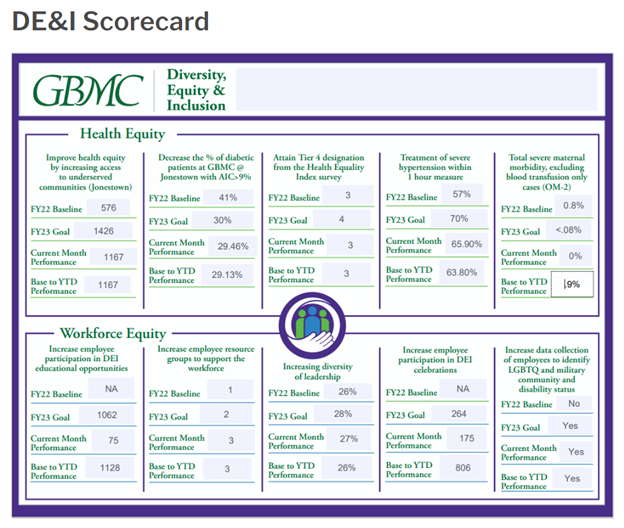
The DE&I Scorecard, prominently displayed on the ODEI homepage, indicates why GBMC is using valuable resident class time to push nonsensical concepts like the Gender Unicorn. The scorecard mentions the Healthcare Equality Index (HEI), which is the 2022 national benchmarking instrument for evaluating the policies and practices of healthcare facilities regarding “the equity and inclusion of their LGBTQ+ patients, visitors, and employees.” And, two metrics in the Workforce Equity section relate to increasing participation in “DEI educational opportunities” and “DEI celebrations.”
Figure 2. DE&I Scorecard from the GBMC DEI Strategic Plan.
GBMC has made significant efforts to embed its DEI agenda into every area of its workforce and professional development operations. Medical residents need to use the limited time they have for instruction in content that helps them learn how to effectively care for patients – not a dose of woke gender ideology.
Are you a student in the health sciences who is being inundated with DEI-related content in the name of education? Do No Harm invites you to contact us – anonymously and securely.
https://donoharmmedicine.org/wp-content/uploads/2023/08/shutterstock_185722670-scaled.jpg17352560Laura Morganhttps://donoharmmedicine.org/wp-content/uploads/DNH_Logo_Stethescope-1.pngLaura Morgan2023-08-16 21:21:362026-02-11 15:33:35Greater Baltimore Medical Center Seeks to Indoctrinate Residents with “The Gender Unicorn”
In a spectacular turnaround, the Kentucky Board of Nursing (KBN) has quietly rescinded its prior requirements for all nurses in the state to take implicit bias training as a condition of licensure.
The deadline for completing an approved implicit bias course was July 1, 2023. However, according to the KBN website as of July 27, the mandate has been removed. “If you have not obtained the training at this time,” the Continuing Education Competency webpage states, “please note you will no longer be required to do so.”
Figure 1. KBN website as it currently appears.
Do No Harm was the first to report in September 2022 that the KBN was endorsing the course titled Implicit Bias in Healthcare by the Kentucky Nurses Association (KNA) at a cost of $5.00 per KNA member (the non-member price is $35.00 per course). But, as a result of our reporting, a Kentucky-based Do No Harm nurse member’s appeal to the American Nurses Association, and subsequent media attention to the inflammatory and discriminatory nature of the course, the KBN attempted to cover its tracks by scrubbing its website of the KNA recommendation.
Figure 2. Mandatory courses available from the Kentucky Nurses Association as of August 9, 2023.
While Do No Harm applauds the removal of the mandate, we still have some questions. The requirement for this training is outlined in the Kentucky Administrative Regulations. Where did the discussion take place about removing the mandate, and who made that decision? Who is going to refund the money that more than 100,000 RNs, LPNs, and advanced practice nurses with an active Kentucky license would have needed to spend on obtaining this training since June 2022? Where does the money go that is paid to the KNA for this course?
We are asking these questions and monitoring this situation as it evolves.
https://donoharmmedicine.org/wp-content/uploads/2023/08/shutterstock_732496792-scaled.jpg13012560Laura Morganhttps://donoharmmedicine.org/wp-content/uploads/DNH_Logo_Stethescope-1.pngLaura Morgan2023-08-09 19:52:202026-02-11 15:33:35The Kentucky Board of Nursing’s Backpedaling on Bias Training Comes Full Circle
Will medical schools stop discriminating by race? That’s the big question following the Supreme Court’s recent decision ending so-called “affirmative action” in college admissions. Most medical schools are trying to find workarounds, but one Texas institution appears to be doing the right thing.
We submitted FOIA requests to Sam Houston State University’s osteopathic college. We asked for all internal communications regarding the Supreme Court’s decision. Lo and behold, we received a document from the director of admissions:
“I wanted to update you on some changes we are implementing in our COM admissions system (AMP) in response to the recent Supreme Court ruling… We have contacted AMP to initiate the necessary updates to our system. The plan is to completely remove race and ethnicity from the system until after offers are sent. This will ensure that our COM admissions process fully complies with the ruling and that all applicants are evaluated without any potential bias.” (emphasis added)
Did you catch that? Sam Houston State University’s osteopathic college will be unable to make admission decisions based on applicants’ race. That means no overt racial discrimination. The school will learn about applicants’ race only after the admissions process ends (presumably to comply with deferral reporting requirements).
This is the bare minimum change that every medical school should immediately make. At the same time, medical schools should commit to avoiding other ways of trying to discover and admit applicants based on race. If medical schools won’t stop discriminating, they deserve to be held accountable in the court of law and public opinion.
For now, at least, we’re grateful that Sam Houston State University is showing the way forward.
https://donoharmmedicine.org/wp-content/uploads/2023/01/shutterstock_533282275-scaled.jpg16812560Laura Morganhttps://donoharmmedicine.org/wp-content/uploads/DNH_Logo_Stethescope-1.pngLaura Morgan2023-08-09 19:52:012026-02-11 15:33:35Good News: This Texas Osteopathic School Is Going Colorblind